


Your watch slides around your wrist, the buckle tongue lands past the comfortable position, and the next factory hole is just out of reach. Adding one carefully placed hole can solve that fit problem, but only if you use a leather punch, match the existing hole size, mark the centre line accurately, and finish the cut so the edge doesn't fray.
3 Key Takeaways: Punching a Hole in a Leather Strap
Use a real punch: A sharp rotary or hollow punch cuts cleanly. Drills and awls stretch the hole.
Match size and spacing: Copy the existing holes, usually 1.5 to 2mm, on the same centre line.
One firm strike: Punch grain-side up on a firm board, then finish the edge.
The job is simple when treated as four separate decisions. Choose the right tool, choose a diameter that suits the buckle tongue and existing holes, choose a position that preserves spacing and leather strength, then finish the raw edge. Remove the strap from the watch before cutting, and never punch while the strap is still attached to the case.
Table of Contents
- Punching a Hole in a Leather Watch Strap Without Ruining It
- Which Tool Actually Cuts a Clean Hole in Leather
- Finding the Right Spot and Marking It
- Making the Cut in One Decisive Action
- Finishing the Hole So It Looks Factory Made
- When the Strap Is the Wrong Length, Not the Hole
- Quick Answers on Punching Watch Strap Holes
Punching a Hole in a Leather Watch Strap Without Ruining It
The buckle tongue misses the comfortable position by one setting, while the next factory hole sits too far away. One accurately placed extra hole can correct that fit, provided the strap is punched with the right tool, diameter, spacing, and finish. A row of improvised openings weakens the leather and makes the adjustment look unfinished.
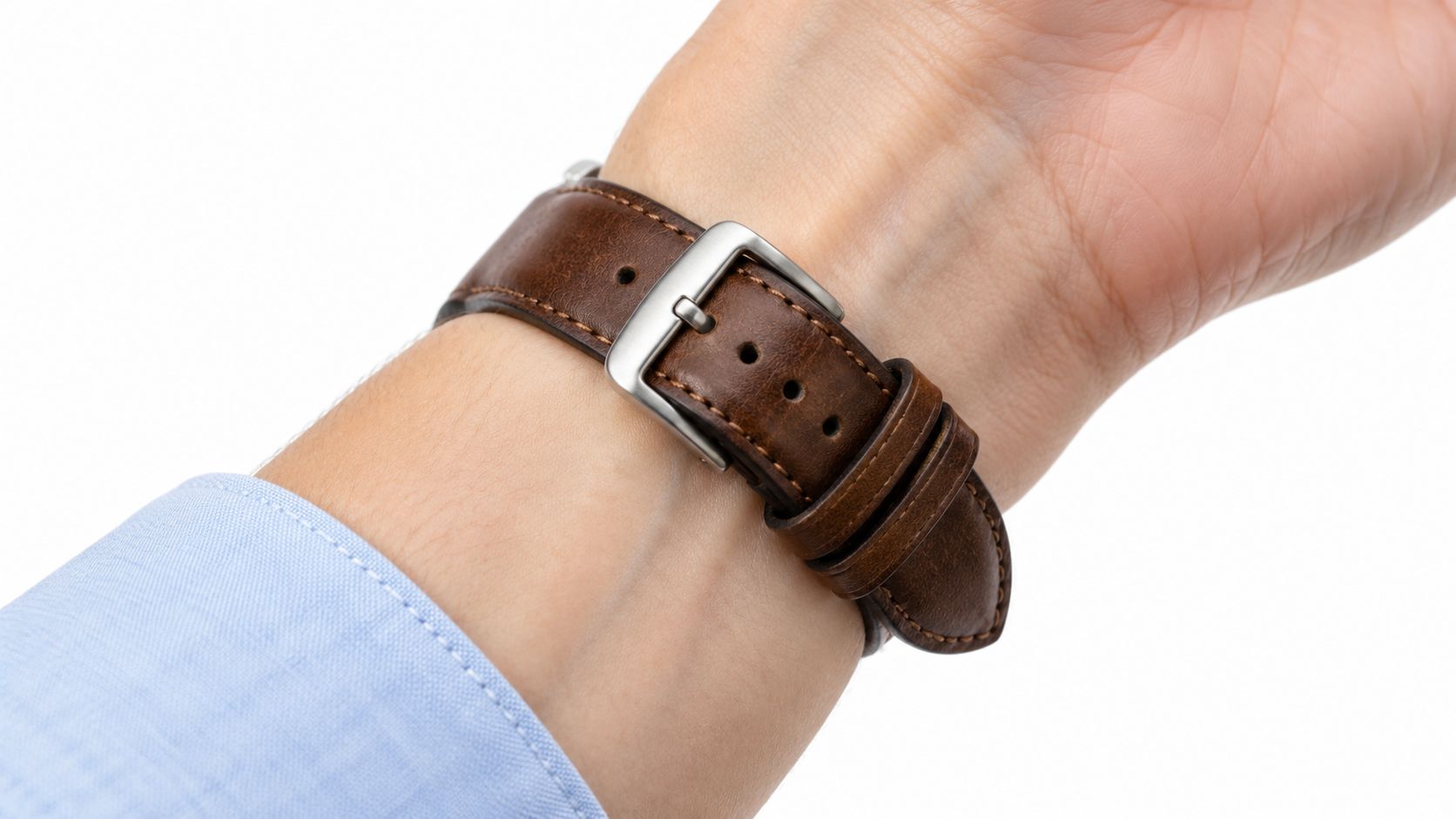
Make one clean decision at each stage:
- Tool: Choose a sharp rotary punch or hollow drive punch. A drill, screwdriver, or awl pushes fibres aside and can leave an opening that stretches. A heated nail scorches the grain and hardens the edge.
- Diameter: Match the existing holes and the buckle tongue. Watch-strap openings are commonly small, often around 1.5 mm to 2 mm, so a belt punch is generally too large. Leather punches cut hole diameters that typically range from about 1 mm to 6 mm, and a standard six-tube revolving punch plier carries 2 mm, 2.5 mm, 3 mm, 3.5 mm, 4 mm, and 4.5 mm tubes — so even its smallest tube already sits at the top of the watch-strap range.
- Position: Mark the point where the tongue rests naturally, then copy the factory centre line and spacing. Keep enough leather between the new hole and both edges. A hole placed too close to an edge leaves a narrow bridge that can split under buckle tension.
- Strike: Support the strap grain-side up on a firm cutting board or hardwood scrap. Hold the punch square to the leather and make one controlled cut. Repeated strikes or a tilted punch can enlarge the rim.
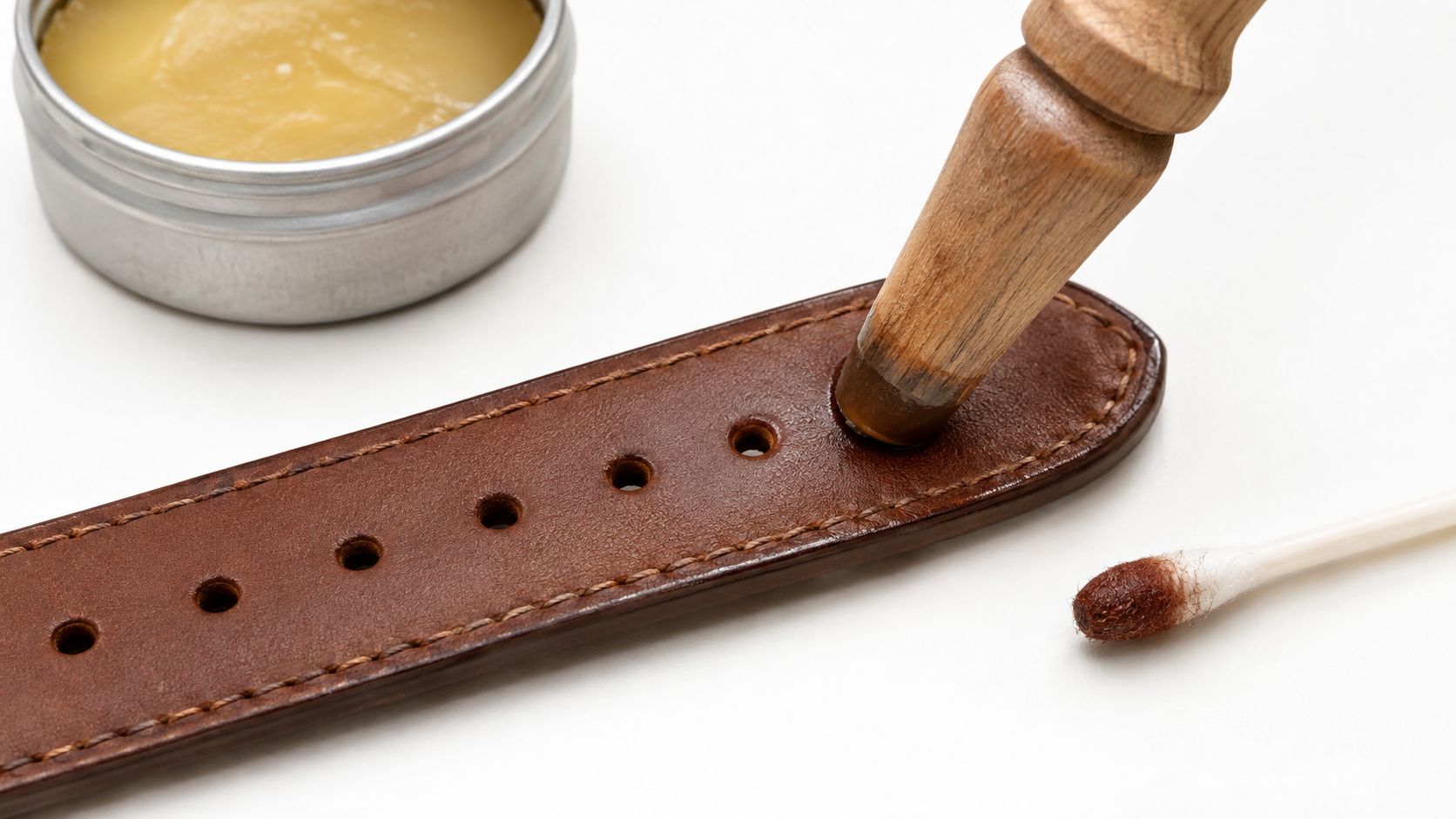
- Finish: Remove loose fibres, colour any pale core, and burnish the edge with beeswax or gum tragacanth. Apply only a light wipe of conditioner.
Punching is the wrong fix when the strap is already too short, badly cracked around the buckle, or unable to leave a safe margin around another hole. In those cases, replace or resize the strap instead of weakening it with another opening. A broader guide to leather watch strap fit and construction can help distinguish a hole-position problem from a strap-length problem.
Once the strap is removed from the watch, mark and cut it on the board. Never punch while the strap remains attached to the case.
Which Tool Actually Cuts a Clean Hole in Leather
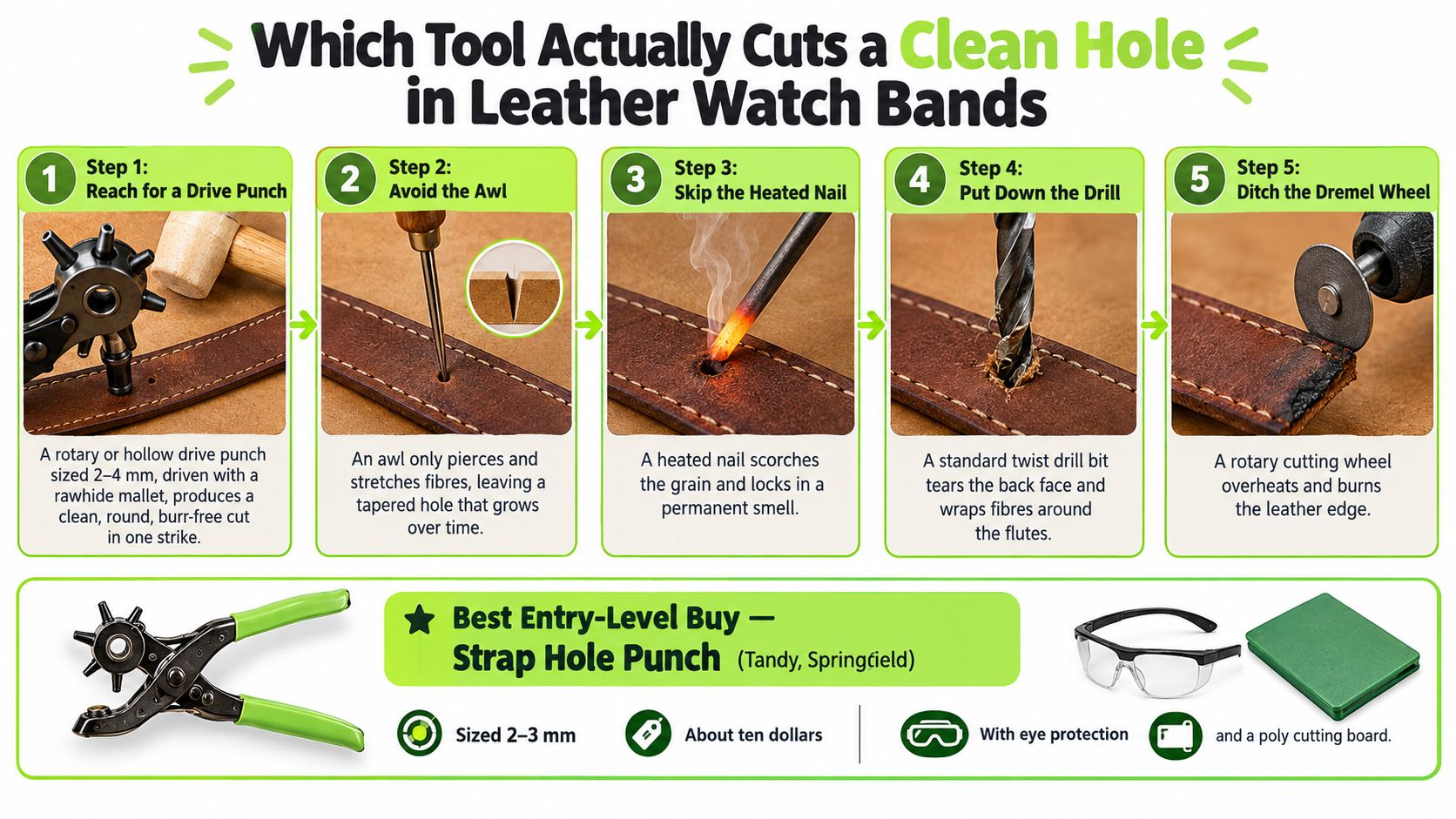
A sharp rotary punch or hollow drive punch produces the cleanest result. Use a rotary punch for convenience, or place a hollow drive punch over the mark and strike it squarely with a rawhide or wooden mallet. A correctly sized punch shears the leather instead of dragging through its fibres.
For watch straps, small-diameter tools are normal. Dedicated watch-strap punch sets are sold with interchangeable ends sized 1 mm, 2 mm, and 3 mm, which is why they suit straps better than a general-purpose punch. A revolving rotary punch bottoms out at 2 mm, so it covers a 2 mm factory hole but not the narrower 1.5 mm holes found on many dress straps — for those, use a watch-strap punch or a small hollow drive punch. If two sizes seem close, choose the smaller one because leather openings relax and stretch with wear.
A hole punch is not the same as an awl. An awl makes a tapered puncture by pushing fibres aside, so the opening can enlarge and become oval as the buckle tongue loads one side. A heated nail scorches the grain, hardens the surrounding leather, and leaves an unpleasant smell. A twist drill bit catches fibres on its flutes, often tearing the back face and leaving a ragged rim. A Dremel cutting wheel is even less suitable because friction can overheat and burn the edge.
For very thin dress straps, a Japanese screw punch can offer controlled cutting with less impact. For most first-time repairs, though, a strap hole punch from a leatherworking supplier such as Tandy or Springfield, sized around 2 mm to 3 mm, is easier to control. Sharp trimming tools from a supplier offering Olfa cutting tools for tradespeople can help with finishing, but don't use a knife as the primary hole-making tool.
| Tool | Cut Quality | Risk to Strap | Verdict |
|---|---|---|---|
| Rotary punch | Clean, round cut when sharp | Low | Best for a beginner |
| Hollow drive punch and mallet | Clean cut with a square strike | Low | Excellent for precise work |
| Japanese screw punch | Controlled cut on thin leather | Low when correctly sized | Useful for delicate dress straps |
| Awl | Tapered, stretched opening | High | Avoid |
| Heated nail | Burned and distorted edge | Very high | Never use |
| Twist drill bit | Ragged back face and wrapped fibres | High | Never use |
| Dremel cutting wheel | Overheated, burned rim | Very high | Avoid |
Wear eye protection when striking a drive punch, keep your supporting hand away from the punch path, and work on a poly cutting board rather than glass or bare steel. A modest dedicated punch is a better choice than improvising with a household tool, especially when the strap is worth more than the tool.
Not every adjustable strap needs holes. The Vayra Magnetic Milanese for Apple Watch uses a magnetic clasp and stainless-steel Milanese mesh, so adjustment doesn't rely on punched leather openings.
Finding the Right Spot and Marking It
Choose the new hole from the fit on your wrist, not from the strap end. The correct position is where the buckle tongue sits naturally, aligned with the strap's existing centre line and hole pattern.
Put the watch on and thread the strap normally. Fasten it where it feels secure without pinching, then let the strap settle briefly. If a middle hole gives the right fit, use it as the reference because it leaves adjustment in both directions. If the required position falls beyond the existing pattern, measure from the nearest hole rather than guessing.
Mark the tongue's position on the underside of the long strap with a fine pencil, silver pen, or tailor's chalk. The underside keeps the visible grain cleaner. Pencil and chalk also mark the leather without cutting fibres, unlike a knife score.
How far apart should watch-band holes be?
Match the factory spacing as closely as possible. For a watch strap, the new hole will commonly sit approximately 6 mm to 8 mm from its neighbour. General leatherworking guidance may use 25 mm, or 1 inch, centre-to-centre spacing, but that is usually too wide for a watch strap. A dedicated watch-strap punch can specify 6.5 mm spacing between five in-line holes, giving a useful mechanical reference for a compact pattern. Copying the existing layout is still safer than placing holes freehand.
Extend the centre line with a ruler. Set the new mark directly over it, not toward either edge. An off-centre opening pulls the buckle tongue sideways, twists the strap, and makes the finished adjustment look careless.
Keep generous leather around the opening. The new hole needs a full bridge of leather on both sides and enough material behind it toward the strap tip, because it is a thin bridge that splits first under buckle tension. Watch-strap hole-punch advice also recommends measuring the gap between the existing holes and keeping that same interval, then holding the punch tube vertical over the mark.
Before you cut, test the mark against the keeper loops. The buckle should lie flat, the tongue should enter without force, and the tail should still pass through both keepers. Check the strap's fitting separately. Traditional and quick-release straps are commonly sold in 20 mm and 22 mm lug widths, and most Galaxy Watch models sit on that same standard at 20 mm — the exceptions are Galaxy Watch Ultra and Watch 8, which use Samsung's Dynamic Lug fitting rather than a plain spring bar. Apple Watch and Fitbit straps are matched to the case size or model instead. Either way, a new hole must not compromise the attachment area or alter how the strap sits at the watch head.
Punching is the wrong fix if the strap already reaches its usable adjustment range, the leather is cracked around the holes, or the buckle tongue cannot lie flat. In those cases, choose a strap with the correct length or replace the damaged strap instead of adding another opening.
Making the Cut in One Decisive Action
Place the strap grain-side up on a poly cutting board or a scrap of hardwood such as maple. Don't use glass or bare steel. An unyielding surface can dull the punch, while a soft surface lets the leather dome and stretch instead of supporting the cut.
Position the hollow drive punch directly over the mark. Look from both the side and the end of the strap to confirm that the tube is perpendicular. A tilted punch cuts one side before the other, leaving a crescent-shaped edge rather than a round opening.
Hold the punch firmly and strike it once with a controlled, vertical blow from a rawhide or wooden mallet. A hesitant series of taps crushes the fibres around the rim and makes the edge harder to finish. With a rotary punch, squeeze the handles fully closed in one smooth action. Don't rock the tool or half-punch the leather.
Pull the punch straight up. Tap the leather plug out onto the bench. If it remains inside the tube, push it through with a wooden dowel rather than prying it out with a blade. A blade can score the inside of the punch or cut the strap when your hand slips.
Thread the buckle tongue into the new opening and check the fit before finishing the edge. The tongue should sit flat, the strap should remain straight, and the buckle shouldn't force the strap sideways. For a wider overview of home adjustments beyond this one job, see the watch strap DIY guide.
A clean punch leaves a round opening with minimal fuzz. If the cut is visibly oval, the punch was tilted, dull, or too small for the buckle tongue. Don't enlarge it with a drill. Recheck the tongue, then use the correct punch on a fresh mark only if the first hole can't seat the buckle safely.
Finishing the Hole So It Looks Factory Made
A fresh punched hole can show pale fibres and tiny whiskers even when the cut itself is clean. Finish it in three controlled moves: clear the rim, colour the exposed core, then burnish the edge.
How do you finish the raw leather edge?
First, remove loose fibres without widening the hole. Use a sharp craft knife or edge beveler with a very light hand, or wrap fine sandpaper around a cocktail stick and work around the inside rim. The aim is to remove fuzz, not to reshape the opening.
Second, touch the pale core with matching edge dye or a leather pen. Apply it to the tip of a cotton bud and work around the inside of the hole, keeping the colour off the surrounding grain. The exposed core often looks lighter than the finished strap, so this small step makes the new opening blend with the factory holes.
Third, burnish the rim. Dampen it very slightly, rub a little beeswax around the opening, and work the fibres down with a wooden slicker, rounded bone folder, or the back of a spoon. Gum tragacanth is another option, particularly for vegetable-tanned leather that responds well to a wet polish.
Finishing rule: A small amount of product and light pressure will seal the fibres better than flooding the hole or forcing a hard tool through it.
Once the rim has settled, wipe a light amount of leather conditioner over the nearby area. Don't saturate the hole, because softened leather can stretch out of round under the buckle tongue. Let the strap dry fully before wearing it.
This is the only care step needed for the repair itself. The purpose is to stabilise the fresh cut, not to turn the adjustment into a full cleaning routine.
When the Strap Is the Wrong Length, Not the Hole
Punching makes sense when the strap is one hole short of a comfortable fit. If you need more than one extra hole, the strap is probably the wrong length, and adding openings becomes a way of hiding a sizing problem rather than fixing it.
Each additional hole removes material from the same narrow section of leather. As the holes move toward the buckle, the remaining bridges become less forgiving under repeated tongue pressure. A strap that needs a row of home-made holes can end up looking uneven and may place the buckle in an awkward position on the underside of the wrist.
If the strap only needs one extra position, punch one precise hole. If it needs several, replace the length instead.
Check the fit at the tightest existing hole. If the watch still sits noticeably loose, choose a shorter strap or the next size down rather than continuing to cut. A shorter strap keeps the buckle closer to the intended adjustment range and gives the keeper loops a better chance of holding the tail neatly.
Use the strap's construction as part of the decision. A stitched leather strap with rivets, quick-release springs, or a shaped end is usually cheaper and cleaner to replace than to alter repeatedly. If the strap has already developed stretched, oval holes, a new opening won't restore the tired leather around them.
Smartwatch straps also vary in attachment and length options, so confirm the replacement's width and model fit before ordering. The watch-band measuring guide can help separate the watch's lug width from the wrist-length problem. The strap still needs to match the watch head — a 20 mm or 22 mm lug width on a traditional strap, or the right case size or model fitting on a smartwatch — regardless of whether the strap is short or long.
Nothing but Bands offers replacement options across smartwatch families rather than leather punches or adjustment tools. Its genuine leather watch straps include options for Apple Watch, Fitbit, Garmin QuickFit, and Galaxy Watch. Within the Fitbit straps range, genuine leather models cover Charge 3/4, Charge 5/6, Versa 3/4, and Sense 1/2. The Fitbit versions use a classic buckle with keeper loops and standard punched holes, so the same one-hole adjustment method applies directly — the Ryder genuine leather strap for Fitbit Versa 3/4 and Sense 1/2, one of the Fitbit Versa straps, is a straightforward example.
Genuine leather is also available in the range for Apple Watch under Avelin, Garmin QuickFit under Alder and Langford, and Galaxy Watch under Calder and Varden. A replacement is the better answer when the current strap needs multiple new holes, has a damaged edge, or no longer leaves enough material around the buckle opening.
Quick Answers on Punching Watch Strap Holes
When should you stop punching and replace the strap?
Replace the strap when you need more than one extra hole, the next opening would sit too close to the edge, or the existing holes are already stretched and oval. One careful adjustment is reasonable. Repeated punching weakens the narrow leather bridge that carries buckle tension.
If the leather is cracked, soft, or torn around the buckle holes, punching is the wrong fix entirely. A fresh opening cannot restore weakened material. Choose a replacement or have a leatherworker assess it.
Does smartwatch lug width change when adding a hole?
No. A new hole changes wrist adjustment only; it does not change the watch's lug width. The strap must still match the watch head — commonly a 20 mm or 22 mm lug width, or a model-specific fitting on a smartwatch — while the hole position handles fit around the wrist.
Will a hand-punched hole last as long as a factory hole?
It can, provided the punch is sharp, the opening follows the factory centre line, spacing matches the original holes, and the rim stays well clear of the edge. The buckle tongue loads one side of the opening, so leather may gradually pull the round cut into an oval. Alternating between adjacent holes can spread wear.
Inspect the hole after use. A distorted rim, loose buckle tongue, or slipping buckle means the opening is no longer doing its job.
What should you do if the punch tears the leather?
Stop immediately. Do not enlarge a damaged opening. Tearing commonly comes from a dull or tilted punch, an unsupported cutting surface, an edge placement that leaves too little leather, or a tool that is unsuitable for a clean round cut, such as an awl or drill.
If the remaining bridge cannot hold buckle tension, replace the strap or take it to a leatherworker. If the tongue does not enter the new hole, never force it. Recheck the original diameter, choose the smaller punch when between sizes, and test on scrap leather before cutting again.
Choose a replacement when the strap needs more than one extra hole or has weakened around the buckle. Browse Nothing but Bands for model-matched genuine leather options across Fitbit, Apple Watch, Garmin QuickFit, and Galaxy Watch, then confirm the lug width before ordering.
Related posts

- October 07, 2026
Discover why comfortable watch straps feel different. Learn the materials, closures, and fit rules that actually matter for Samsung Galaxy...

- October 06, 2026
Clear installation instructions for smartwatch straps. Learn how to attach, verify, and troubleshoot Apple, Samsung, Garmin, and Fitbit straps safely.

- October 05, 2026
A practical guide to changing watch straps across Apple, Garmin, Samsung, and Fitbit, covering tools, fitment, daily rotation, and common...

