


The popular advice is to choose the hardest material and stop thinking about wear. That's the wrong priority for a smartwatch strap. Sapphire resists scratches best on the watch itself, but straps age according to scuffing, abrasion, fraying, coating wear, and impact. A replaceable strap can look tired long before it becomes unusable, while a marked case or crystal changes the appearance of the watch every time you check the time.
3 Key Takeaways: Scratch Resistant Strap Materials
Hide marks best: Silicone and resin take knocks with the least visible wear.
Brushed beats polished: Brushed metal hides scratches. Polished metal shows hairline marks.
Every material wears differently: Nylon pills or frays, and leather scuffs into a patina.
For daily wear, silicone and resin composites usually handle knocks with the least visible fuss, brushed metal hides marks better than polished metal, nylon doesn't scratch but can pill or fray, and leather develops scuffs and patina rather than clean scratches. No strap material is scratch-proof. The practical question is which failure pattern you can live with, and whether replacing the strap is easier than repairing the watch.
Table of Contents
- What Counts as a Scratch Resistant Material on a Smartwatch
- How Scratch Resistance Is Actually Measured
- Stainless Steel, PVD Coatings, and Metal Strap Finishes
- Silicone, TPU, Nylon, and Resin Composite Compared
- Sapphire and Ceramic on the Case and Crystal
- Caring for and Repairing Scratched Straps
- Choosing the Right Strap Material for Your Wear
- Frequently Asked Questions About Scratch Resistant Materials
What Counts as a Scratch Resistant Material on a Smartwatch
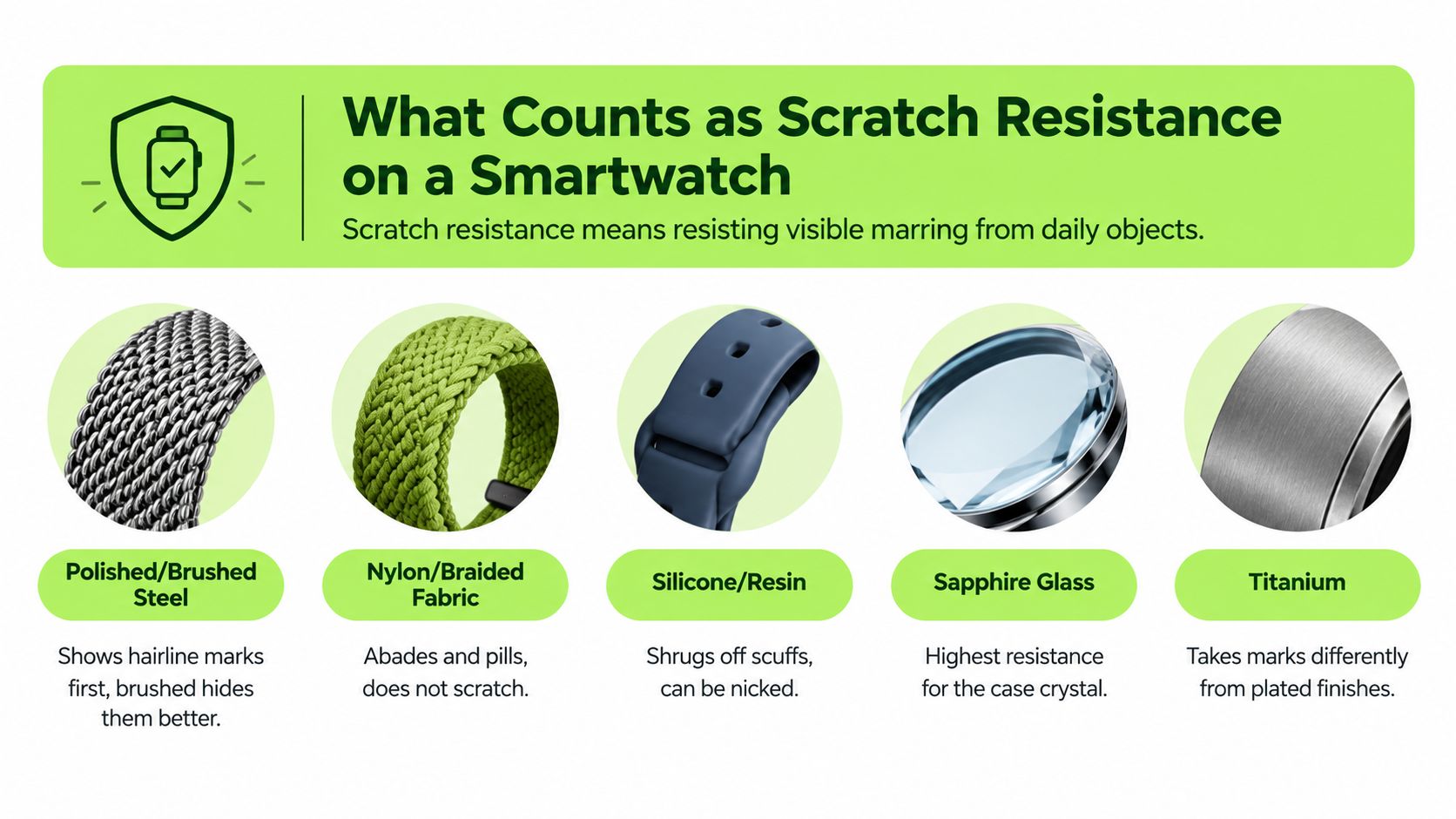
Scratch-resistant materials include stainless steel, titanium, coated metals, silicone, TPU, nylon, resin composites, and, mainly for the watch itself, sapphire and ceramic. In everyday use, scratch resistance means a surface resists visible marring from contact with desks, zippers, door frames, gym equipment, keys, grit, and other hard objects.
A smartwatch strap can fail in several ways:
- Metal can pick up hairline marks, especially when the surface is polished.
- Plated finishes can wear through at clasps, buckle tongues, and link corners.
- Silicone and resin can scuff or take a sharp nick without developing a fine scratch.
- Nylon and braided fabric abrade, pill, or fray instead of scratching.
- Leather scuffs, darkens, and develops patina, which is a change in character rather than a hard surface mark.
The phrase “scratch resistant” is relative, not absolute. The Mohs scale, introduced by Friedrich Mohs in 1812, gives a useful way to compare scratch hardness, but it doesn't predict every kind of wear a strap experiences. A flexible strap may score poorly in a hardness comparison and still survive knocks better than a hard, brittle edge.
Why the strap deserves less anxiety than the case
The crystal and bezel sit in the most visible position and stay attached to the expensive part of the device. A strap is the replaceable part. If a strap gets marked after months of desk edges, workouts, and door frames, replacement normally makes more sense than obsessing over a perfect surface.
That's why I rank real wear behavior above headline hardness. The best strap for you isn't necessarily the one with the hardest surface. It's the one whose aging pattern matches your routine, clothing, workouts, skin, and willingness to replace it.
How Scratch Resistance Is Actually Measured
The Mohs scale measures whether one material can scratch another, and it ranks materials from talc at 1 to diamond at 10. It's an ordinal scale, so the values identify a sequence rather than equal steps. Quartz ranks 7, sapphire and corundum rank 9, and diamond ranks 10, according to the Mohs scale reference.
Common reference points make the idea easier to understand:
- A fingernail is around 2.5.
- A copper penny is around 3.5.
- A steel nail, a knife blade or a glass plate is around 5.5.
- A hardened steel file is around 6.5.
- Quartz is 7, sapphire is 9, and diamond is 10.
Quartz, sapphire and diamond come from the cited Mohs reference; the everyday objects are the standard field-test comparisons geologists use to bracket a mineral without a kit. Either way, they don't tell you whether a strap will crack, bend, stretch, or lose its coating. Mohs hardness is useful for surface scratching. It doesn't measure toughness, flexibility, edge strength, or comfort.
Practical rule: A hard surface can resist a mark and still fail when a sharp edge receives a concentrated impact.
Why a hardness number can mislead
Consumer videos often use scratch kits to drag objects across a surface. That can demonstrate a relative result, but it isn't a complete durability assessment. Pencil hardness tests for polycarbonate coatings, covered by ASTM D3363 testing guidance, are also comparative. A higher pencil grade means the coating resists that defined gouging action more effectively. It doesn't mean the coating is immune to every object a wearer might encounter.
Industrial testing also separates the depth of a mark from the way a surface actually fails. A material may resist a shallow scratch and still chip, delaminate, or gouge under a heavier load, which is why scratch-test wear mapping for steels builds a map of wear behaviour instead of quoting one hardness figure.
| Material | Approximate Mohs hardness | Typical use |
|---|---|---|
| Silicone or TPU | Low relative surface hardness | Flexible sport straps |
| Stainless steel | Varies by alloy and finish | Mesh and link straps |
| Sapphire | 9 | Watch crystals |
| Ceramic | Very hard surface | Case components and bezels |
| Diamond | 10 | Hardness reference |
The useful buying decision combines scratch resistance, toughness, flexibility, weight, finish retention, and repairability. A strap that can be replaced easily may be a better practical choice than a harder construction that becomes expensive or awkward to restore after edge damage.
Stainless Steel, PVD Coatings, and Metal Strap Finishes
Metal straps usually show wear through hairline marks, finish changes, and coating loss rather than deep scratches across the entire surface. Polished steel reveals those marks first. Brushed steel hides them better because new lines blend into the existing grain.
The surface finish matters as much as the underlying metal in ordinary use. Stainless mesh and link straps are commonly finished with PVD or ion plating, which can hold up better than paint or lacquer. DLC finishes are harder and more costly to restore if a deep gouge exposes the substrate. The weak points are predictable: clasp edges, buckle tongues, link corners, and the parts that rub against desks or door frames.
| Finish type | Scratch visibility | Maintenance notes |
|---|---|---|
| Polished steel | High, hairlines and fingerprints stand out | Use a soft jewelry cloth; deep marks remain visible |
| Brushed steel | Lower, marks blend with the grain | Blend light marks only along the existing grain |
| PVD or ion-plated metal | Depends on color and base finish | Watch high-contact edges for finish wear-through |
| Sandblasted matte metal | Moderate, surface disguises small marks | Finish can look uneven when heavily rubbed |
| Milanese mesh | Moderate to low, woven texture breaks up lines | Clean grit from the mesh and clasp regularly |
A Milanese mesh strap is often more forgiving visually than a flat polished link because the woven pattern interrupts the reflection. It isn't immune to wear, though. Fine hairlines can collect across the wires, and plated color can wear at the clasp or contact points.
Finish is the part buyers usually underestimate
A brushed finish is generally the safest choice for a neat-looking daily metal strap. Polished surfaces look sharp when new, but every fingerprint and micro-mark catches the light. Painted or lacquered finishes can look clean initially, yet a chip or worn edge exposes a visible transition that a bare stainless surface doesn't have.
For a broader explanation of whether powder coating or painting is better for alloy wheels, The Alloy Hub Ltd. provides useful finish context. The same principle applies here: a surface treatment changes how the substrate behaves and how damage appears, but it doesn't make a strap invulnerable.
The watch metal strap guide is useful when you're deciding between mesh, links, and other metal constructions. Choose brushed steel if you want marks to disappear into the texture. Choose polished steel if you're comfortable treating appearance as part of the maintenance.
Silicone, TPU, Nylon, and Resin Composite Compared
A strap that resists scratches is not automatically the one that ages best. Silicone, TPU, nylon, and resin composite respond differently to knocks, bending, sweat, and abrasion, so surface hardness alone gives an incomplete picture. Silicone usually shrugs off ordinary scuffs but can be cut by a sharp edge. TPU may develop shallow rub marks that blend into its surface. Nylon and braided fabric do not conventionally scratch, though they can abrade, pill, stain, or fray. Resin composites generally resist everyday surface wear and stay lighter than metal, while sharp point impacts can cause chips or cracks.
Soft silicone remains the practical workout choice because it flexes with the wrist and rinses clean. A slick hard coating may improve the initial finish, but repeated bending can damage or expose that outer layer at stress points. Uncoated TPU can show more superficial rubbing, yet those marks often attract less attention than a bright scratch through colored metal coating. TPU is an engineering elastomer rather than simply a soft plastic — it is specified for elongation, tear strength and abrasion resistance rather than for surface hardness. Flexibility and rebound often matter more than a hard-looking surface.
| Material | Scratch behavior | Sweat and odor | Best use case |
|---|---|---|---|
| Silicone | Resists scuffs, can take sharp nicks | Easy to rinse, may retain odor if neglected | Workouts and daily sport wear |
| TPU | Shallow rub marks can blend over time | Usually easy to wipe clean | Flexible everyday use |
| Nylon | Doesn't scratch, abrades and pills | Can retain sweat or stains | Lightweight casual and active wear |
| Braided fabric | No conventional scratches, frays at edges | Needs careful washing | Breathable everyday wear |
| Resin composite | Resists ordinary scuffs, vulnerable to point impact | Wipes clean, texture can hold debris | Adventure-oriented daily wear |
The practical ranking: Silicone and resin usually look better after knocks, nylon avoids conventional scratches but shows textile aging, and TPU hides many shallow rubs better than glossy coated surfaces.
A resin composite link suits buyers who want a structured appearance without a polished metal surface. Laura Flores, a verified buyer of the Lyra — Resin Composite Link — Apple Watch, wrote: “I've bumped it a couple of times, but it hasn’t scratched at all—definitely made to last.” That is a customer observation, not a laboratory result. It matches the broader pattern: resin handles ordinary contact well but remains vulnerable to sharp, concentrated impact.
For fabric-focused choices, silicone watch straps and nylon watch straps show different aging patterns. Silicone becomes scuffed or nicked, while nylon becomes fuzzy, worn, or frayed. See our comparison of silicone vs nylon watch straps for more detail on fabric aging. Neither material should be described as scratch-proof.
Sapphire and Ceramic on the Case and Crystal
Sapphire resists scratching better than the common materials used on smartwatch cases and crystals, while ceramic offers high surface hardness but can fail through impact. Sapphire, or corundum, ranks 9 on the Mohs scale, while diamond ranks 10, so sapphire is highly scratch resistant but not scratch-proof. Sapphire, mineral glass, and Hesalite are the three crystal materials you will see compared most often.
Mineral glass sits far lower on the same scale: the Mohs reference lists glass at 5.5, while quartz ranks 7, which is why ordinary grit and sand — largely quartz — can mark a glass crystal. Hardened or mineral glass can be perfectly serviceable, but it has less abrasion margin than sapphire. Titanium and steel also take marks differently from plated or coated finishes, with surface texture and color determining how visible those marks become.
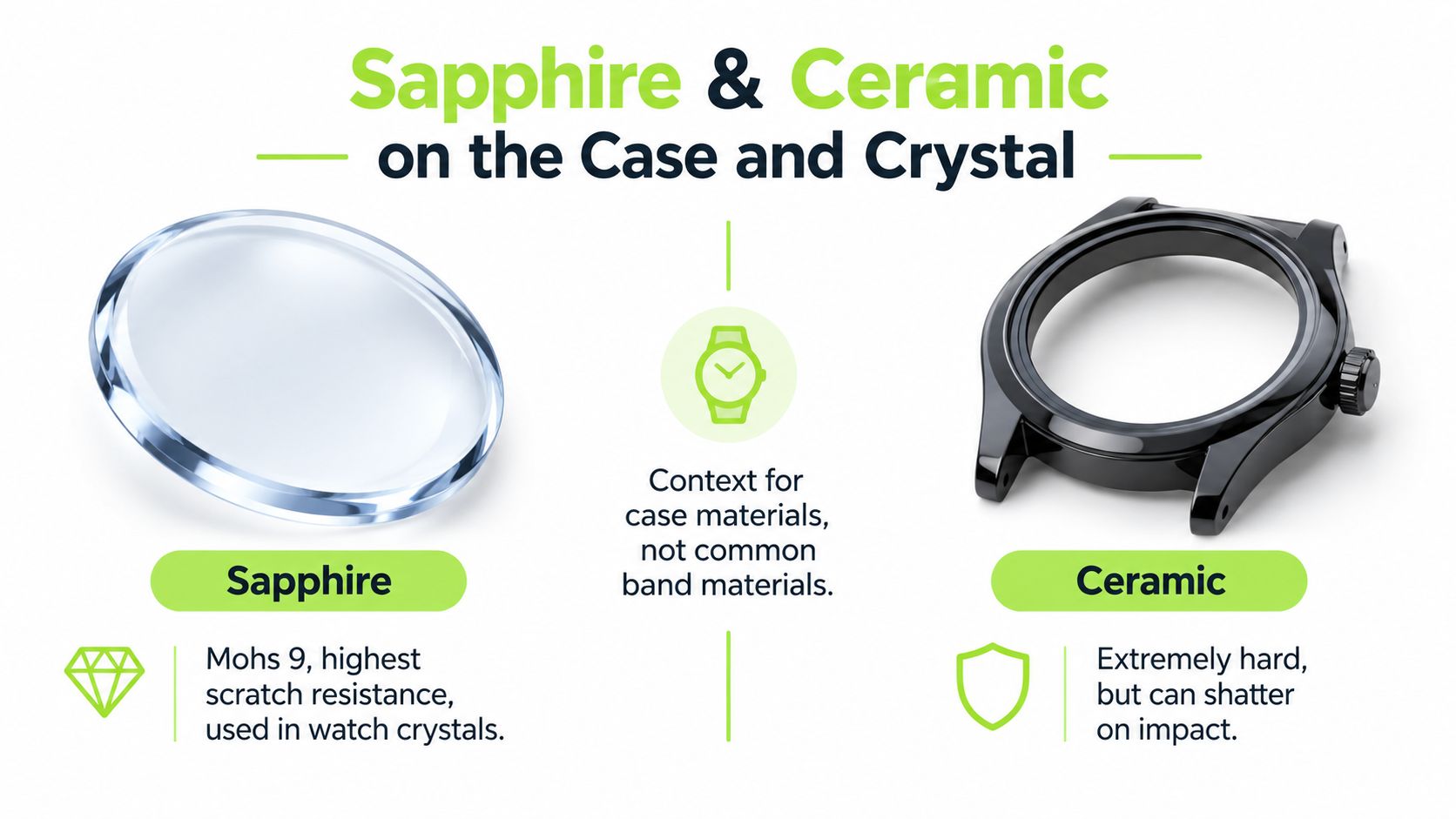
These are case and crystal materials, not common strap materials. They set the benchmark for scratch resistance where the damage is most visible, but upgrading a strap won't change the crystal's behavior. The same distinction applies to protective coatings in general: a surface treatment can reduce marking, but it cannot remove the limits of the material underneath it.
Caring for and Repairing Scratched Straps
Repair depends on whether the strap has a surface mark, a worn coating, textile abrasion, or structural damage. Start by identifying the failure mode rather than reaching for a polishing compound. A scratch on brushed steel may be blendable. A worn PVD edge usually isn't.
Match the treatment to the material
- Brushed stainless steel: Use a fibreglass pen or Scotch-Brite pad lightly along the existing grain. Cross-grain rubbing creates a larger visible patch.
- Polished steel: A jewelry cloth can reduce light surface haze, but deep scratches usually need controlled professional polishing to avoid uneven curves.
- PVD or ion-plated metal: Don't polish aggressively. Once the color layer wears through, home repair won't restore it, and replating is rarely worth the cost of a strap.
- Silicone and TPU: Wash with warm water, mild soap, and a soft brush. Deeper scuffs may soften visually as the material rebounds, but cuts around holes or edges call for replacement.
- Nylon and braided fabric: Hand wash with mild detergent and air dry flat. Pills and frayed edges can be trimmed carefully, but abrasion can't be reversed.
- Resin composite: A light pass with a melamine foam sponge can reduce visible scuffs. Stop before you flatten the texture or change the sheen.
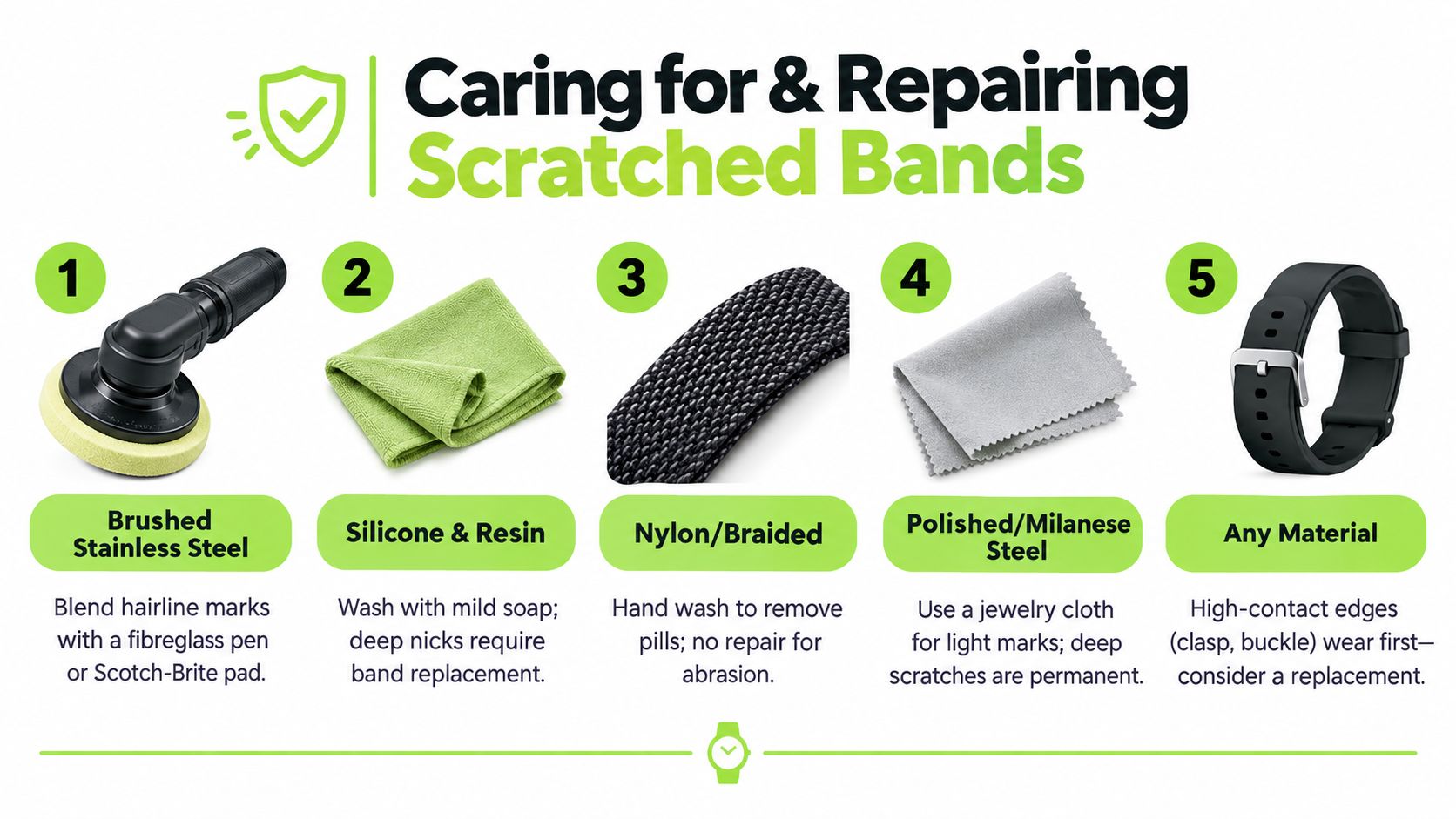
Avoid abrasive cleaners on every material, especially plated metal, colored resin, and soft polymers. A practical watch strap cleaner guide can help you choose a gentler routine without turning ordinary grime into surface damage.
This video shows how light scratches are brushed and polished out of a watch:
Replace rather than repair when: a coated edge has worn through, a clasp no longer holds securely, a polymer has split near a pin hole, or fabric abrasion has reached the structure.
Keep metal straps away from gym bars and door frames. For training, wear a softer silicone or resin strap, then swap back to metal afterward. That simple change prevents the most avoidable dents and hairlines, and it recognizes the central advantage of a smartwatch strap: the strap is the inexpensive, replaceable part.
Choosing the Right Strap Material for Your Wear
Choose the strap according to the contact it will face, then confirm the connector, lug width, and closure before buying. An 18mm, 20mm, or 22mm strap isn't interchangeable just because the materials look similar. Quick-release fittings, butterfly clasps, proprietary connectors, and adapters also affect whether a strap fits the watch securely.
If you train regularly
Silicone is the sensible starting point for running, cycling, gym work, and other sweaty activity. It rinses clean, tolerates wrist flexion, and doesn't develop the bright hairlines that appear on polished steel. A resin composite can work when you want more structure and a link-style appearance, but inspect edges and connection points after hard knocks.
If appearance matters most
Choose brushed stainless steel when you want a metal strap that ages gracefully. The texture disguises fine marks better than a mirror finish. A Milanese construction also breaks up reflections, so small lines are less obvious than they would be on a broad polished link. You can browse Milanese watch straps when that woven look suits your daily clothing and office wear.
If you have sensitive skin
Comfort and cleaning matter as much as visible wear. A smooth silicone strap avoids textile friction, while stainless mesh can provide ventilation and fine adjustment. Check the clasp and any plated components carefully, because the surface touching your skin may not behave like the main strap body.
If you want one strap for mixed use
A structured resin composite or brushed link strap works for office wear and ordinary daily use, but it's still sensible to change into a softer strap for a workout. Nylon is another low-scratch option when you prefer lightness and breathability, although its eventual failure is pilling and fraying rather than a clean surface mark.
| Wear profile | Recommended material | Why it fits | Example product |
|---|---|---|---|
| Fitness and outdoor use | Silicone or resin composite | Handles sweat, scuffs, and routine impacts | Active silicone construction or a resin link |
| Sensitive skin | Smooth silicone or stainless mesh | Easy cleaning and reduced fabric friction | Silicone strap or Milanese mesh |
| Office and style wear | Brushed stainless steel | Hides hairlines better than polished metal | Brushed link or mesh strap |
| Lightweight casual wear | Nylon or braided fabric | Won't scratch and feels flexible | Nylon loop or braided strap |
| Mixed routine | Two-strap rotation | Protects metal during workouts and extends wear life | Soft workout strap plus brushed daily strap |
A real buyer review can illustrate appearance and comfort, but it shouldn't replace fit information. Frank Brown, verified buyer of the Solin — Magnetic Milanese — Quick Release 20mm, wrote: “The quality of this magnetic Milanese strap is just top-notch. Feels super sturdy and the finish looks really sharp, not cheap at all. It's comfy too, and I love how easy it is to switch out; you can tell it was crafted with care. Definitely impressed with the durability—no scratches or signs of wear after a few weeks!”
Nothing but Bands sells replacement constructions across silicone, nylon, Milanese stainless steel, resin links, braided loops, and genuine leather. Treat those as material choices first, then verify your smartwatch model, connector type, and strap width before ordering.
Frequently Asked Questions About Scratch Resistant Materials
Can a PVD-coated stainless steel strap scratch a polished watch case?
Yes, a PVD-coated stainless steel strap can mark a polished watch case through repeated friction. A PVD layer is considerably harder than the bare stainless steel underneath it, so a plated edge can leave hairlines on a softer polished surface, and small particles trapped between the strap and case increase the abrasion further. Keep metal straps away from hard contact points and check the case edges regularly.
Do silicone smartwatch straps degrade or tear instead of scratching?
Yes, silicone smartwatch straps usually show wear as scuffs, fuzzing, cuts, or tearing around pin holes rather than as a clean scratch. A hard coating may delay visible marking, but repeated bending can stress the coating and the underlying elastomer. Replace the strap when a cut reaches a hole, edge, or connector.
Can Milanese mesh straps trap dirt under the magnetic clasp?
Yes, Milanese mesh straps can hold grit around the magnetic clasp and woven wires. Brush the mesh gently during regular cleaning, because trapped particles can increase rubbing and make fine wear more visible. Don't use a stiff abrasive tool that could flatten or snag the weave.
How can you tell whether a listed sapphire strap is genuine?
A listed sapphire component needs more than a marketing label. Mohs-style testing can provide a rough indication, but testing a finished smartwatch part risks damaging it, and price alone doesn't prove the material. If you're choosing a replacement strap rather than a full sapphire watch component, a Milanese stainless mesh, a resin composite link or a silicone sport strap addresses strap wear without pretending the strap itself is sapphire.
Nothing but Bands offers replacement smartwatch straps in silicone, nylon, Milanese stainless steel, resin link, braided, and genuine leather constructions, so you can choose the wear pattern that suits your routine. Visit Nothing but Bands to check compatible options, confirm sizing, and swap a worn or marked strap instead of replacing the watch.
Related posts

- October 07, 2026
Discover why comfortable watch straps feel different. Learn the materials, closures, and fit rules that actually matter for Samsung Galaxy...

- October 06, 2026
Clear installation instructions for smartwatch straps. Learn how to attach, verify, and troubleshoot Apple, Samsung, Garmin, and Fitbit straps safely.

- October 05, 2026
A practical guide to changing watch straps across Apple, Garmin, Samsung, and Fitbit, covering tools, fitment, daily rotation, and common...
