


If you landed here to remove a link from a watch bracelet, this is about taking out a link from a metal watch strap, not deleting a web link or removing anything from a page. The fit problem is usually simple, but the sizing decision is where people go wrong, because the bracelet can feel loose for three different reasons: too many links, links removed from the wrong side, or a clasp that still has room to fine-tune.
3 Key Takeaways: Removing a Link from a Metal Strap
Try the clasp first: Micro-adjust holes in the clasp may remove enough slack on their own.
Remove in pairs: Take links from both sides of the clasp so it stays centred.
Decide before you push: Work out how many links come out before touching a pin.
The safest approach is to decide how many links need to come out, which side of the clasp they should come from, and whether a link needs to come out at all. Most frustration starts when someone reaches for the pin pusher before answering those three questions.
Table of Contents
- Why Link Removal Goes Wrong: The Clasp Gets Ignored
- How to Measure Your Wrist and Decide What to Remove
- Which Metal Watch Straps Can Be Resized
- The Safe Way to Push Out Watch Strap Pins
- What to Do When the Link Is Stuck or Too Tight
- When to Skip Resizing and Choose a Different Strap Instead
Why Link Removal Goes Wrong: The Clasp Gets Ignored
The common mistake is treating link removal like a pure mechanical job. A metal bracelet can be easy to open and still sit badly on the wrist if the clasp ends up off-center, or if the last bit of slack could have been handled by the clasp instead of by removing metal.
The clasp tells you more than the links do
A bracelet should sit centered on the wrist, with the clasp balanced rather than drifting to one side. Pull links from only one side and the clasp shifts, the taper looks uneven, and the watch often feels heavier on one edge of the wrist.
Practical rule: take links off in pairs, one from either side of the clasp, unless the bracelet design clearly forces a different approach.
That paired approach keeps the bracelet visually even and usually makes the fit more stable during daily wear. It also leaves future adjustments open, instead of creating a one-sided problem while solving a loose-fit issue.
The other thing people miss is the clasp's own adjustment range. Those micro-adjustment holes are there for the last bit of slack, and that small change is often enough before you remove permanent material. Skip that check and you can take out a link you still needed.
Before touching a pin, answer the three sizing questions below. How many links need to come out, which side should they come from, and whether the clasp can handle the final adjustment.
How to Measure Your Wrist and Decide What to Remove
Start with the watch on your wrist, fastened the way you wear it. Check where the clasp sits, and see whether the bracelet has a little movement or too much slack. If the fit already feels close, use the clasp before you remove any metal.
Use the clasp before you touch a link
A slightly loose bracelet often improves with the micro-adjustment holes in the clasp. That keeps the bracelet balanced and avoids changing the link pattern before you need to.
If the tightest clasp setting still leaves extra slack, remove links in pairs. Take out one pair, test the fit again, and stop there if the watch now sits properly. That keeps you from overshooting and turning a loose fit into one that pinches or leaves marks.
A simple way to make the call:
- Slight slack, adjust the clasp first.
- Clear looseness, remove links in pairs.
- Borderline fit, remove less and test again.
A metal bracelet should move with the wrist without flopping or feeling locked in place. If you are between two sizes, start with the smaller change and let the clasp handle the rest.
When the fit falls between two full links, check whether your bracelet has a half-link. Some bracelets carry one, usually next to the clasp, and swapping a full link for it takes up roughly half a link's length. No half-link? Remove the smaller amount and let the micro-adjustment holes cover the last couple of millimetres.
To measure the wrist properly, use a method that reflects real wear, not a guess from how the watch looks off the wrist. A clear guide to measuring watch size helps you decide whether the problem is link count, clasp position, or a bracelet that should not be resized at all.
Which Metal Watch Straps Can Be Resized
A bracelet only needs resizing if it has removable links, and that is the first decision worth making. Solid link bracelets, like the Kryos — Stainless Link — Galaxy Watch 8 & 9 and the Kryos — Stainless Link — Galaxy Watch Ultra & Ultra 2, are built for that kind of adjustment. Other straps are one-piece, woven, or use a different connector altogether.
Removable links versus straps that close differently
The connector decides which strap fits, not how long it is. Apple Watch straps slide into the case after you press the release button on the back of the watch case. Samsung Galaxy Watch4 to Watch7 take a 20 mm quick-release spring bar, while the Galaxy Watch8, Watch8 Classic and Galaxy Watch Ultra use Samsung's Dynamic Lug, so a link bracelet has to be built for that fitting. Garmin is even more specific, because QuickFit and ordinary quick release are different systems, and they are not interchangeable.
Before you reach for a pin tool, check the strap family and the closure it uses.
A woven Milanese mesh closes along its length, so it does not get sized by removing individual links. A hook-and-loop nylon loop has no links at all. Magnetic or looped styles need a fit decision, not a pin punch.
The central question is not whether the strap looks metal, but whether it was built for link removal. Visible removable segments, small arrows on the inside, and a link pattern that repeats in sections usually point to a true bracelet. Mesh, solid one-piece straps, and straps with proprietary connectors call for a different approach.
If you shop by model, the connector system should guide the choice. The strap has to match the watch case and the way it attaches, not just the color or finish. That saves time and keeps you from buying a bracelet that cannot be resized the way you expected.
The Safe Way to Push Out Watch Strap Pins
Once you know how many links come out and from which side, the mechanics are their own job. Our step-by-step guide on how to remove links from a watch strap walks through identifying the pin system and each removal method, so this section only covers the habits that keep the bracelet unmarked.
A clean pin push starts with a stable setup, not brute force. Work over a soft cloth, add masking tape around the adjacent links, and keep the bracelet supported so the tool doesn't skate across the metal and mark the finish.
Use controlled pressure, not side leverage
A proper bench-style pin pusher with a bracelet holder gives you the most control. Push the pin squarely in the direction of the arrows on the inside of the link, and stop if the pin doesn't move with moderate pressure.
Never use pliers to twist the pin out or lever sideways against the link, because that's how pins bend and holes get damaged.
Bracelets that use screws instead of friction pins need a precision screwdriver rather than a pusher. Either way, keep the removed pins and links together in a labelled bag with the original box, because a spare link is what saves you if the fit changes later or one link too many came out.
Nothing but Bands sells replacement straps, not watch tools. Our stainless link straps, including the Rovik — Stainless Link — Garmin QuickFit 22 and the Orven — Stainless Link — Garmin QuickFit 22, do not come with a link-removal tool as a standard accessory, and don't count on spare pins in the package unless the product listing says so. A generic pin pusher matters more than improvising with household objects that can deform the pin head or scar the link.
If you are new to watch tools in general, how to use a spring bar tool is helpful for understanding controlled pressure and hand position, even though a bracelet link job is a different task. The point is the same: steady alignment beats force every time.
What to Do When the Link Is Stuck or Too Tight
If a pin won't move with correct alignment and steady pressure, stop. A stubborn pin usually means corrosion, a distorted link, a bad tool angle, or a bracelet design that needs a jeweler or watch-repair professional instead of more force.
Don't fight a damaged link system
Forcing a seized pin is how you end up with a bent link, a scratched case, or a pin that no longer seats cleanly on reassembly. That's especially true if the bracelet already looks twisted or if the link you're working on has visible damage around the hole.
If you've already removed one link too many, your options are narrower. You can look for a matching spare link, use any remaining micro-adjustment holes in the clasp, or move to a replacement strap if the bracelet no longer has enough usable adjustment range.
Forced repair isn't always the cheapest route, and sometimes a replacement strap is the more sensible spend. That is especially true if the clasp integrity is compromised and the watch could slip during exercise.
If the bracelet won't cooperate, the smart move is often to stop preserving the bracelet and start preserving the watch.
That decision becomes even more important for active wearers and sensitive-skin users, because a fit that's too tight can increase friction and irritation, and a damaged clasp can create a security problem rather than a comfort problem.
When to Skip Resizing and Choose a Different Strap Instead
Skip resizing when the bracelet was never built for link removal, when the fit still feels wrong after careful adjustment, or when the hardware has already taken damage during the attempt.
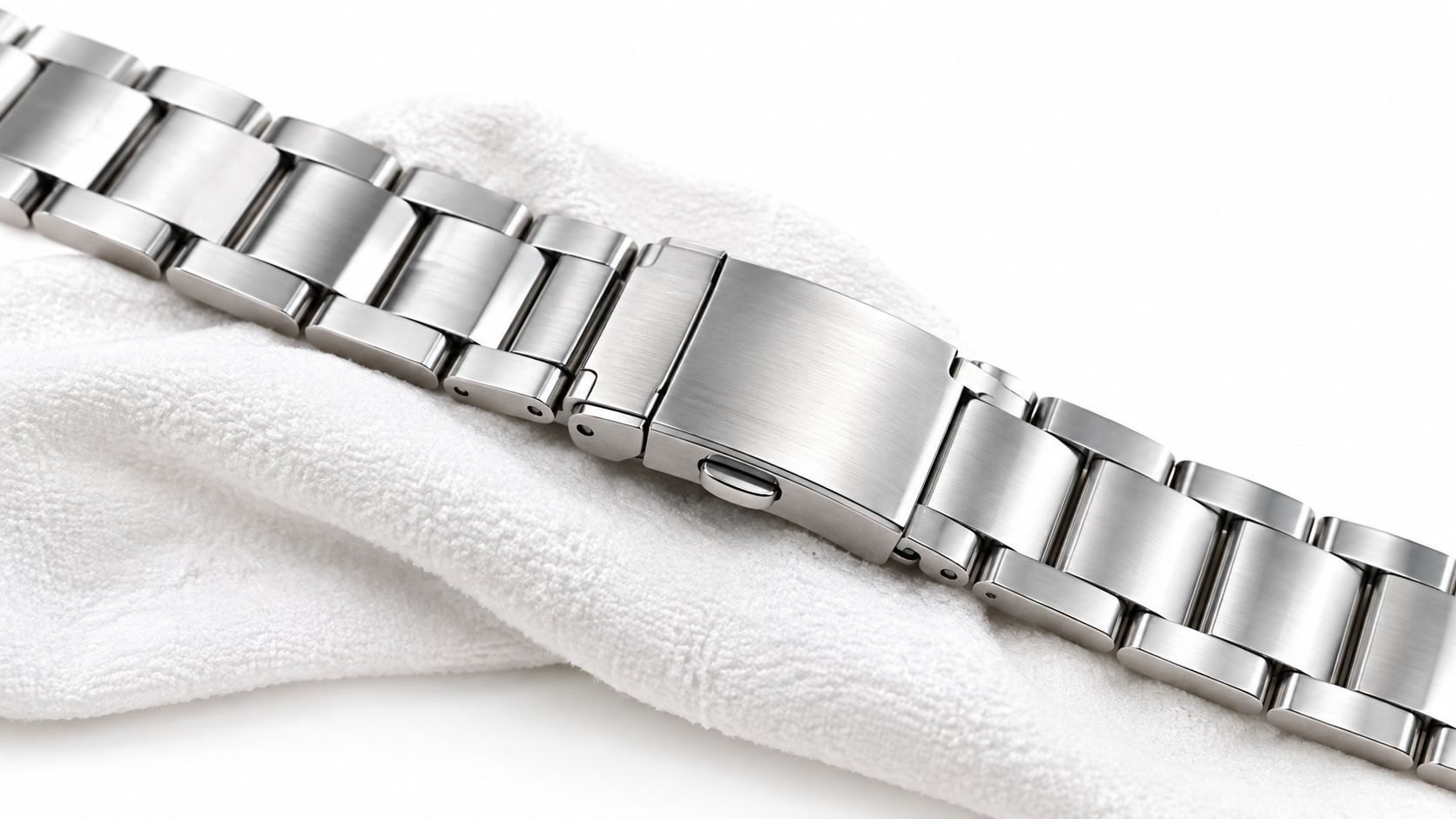
The cleanest solution is sometimes a different construction
A link-style strap is not always a steel bracelet. The Lyra — Resin Composite Link (made for Apple Watch and for Fitbit Luxe) is resin composite with a magnetic clasp, so there are no links or pins to remove at all.
For people whose wrists change through the day, the key question is whether you are fixing a bracelet or just postponing the same problem. If you keep resizing because of swelling, a mesh or elastic construction ends that cycle; stretch and expansion bracelets have their own method, covered in how to remove links from a stretch watch strap. If the bracelet has already lost its clean shape, a replacement strap is usually the better use of time.
If you want a stainless link strap built for your watch's fitting, start with the connector. Samsung owners with a Galaxy Watch8 or Watch8 Classic can look at the Kryos — Stainless Link — Galaxy Watch 8 & 9: solid 316L stainless steel, brushed with polished edges, with a deployment clasp and a Samsung Dynamic Lug fitting. It does not fit the Galaxy Watch4, 5, 6 or 7, which take a 20 mm quick-release strap; the full range sits in our Samsung Galaxy Watch straps. Garmin owners will find the Rovik and Orven stainless links for QuickFit 22 among our Garmin watch straps.
And if you never want to do this again, choose a strap that is never resized. Milanese mesh straps close anywhere along their length, and a hook-and-loop nylon loop has no holes at all, so neither ever needs a link taken out. If the bracelet keeps fighting you, choose a strap that fits the way you wear the watch.
Related posts

- October 21, 2026
Discover truly nickel free watch straps that won't irritate skin. Compare materials, avoid common myths, and find comfortable hypoallergenic options.

- October 20, 2026
Learn what a watch strap adapter is, how it converts proprietary fittings, and whether your smartwatch actually needs one. Honest...

