


Nylon is yes-and-no breathable. Nylon fiber itself absorbs far less moisture than cotton, so it isn't breathable the way cotton is, but a nylon watch strap can still feel airy because air moves through the weave and sweat evaporates off it instead of staying trapped on your wrist.
3 Key Takeaways: Is Nylon Breathable?
The weave breathes: Nylon fibre isn't breathable like cotton, but an open weave lets air and sweat escape.
Not all nylon feels the same: Weave openness, thickness and coatings decide how airy a strap feels.
Best for breathability: Nylon wins on airflow, silicone on easy cleaning, and leather handles sweat worst.
That's the part shoppers usually miss. A watch strap doesn't breathe because the word “nylon” is on the label. A nylon watch strap breathes because of how the strap is built. An open weave, a single fabric layer, and a fit that isn't cinched too tight can feel comfortable for long wear. A dense weave, padding, rubber backing, or a damp strap put back on too soon can make the same material feel sticky.
If you're deciding between nylon, silicone, and leather because your current strap gets sweaty, the short version is simple. Breathability usually favors nylon, easy wipe-clean care favors silicone, and leather is the least forgiving when sweat is part of daily wear.
Table of Contents
- Is Nylon Breathable
- Is Nylon Itself Breathable or Is It the Weave That Breathes
- What Makes a Nylon Watch Strap More or Less Breathable
- How Does Nylon Compare to Silicone and Leather for Breathability
- Does Fit and Weave Change How Breathable a Nylon Strap Feels
- Can You Wash a Nylon Strap in the Machine and How Should You Dry It
- Which Strap Should You Choose If Breathability Matters Most
Is Nylon Breathable
Yes, nylon watch straps can be breathable, but nylon fiber itself is not naturally breathable in the same way as cotton or linen. The key difference is that the fiber and the finished strap are not the same thing.
Nylon became popular because it was strong, light, elastic, and durable. Its commercial rise started after DuPont's early polyamide work in the 1930s: Wallace Carothers produced the first wholly synthetic fiber later known as nylon on 28 February 1935 (Science Museum), and nylon went into production in 1939, the year the new stockings caused a sensation at the New York World's Fair (Science History Institute). That history matters because nylon earned its place in clothing and gear for toughness first. Breathability had to be designed in later.
For a watch strap, what you feel on the wrist is less about the chemistry of nylon and more about whether the strap lets air and moisture move. Nylon fiber takes up only a small share of its weight in moisture, far less than cotton, so it does not carry sweat away by absorbing it. What changes the wrist feel is the fabric built around the fiber: an open structure lets air through, while a dense or coated one does not.
Practical rule: If a nylon watch strap feels breathable, you're usually feeling the effect of the weave, not the fiber alone.
That's why two nylon straps can feel completely different. One can feel light and easy during a walk or gym session. Another can feel close, warm, and damp if it's dense, backed, or worn too tight.
A soaked nylon strap also needs time off the wrist. Nylon fiber itself doesn't soak through the way leather does, but water can sit in the spaces of the fabric. If the strap goes straight back on while damp, the wrist experience changes fast.
Is Nylon Itself Breathable or Is It the Weave That Breathes
It's the weave that breathes, not the nylon fiber by itself. Nylon can feel ventilated or stuffy depending on yarn structure, weave openness, thickness, coatings, and layers.
Why the fiber answer is incomplete
When people ask, “Is nylon breathable?” they usually want one simple answer. Textiles don't work that way. Nylon as a polymer has very low moisture absorption, which is why it isn't naturally breathable like cotton. But fabric comfort depends on the spaces created when yarns are spun, woven, knitted, finished, and layered.
A good mental picture is window screen versus plastic sheet. Both can cover the same opening. One lets air pass through because it has gaps. The other blocks movement because it forms a continuous barrier. Nylon behaves the same way in real products. Open nylon constructions can feel breathable. Coated or dense nylon can feel much less so.
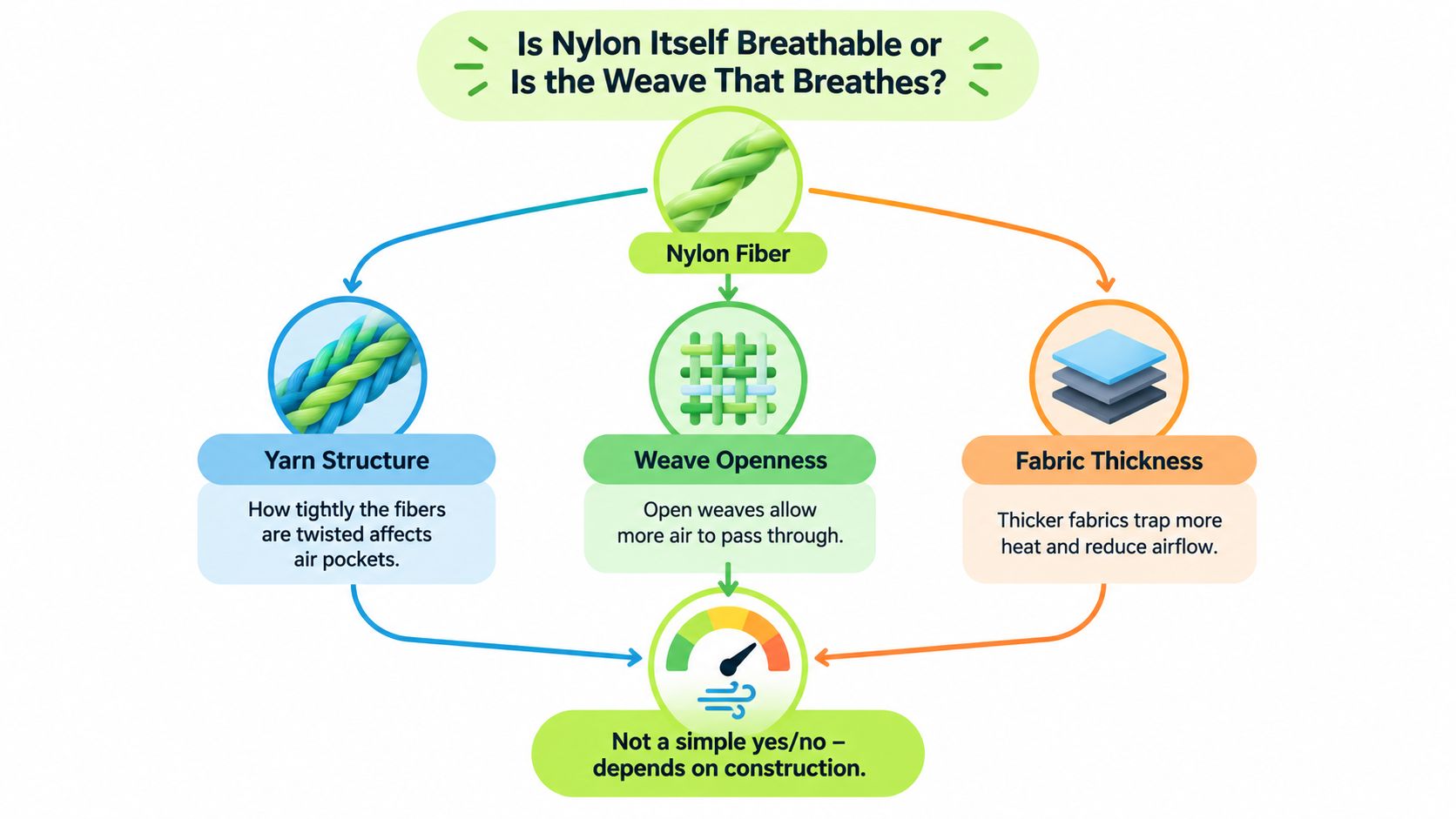
If you want a plain-language refresher on how woven structures create more or less openness, More Sewing's weave guide is a useful visual reference.
Why coated nylon feels different
Test methods reflect this difference too. Breathability in nylon isn't a simple yes-or-no property, so a coated or laminated nylon and a plain woven one are not judged the same way: the construction, not the fiber name, decides how moisture moves through the material.
That's a technical way of saying something very simple: a nylon layer with coating or laminate doesn't behave like open woven nylon.
You can see how this matters in watch straps. A single-layer fabric strap gives air somewhere to go. Add backing, padding, or sealing materials and you reduce that pathway.
What that means on the wrist
A product like Arden, Nylon Loop, Apple Watch is relevant here because the comfort claim makes sense at the construction level. The catalog describes a soft, breathable nylon weave, stretch fit, and quick-release design for Apple Watch. That doesn't mean “all nylon breathes.” It means a woven nylon Apple Watch strap can feel comfortable when the fabric structure allows airflow and doesn't seal the wrist.
Breathability in nylon is a construction choice. Change the weave, coating, or thickness, and the wrist feel changes with it.
What Makes a Nylon Watch Strap More or Less Breathable
A nylon watch strap can feel airy or annoyingly sticky. The difference usually comes from how the strap is built, not from the word nylon alone.
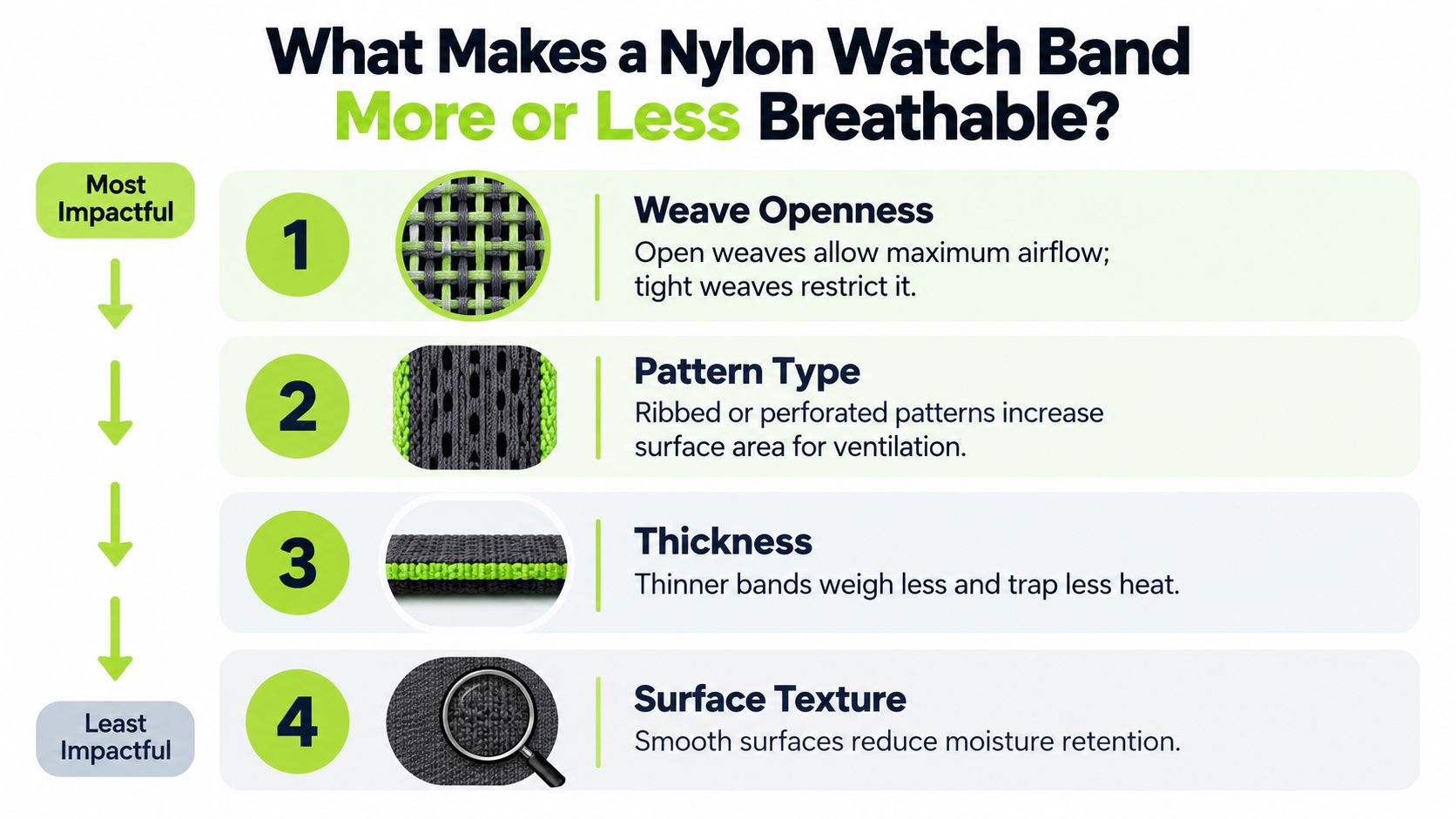
If you want the short version, check four things first: weave openness, underside backing, strap thickness, and how tightly it sits on your wrist. Those are the features that change whether a nylon strap feels breezy during a walk or damp after an hour at a desk.
Which part matters most
Start with the surface. An open weave works like a screen door. Air can pass through, and sweat has more room to dry out. A tight, dense weave works more like a windbreaker. It may still be fabric, but it lets much less air move.
The next difference is texture and pattern. Braided nylon, ribbed nylon, flat woven nylon, and dense tactical-style nylon do not feel the same on skin. They change two things at once: how much air can move through the strap, and how much of the strap stays in contact with your wrist.
Thickness matters too. A thin single-layer strap usually feels lighter and cooler. Add bulk, padding, or extra density, and the strap tends to feel warmer because more material sits between your skin and the air.
Fit changes everything.
A breathable strap worn too tight can still feel clammy. If the strap is cinched down hard, the small gap that helps heat and moisture escape gets squeezed out. A snug fit is usually better than a tight one.
Why backing and layers matter so much
The underside often decides whether nylon feels like fabric or like a cover. A single-layer strap leaves more pathways for airflow. A strap with lining, padding, or a rubbery backing puts a more closed surface against the wrist, which traps warmth and sweat more easily.
That is why two nylon straps can behave so differently in normal wear. One feels dry enough to forget about. The other starts to feel warm and slightly slick, even if both look similar in product photos.
A video view helps make that easier to spot when you're comparing strap styles:
Why wet nylon still needs airing
Nylon itself does not soak up much water, but a woven strap can still stay damp because moisture sits between the fibers. That trips people up. The fiber is not acting like a sponge. The weave is acting more like a mesh that holds tiny pockets of moisture until air and time dry them out.
On the wrist, that means a nylon strap can feel breathable and still need airing after sweat, rain, or hand-washing. If the weave is open and the strap is thin, it usually dries faster. If it is dense, doubled-up, or backed, the damp feeling can hang around longer.
We wear samples ourselves, and nylon is excellent for daily wear because it breathes — though it takes hours to dry properly after a swim or heavy sweat, while silicone dries in minutes. Putting a nylon strap straight back on while it is still damp traps moisture against the skin and creates odor or irritation.
A nylon strap usually feels most breathable when the weave is open, the build is simple, and the fit stays snug without pressing flat against the skin.
If you're browsing nylon watch straps, use that as your checklist. Look past the material label and ask better shopper questions: Does the weave look open or packed tight? Is there a backing layer underneath? Does the strap look thin and flexible, or thick and padded? How tight will you wear it?
How Does Nylon Compare to Silicone and Leather for Breathability
For breathability, strap construction matters more than the material name. In plain wrist feel, an open woven nylon strap usually feels airier than silicone and easier to live with in sweat than leather. Silicone feels the most closed against the skin. Leather can feel comfortable at first, but it is usually the least forgiving once sweat builds up.
That difference helps explain why shoppers sometimes expect nylon to feel plastic-like and then end up surprised by it. A nylon strap is still made from a synthetic fiber, but if it is woven in a way that leaves room for air and flex, it can feel much less stuffy on the wrist than a solid strap.
What each material feels like
Nylon usually wins on day-to-day comfort if you dislike that sealed, slightly sticky feeling. The reason is simple. A woven nylon strap has small gaps and texture, so the strap does not sit against the skin like one continuous sheet. On the wrist, that often feels closer to a fabric sleeve than a rubber strip.
Silicone behaves more like a lid. It is smooth, practical, and easy to rinse, but it tends to hold heat and sweat underneath because the underside sits flush on the skin. Some people do not mind that. Others notice it within an hour, especially in warm weather.
Silicone is what we reach for in the gym, for swimming and in hot weather, though it can feel slightly sticky when the weather is very hot.
Leather sits between them for airflow, but it has a different trade-off. It can feel softer and less sealed than silicone, yet sweat tends to sink into the material instead of drying away quickly. That can leave the strap feeling damp, then stiff or tired-looking over time.
Breathability and sweat handling by strap material
| Material | Wrist feel | Sweat and moisture | Best For |
|---|---|---|---|
| Nylon | Usually the airiest if the weave is open | Sweat can escape better, though the weave can stay damp until it airs out | Long wear, warm days, people who want less wrist stickiness |
| Silicone | Usually the most closed | Sweat stays trapped more easily, but the strap wipes clean fast | Water use, gym wear, low-maintenance cleanup |
| Leather | Often comfortable at first, but warmer over time | Absorbs sweat, dries more slowly, can show wear faster | Dressy use, lighter-sweat days |
A good shorthand is this: nylon usually feels breezier, silicone feels simpler to clean, and leather feels better suited to looks than sweat.
For a closer material-by-material comparison, the store's guide to silicone vs nylon watch straps gives a useful side-by-side view.
Which type makes sense for your priority
If breathability is your top concern, nylon is usually the safer pick. If you want the fastest cleanup after sweat, sunscreen, or water, silicone sport straps are hard to beat. If your watch strap is mainly for office wear, dinners, or lower-heat use, leather straps can still make sense. You just want clear expectations about how it behaves once the wrist gets hot.
Does Fit and Weave Change How Breathable a Nylon Strap Feels
Very often, yes. Fit and weave can change the feel of a nylon strap more than the word "nylon" itself. Two straps can both be nylon and still wear very differently on the wrist.
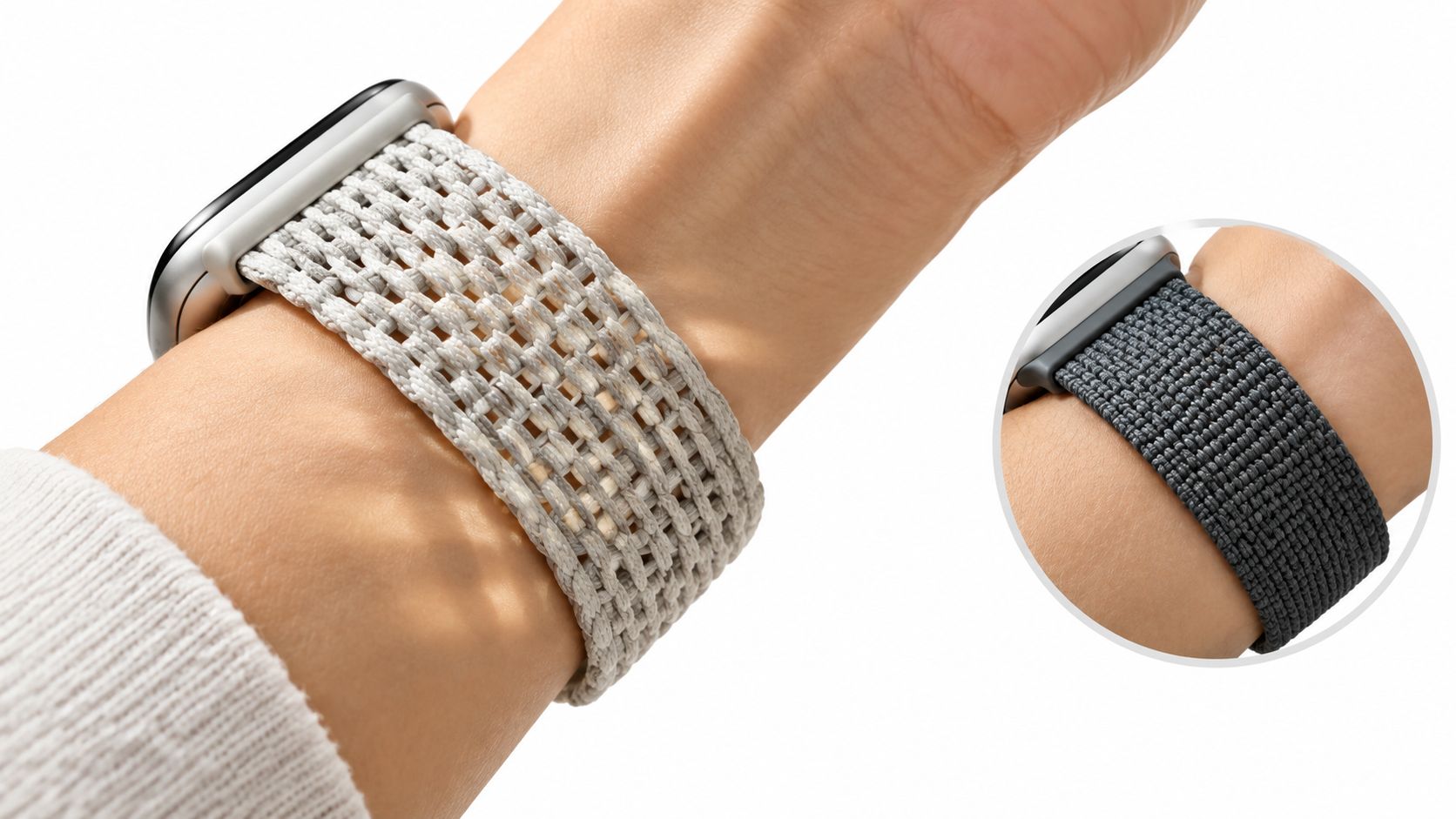
A simple way to judge it is to look at how much of the strap is acting like fabric and how much is acting like a cover pressed against your skin. An open weave leaves tiny paths for air and moisture to escape. A tight weave closes those paths down. Add padding, lining, or a thick underside, and the strap can start to feel warmer even though the top layer is still nylon.
Fit changes the result again. If the strap is pulled very tight, the strap sits flatter against the wrist and gives sweat fewer places to go. If it is adjusted snug but not squeezed, you usually get a drier, less sticky feel.
That is why two nylon straps can give opposite first impressions.
What usually feels airier on the wrist
An open flat weave often feels the breeziest. A dense weave feels more closed and uniform. A padded or backed strap usually feels warmer because there is more material sitting between your skin and the air.
The closure matters too. Hook-and-loop styles often let you fine-tune the fit in small steps, which helps because comfort usually comes from avoiding pressure points, not from wearing the strap loose enough to slide around.
How that applies to real nylon strap styles
Across nylon watch straps, the construction changes a lot by model. The Véllo Nylon Loop 22mm, for example, is a single woven loop on standard quick-release spring bars, while other models are ribbed or braided. Some are soft loops with visible gaps in the weave. Some use tighter, flatter fabric. Others add ribbing, braiding, or a thicker structure that feels more substantial on the wrist.
In our own range, Arden and Ridge are stretch-weave nylon loops: soft, flexible, and able to give slightly as the wrist moves. Muse is a softer woven Sport Loop with hook-and-loop adjustment, so you can retension it during the day or during a workout. We don't hold a reliable thread-count or thickness specification, so the meaningful difference is the construction: stretch weave feels more continuous and hardware-free, while Muse gives you more deliberate adjustment.
Those are not just style differences. They change how the strap handles heat, sweat, and pressure during a normal day of wear. A single-layer woven strap with no sealed backing usually feels airier than a nylon strap with more bulk underneath, even if both are made from similar fibers.
What to adjust first: If a nylon strap feels clammy, try loosening it one notch or a small amount before giving up on the material.
What customers actually notice
Shoppers usually describe breathability in plain comfort terms. They say a strap feels less sticky, less sweaty, or less constricting. That is useful, because those are the sensations you notice during a workout, a walk, or a warm afternoon at your desk.
Lisa Thomas on the Arden — Nylon Loop — Fitbit Charge 5/6: "This Arden nylon loop is seriously just what I needed for my Fitbit Charge. It's comfy and breathable, perfect for workouts or just hanging out at home."
Anthony Miller on the Ridge — Nylon Loop — Apple Watch: "Totally loving this Nylon Loop! The navy color is perfect and goes with pretty much everything. Super soft and breathable, so it’s been great for workouts without feeling constricting. Would definitely buy again and tell my friends to check it out too!"
Nylon loops consistently outperform what people expect: they are comfortable, easy to adjust, and inexpensive enough to buy in more than one color. That is part of why we stock nylon — it is breathable, adjustable, and forgiving when someone is between sizes.
Runners and hikers often like nylon's breathability. When customers come back, the pattern is usually the same fitting in another color, then a different material: nylon for daily wear, silicone for gym or water.
The useful takeaway is simple. If breathability matters, do not stop at the material label. Check the openness of the weave, whether there is backing underneath, and how precisely you can set the fit. Those details often decide whether nylon feels airy or clammy on your wrist.
Can You Wash a Nylon Strap in the Machine and How Should You Dry It
Yes, a nylon strap can be cleaned, but a nylon watch strap is better rinsed and air-dried carefully than thrown into hot machine drying. The important part isn't speed. It's getting sweat and chlorine out, then letting the strap dry fully before it goes back on your wrist.
A simple care routine
Use a plain routine that protects the weave:
- Rinse after sweaty wear: Wash out sweat, salt, or chlorine with water.
- Press with a towel: Don't wring the strap harshly. Press it to remove excess moisture.
- Air-dry fully: Leave the nylon strap to dry completely before reattaching or wearing it again.
- Keep it away from heat: Don't put the nylon strap on a radiator and never use a tumble dryer, because heat can distort the weave.
That is what we do with our own nylon straps: rinse, gently squeeze — never wring — and dry flat.
If you want model-specific cleaning steps, the guide on how to clean an Apple Watch strap is a helpful companion.
Why nylon dries differently from leather
Nylon doesn't behave like leather when wet. Uncoated filament nylon can transmit about 1,800 to 2,400 g/m²/24h of moisture vapor, while coated or laminated nylon can drop to about 400 to 900 g/m²/24h, which shows how much finish changes moisture movement (nylon fabric properties). On a watch strap, the practical meaning is simpler. Nylon fiber itself doesn't soak through the way leather does, so the moisture mostly sits in the weave and leaves as the strap airs.
A damp strap put back on too early is often what creates the stale smell people blame on nylon. Clean it, press it, and let it finish drying off the wrist.
Which Strap Should You Choose If Breathability Matters Most
If your top priority is keeping your wrist cooler, start by looking at strap construction before you look at the material name. A nylon strap can feel light and airy, or warm and sticky. The difference usually comes from how open the weave is, whether there is extra backing underneath, and how close the strap sits against your skin.
For most sweaty, all-day wear, an open-weave nylon strap is the safest first pick. It usually lets more air move around the wrist than silicone, which tends to sit like a soft seal. Leather can feel comfortable in dry, dressier use, but it is less forgiving once sweat becomes part of your routine.
A simple way to choose is to match the strap to the job. If you exercise often, walk in warm weather, or dislike that trapped feeling under the watch, pick nylon with visible gaps in the weave and as little extra bulk as possible. If you want the quickest wipe-clean option after a workout, silicone is still easier to rinse and put back on. If appearance matters more than cooling, leather may still be the better fit, as long as you accept the warmer feel.
Use these buying rules:
- Pick open, braided, or loop-style nylon: More space in the structure usually means better airflow on the wrist.
- Avoid thick padding or full backing layers: Extra material underneath blocks air, even if the outer surface is nylon.
- Wear it secure, with a little give: A strap pressed flat against the skin has less room to vent moisture.
- Choose based on your daily use: Gym wear, office wear, and dress wear do not all need the same strap.
If you are still comparing materials, this guide to choosing a breathable watch strap can help sort the trade-offs. Nothing but Bands offers woven, ribbed, braided, silicone, and leather options across major smartwatch fittings, and nylon is the material our own customers reach for most: 107 of the 222 straps ordered between 4 December 2025 and 20 September 2026. So the useful comparison is not just nylon versus silicone versus leather. It is open versus closed construction, thin versus padded build, and loose comfort versus a tight seal.
If breathability matters most, start with nylon. Then inspect the weave like you would inspect a screen door. More openings usually mean more air.
Related posts

- October 07, 2026
Discover why comfortable watch straps feel different. Learn the materials, closures, and fit rules that actually matter for Samsung Galaxy...

- October 06, 2026
Clear installation instructions for smartwatch straps. Learn how to attach, verify, and troubleshoot Apple, Samsung, Garmin, and Fitbit straps safely.

- October 05, 2026
A practical guide to changing watch straps across Apple, Garmin, Samsung, and Fitbit, covering tools, fitment, daily rotation, and common...
