


Pick Amazfit for budget-friendly road running and daily wear, and pick Garmin for navigation and deeper training records. Paying more for a Garmin only makes sense if you will use the extra sports tools, because Amazfit already covers everyday tracking at a far lower price.
Choose the watch around your sessions first. Then choose the strap around the connector and width, because two straps with the same millimetre measurement aren't necessarily interchangeable: Amazfit uses standard quick-release pins while Garmin's QuickFit is its own fitting.
Table of Contents
- Should You Buy Amazfit or Garmin?
- What Battery, Water and Strap Specs Does Each Maker List?
- Which Watch Tracks a Run or Ride More Accurately?
- How Long Does Each Watch Last Between Charges
- Will an Amazfit Strap Fit a Garmin Watch?
- Which Strap Material Suits Running and Cycling?
- Frequently Asked Questions
Should You Buy Amazfit or Garmin?
The gap between Amazfit and Garmin is real, but narrower than the price tags suggest. Buy Amazfit when price and everyday usefulness come first; buy Garmin when navigation and training analysis will shape your workouts. Amazfit suits runners who value cost and familiar routes. Garmin suits runners who study their training data and head into unfamiliar terrain.
BGR's Amazfit-versus-Garmin comparison rounds up reviews that pair the Amazfit Active 2 with the Garmin Fenix 8 and the Amazfit Cheetah 2 Pro with the Garmin Forerunner 970, and in both pairings the Garmin costs considerably more. The reviews it cites also describe broadly comparable core distance and heart-rate tracking, and praise the battery life of both the Active 2 and the Fenix 8. Check current prices on each maker's own page.
Which brand fits the session and the budget
| Situation | Lean toward | Why, from BGR's comparison |
|---|---|---|
| Road running and daily steps on a budget | Amazfit rather than Garmin | BGR's pairings put the Amazfit well below the Garmin on price |
| Trails, hills and navigation | Garmin rather than Amazfit | BGR favours Garmin's mapping and route tools over Amazfit's |
| Fewer charges and travel wear | Compare Amazfit and Garmin model by model | BGR's sources praise the battery life of both the Active 2 and the Fenix 8, so charging habits come down to the exact watch |
| Maps and more training measurements | Garmin rather than Amazfit | BGR favours Garmin's app performance and training detail |
| Mid-price endurance watch | Compare Amazfit and Garmin model by model | BGR's pairing of the Cheetah 2 Pro with the pricier Forerunner 970 involves different prices and feature priorities, not equivalent products |
BGR's distinction is more useful than a blanket winner: Amazfit offers lower prices, lighter designs and bright displays, while Garmin offers more extensive navigation and performance tools. Read the price gap as a features question, not a quality verdict.
Pick Amazfit if you want useful tracking without paying for unused analysis
Choose Amazfit over Garmin if your typical week means familiar road runs, walking, gym sessions and checking your daily activity. Start with the information you will review after exercising, not the longest feature list you can afford.
Say you finish a familiar run and want your route, elapsed time and a sense of how hard the effort felt. If you rarely open detailed training reports, paying extra for more reports will not improve your routine.
No single Amazfit suits every runner. Read the exact model's feature list and check how you start an activity, review a route and use the controls during exercise. A watch that feels straightforward on an ordinary weekday is often a better purchase than one whose main appeal is an impressive specification sheet.
- Buy for your routine. Prioritise the activities you repeat, rather than an expedition you might attempt.
- Keep the comparison fair. Compare similarly positioned models before treating a flagship price gap as the entire brand story.
- Separate value from reputation. Our guide to whether Amazfit is a good brand addresses the broader brand question; this decision should centre on your use.
Pick Garmin if you use training records to make decisions
Choose Garmin over Amazfit if you regularly examine workouts, explore unfamiliar routes, or want more information to guide your next session. Garmin's extra depth pays off when you have a practical use for it.
A runner preparing for a demanding event may want to review sessions together rather than treat each outing as an isolated activity. A cyclist exploring unfamiliar terrain may care more about readable mapping and route guidance than the lowest purchase price.
Garmin's training focus shows in its line-up, from Forerunner running watches to its cycling computers. That supports the distinction between the brands' priorities, but a brand's focus alone is not proof that a particular Garmin is right for your wrist.
Buying rule: Choose Amazfit for the features you will use at a lower cost. Choose Garmin when you can name the navigation or training tools that justify spending more.
A committed runner on familiar roads can reasonably choose Amazfit, while a newcomer who needs dependable navigation has good reason to choose Garmin. Experience level alone is a weak predictor of the right watch.
Before committing, write down the activity you repeat most, your navigation requirement and your charging preference. Compare the actual Amazfit and Garmin models against those needs, then treat the strap as a separate decision. The two brands use different fittings, so strap compatibility is its own check, and Nothing but Bands sells replacement straps that fit both by connector and width.
What Battery, Water and Strap Specs Does Each Maker List?
Amazfit and Garmin both publish specifications per model, so there is no single Amazfit battery figure or Garmin water rating to compare. Battery life, water resistance and strap fitting each live on the individual product page, in the mode table and in the manual for the exact watch. Confirm the full model name first, then read that model's own numbers.
| Point | Amazfit | Garmin | Where to confirm |
|---|---|---|---|
| Strap connector | Amazfit's strap-size guidance uses standard quick-release spring bars for the models it covers | Garmin models use either standard quick release or the QuickFit fitting, so identify which system your model has | Amazfit's strap-size guidance and the exact Garmin manual |
| Width | Amazfit's chart assigns a width to each model, and similarly named watches can differ | Garmin's chart assigns a width to each model, plus a QuickFit size where that system is used | The maker's chart entry for the full model name |
| Shared names | GTR and GTR Mini labels do not guarantee the same strap | A Venu or Fēnix family label does not guarantee one fitting across the range | Model name, fitting and width together |
| Battery | Mode-specific figures on the selected model's product page | Mode-specific figures on the selected model's product page | Product page and battery notes |
| Water rating | The stated rating plus permitted-activity guidance for that model | The stated rating plus permitted-activity guidance for that model | Product page and care instructions |
Read each battery claim with its mode attached. A smartwatch-mode figure and a GPS-activity figure answer different questions, and both Amazfit and Garmin publish several numbers per model. Compare the mode that matches your training. The largest number on the page is marketing's favorite, and it is rarely yours.
The naming trap catches buyers on both sides. Amazfit's strap-size chart separates similarly named watches, so never shorten a model name when ordering. On the Garmin side, Garmin's manual gives the Venu 3 a 22 mm and the Venu 3S an 18 mm standard quick-release strap, while QuickFit models come in 20 mm, 22 mm and 26 mm. The family label tells you nothing about which of those your watch takes, and neither does the case measurement.
Water resistance follows the same rule as battery life: it is a per-model spec. Each maker pairs a rating with permitted activities, care guidance and restrictions, so read all three before swimming with either an Amazfit or a Garmin. Do not infer suitability for a water sport from the watch's appearance or from a sibling model in the same family.
A replacement strap's material does not change an Amazfit or Garmin watch's water rating.
Which Watch Tracks a Run or Ride More Accurately?
Garmin is the safer choice for technical trails, hills and navigation in published comparisons; Amazfit can still suit ordinary road running when you check its recorded track against a familiar course. That's a use-based recommendation, not a claim that every Garmin outperforms every Amazfit on every outing.
The visual comparison separates the navigation-focused buyer from the familiar-road runner.
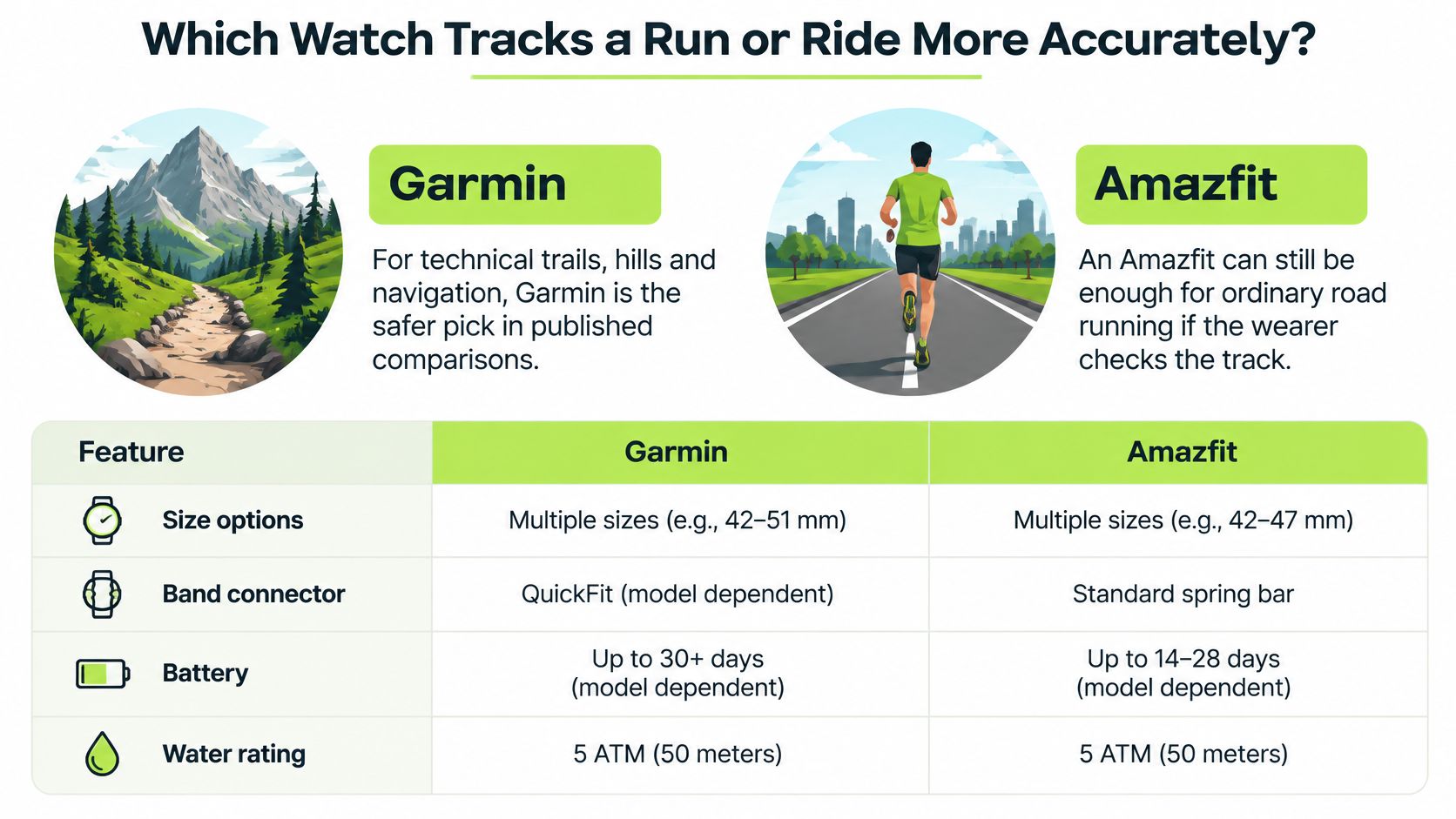
In NBC Select's Amazfit-versus-Garmin review, the Amazfit Active 2 frequently placed runs near roads rather than directly on them, while the Garmin followed the actual hill path more closely during repeated hill-training sections. That finding matters most when the shape and location of your route are important, not merely whether an activity appears in your history.
For a runner, a misplaced track can make a hill session harder to interpret. For a cyclist, the equivalent concern is whether the saved route accurately follows the road or trail you rode. Neither scenario justifies turning a particular comparison into a universal accuracy ranking.
Check the route, not just the final distance
Before relying on an Amazfit or Garmin for pacing on technical terrain, record an outing on a course you already know. Review the whole track rather than stopping at the distance total.
- Inspect junctions. Look for lines that cut corners or follow the wrong branch.
- Review repeated sections. Check whether repeated climbs follow a consistent path.
- Check difficult surroundings. Examine wooded stretches, closely spaced roads and steep terrain.
- Compare like with like. Keep the route and recording settings consistent before drawing conclusions.
A plausible distance total doesn't establish precise route placement. Conversely, an untidy section of track doesn't mean every measurement from the session is unusable.
The following video provides another way to approach the watch comparison.
Match the records to the training question
Amazfit and Garmin buyers should distinguish collecting information from using it. If you want to review where you went, inspect route handling; if you want to plan training, examine the exact model's available measurements and how you interpret them.
Don't assume that a sensor, navigation feature or training tool appears throughout either brand. Read the maker's model-specific feature list before buying accessories or building a training routine around it.
For athletes seeking an assessment separate from a wristwatch estimate, Telomyx's VO2 max fitness testing in Chester is a relevant service to investigate. Treat that as a separate training decision, not evidence that either watch brand produces laboratory-equivalent results.
How Long Does Each Watch Last Between Charges
A three-day walking trip with one long recorded route on day two is the test battery specs are built for. Pick the wrong watch and the activity dies mid-route; pick the right one and you charge when you get home. Independent comparisons generally give Amazfit longer everyday smartwatch endurance, while Garmin stays competitive or stronger during GPS use once you account for the exact model and mode. Judge each brand on the mode you will record in.
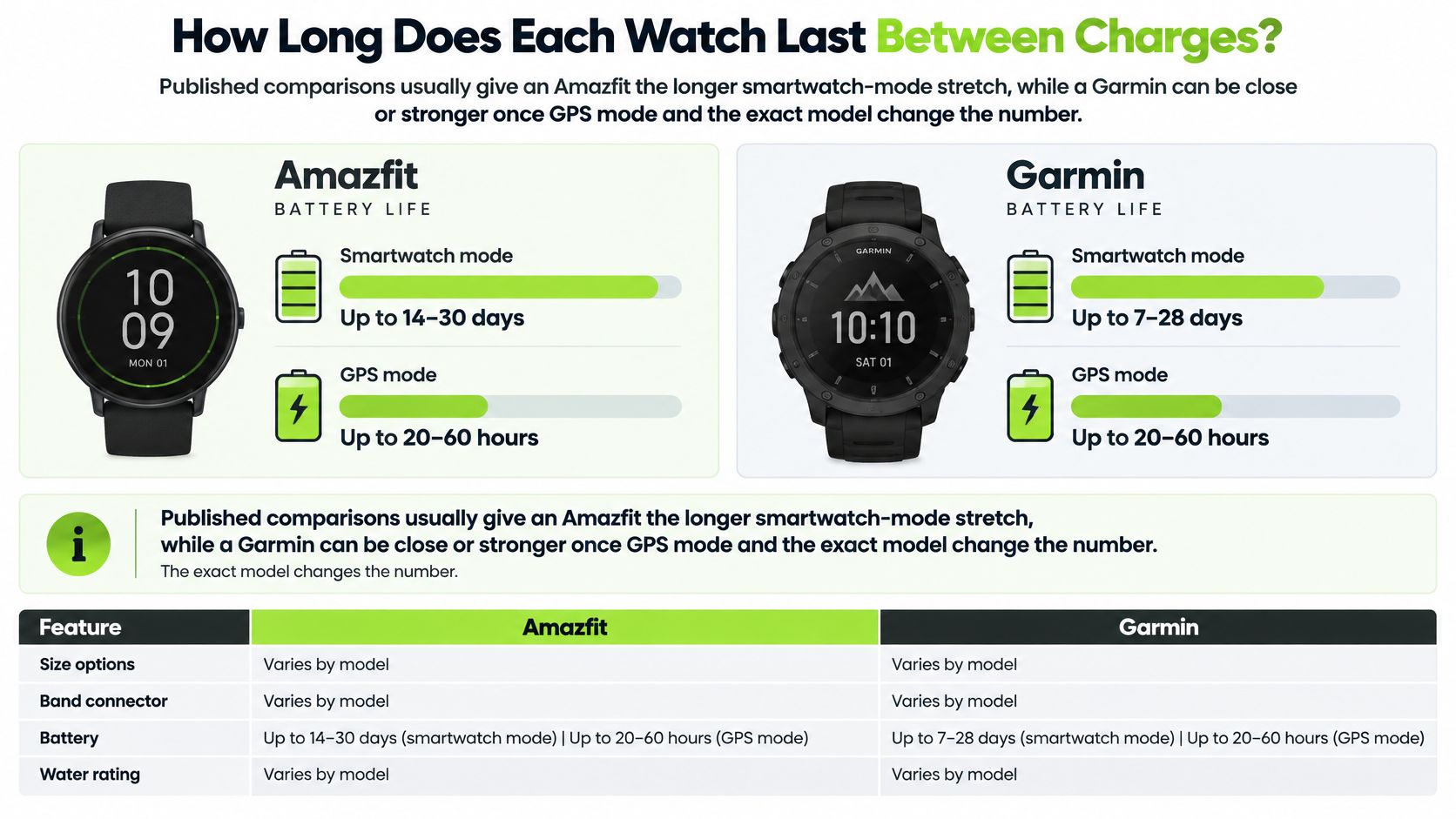
Run to the Finish's Amazfit-versus-Garmin comparison reports the smartwatch and GPS ranges in this table; treat each figure as that outlet's reported average, not a figure for any single model.
Battery figures reported by Run to the Finish
| Comparison | Amazfit figure reported | Garmin figure reported |
|---|---|---|
| Smartwatch mode, comparative summary | About 15–25 days | About 10–15 days |
| GPS runtime, same summary | About 30–40 hours | About 20–40 hours, higher on Fenix, Enduro and higher-priced models |
Choose around your charging opportunities
Amazfit's reported everyday pattern suits travellers and anyone who dislikes interrupting continuous wear to charge. If you mainly log ordinary sessions and want fewer charging decisions, give that convenience real weight in your pick.
Garmin earns the extra charge cycles when navigation and training tools matter more than stretching the interval between charges. Paying in plug time for a feature you use every week is a fair trade.
The table's rows answer different questions. Comparing Amazfit's low-power daily claim against a Garmin GPS figure produces a misleading verdict. Compare the mode you will use, with the features you intend to leave enabled.
Before a long outing: Check remaining battery in the intended activity mode, rather than assuming the daily-wear estimate covers the session.
Verify the purchase claim on the maker's page
Use the reported ranges to shortlist Amazfit and Garmin candidates, then confirm the final claim on the exact product page. Read the battery notes, not just the largest number in the headline.
Check which positioning mode the claim describes and whether your intended settings match it. Leave a reserve for delays, route changes and time spent navigating instead of planning to finish on an empty battery.
For daily wear, ask whether the charging routine fits your habits. For endurance activity, ask whether the selected mode covers the planned outing with room to spare. Those are separate buying questions, and one brand-wide battery verdict can't answer both. Settle the watch first, then treat strap fitting as its own check, since Amazfit and Garmin use different connector systems.
Will an Amazfit Strap Fit a Garmin Watch?
Swapping a strap between an Amazfit and a Garmin is a connector question first and a millimetre question second. Amazfit models such as the GTR, GTS, T-Rex 3, Balance, Bip, Cheetah and Active attach straps with standard quick-release spring bars, while much of the Garmin range, including Fenix, Epix and Enduro lines, uses Garmin's proprietary QuickFit fitting. A 22 mm quick-release strap and a 22 mm QuickFit strap share a width figure, and nothing else: QuickFit locks into Garmin's own latch. So a 22 mm Amazfit strap can move to a Garmin that uses standard quick release at that width, such as the Venu 3, but not to a QuickFit 22 watch such as a Fenix 7.
Check the fit in this order
- Identify the complete model. Include suffixes and size variants rather than relying on the family name.
- Confirm the connector. Read the maker's manual and inspect the existing attachment.
- Match the width. Measure the attachment width, not the outside of the watch case.
- Confirm the replacement listing. Check the model in the Nothing but Bands Watch Strap Finder before ordering.
- Check secure engagement. Follow the fitting instructions and gently check both ends before wearing.
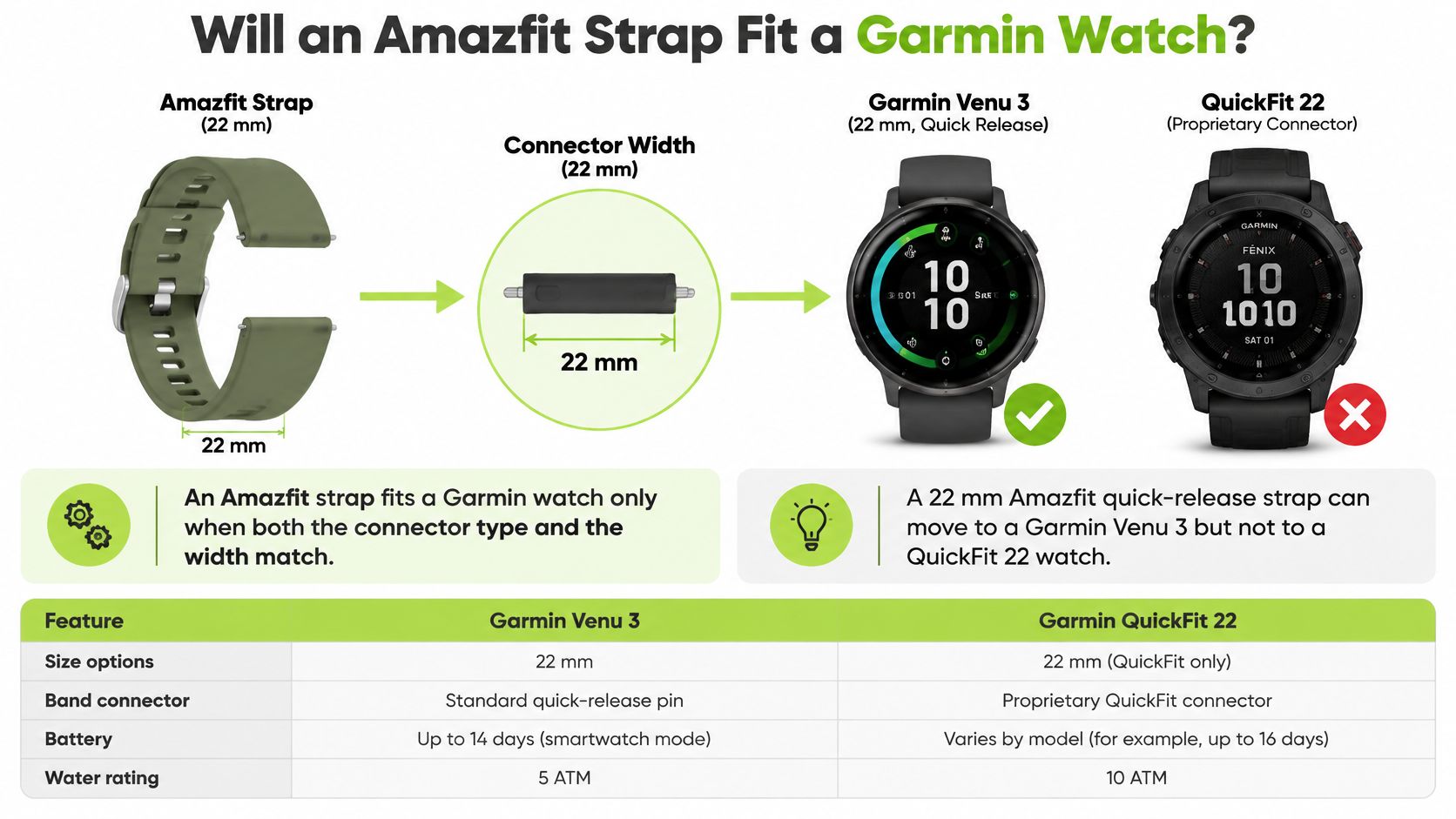
If a model isn't explicitly supported, check rather than guessing. An adapter can sometimes bridge two fittings, but it should never be assumed to rescue an otherwise incompatible attachment.
What our replacement range covers
Amazfit models such as the GTR, GTS, T-Rex 3, Balance, Bip, Cheetah and Active take our standard 20 mm or 22 mm quick-release straps by width. Our Garmin selection covers QuickFit 20, QuickFit 22 and QuickFit 26.
A family name doesn't establish universal fit within that family. Confirm the exact model and attachment before choosing silicone, nylon, stainless steel, leather or Milanese.
Nothing but Bands sells replacement straps only, not watches or trackers.
Which Strap Material Suits Running and Cycling?
Choose silicone for sweaty runs and rainy rides on Amazfit or Garmin, and choose nylon when breathable comfort matters more than quick drying. The material decision is the same for both brands. The attachment is what changes.
Silicone doesn't absorb water and rinses clean after exercise. Nylon feels lighter and breathes better during a long session, but a soaked nylon strap needs time to dry before comfortable all-day wear.
Choose the material around the session
- Sweaty training and wet rides. Start with silicone if you want simple cleaning and less retained moisture.
- Long efforts and adjustable comfort. Consider nylon loops if you prefer their feel and can let them dry afterwards.
- Work and post-training wear. Milanese, steel-link and leather options suit a change of style after the session.
Nylon loops suit long sessions for many wearers. Laura Wright, who wears the Teral — Nylon Loop — Garmin QuickFit 26, wrote:
"After searching for a good watch strap, finally found this nylon loop for my Garmin. The quality is top-notch—feels super sturdy and looks great in black. Love how the material holds up during workouts; it doesn’t get all stinky like some other straps I’ve had. The seller was also really responsive when I had a quick question about sizing, which is always a plus in my book. Can’t complain at all! It's comfortable, stylish, and definitely seems durable enough to last. Totally pleased with this purchase!"
Keep the material preference and change the fitting
Amazfit watches take standard quick-release straps. Most Garmin sport watches take Garmin's own QuickFit latch in QuickFit 20, QuickFit 22 or QuickFit 26, while some models, such as the Venu 3 and Venu 3S, use standard quick-release straps. A 22 mm quick-release strap and a QuickFit 22 strap are different straps with the same number. Matching millimetres is not enough; the connector has to match too.
In our Garmin watch straps collection, pick the QuickFit size or standard quick-release width your exact model takes, then choose silicone, nylon, leather, stainless steel or Milanese. In our Amazfit watch straps collection, match the standard quick-release width Amazfit's strap-size page lists for your model, 20 mm or 22 mm.
A rider changing from Amazfit to Garmin, or Garmin to Amazfit, can keep the same material preference while choosing the correct connector.
Browse the quick-release watch straps collection only after confirming that your exact model uses that format. Don't buy a familiar-looking attachment on appearance alone.
Frequently Asked Questions
Do Amazfit and Garmin share one phone app?
No, Amazfit and Garmin use separate companion apps and separate accounts. Using both brands doesn't automatically merge their workout histories into one maker's login. Confirm the current companion app and supported connections on each maker's product or support page before switching.
Does Nothing but Bands sell Amazfit or Garmin watches?
No, Nothing but Bands sells replacement straps that fit Amazfit and Garmin models by connector and width, not watches or trackers. Choose the watch from the relevant maker or watch retailer, then select a replacement strap for its exact fitting.
Nothing but Bands offers replacement straps for Amazfit and Garmin models in silicone, nylon, leather, stainless steel and Milanese options. Once you've chosen your watch, confirm its exact model, connector and width, then choose a strap from Nothing but Bands for your training and daily wear.
Related posts

- November 06, 2026
Compare Garmin watches for women by case size, style and use, from everyday and running to outdoor and health, with...

- November 04, 2026
Galaxy Watch 7 vs 8: Samsung specs, battery, and strap fit, so you know who should upgrade and which straps...


