


A watch strap adapter is a small metal piece that converts a proprietary fitting into an ordinary spring-bar lug gap. Whether a watch strap adapter makes sense is decided entirely by what's on the back of the watch, not by the strap you wish the watch could take.
3 Key Takeaways: Watch Strap Adapters
What it does: An adapter converts a proprietary fitting into a standard spring bar gap.
Most watches don't need one: Watches with plain straight lugs take standard straps directly.
Check the watch first: Apple, Fitbit, Garmin QuickFit and Samsung Dynamic Lug each need a matching adapter.
That's where most of the confusion starts. It's easy to assume a clever middle piece will make any strap fit any smartwatch. Sometimes that's true, but very often the cleaner answer is a direct-fit band made for that exact fitting, which is why the back of the watch matters more than the look of the strap.
Table of Contents
- What a Watch Strap Adapter Actually Is
- Plain Straight Lugs and Why Most Watches Do Not Need an Adapter
- Apple Watch Fitbit Garmin QuickFit and Samsung Dynamic Lug Fittings
- Choosing the Right Adapter Size and Material
- The Honest Trade-Offs of Adding an Adapter
- How to Decide Between an Adapter and a Direct-Fit Band
- Frequently Asked Questions About Watch Strap Adapters
What a Watch Strap Adapter Actually Is
A watch strap adapter is a mechanical interface, not a decorative add-on. It sits between the watch case and the strap, and its job is to translate one connector system into another, usually from a proprietary smartwatch attachment into a pair of standard spring-bar lugs.
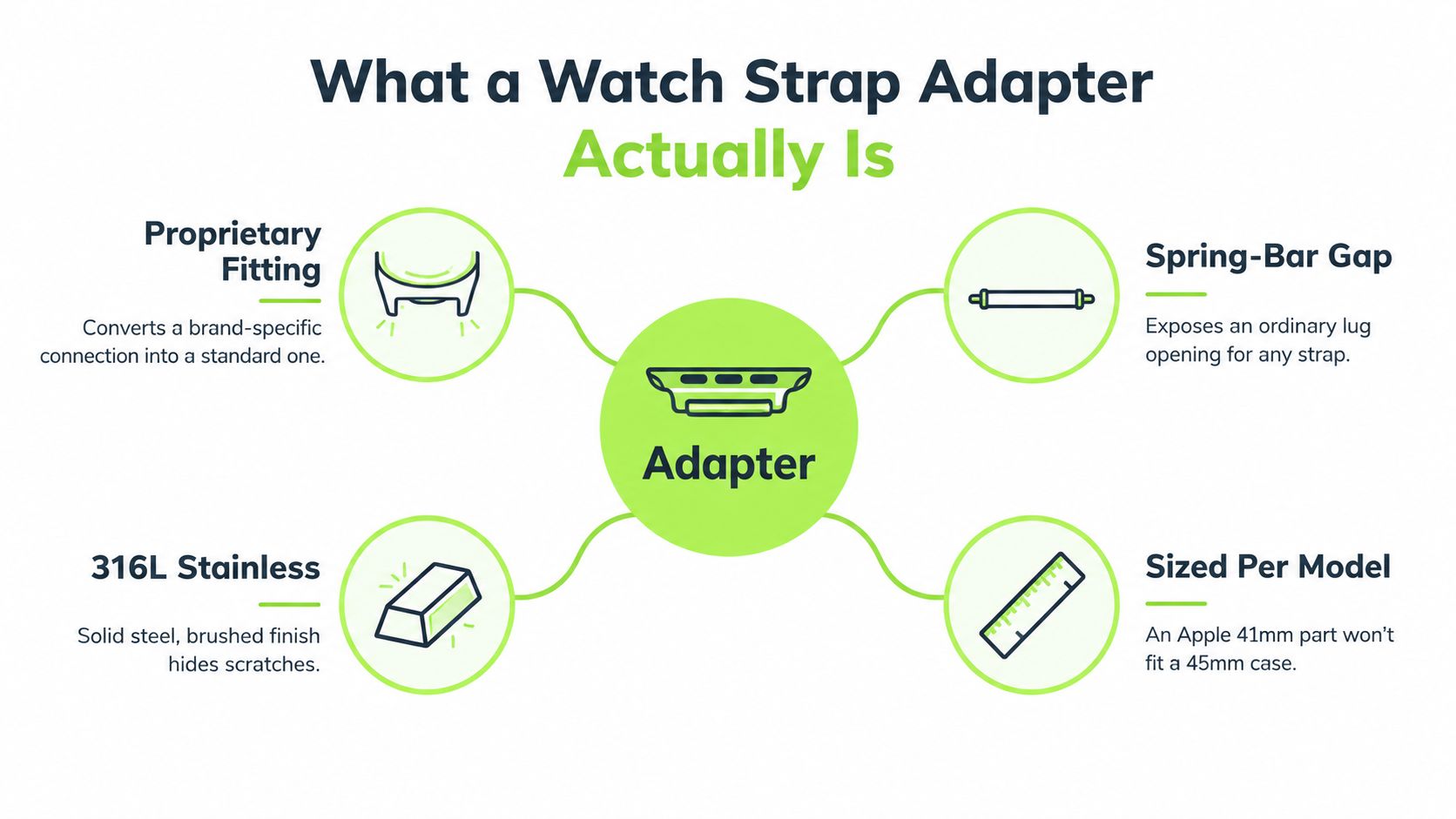
The important part is that an adapter has two jobs at once. On the watch side, it has to lock into the exact connector family on the case. On the strap side, it has to present the correct lug width, so the band can attach the same way it would on a traditional watch.
Practical rule: if the back of the watch does not have a standard spring-bar gap, the strap decision starts with the watch fitting, not the strap style.
That sounds simple until you look at real watches. Some models use plain drilled lugs, some use proprietary channels, some use pins that only match one brand's hardware, and some use special latches that a normal strap can't touch. The core problem is always the same: reconciling one case with another strap system.
For shoppers, the useful test is straightforward. Ask three questions. What fitting is on the back of the watch, what width does the strap need, and does the case shape leave enough room for the adapter body to sit without hitting buttons, bezels, or sensors? The mechanical answer comes before the style answer.
If you want the shorthand, think of a watch strap adapter as a translator. It doesn't change the watch into a different watch, it just gives a strap something familiar to hold onto.
A quick-release spring bar is a different thing again: it makes an ordinary lug strap easier to swap, but it doesn't convert anything. Our quick release strap adapter guide covers how that sprung lever works, and the quick-release mechanism guide is useful background if you're trying to separate spring-bar convenience from a true fitting conversion.
Plain Straight Lugs and Why Most Watches Do Not Need an Adapter
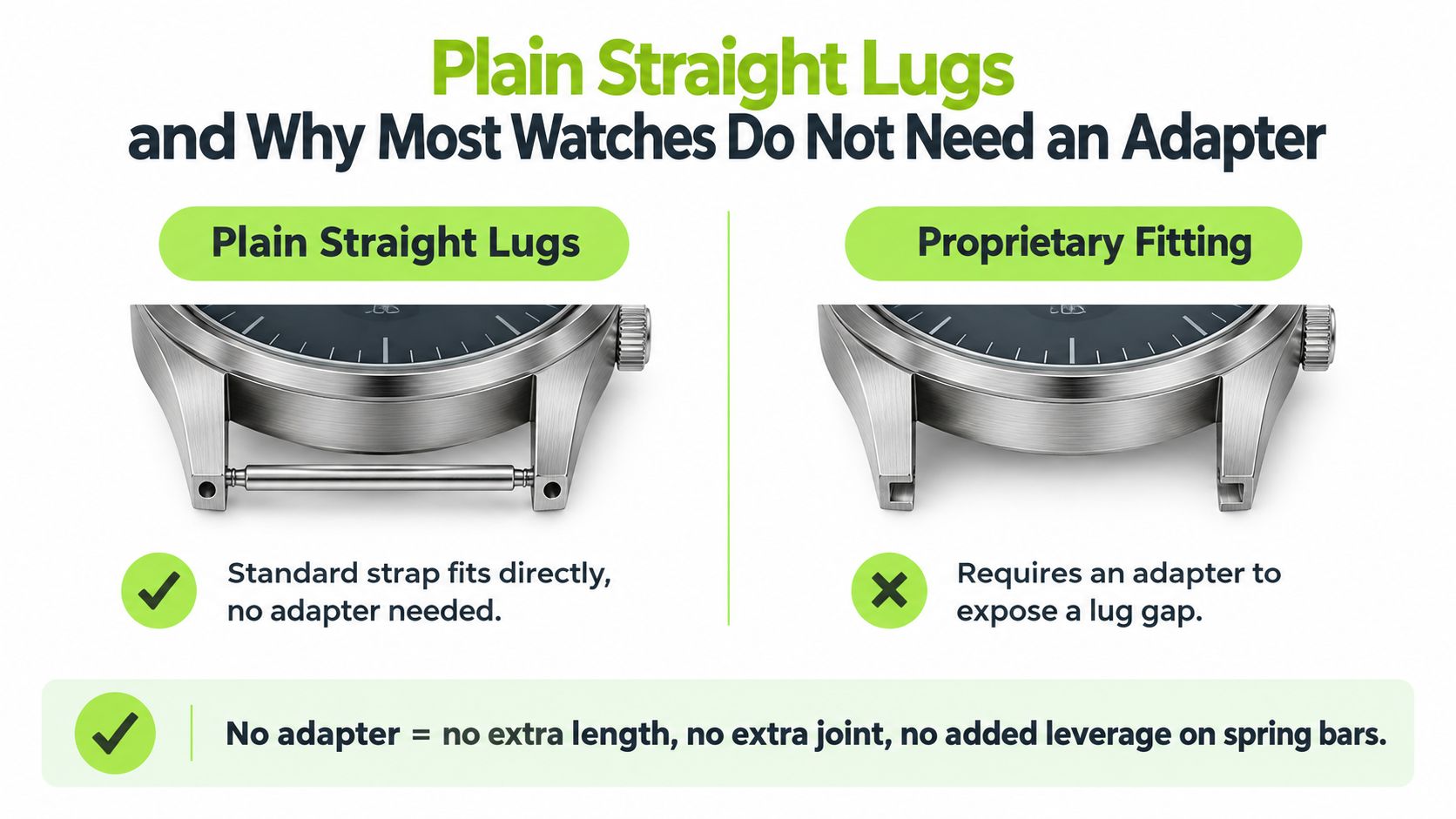
A watch with plain straight lugs does not need a watch strap adapter at all. If the case has the normal pair of parallel lugs and a spring-bar gap, the right strap width is the answer, not an extra piece of hardware.
Measure the opening, not the brand name
The width between the lugs has to match the strap width exactly. A 20 mm lug gap takes a 20 mm strap, and a 22 mm lug gap takes a 22 mm strap, while the spring-bar diameter also needs to suit the lug-hole bore.
Historical strap widths were smaller and less standardised, but the modern replacement market has settled mainly around 20 mm and 22 mm, which is why those sizes dominate ordinary strap catalogues. That doesn't mean every watch is one of those two sizes, only that those widths are the most common starting points.
A standard watch with drilled or open lugs already gives the strap what it needs, so adding an adapter only creates more hardware without solving a real fit problem.
The measurement itself should stay simple. Check the lug opening once, then match the strap width to that number. The full measuring method belongs in a dedicated lug-width guide, but the practical point is enough here. If the watch already accepts a standard spring bar, the simplest path is a direct-fit band, not a conversion part.
That's also why quick-release bands are so popular for ordinary lugs. A 20 mm or 22 mm quick-release strap already has the sprung bar built in, so the strap goes straight onto the watch without changing the fitting. Our own quick-release bands come in 20 mm and 22 mm with the bars already fitted, so a plain-lug watch only needs the width its case already accepts.
Our watch strap width guide covers the measuring step in more detail if you're unsure whether the case takes 20 mm or 22 mm.
Apple Watch Fitbit Garmin QuickFit and Samsung Dynamic Lug Fittings
Apple Watch, Fitbit, Garmin QuickFit, and Samsung Dynamic Lug all use different hardware on the back of the watch, so a single generic adapter is not a universal answer.
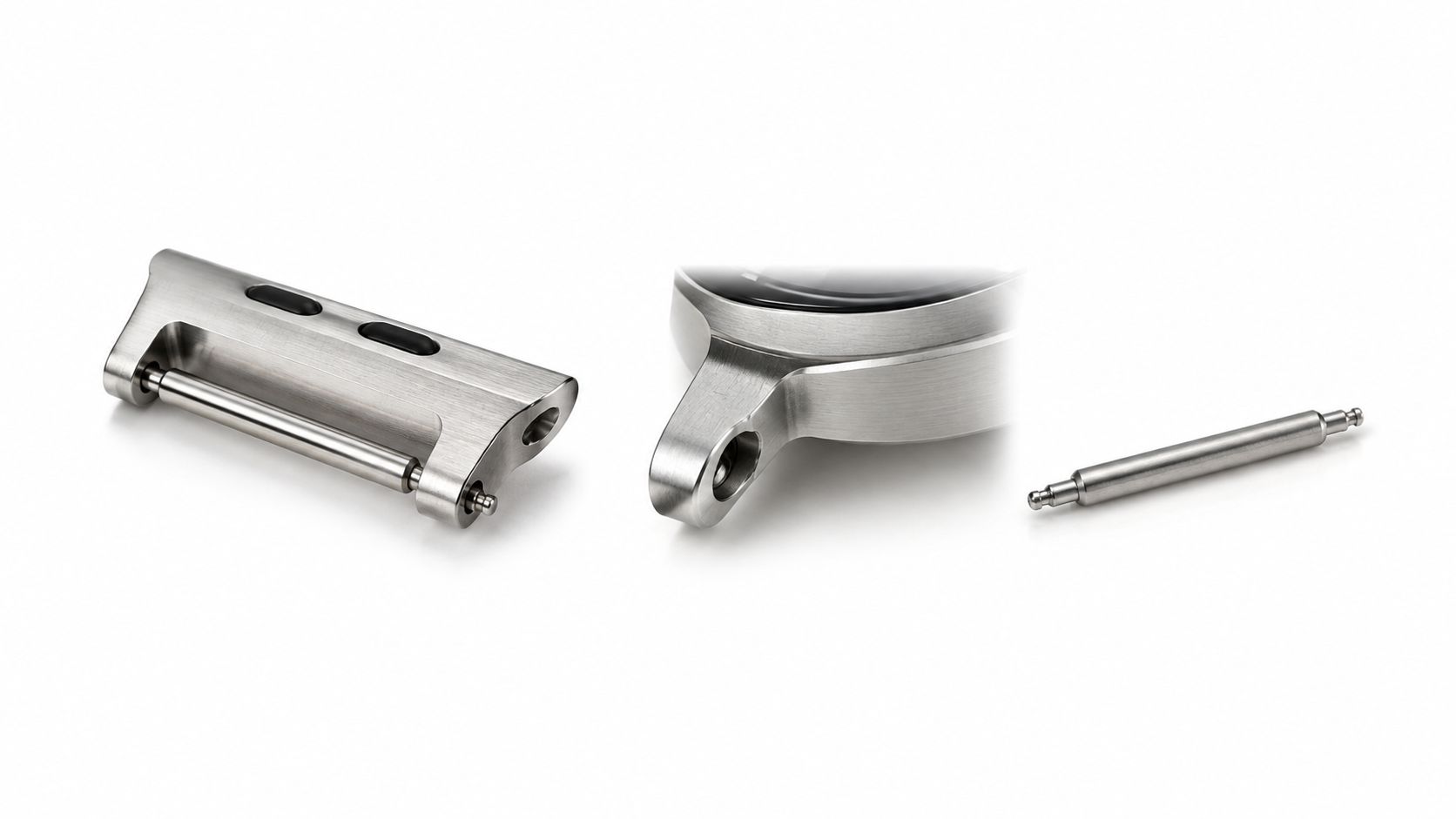
Apple Watch uses a slide-in channel rather than a normal lug gap, which is why Apple-to-standard-lug adapters exist as a category. The band slides into a channel in the case and is released with a button on the back of the watch case, not on the band. Compatibility runs in case-size families rather than a strap width, so any Apple band or adapter has to match the size family of your case (Apple band compatibility).
Fitbit is different again, and there is no single Fitbit mechanism. The Charge 5 and Charge 6 share one fitting, the Charge 3 and Charge 4 share another, the Versa 3, Versa 4, Sense and Sense 2 share a third, and the Versa, Versa 2 and Versa Lite share a fourth, with Charge, Versa and Sense using different release mechanisms. A Fitbit strap or adapter has to match the exact model family, which is why a direct-fit Fitbit band is usually the cleaner move when you already know the model.
Garmin QuickFit is a separate system from Quick Release, and the two are not interchangeable. QuickFit bands come in 20 mm, 22 mm, and 26 mm sizes, matched to the watch, while Quick Release uses an ordinary spring bar in a standard lug gap (Garmin band systems). QuickFit uses a sliding latch on the band end: slide the latch open and lift the band off the watch's fixed pin, then press the new band onto the pin until the latch closes. It never twists or rotates. For Garmin owners, the brand-matched route is clearer than trying to stack another interface on top of the existing one.
Samsung's Galaxy Watch4, Watch5, Watch6 and Watch7 use a standard 20 mm band connection, so they take an ordinary 20 mm quick-release band. The Galaxy Watch8, Watch8 Classic and Galaxy Watch Ultra are different: they use Samsung's Dynamic Lug attachment with its own release button, and Samsung states that the Ultra's 34 mm connection is incompatible with any previously released Galaxy Watch band (Samsung strap compatibility guide). An ordinary spring-bar strap will not attach to any of them.
For shoppers, the pattern is simple. If the watch uses Apple, Fitbit, Garmin QuickFit, or Samsung Dynamic Lug hardware, a strap built for that ecosystem is the cleaner answer than trying to force a general-purpose strap into the wrong connector family.
Choosing the Right Adapter Size and Material
A watch strap adapter has to match the watch model on one side and the strap width on the other, and that fit has to be exact.
Width and spring-bar fit matter more than the listing title
The strap side must match the lug width exactly. A 20 mm adapter needs a 20 mm strap, and the spring bar has to fit the lug-hole bore properly as well. A common standard spring-bar diameter is about 1.5 mm, with thicker bars of around 1.8 mm used where a sturdier bar is needed.
A bar that's too short won't fully engage both holes, which raises pull-out risk. A bar that's too long may not compress correctly during installation. The watch side has the same problem in a different form, because a model-specific connector has to fit the case it was designed for, not just the case diameter printed on the box.
Materials and finishes tell you a lot
316L stainless steel is the standard to look for in watch hardware. It's solid steel rather than plated alloy, which matters because plated brass or zinc alloy tends to wear through at the edges first and corrode after the base metal shows. Titanium is lighter and corrosion-resistant too, but it marks more easily.
Finish matters as much as material. A brushed finish hides fine scratches better than a polished one, and brushed surfaces can be renewed along the grain. PVD and DLC coatings are hard, but they chip rather than scuff when the edge takes a knock, so a clean-looking coating can still reveal the underlying metal after enough contact.
Practical rule: no adapter finish will ever quite match the case, so aim for a safe, well-made fit before you worry about a perfect visual blend.
For straight direct-fit bands, the same logic still helps. A solid 316L stainless link band or a properly made silicone strap usually ages better than a cheap plated connector with a shiny surface that looks right on day one and wears badly later. Among the bands we carry, the focus stays on direct-fit options, not adapters, because the fitting itself is the part that has to be right first.
The Honest Trade-Offs of Adding an Adapter
A watch strap adapter always adds something, and the something is not free.
More hardware means more points of movement
The first trade-off is extra length on the wrist. The adapter stacks above the case, so even a neat installation sits a little taller than a strap that connects directly. The second is an extra joint, which creates another place where the system can develop slop over time.
The third trade-off is more mechanical advantage on the spring bars. A longer load path gives the strap more room to work against the bar, so the retention points matter more than they would on a direct-fit strap. The fourth is the one most wearers notice first, a faint rattle, which is usually the earliest sign that something is wearing, loosening, or not fully seated.
A useful rule is to treat adapters as load-bearing parts, not just fittings. For active wear, that means checking for side-to-side play, uneven gaps, and partially exposed bar ends before you leave the house. Sweat and grit can make a marginal fit feel fine until the first hard movement exposes the problem.
The adapter also changes the look of the watch. It converts the fitting, not the width or the end shape, so a 20 mm strap on a large case can read visibly narrow, and a straight end against a curved case can leave a gap. That's why the visual result often looks cleaner when the band is built for the watch rather than adapted to it.
Water resistance is simpler. A strap or adapter does not set the watch's water rating, the case and gaskets do. If the sealing surfaces are compromised, no strap choice can fix that.
How to Decide Between an Adapter and a Direct-Fit Band
Start with the back of the watch, not the strap catalogue. That one habit removes most of the guesswork.
| Watch ecosystem | Fitting type | Simplest strap path |
|---|---|---|
| Plain straight lugs | Standard spring-bar gap | A direct-fit 20 mm or 22 mm strap |
| Apple Watch | Slide-in Apple connector | An Apple Watch band built for the right case-size family |
| Fitbit | Model-family sprung pin system | A Fitbit band matched to the exact model family |
| Garmin QuickFit | QuickFit latch system | A Garmin QuickFit band in the correct size |
| Samsung Galaxy Watch4 to Watch7 | Standard 20 mm band connection | A 20 mm quick-release band |
| Samsung Galaxy Watch8, Watch8 Classic, Galaxy Watch Ultra | Dynamic Lug | A Samsung band made for that model |
If the watch has plain spring-bar lugs, a standard strap is enough. If the watch is Apple, Fitbit, Garmin QuickFit, or a Samsung Dynamic Lug model, the cleanest answer is a band built for that exact fitting rather than a conversion part. Lug adapters add fitment and liability problems, so we've deliberately kept our range to direct-fit smartwatch bands and don't sell adapters of any kind.
For a simpler path, the direct-fit collections are the practical answer. Apple Watch bands, Fitbit bands, and Garmin watch bands are built for each brand's own fitting, including Garmin QuickFit 22 and 26, while a 22 mm quick-release option like the Vornis Silicone Sport Band in 22mm quick release handles many ordinary lug watches without adding another joint.
If you're unsure which side of the decision you're on, look at the watch first and the strap second. The fitting on the case decides the path.
Frequently Asked Questions About Watch Strap Adapters
Will a 20 mm strap fit a 22 mm lug?
No, a 20 mm strap does not fit a 22 mm lug correctly. The strap width has to match the lug opening exactly, otherwise the band can shift or sit loosely.
Is a quick-release strap the same as a watch strap adapter?
No, a quick-release strap is not the same thing as a watch strap adapter. A quick-release strap still fits a standard spring-bar lug gap, it just has a built-in lever for easier installation.
Does adding an adapter change water resistance?
No, a watch strap adapter does not change the watch's water resistance rating. The case construction and gaskets determine that, not the strap hardware.
How do I spot the first signs of adapter wear?
Look for rattle, side-to-side play, uneven gaps, or bar ends that sit visibly off-center. If the adapter no longer sits squarely in the fitting, stop using it and inspect the seating before wearing the watch again.
For readers who want a cleaner FAQ structure on the page, structuring FAQ pages for search is a useful reference on keeping short answers focused and easy to scan.
If you'd rather skip the fitting puzzle, Nothing but Bands focuses on direct-fit smartwatch straps for Apple Watch, Fitbit, Garmin, Samsung (including Galaxy Watch8 and Galaxy Watch Ultra), and ordinary spring-bar watches, so you can choose a band built to match the watch you already own without adding hardware you don't need.
Articles similaires

- October 21, 2026
Discover truly nickel free watch bands that won't irritate skin. Compare materials, avoid common myths, and find comfortable hypoallergenic options.

- October 19, 2026
Learn how to remove a link from a metal watch band safely at home, with simple tools and step-by-step tips...
