


What if the watch with the longer headline battery isn't the right choice for the longest run you do? Choose the COROS PACE 4 if you want longer maker-stated battery ratings for long sessions and infrequent charging, and choose the COROS PACE 3 if you prioritize a lower purchase price and routine training where extra battery margin rarely matters. That distinction matters far more than the 0.1 mm difference in case thickness.
Table of Contents
- Which COROS Pace Should You Buy?
- How Do the COROS Pace 4 and Pace 3 Compare on Specs?
- How Does the COROS Pace 4 Design and Display Differ?
- How Long Does the COROS Pace 4 Battery Last on GPS?
- Do the Training Features and Controls Differ Between the Two Models?
- Which Runner Should Pick the COROS Pace 3 or the COROS Pace 4?
- Which Band Material Suits Long Runs and Triathlons on a COROS Pace?
- Do COROS Pace 3 and Pace 4 Bands Fit Each Other?
Which COROS Pace Should You Buy?
The answer splits cleanly by which of three readers you are, because the same battery and weight figures land differently for each.
Upgraders already wearing a COROS PACE 3 should check one thing first: whether their current bands fit the new case. If they do, the upgrade cost is the watch alone; if they don't, straps join the total before the decision is final.
First-time COROS buyers get the simplest rule. Compare the battery mode you will run in against your longest weekly session, and buy whichever generation's stated rating covers it with margin.
Ultra and triathlon runners should read only the GPS-mode rows and skip the daily-use figure. Match the row for the mode you race in, all-systems or dual-frequency, to your longest planned session; that single line decides the pick.
Two cautions apply to all three. Every figure in this comparison is a COROS-stated rating, taken from COROS's product and press pages or as Lifehacker reports it from COROS, not measured in hands-on testing, so it judges maker claims side by side rather than wrist performance. Method shapes outcomes across wearables: the Fitbit Edge One step tracking comparison shows how grading two devices on one defined task can reorder a verdict, which is why each rule above keys on a matched spec row instead of a headline number.
How Do the COROS Pace 4 and Pace 3 Compare on Specs?
On the figures COROS publishes, the COROS PACE 4 and COROS PACE 3 separate on battery and GPS endurance and sit close almost everywhere else.
Read the table as COROS states each figure, not as a promise for your settings. A battery row only supports a fair comparison when the GPS mode matches on both sides, and a weight row only works when you notice whether COROS includes the strap and which strap material is fitted.
| Spec as stated by COROS | COROS PACE 3 | COROS PACE 4 |
|---|---|---|
| Case size and thickness | 42 × 42 × 11.7 mm | 11.8 mm thick |
| Weight | 30 g with nylon band; 35–36 g with silicone band | 32 g with nylon band; 40 g with silicone band |
| Display | 1.2-inch transflective (reflective MIP) touchscreen | 1.2-inch AMOLED touchscreen |
| Daily-use battery | 15 days | 19 days |
| All-systems GPS battery | 25 hours | 41 hours |
| Dual-frequency GPS battery | 15 hours | 31 hours |
| GPS-only mode battery | 38 hours | COROS lists no GPS-only figure |
Waterproofing stays out of the table because the maker-stated material compared here covers dimensions, weight, display, and battery. Check COROS's product pages for water resistance before pool or open-water use.
The display row leans on a second source in this COROS Pace 4 vs Pace 3 comparison. The Lifehacker COROS Pace 3 vs Pace 4 comparison describes the PACE 4's AMOLED screen replacing the PACE 3's reflective MIP display, and lists dual-band GPS on both watches, so the table treats GPS endurance by mode, not GPS generation, as the practical difference.
The video below shows the PACE 4 on the wrist next to the COROS PACE Pro and a Garmin Forerunner 165; it does not include the PACE 3.
That mode rule changes the conclusion many shoppers reach from a quick scan. The COROS PACE 3 figure of 38 hours belongs to a lower-power GPS-only mode with no listed PACE 4 counterpart, so it shouldn't be set against the PACE 4 all-systems or dual-frequency figures. Match the mode first, then judge the gap. A runner whose longest outing fits inside either watch's dual-frequency rating gains charging frequency from the PACE 4 and little else. A runner planning sessions that push toward the PACE 3's 25-hour all-systems mark gains headroom that decides whether the watch is still recording at the finish.
The weight rows reward a second look. COROS quotes both watches by strap material, and read like for like the PACE 4 is slightly heavier: 32 g against 30 g with nylon. The strap you pick moves the number on your wrist more than the generation does, so weight is not a reason to upgrade on its own.
How Does the COROS Pace 4 Design and Display Differ?
The COROS PACE 3 page lists the COROS PACE 3 at 42 × 42 × 11.7 mm and 30 g with a nylon band, against 32 g for the COROS PACE 4 with a nylon band. Read like for like, the PACE 4 is 2 g heavier. With silicone bands the PACE 3 is listed at 35–36 g and the PACE 4 at 40 g, so the strap decision moves the total more than the generation does.
Case footprint controls how the lugs sit, whether the case overhangs the wrist bone, and how much the watch rotates when your arm swings. Strap stiffness changes the result again. A rigid strap can hold a light case away from the wrist, while a softer band that curves close makes the same case feel smaller. If you sleep in the watch, train with gloves, or wear tight cuffs, judge the complete watch and band combination rather than the case in isolation.
Fit rule: Compare total weight with the band you plan to wear, because the band can change the result more than the small gap between the two cases.
How much does the band change COROS Pace 4 weight?
The COROS PACE 4 weighs 32 g with its nylon band and 40 g with its silicone band, an 8 g swing driven entirely by the strap. That swing lands differently by runner. If you wear the watch snug for wrist-based readings, or a heavier combination tends to bounce during long runs, the lighter setup earns its place. Band for band, COROS lists the PACE 3 as the lighter watch, so weight alone is not a reason to move to the PACE 4.
A woven nylon option such as the Bravik, Nylon Loop, Quick Release 22mm, a durable woven nylon band with quick-release spring bars and an adjustable metal buckle, shows why textile bands suit fine adjustment. Nylon is not right for every session, since water absorption and drying time also matter. Before reusing a band you already own, confirm the lug width and fitting COROS lists for the PACE 4.
For the display, stick to the panel type, size, resolution, and brightness COROS publishes for each model. If the two pages do not give a directly comparable brightness figure, do not infer a winner from panel type alone. Your conditions decide whether the difference matters: bright midday road running, dawn starts, night sessions, and indoor training each place different demands on contrast and glanceability.
Runners who glance at one or two large fields will find either approach workable. Runners who read dense screens in low light should give the published panel difference more weight. The design verdict stays narrow: the watches sit close in size, the strap drives wearing weight, and the display choice should follow the light you train in.
How Long Does the COROS Pace 4 Battery Last on GPS?
Battery is where the two generations separate most clearly on paper. The COROS PACE 4 is rated at 19 days in daily use, 41 hours in all-systems GPS, and 31 hours in dual-frequency GPS. Those headline figures only mean something against the same modes on the COROS PACE 3, because mixing modes inflates or shrinks the gap you will see in training.
How do the GPS battery ratings match by mode?
Matched mode for mode, the COROS PACE 4 rates 41 hours in all-systems GPS against 25 hours for the COROS PACE 3, and 31 hours in dual-frequency GPS against 15 hours. The Lifehacker COROS Pace 4 review reports that same mode-matched rise, from 15 to 19 days in daily use, 25 to 41 hours in all-systems GPS, and 15 to 31 hours in dual-frequency GPS. Lifehacker attributes its figures to COROS, so both sets are maker ratings rather than independent measurements.
The one unmatched row is the PACE 3's lower-power GPS-only mode, rated at 38 hours with no PACE 4 equivalent, which the specs table already covers.
- All-systems mode: Use this comparison if you want access to multiple satellite systems as COROS defines the mode on each model's page.
- Dual-frequency mode: Use this comparison if that is the mode you run in built-up areas, tree cover, or other difficult reception conditions.
- GPS-only mode: Treat the PACE 3 figure as model-specific, not as evidence that the PACE 3 outlasts the PACE 4 in matched modes.
- Daily use: Treat the day rating as a charging-frequency guide, not as a substitute for GPS-hour planning.
Does always-on display change the COROS Pace 4 calculation?
Always-on display use shortens COROS PACE 4 endurance, so check COROS's AOD figures before planning around the standard ratings. The same caution applies whenever your display settings differ from the conditions behind a published rating. If you plan to keep the screen visible throughout a race, the relevant number is COROS's AOD figure for your GPS mode, not the longer standard-mode figure.
A simple example shows why mode-matched hours matter more than day ratings for long training. A 6-hour run uses about 15% of a 41-hour all-systems rating, leaving room for several long sessions between charges if other use is modest. Run the same session in dual-frequency mode and the contrast between generations sharpens: about 19% of the PACE 4's 31-hour rating, against 40% of the PACE 3's 15-hour rating. In the mode suited to city streets and tree cover, the battery gap matters more, not less.
A 20-hour ultra block is different again. It consumes a large share of either watch's relevant GPS rating, so you still need a charging plan, a mode decision, and a reserve for delays, navigation checks, or a longer finish than planned. The PACE 4 gives more margin in the matched modes, but margin is not a plan.
If your longest session fits comfortably inside the mode you use, the battery gap matters less than the headline numbers suggest.
Build the decision from your longest realistic week. Add your GPS hours, choose the mode you will run in, and leave reserve rather than planning to arrive at zero. If that total sits well inside the PACE 3 rating, extra PACE 4 endurance mainly buys fewer charges. If it approaches or exceeds the PACE 3 rating, the PACE 4 battery margin becomes a functional advantage rather than a convenience.
Do the Training Features and Controls Differ Between the Two Models?
The COROS model pages do list a few differences. The COROS PACE 4 page describes landscape and topo maps on the watch, a microphone for voice notes and voice pins, and an Action Button for switching screens; the COROS PACE 3 page describes breadcrumb and turn-by-turn navigation without those additions. For sport profiles, interval and structured-workout support, heart-rate and sensor pairing, and smartphone app sync, the two pages give no clear differentiator, so compare them line by line.
Runner type determines how much that uncertainty matters. A triathlete should check swim, ride, run, and multisport entries across both pages before assuming a broad category covers every format. A trail runner should check route navigation and offline maps separately, since a navigation label and an offline-map label make different promises. Each check becomes useful only when the exact page wording supports the activity.
Controls deserve the same scrutiny. Confirm whether COROS lists buttons, a dial, touchscreen input, or a combination for each model, then match that description to your conditions. Physical controls can matter more during gloved winter intervals, rain, or swim-to-bike transitions, while touch input may suit a runner who changes settings mostly between workouts. COROS describes an Action Button on the PACE 4 and highlights the touchscreen on the PACE 3, so check how each handles the inputs you use mid-session.
Which features should you compare line by line?
- Write your workout set: Include every run, ride, swim, strength session, and multisport format, plus route and offline-map needs if you train off-road.
- Match the exact labels: Put each PACE 3 and PACE 4 feature name side by side so different wording does not look like a capability gap.
- Check workout mechanics: Compare interval and structured-workout support with the input method listed for each watch.
- Check sensors and sync: Confirm the heart-rate or external sensors and the phone-app connection you rely on.
- Count model-specific entries: Treat a feature named for one model as unresolved until COROS support names that exact watch.
If the workout checks come out equal, the COROS Pace 4 vs Pace 3 choice should turn on battery margin, stated weight, and band fit. Long GPS sessions give battery margin more weight, while runners sensitive to wrist load can put stated weight first. An upgrader should check the current band's connector and width before assuming an existing setup carries over.
Which Runner Should Pick the COROS Pace 3 or the COROS Pace 4?
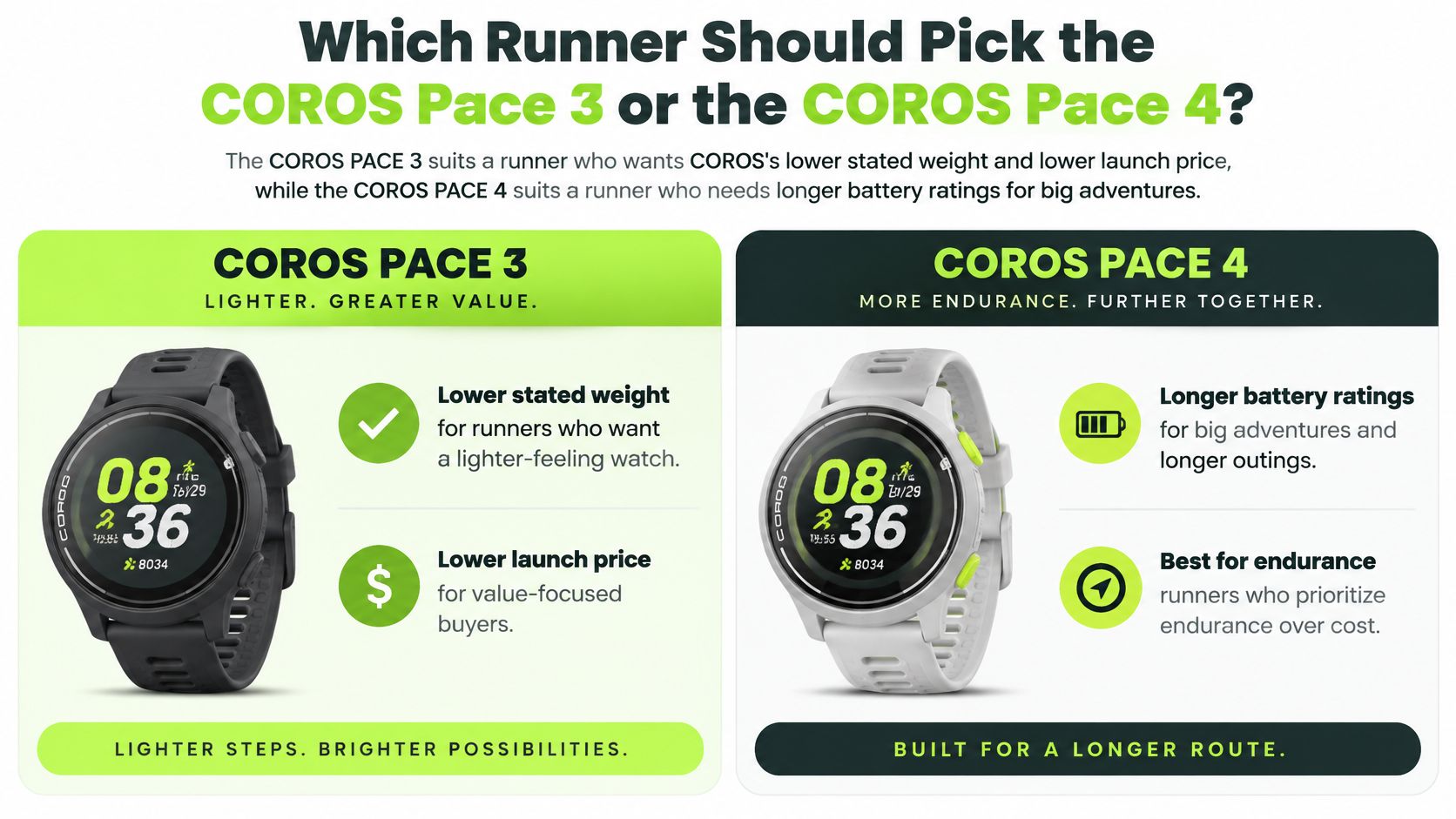
A runner whose longest weekly session sits well inside the PACE 3's stated GPS battery life needs a different watch than a runner planning back-to-back long days at a training camp. The COROS spec sheets define that split: the PACE 4 carries longer matched-mode GPS ratings, while the PACE 3 carries the lower stated weight and the lower launch price. Your longest session, charging habits, and willingness to pay for margin you might never use decide which side of the trade-off you land on.
The two profiles below turn the spec-sheet gap into buying paths.
Who Should Choose the COROS Pace 3?
The COROS PACE 3 is the better pick for a runner whose sessions last a few hours, who charges routinely, and who wants to keep the purchase price down. If your week consists of weekday runs, one longer weekend session, and regular access to a charger, the PACE 4's extra endurance may never change your routine. You would be paying for margin you'd rarely touch.
The PACE 3 also suits a buyer who values the lighter stated weight on long, steady runs. An existing PACE 3 owner with bands that fit well shouldn't treat an upgrade as automatic, since replacing a watch that already covers your longest session only makes sense if a confirmed battery, display, or feature difference solves a problem you have. Before counting your current straps as a reason to stay, check whether the PACE 3 and PACE 4 share the same band fitting. That check takes a minute and changes the cost of upgrading in either direction.
Price-sensitive first-time buyers fit here too. If COROS's PACE 3 feature page covers your sports, sensors, and sync needs, the lower launch price leaves money for shoes, race entry, or a second band for a different use. The sensible PACE 3 buyer isn't settling for inadequate endurance. That buyer has checked the longest planned session against the GPS mode they use and found enough room.
Who Should Choose the COROS Pace 4?
The COROS PACE 4 is the better pick for a triathlete, ultra runner, or high-volume runner who needs the longer matched-mode GPS ratings and charges infrequently. Multi-day training camps, back-to-back long sessions, travel without a convenient charging routine, and races that stretch beyond a standard long run all make battery margin useful. In those cases, extra hours reduce the need to manage settings purely to finish with charge remaining.
The PACE 4 also suits a buyer building toward longer events. Training for a marathon now while expecting trail ultras or long triathlon blocks later in the same ownership period is a rational reason to buy the bigger battery, provided the price difference is acceptable and COROS's feature list otherwise fits. The logic fails when your plans stay short and predictable.
Value depends on how often that margin matters. The COROS PACE 4 press release gives the PACE 4 a launch price of $249; the PACE 3 launched at $229, a gap of $20. Confirm current prices on COROS's site, since launch prices don't tell you today's selling price. If the extra endurance prevents even occasional charging anxiety during your biggest blocks, the gap is easy to justify. If it only reduces routine charges from frequent to slightly less frequent, its value is weaker.
Runners still deciding between brands rather than generations should separate that question from this one, and our Garmin vs COROS comparison covers the cross-brand decision. Within COROS, follow the longest session you run. The PACE 3 wins on price and stated weight for contained training, and the PACE 4 wins when battery margin protects the sessions that define your season.
Which Band Material Suits Long Runs and Triathlons on a COROS Pace?
On a COROS PACE 3 or COROS PACE 4, silicone is the better band material for frequent swimming and sweaty training, while nylon suits softer everyday comfort. The right choice depends on how long the band stays wet, how soon you can rinse and dry it, and whether you keep wearing the same band after the session ends.
Silicone doesn't soak up water, stays flexible, and cleans easily after a swim, ride, or hot run. Its weakness is breathability. Moisture can remain between the strap and your skin, especially when you wear the watch tightly, so remove it, rinse it, and dry both the band and your wrist even though the material itself dries quickly.
Nylon gives a softer textile feel and comfortable fine adjustment for everyday wear and many training sessions. Once immersed, however, water remains within the weave, so drying time is the compromise. A runner who swims and then keeps the same strap on for hours will usually be more comfortable changing to silicone or allowing the nylon band to dry fully.
- Frequent swimming: Choose silicone for the session and dry your wrist afterward.
- Long dry runs: Choose the material that holds the watch steady without forcing you to overtighten it.
- All-day wear after training: Consider nylon for its softer textile feel once it's clean and dry.
- Two-band rotation: Keep one band for wet training and another for daily wear if drying time becomes a recurring problem.
We start both with the same fitting: 22 mm quick release. Comfort then comes down to the wearer’s wrist, activity and preferred adjustment. A soft nylon band suits someone who wants fine adjustment and a lighter feel during everyday wear or sleep. When moving between the watches, check the particular band’s compatibility and remaining adjustment range rather than assuming the new watch requires a different material.
A textile example such as the Voren, Nylon Loop, Quick Release 22mm is described as a high-density nylon band with quick-release spring bars and a G-hook closure. Our separate COROS Pace 4 nylon band guide covers nylon-specific sizing and care in more detail. You can compare material options across the COROS watch bands collection, but a water-resistant band material doesn't remove the need to assess the connectors, clasp, and watch itself against COROS's guidance.
Do COROS Pace 3 and Pace 4 Bands Fit Each Other?
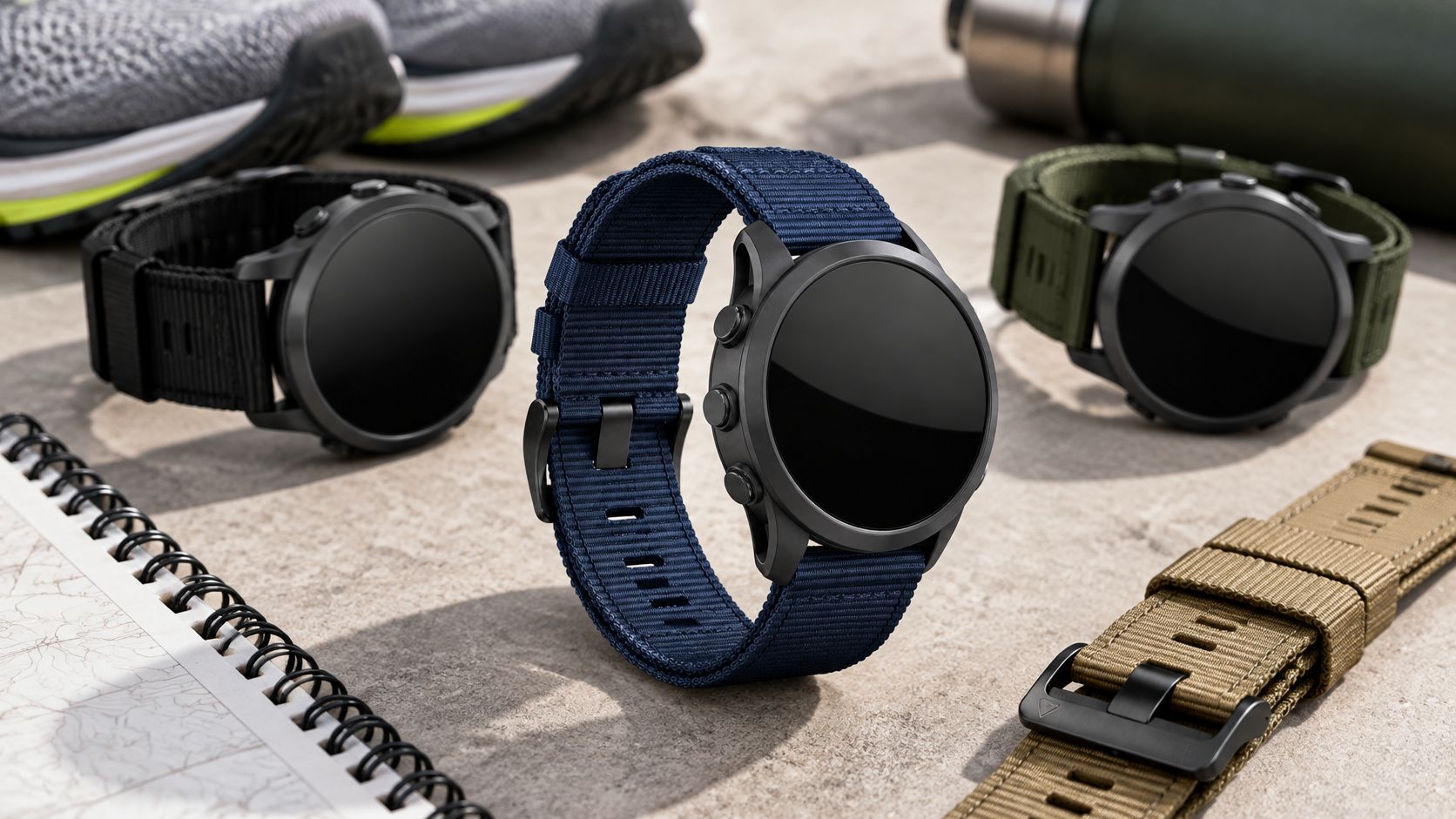
Yes. A 22 mm quick-release band from a COROS PACE 3 fits a COROS PACE 4, because COROS lists the same 22 mm lug width for both models and offers its own 22 mm nylon and silicone bands for each. Ordinary PACE 3 bands carry over. The one exception is model-specific bands, which COROS flags on the individual band listing, so check that note before you buy.
Lug width is the distance between the inside faces of the lugs, not the case size. A 22 mm PACE band uses an ordinary quick-release spring-bar fitting, so you slide the tab, remove the band, and click the replacement into place without a tool. A similar case diameter, or the word Pace on the box, tells you nothing about fit on its own.
The band shown here illustrates the quick-release format to look for, not a guarantee for any individual model.
| COROS model | Lug width | Band connector | Before you buy |
|---|---|---|---|
| COROS PACE 2 | 20 mm | Quick-release spring bar | 20 mm bands don't cross-fit the 22 mm models |
| COROS PACE 3 | 22 mm | Quick-release spring bar | Shares 22 mm fit with PACE 4 |
| COROS PACE 4 | 22 mm | Quick-release spring bar | Shares 22 mm fit with PACE 3 |
| COROS PACE Pro | 22 mm | Quick-release spring bar | Some model-specific bands are not shared |
The generation trap is the COROS PACE 2. Its 20 mm band doesn't fit a PACE 3 or PACE 4, and a 22 mm PACE 3 or PACE 4 band doesn't fit a PACE 2. Our COROS Pace 3 watch band size guide covers that sizing distinction without turning this generation comparison into a full sizing article.
Width alone still isn't enough. Garmin QuickFit 22 is also described by a 22 mm width, but it locks into a Garmin-only latch and is a different fitting from an ordinary 22 mm quick-release spring-bar band. COROS also says some model-specific bands, such as its silicone PACE Pro band, aren't shared with other models, so the individual band note controls the final answer.
If you are unsure of your exact model, the Watch Band Finder on our site matches bands by watch model. Once the 22 mm quick-release fit is settled, browse the COROS PACE 4 bands collection or the COROS PACE 3 bands collection.
Whether you're keeping a PACE 3 or moving to a PACE 4, Nothing but Bands organizes replacement bands by model and connector, so you can shop the 22 mm quick-release format for your exact watch. Confirm your model, then pick the material that suits how you train.
Articles similaires

- November 10, 2026
Learn how to fix a watch strap that is loose, popped off, stuck or torn, and when replacing it is...

- November 09, 2026
Pixel Watch vs Galaxy Watch: see who should buy which Android watch, how phone and health tools differ, and why...
