


Comfortable watch straps depend on weight distribution, breathability, closure precision, and fit stability, not material alone. If a band digs in, traps sweat, catches hairs, or feels heavy, the fix is usually a better combination of those four mechanics, not just a different label on the packaging.
A strap can look soft and still feel wrong once the wrist warms up, swells, or starts moving through the day. That's why a good Samsung Galaxy Watch or universal quick-release replacement has to do more than look clean on a product page.
Table of Contents
- Why Your Current Watch Strap Feels Uncomfortable
- What Makes Silicone, Nylon, Milanese, Braided, and Resin Links Comfortable
- Do Closure Systems Matter More Than Strap Material
- How to Measure and Adjust Your Watch Strap for All-Day Comfort
- Why Trapped Moisture Causes Irritation More Than Any Material
- What to Look for When Buying Comfortable Watch Straps
Why Your Current Watch Strap Feels Uncomfortable
Your current watch strap feels uncomfortable because one or more of the four comfort mechanics is off, usually the way the strap spreads weight, lets skin breathe, holds tension, or stays put while your wrist moves.
The four things your wrist notices first
A strap that feels fine for ten minutes can become irritating once sweat builds up or the watch shifts. Weight distribution determines whether the case feels balanced or top-heavy. Breathability determines whether heat and moisture can escape. Closure precision determines whether the band lands at the right tension instead of the nearest hole. Fit stability determines whether the watch slides, twists, and rubs.
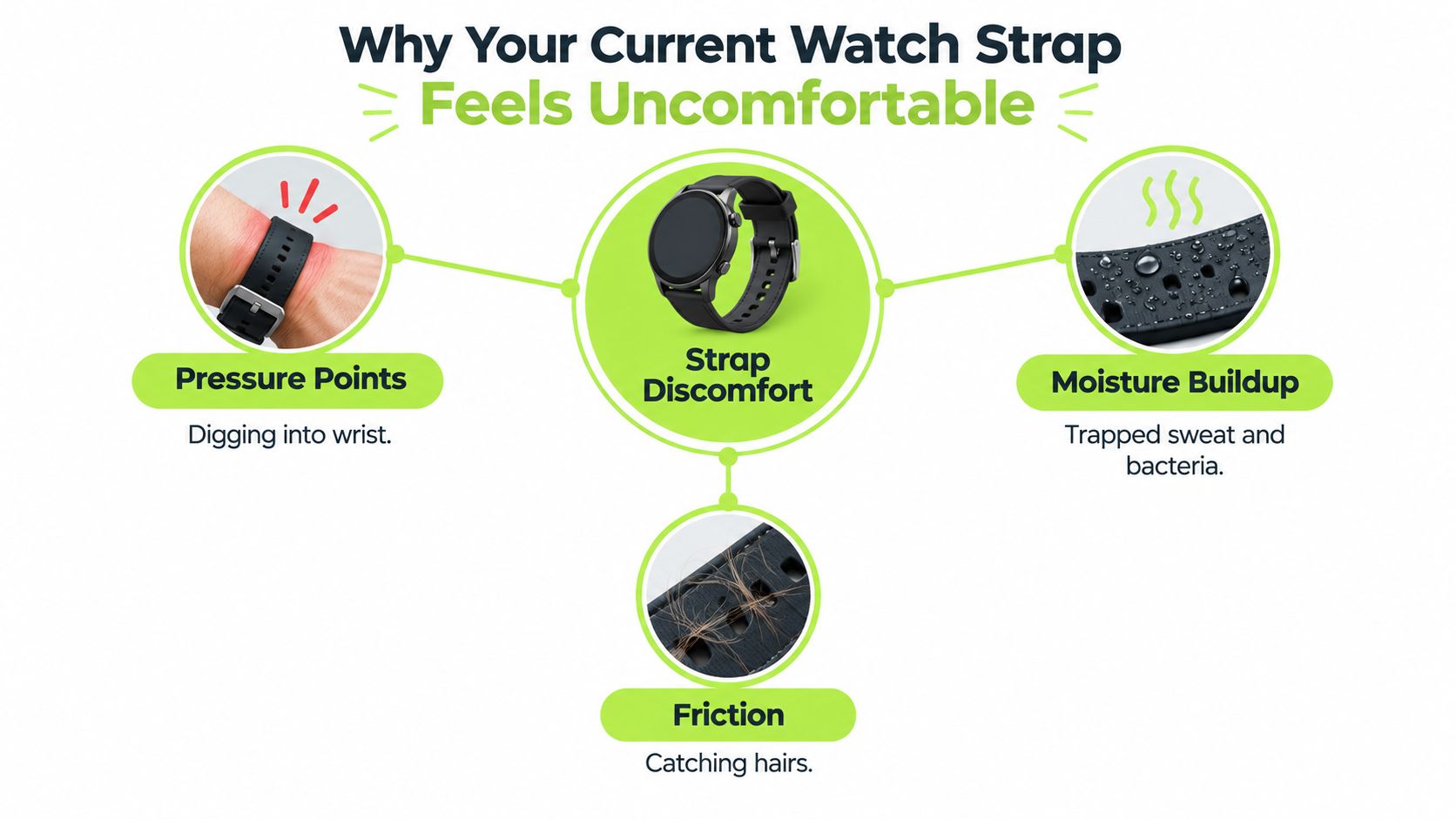
A lot of generic comfort reviews miss this because they treat material as the whole story. Material matters, but the band's shape, closure, and how it behaves against sweaty skin matter just as much. A soft-feeling strap can still chafe if it sits too tight, and a tougher strap can feel fine if it breathes and stays stable.
Practical rule: if the band leaves marks, rotates, or stays damp, the comfort problem is mechanical before it's stylistic.
That's why the same wrist can hate one silicone band and tolerate another, or love nylon for one routine and dislike it for another. The useful question isn't “what's the best material,” it's “what setup matches my day, my skin, and how much my wrist changes size.”
What Makes Silicone, Nylon, Milanese, Braided, and Resin Links Comfortable
Silicone, nylon, Milanese mesh, braided constructions, and resin links all solve comfort in different ways, and none of them win every category.
How each material behaves against the four comfort factors
Silicone usually wins on easy cleaning and predictable softness, while nylon wins on airflow. Milanese mesh is the strongest answer when a buyer wants the watch to feel lighter through better load distribution and precise adjustment. Braided elastic and resin links can feel comfortable in the right setting, but they solve different problems, one by adapting tension dynamically, the other by giving a hard-wearing, low-maintenance structure that is usually less breathable.
Verified product ratings across the range reflect that variety. The Vornis — Silicone Sport Band — Quick Release 22mm has 18 verified five-star reviews and a 4.67 average. The Lurea — Magnetic Milanese — Fitbit Charge 3/4 has 19 verified five-star reviews and a 4.76 average. The Véllo — Nylon Loop — Quick Release 22mm has 14 verified five-star reviews and a 4.64 average. Those are overall product ratings from verified buyers, not comfort scores. If silicone is your route, our silicone watch bands collect the sport-band options in one place.
| Material | Weight Distribution | Breathability | Closure Precision | Best Use Case |
|---|---|---|---|---|
| Silicone | Moderate, depends on strap width and case weight | Low to moderate | Good with secure buckle or magnetic sport design | Sweat-prone daily wear, gym use |
| Nylon | Light, especially in woven or looped forms | High | Very good with hook-and-loop or micro-adjustable fastening | Warm weather, all-day wear |
| Milanese mesh | Strong, spreads weight across a larger surface | Moderate | Excellent, closes anywhere along the band | Office wear, wrist size changes |
| Braided elastic | Very good, tension spreads dynamically | Moderate to high depending on weave | Excellent, because tension adjusts continuously | Long wear, changing wrist size |
| Resin links | Good if the bracelet is well balanced | Low to moderate | Good when sized correctly, weaker if fit is off | Durable casual wear |
For a buyer comparing constructions, the material ranking is less useful than the fit behavior. A magnetic Milanese band can feel better than a stiffer leather or resin option because the closure lands exactly where the wrist needs it. A nylon loop can feel better than a smooth-looking synthetic strap because air can move through the weave instead of sitting under the band.
A useful outside reference on fabric choice and skin comfort is Thermo Recovery Wear on sensitive skin, because the same moisture-and-friction logic applies even when the item isn't a watch strap.
Comfort takeaway: the band that feels best is usually the one that balances airflow, weight, and exact tension, not the one with the softest product description.
Do Closure Systems Matter More Than Strap Material
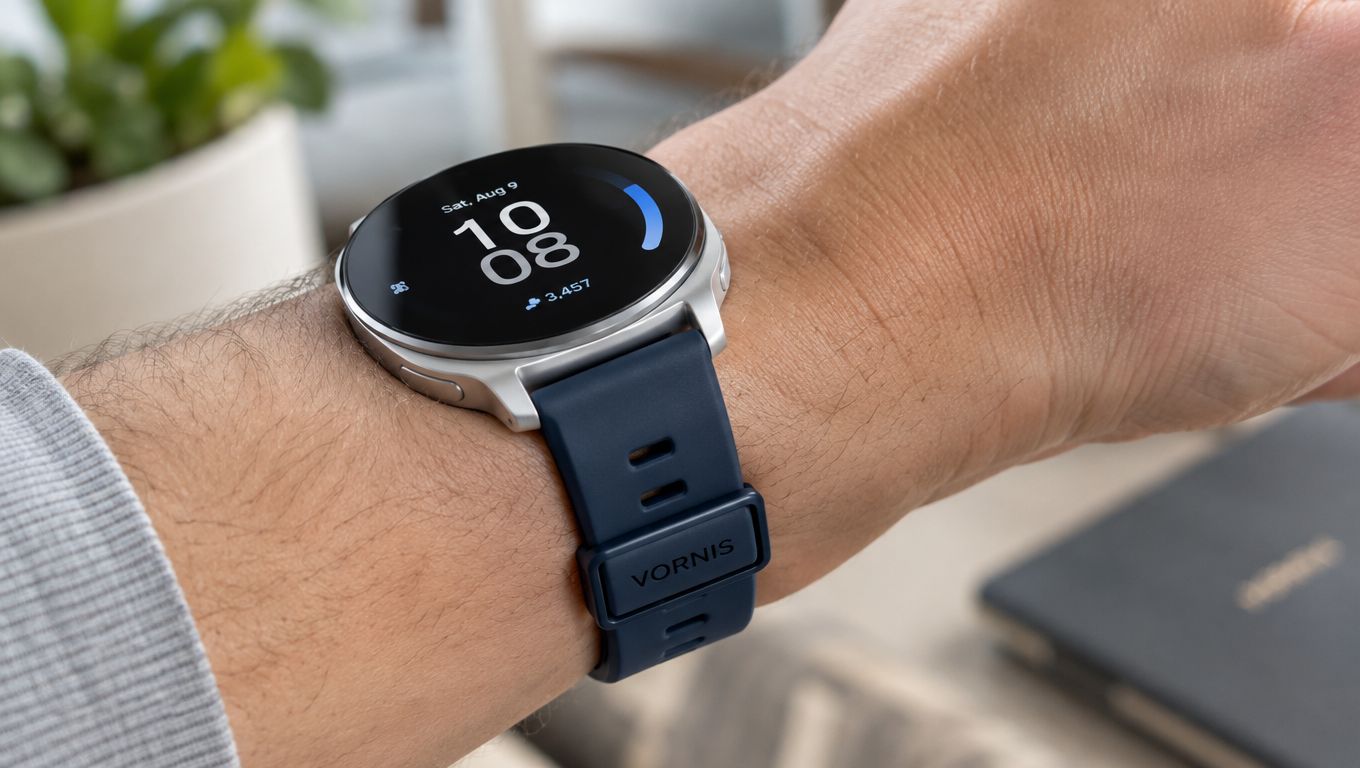
Closure systems often matter more than strap material because a wrist that changes size through the day needs precise adjustment, not just a nicer surface.
Why buckle holes create the wrong compromise
A buckle-and-hole strap forces a choice between too tight and too loose. Too tight restricts circulation, raises moisture under the band, and can leave the watch imprinting the skin. Too loose lets the case slide, which creates rubbing and makes the watch feel heavier than it really is. That's why a “good” material can still feel bad if the closure only offers coarse tension steps.
Hook-and-loop straps solve part of that problem by allowing smaller adjustment changes. They're a strong fit for a Samsung Galaxy Watch audience using quick-release nylon watch bands because they let the wearer correct tension during the day without hunting for the nearest hole. The trade-off is that hook-and-loop can snag hair and eventually lose crisp fastening if the loop surface wears down.
Magnetic closures, including Milanese mesh, are the cleanest answer when the wrist isn't fixed in one size all day. The closure can land anywhere along the band length, so the watch doesn't need to sit between two holes. That makes magnetic bands especially useful for wrists that swell in heat, shrink in cold, or change after movement.
The clasp type matters enough that a buyer should study it as closely as the material, especially if the current strap discomfort comes from a buckle that never quite lands in the right place.
Why a changing wrist needs a changing closure
A wrist isn't static. It changes with temperature, hydration, and activity, so the closure system has to tolerate those changes without constant readjustment. That's where magnetic-anywhere and well-made hook-and-loop systems beat fixed-hole designs in real life.
A wrist that expands during the day doesn't need more padding, it needs more adjustment range. A wrist that tightens in cool air doesn't need a softer label, it needs a closure that can shift one notch, or two millimeters, without forcing the whole watch to move.
Practical rule: if you keep re-tightening the band, the closure system is probably the real problem.
How to Measure and Adjust Your Watch Strap for All-Day Comfort
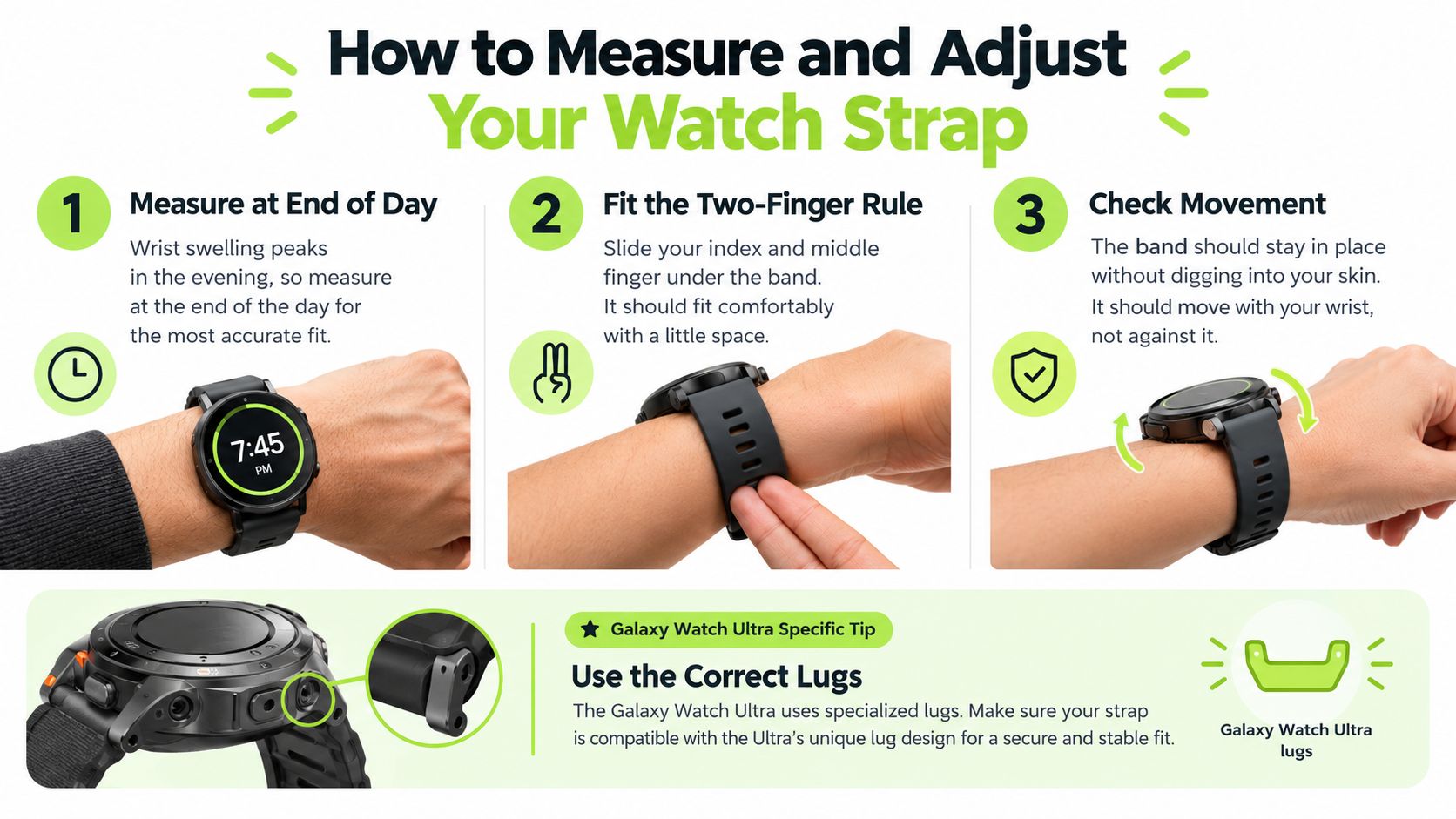
A watch strap should be measured later in the day, fit snugly over the sensor, leave room for airflow, and still let you slide a finger under the band.
The most useful sizing habit is to measure when your wrist is at its largest, because that's when a band that feels perfect in the morning often starts to bite later. Common watch-fitting advice is to leave a little clearance for airflow and enough room to slide a finger between the band and wrist, the familiar one finger rule. Apple also notes that a watch worn too tight can irritate skin, while a watch worn too loose can rub, so comfort comes from balance, not force.
The fit details that matter in daily wear
A strap should sit snugly enough that the sensor stays in contact with the skin, but not so tight that the band leaves a deep mark. If the watch moves during normal arm swing, the band is too loose. If the skin blanches or feels warm under the band, the fit is too tight.
After a workout, moving the watch a little farther up the forearm helps because the wrist area that just trapped sweat can dry faster. That small adjustment is often enough to reduce the damp, rubbed feeling that makes a band seem uncomfortable even when the material itself is fine.
Compatibility is part of comfort too
Sizing and fit also depend on what the watch accepts. A 22mm strap measures 22mm at the lugs; some straps taper toward the buckle, which is normal rather than a defect. Quick-release spring bars are standard across many 20mm and 22mm bands. For Samsung, the Galaxy Watch4 through Watch7 take standard 20mm quick-release spring bars (the Watch3 45mm and the original Galaxy Watch 46mm take 22mm), while the Galaxy Watch8 and Galaxy Watch Ultra use Samsung's own Dynamic Lug system and need bands made for it.
That means comfort and compatibility overlap. A great-feeling band isn't useful if the lug width is wrong, and a correctly sized band won't feel right if the closure can't hold the exact tension the wrist needs. When the issue is fit rather than style, measure before you buy.
Why Trapped Moisture Causes Irritation More Than Any Material
Trapped moisture causes more under-band irritation than any single material because occlusion, not just surface texture, is usually what turns a comfortable strap into an itchy one.
Under-band irritation usually comes from three places: nickel in metal parts, additives in some synthetic materials, and moisture held against the skin. For many wearers, that last one is the biggest day-to-day problem. Continuous wear holds sweat and heat against the skin, and damp skin under a moving band means more friction. The practical result is simple, if a strap reduces occlusion and dries quickly, skin usually stays calmer.
That's why a breathable woven nylon band can outperform a sealed or low-permeability design in warm weather, workouts, and all-day wear. It's also why silicone can still irritate some users when it's worn too tightly or left damp, even though the material itself is soft. A smooth, skin-safe silicone is a common choice for sensitive skin, but even that doesn't override fit and moisture management.
Melissa Baker put the long-wear experience plainly in her review of the Drift — Silicone Sport Band for her Fitbit Luxe: “The material feels really nice and soft against my skin, no irritation even after long wear.” That's a useful reminder that soft contact can feel great when the strap is fitting correctly. Her experience is real, but it isn't a universal guarantee for every wrist.
What sensitive-skin buyers should check first
Sensitive-skin shoppers usually need to think about the hardware and the microclimate, not only the strap label. Nickel-free components matter when metal touches skin. Quick-drying weaves matter when sweat is the trigger. Clean fit matters because even a breathable strap can trap moisture if it's cinched too tightly.
A practical place to start is the HempWell USA sensitive skin products page, since the same kind of irritation screening mindset applies across wearables and skin-contact products. The label alone never tells the whole story.
If a strap feels fine at first but turns itchy later, moisture management usually explains it before the material does.
What to Look for When Buying Comfortable Watch Straps
The right comfortable watch strap is the one that matches your wrist's movement, your skin's sensitivity, and your watch's compatibility at the same time.
For workouts and hot conditions, choose silicone or breathable nylon. For office wear and all-day elegance, a magnetic Milanese band does a better job of spreading weight and adapting tension. For sensitive skin, prioritize smooth silicone or a quick-drying nylon band, then make sure the fit leaves airflow and doesn't clamp the wrist shut.
A Samsung Galaxy Watch buyer should also check the lug system before anything else. The Watch4 through Watch7 work with standard 20mm quick-release bands, while the Galaxy Watch8 and Galaxy Watch Ultra need Dynamic Lug bands; for the Watch8, the Vornis — Silicone Sport Band — Samsung Watch 8 is cut for that fitting. That's the difference between a strap that fits on paper and a strap that actually feels comfortable on the wrist.
Nothing but Bands carries Samsung Galaxy Watch bands in silicone and nylon, plus quick-release nylon and magnetic Milanese ranges for buyers who care more about fit mechanics than hype. If the current strap digs in, catches hairs, or keeps the skin damp, start by choosing the closure type and material that solve that specific problem.
Nothing but Bands offers Samsung-compatible straps built around the comfort mechanics that matter most, including silicone and nylon options for easy daily wear and quick swaps. If you want to replace a band that's rubbing, trapping sweat, or never quite fitting right, browse our Samsung Galaxy Watch bands and choose the material route that matches your watch and your routine.
Articles similaires

- October 06, 2026
Clear installation instructions for smartwatch bands. Learn how to attach, verify, and troubleshoot Apple, Samsung, Garmin, and Fitbit straps safely.

- October 05, 2026
A practical guide to changing watch bands across Apple, Garmin, Samsung, and Fitbit, covering tools, fitment, daily rotation, and common...
