


Your best replacement watch bands are the ones that fit your watch first and your wrist second. If the fitting is wrong, the prettiest strap in the cart is useless. If the fitting is right, a plain, affordable band can be the smartest buy you make.
Most shoppers make the same mistake. They shop by color or material before they check whether their watch takes standard lugs, quick-release, or a proprietary connector. Start with the attachment, then choose the material for how you wear the watch.
Table of Contents
- The Fitting Question That Decides Everything Else
- Standard Lugs or Proprietary Fittings
- Which Material Matches How You Actually Wear It
- Sensitive Skin and Bands That Sit Against You All Day
- Cleaning and Adjusting a Replacement Band
- What the Sales Data Actually Shows
- Our Picks and the Basis Behind Them
- Putting It Together and Where to Go Next
The Fitting Question That Decides Everything Else
A snapped strap leaves you with one job first, and only one, figure out how the replacement attaches to the watch head. The right band is decided by the watch's lug width or connector geometry before you think about nylon, silicone, or metal.
Measure the watch, not the listing
A standard strap has to match the watch's internal lug gap exactly, and the wrong width can bind or wobble. The practical way to size a band is to measure the lug opening in millimeters, or check the manufacturer's spec, before you add anything to cart. If you want a simple sizing reminder, translate measurements into your size is a useful way to think about the step, even though the context is different.
Practical rule: the watch decides the fitting, not the band listing.
That's why a top-tier strap can still be a bad buy. A premium 22 mm band won't help if the watch takes a proprietary pin or a different connector shape. On a standard watch, the lug width is the one number that settles this part of the purchase.
| Brand | Typical attachment | What to check | What to buy |
|---|---|---|---|
| Apple | Slide-in channel on the case | Case-size family, not lug width: smaller (38/40/41mm, plus 42mm on Series 10 and 11) or larger (42mm on Series 1–3, 44/45/46mm, 49mm Ultra) | A band made for the Apple Watch fitting in your case family |
| Samsung | 20 mm quick-release spring bar on Watch4–7; Dynamic Lug on Watch Ultra and Watch8 | 20 mm or 22 mm on spring-bar models; otherwise the model name | A spring-bar band in the right width, or a band made for that Dynamic Lug model |
| Garmin | QuickFit or ordinary quick release | The system and the width (QuickFit comes in 20, 22 and 26 mm) | A band made for that system and width |
| Fitbit | Model-specific connector | The exact model (Charge 5/6, Charge 3/4, Versa 3/4 and Sense 1/2 each differ) | A band made for that model |
| Standard watch lugs | Quick-release spring bar | Usually 18 mm, 20 mm, or 22 mm | A quick-release band in the same width |
The hard truth is simple, the cheapest compatible strap beats the nicest incompatible one. A band that seats cleanly, clicks in properly, and stays put during movement is the one worth buying.
Standard Lugs or Proprietary Fittings
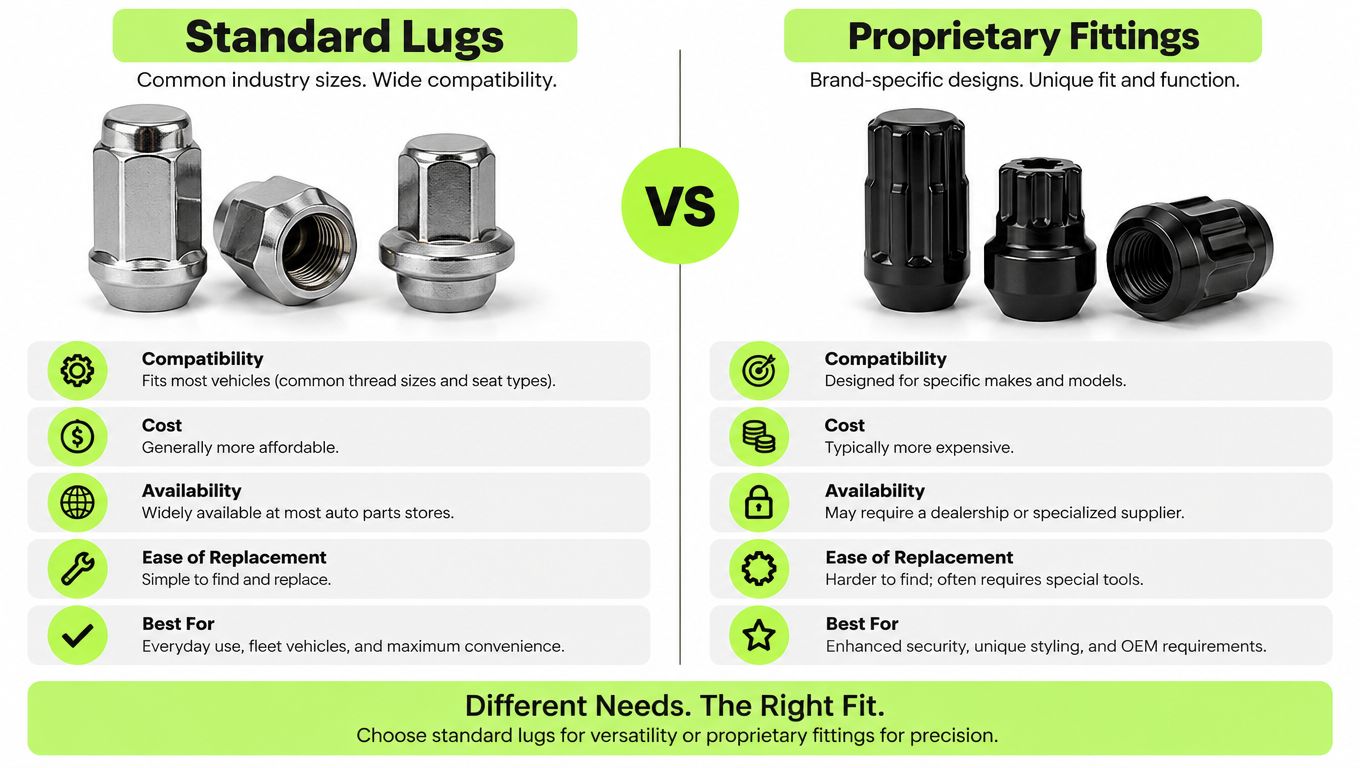
Standard lugs use a measured width, usually 18 mm, 20 mm, or 22 mm, while proprietary fittings use a brand-specific connector that only matches certain models. If your watch has standard lugs, you can shop widely. If your watch uses a proprietary fitting, you need to narrow the search immediately.
Standard lugs are the easy case
Most generic replacement straps are built around standard lugs and quick-release spring bars. That means the band can be swapped with no special adapter, as long as the width matches exactly and the spring bar seats fully. For many buyers, that's the whole game.
Proprietary fittings are where people get burned
Apple's slide-in channel, Garmin QuickFit, Garmin Quick Release, Fitbit's model-specific pin systems, and Samsung's dedicated Ultra fitting are not interchangeable by default. Samsung also separates models clearly, the Galaxy Watch Ultra and Galaxy Watch Ultra2 do not take standard 20 mm bands, and the Galaxy Watch8 series uses its own mechanism. Garmin's QuickFit and Quick Release are different systems, so a correct millimeter width alone is not enough.
A band that “almost fits” is the one that wastes your money.
That's why model name matters as much as width. A Galaxy Watch7 uses a standard 20 mm connection, while Samsung lists the Galaxy Watch3 45 mm as a 22 mm model and treats the Ultra line as a separate case entirely. If you buy for the watch name alone, you'll eventually end up with the wrong connector.
If you want a deeper styling breakdown, our guide on different styles of watch bands covers that. This guide stays on the buying decision you need right now.
Which Material Matches How You Actually Wear It
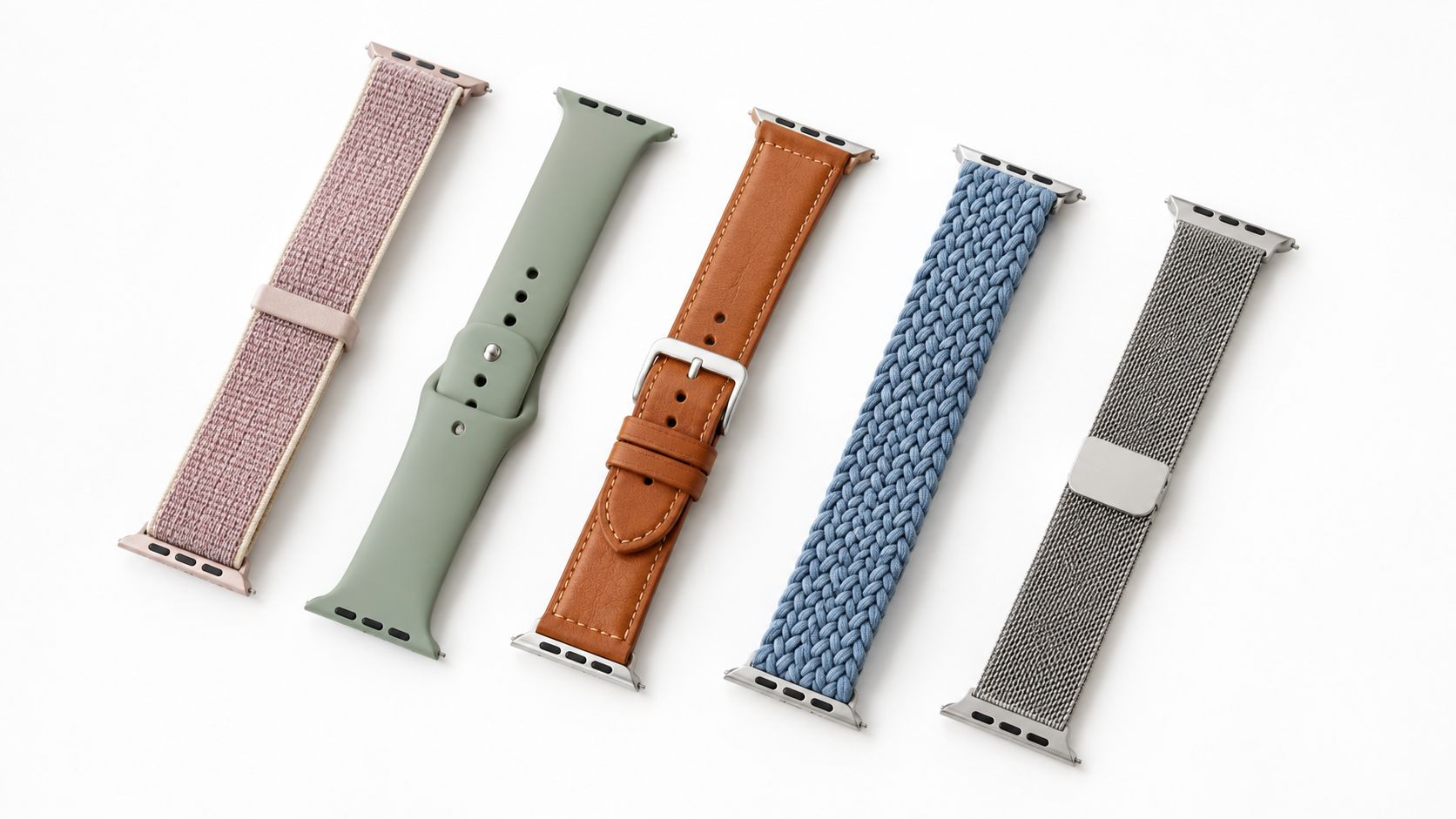
Nylon is the everyday comfort and washability pick, silicone is the sweat and water pick, magnetic Milanese is the dressier tool-free sizing pick, braided is the stretch pick, resin composite link is the lighter statement look, and genuine leather is the traditional watch look. Pick the material by use, not by label.
Nylon, silicone, and braided each solve a different problem
A nylon loop makes sense if you want a strap that feels light, dries reasonably well, and doesn't fight you all day. Silicone is the more obvious choice if the watch sees sweat, rain, or gym use, because a smooth elastomer surface is easy to rinse and keep in rotation. Braided straps bring stretch and a softer on-wrist feel, but they're a comfort choice first, not a water-first choice.
If nylon is your direction, the nylon watch bands collection covers loops across several fittings, so pick the loop made for your watch first and the colour second.
Milanese, resin, and leather change the watch's personality
A magnetic Milanese band looks cleaner in office settings and is easy to size without tools, which is why people who hate fiddling with clasps gravitate to it. Resin composite link bands sit in a style lane of their own, more statement than sport, and they're the right choice when you want a watch to look deliberate instead of purely technical. Genuine leather still does the classic-watch job best when you want warmth, structure, and a more traditional profile.
We carry genuine leather across several watch families, including Avelin for Apple Watch bands, Alder and Langford for Garmin QuickFit, and Calder and Varden for Samsung, with Fitbit covered as well. That matters because leather isn't one thing, and the connector still has to match the watch.
Buy the material for the way you wear the watch, not the way it looks in the product photo.
Our guide on comfortable watch straps handles deeper comfort comparisons. This guide stays on the replacement choice, which means choosing the band that matches your day, your sweat, and your tolerance for maintenance.
Sensitive Skin and Bands That Sit Against You All Day
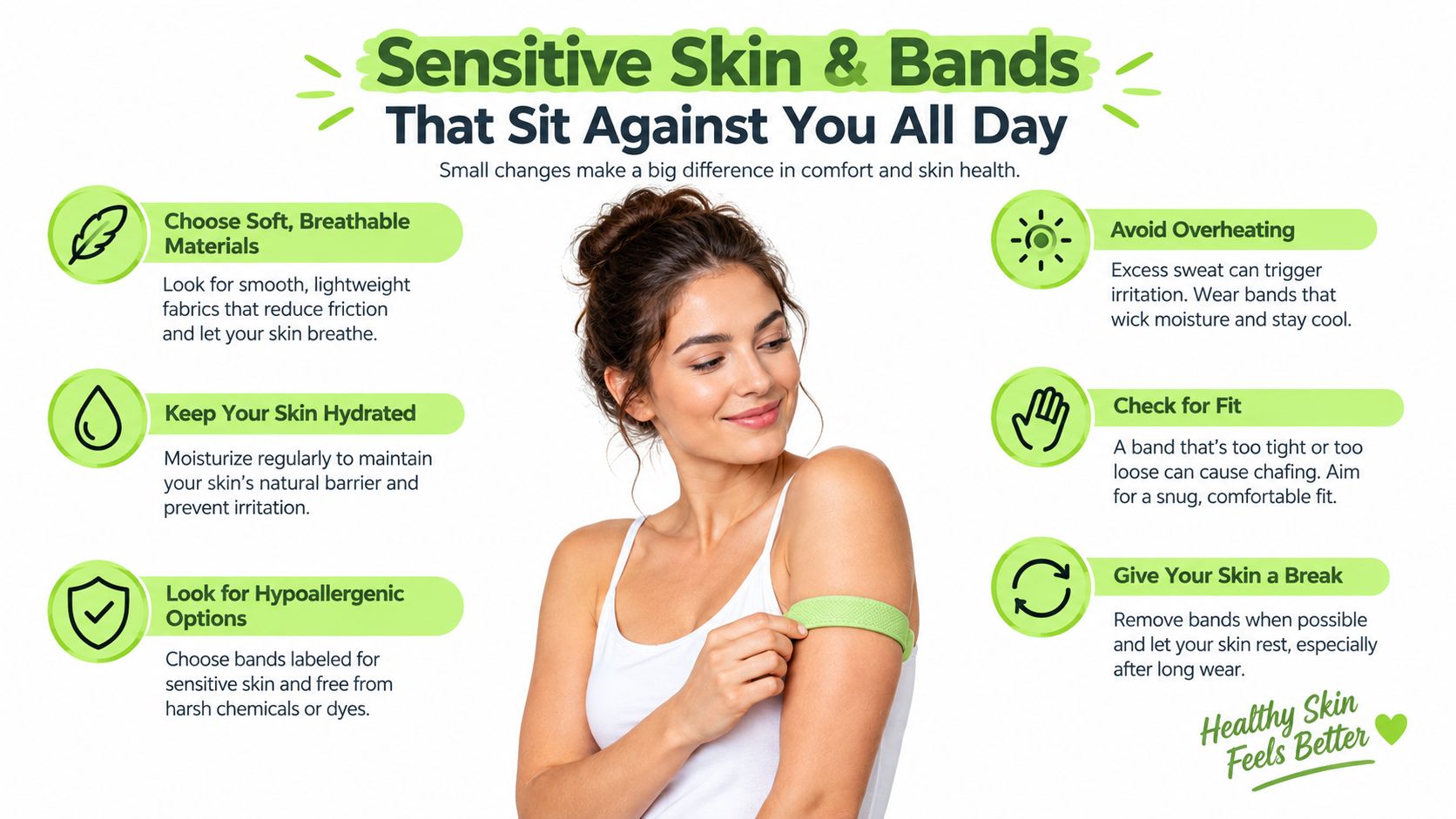
Sensitive skin needs a decision tree, not a material slogan. If a band traps sweat, rubs the same patch of skin for hours, or carries hardware that irritates you, the wrong choice can turn into a rash no matter how nice it looks.
Start with friction and moisture, not marketing words
The irritation triggers are usually plain enough, sweat, friction, occlusion, and sometimes metal or polymer exposure at the contact points. A dermatology case report tied a wrist rash to a synthetic-rubber smartwatch band and considered sweat, friction, and material exposure as possible causes. In other words, a “sweat-proof” band can still be skin-risky if it sits too tight or doesn't breathe.
The practical fix is boring, and it works. Wear the band a little looser during workouts, clean and dry the wrist after exercise, and rotate in a second band so the same skin isn't taking the same contact every day. Breathable weaves and smoother surfaces usually feel better than stiff, abrasive ones.
Know when to stop guessing
No material is universally hypoallergenic. If you already know you react to nickel, acrylates, or certain rubber compounds, check the band and hardware composition before you buy, then stop wearing the band at the first sign of redness or itching.
If the wrist is irritated, change the band before you change your whole routine.
The caution matters because medical reporting on smartwatch bands has found measurable PFHxA in some wearable-tech bands and raised concern about what long skin contact might mean, while also noting that the evidence wasn't enough to prove a specific disease risk from routine use. That's enough reason to care about disclosed materials, breathability, cleanability, and skin response instead of shopping on appearance alone.
If you want the broader heavy-sweat angle, our guide to the best watch straps for heavy sweating goes further there. This guide keeps the focus on how to choose a replacement that doesn't bother your skin by accident.
Cleaning and Adjusting a Replacement Band
A replacement band stays comfortable when you clean it regularly and don't over-tighten it. The routine is short enough to remember and short enough to do after a workout.
A two-minute care routine that prevents most problems
Rinse the band with fresh water after exercise or visible grime. Use mild soap when the material allows it, then dry the strap fully before putting it back on the wrist. That matters because damp material sitting against skin is a fast route to irritation.
Fit also matters more than people think. The band should sit secure enough that the watch doesn't slide around, but not so tight that it traps sweat or marks the skin. Check the spring bars or pins regularly, especially if you swap bands often.
Fitbit's care guidance is straightforward here, clean the band and wrist regularly, especially after exercise, sweating, or handwashing, use fresh water and, when needed, hypoallergenic soap, and let the band dry thoroughly before reuse. Fitbit also says leather bands should not be cleaned with soap, which is the kind of detail people ignore until the strap looks tired.
A real example of an everyday-durability pick
Scott Lopez on the Vornis — Silicone Sport Band — Quick Release 22mm: "This silicone sport band is a real winner! It arrived super fast, which was a nice surprise. The quality feels great – not flimsy at all, and it’s held up through some sweaty workouts without any signs of wear. Plus, the navy color looks sharp; definitely makes my watch stand out."
That review shows what a workout band has to do. People want something that rinses easily, feels solid, and doesn't become a hassle after sweat.
If you like that route, the quick-release replacement bands collection is the right place to browse, and the Vornis Silicone Sport Band, Quick Release 22mm is the specific band named in the review.
What the Sales Data Actually Shows
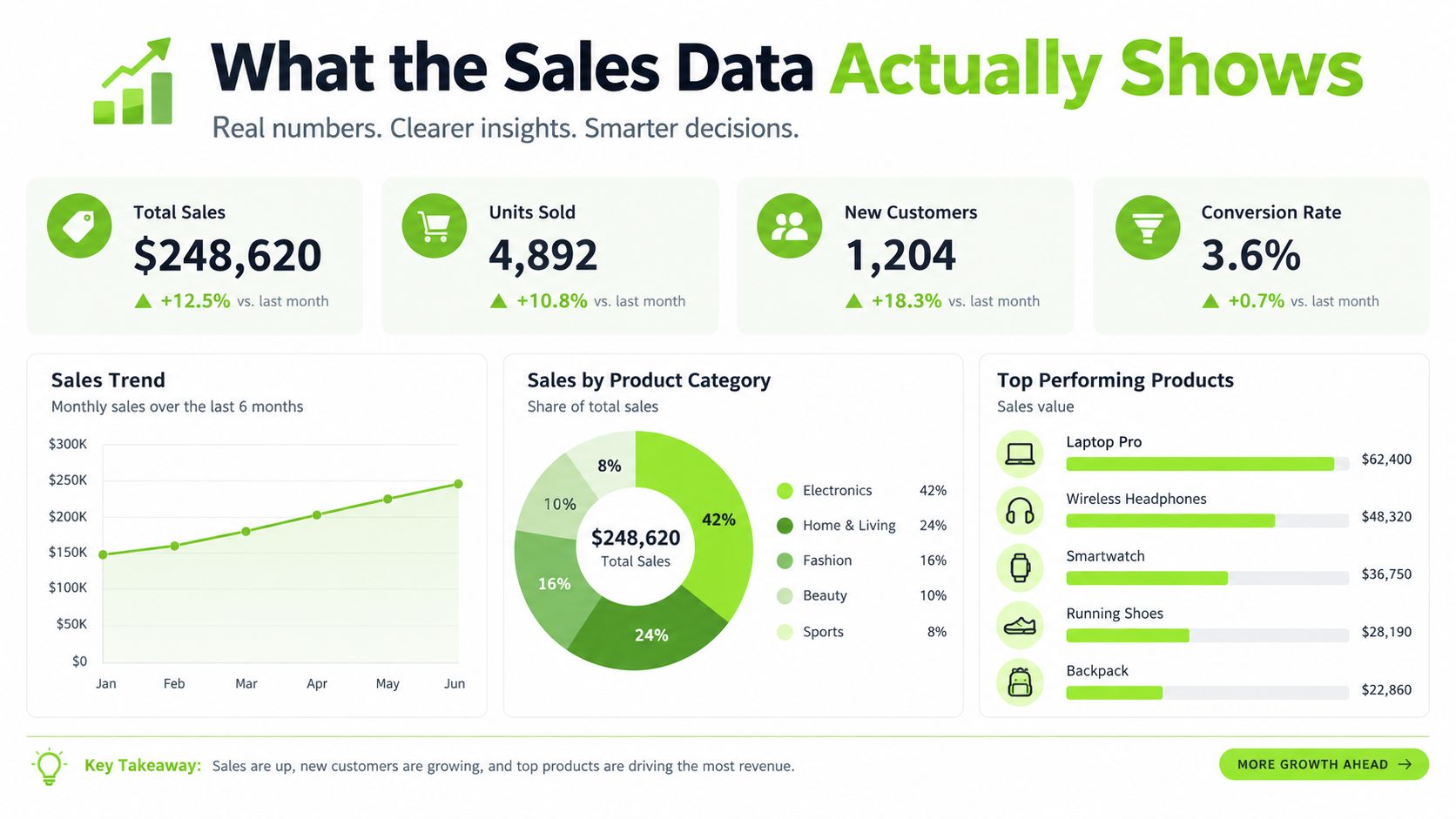
The sales pattern is blunt. Of the 322 units ordered between 4 December 2025 and 8 October 2026, nylon takes 45%, Milanese takes 16%, silicone and leather take 15% each, braided takes 5%, stainless link takes 4%, and resin takes 1%. Those are sales shares, not wear-test verdicts.
The biggest seller is function, not flash
By fitting, universal quick-release bands are 23% of units ordered between 4 December 2025 and 8 October 2026, the single largest group, ahead of Garmin QuickFit at 21% and Apple Watch and Fitbit Charge at 18% each. A quick-release band in the right width fits any watch with standard lugs, so one band family serves owners of many different watches.
The individual unit leaders over the same period tell a similar story. The Véllo — Nylon Loop — Quick Release 20mm leads at 17 units (5% of units ordered), the Aeri — Sport Loop — Fitbit Charge 5/6 and the Arden — Nylon Loop — Fitbit Charge 5/6 follow at 13 units each (4%), and the Solin — Magnetic Milanese — Quick Release 20mm sits at 11 units (3%). Nylon and the universal 20mm quick-release fitting keep showing up near the top.
What those numbers do and do not mean
These shares are not a verdict. They show what sold, not why each buyer picked a band, and not which band “won” a lab test.
If you want to compare these sales patterns with conversion behavior in your own store, the article on audit and test Shopify sales tactics is a good adjacent read. For this guide, the useful takeaway is simpler, quick-release nylon and magnetic Milanese are strong live categories because they fit a lot of watches and solve a lot of daily-use problems.
Our Picks and the Basis Behind Them
The shortlist here is based openly on verified five-star review count and average rating, with one pick per fitting family. On that measure, the Vornis — Silicone Sport Band — Quick Release 22mm has 18 five-star reviews and a 4.67 average, the Lyra — Resin Composite Link — Apple Watch has 15 five-star reviews and a 4.6 average, and the Lurea — Magnetic Milanese — Fitbit Charge 3/4 has 19 five-star reviews and a 4.76 average.
The everyday pick
The Vornis — Silicone Sport Band — Quick Release 22mm is the clearest daily-use pick: 18 verified five-star reviews, a 4.67 average, and a universal 22mm quick-release fitting. It fits the profile of the buyer who wants a band that handles sweat, swaps quickly, and doesn't need babying.
The transformation pick
Jacob Torres on the Lyra — Resin Composite Link — Apple Watch wrote, "Gotta say, this resin composite link for my Apple Watch is totally worth the price! It looks super classy with that tortoiseshell design and feels really nice on the wrist. Just enough flair without being over the top. Really happy with how it transformed my watch; can’t stop staring at it!"
That's the right use case for resin link, a watch that needs a cleaner, more polished look without sliding into full dress-watch territory.
The dressier pick
The Lurea — Magnetic Milanese — Fitbit Charge 3/4 earns its place with 19 verified five-star reviews and a 4.76 average, and the material does a specific job well: quick size changes, a cleaner profile, and a dressier finish than sport straps. It suits anyone who wants easier wrist adjustment.
We sell replacement bands and straps only, not watches, tools, or lug adapters, and these picks rest on review counts and average ratings, nothing more.
Putting It Together and Where to Go Next
Confirm the fitting bucket first, standard lugs or a proprietary connector, then match width and connector type before you think about style. After that, pick the material for the way the watch is worn, factor in sweat and skin sensitivity, and use verified review counts and average ratings instead of chasing a pretty product photo.
For most shoppers, the strongest starting points are the quick-release replacement bands and the nylon watch bands collection. If you're still deciding on style or comfort, our guides on different styles of watch bands and comfortable watch straps are the next sensible stop.
Nothing but Bands offers replacement straps across Apple Watch, Samsung, Garmin, Fitbit, and standard quick-release fits, with the practical stuff covered up front: size, material, and secure attachment. That keeps the decision where it belongs, on fit and wear, not guesswork.
If your old strap is done, start with the fitting, then choose the band you'll want to wear every day. Visit Nothing but Bands to compare quick-release, nylon, silicone, Milanese, and leather replacements without wasting time on bands that won't fit your watch.
Related posts

- October 13, 2026
Learn how to clean rubber watch bands safely and effectively. Simple methods to remove dirt, sweat, and grime without harming...

- October 12, 2026
Most smartwatch owners don't need a quick release strap adapter. Learn what the term actually means, how to check your...
