


Your watch band is already on, but it's loose, tight, or sitting off-centre. To adjust it, first identify the closure you're holding: a removable-link bracelet, a buckle strap with holes, a magnetic Milanese strap, a hook-and-loop sport loop, or a stretch loop with nothing to adjust at all. Each mechanism adjusts differently, and the right method depends on the band, not the watch brand.
You don't need to buy a sizing kit to make a basic adjustment to the band you're wearing. Most of these closures adjust by hand.
Table of Contents
- Which Adjustment Family Does Your Band Belong To
- How to Adjust a Metal Link Bracelet
- How to Adjust a Buckle Strap
- How to Adjust a Magnetic Milanese Strap
- How to Adjust a Hook-and-Loop Sport Loop
- How to Adjust a Stretch Loop
- How to Tell the Fit Is Actually Right
- Frequently Asked Questions About Adjusting Watch Band Size
Which Adjustment Family Does Your Band Belong To
Look at the closure and the part that changes the fit. That's usually enough to choose the right method without measuring your wrist or guessing from a brand name.
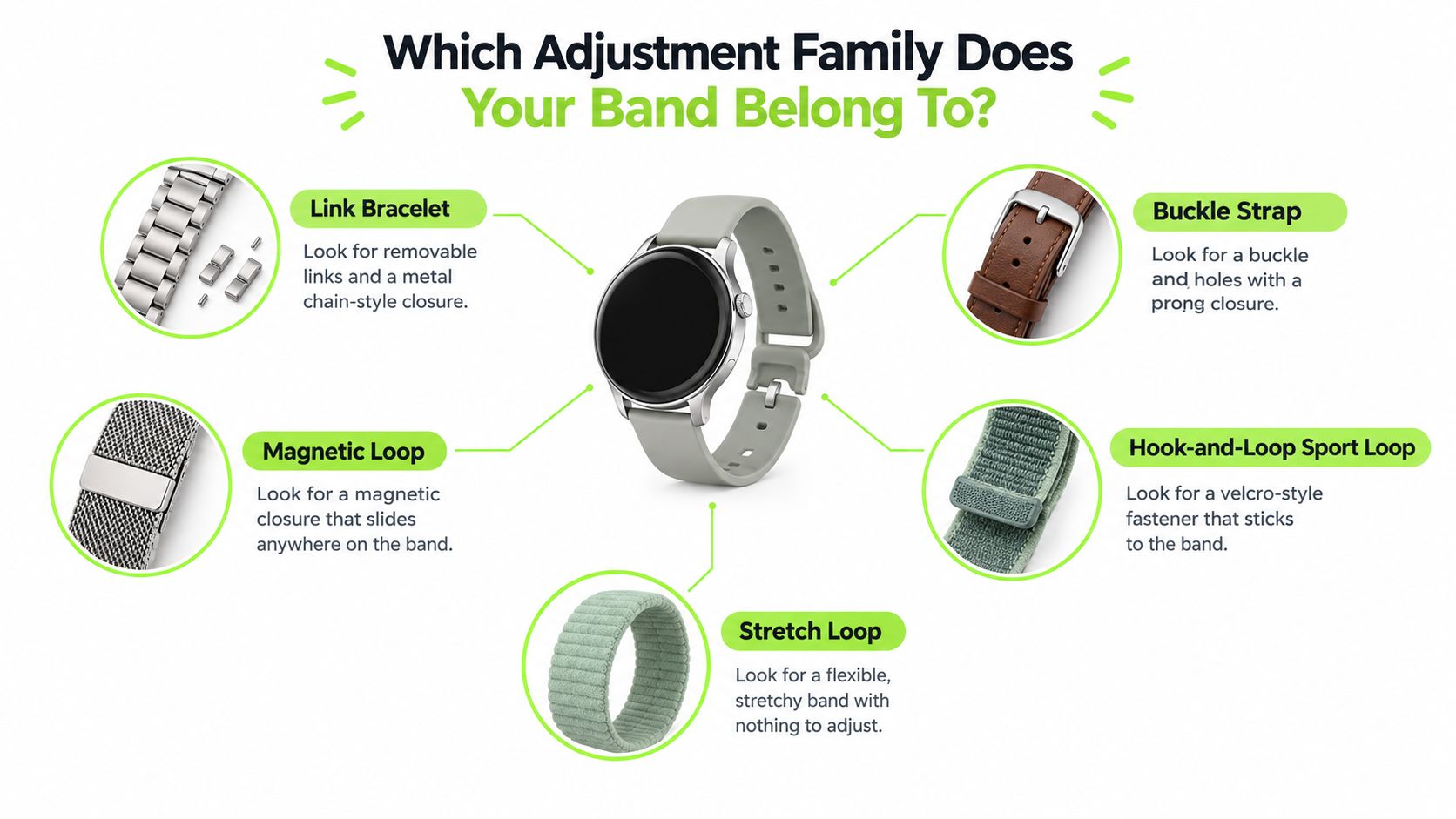
Start with a metal link bracelet. It's made of separate rigid links, and removable links may have small arrows on their underside or edge showing the direction a pin comes out. Some bracelets use screws instead, so check the link edges before reaching for a tool.
A buckle strap, often leather, stitched fabric or perforated silicone, has a prong that goes through a row of fixed holes. A magnetic Milanese strap is fine metal mesh with a clasp that slides along the mesh and holds by magnet, so it has no holes at all.
Last, check whether the band is a hook-and-loop sport loop or a stretch loop. A hook-and-loop strap peels apart and fastens again at a different point. A stretch loop has no clasp or adjustment hardware, so the fit comes from its elastic stretch rather than a setting you can change.
Follow the section that matches the mechanism in your hand. If the band doesn't move by that method, don't force it. A similar-looking connector or closure can work differently, and pressure is more likely to damage it than improve the fit.
How to Adjust a Metal Link Bracelet
To shorten a metal link bracelet, centre the clasp under your wrist first, then take links out in pairs, one from each side of the clasp, rather than removing everything from one end. That keeps the clasp centred and preserves the bracelet's taper.
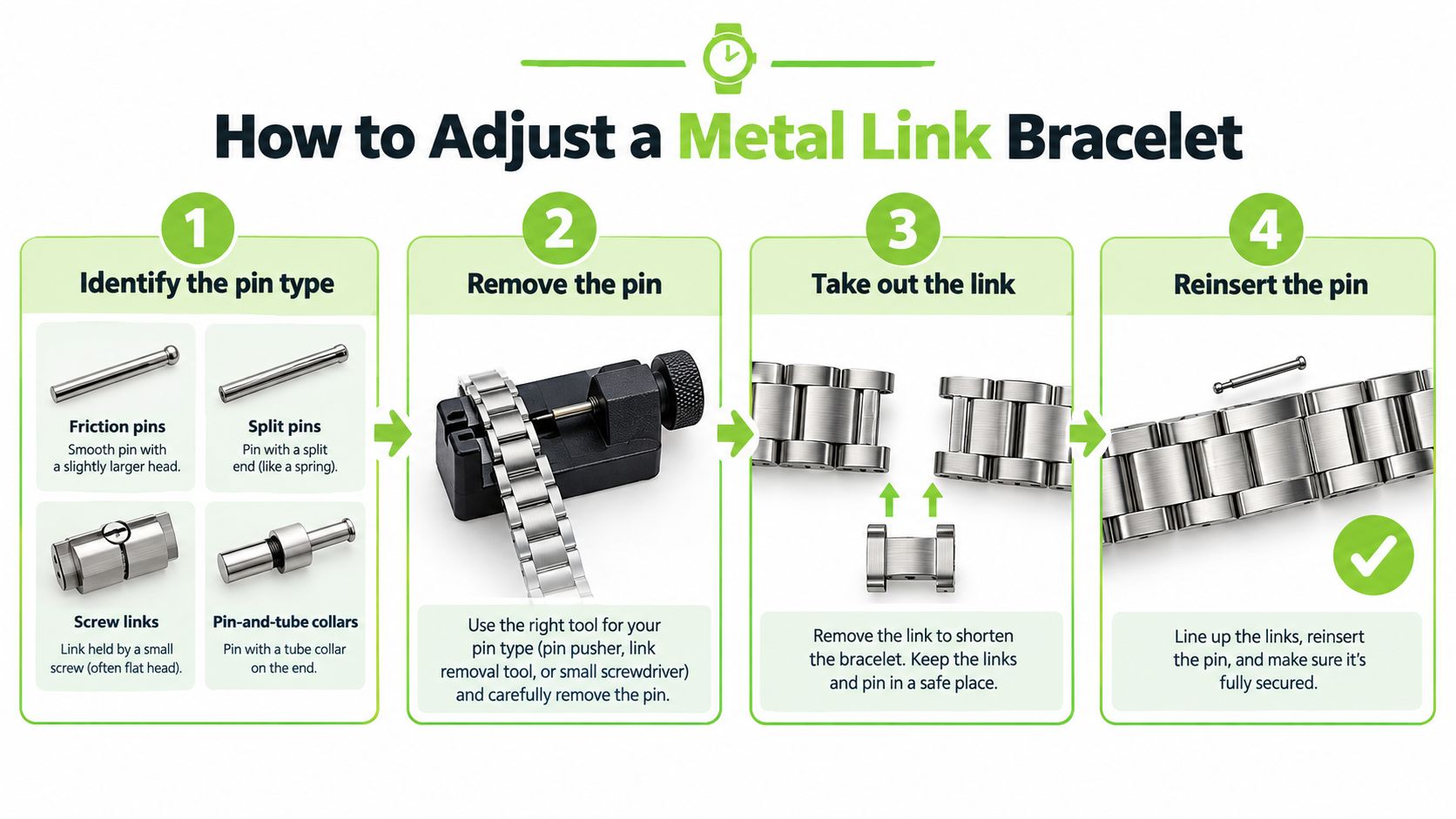
Use a proper pin pusher with a bracelet holder rather than improvising with a nail or screwdriver, and follow any arrows stamped on the links. Push only in the arrow's direction, remove one link first, and keep each pin and its collar together. Use the clasp's micro-adjustment holes for the last few millimetres.
If a pin won't move under steady pressure, stop. Forcing it can bend the pin and scratch the link.
Friction pins, split pins, pin-and-collar links and screw links each come apart differently. The guide to removing links from a watch strap walks through each of those mechanics step by step.
Our own link bracelets are the Rovik — Stainless Link — Garmin QuickFit 22 and the Orven — Stainless Link — Garmin QuickFit 22, plus the Kryos — Stainless Link for Galaxy Watch 8 & 9 and for Galaxy Watch Ultra & Ultra 2. Each has removable links; resize it with an appropriate link-removal tool or at a watch service. A QuickFit band comes off the watch by sliding its latch open and lifting it away, which makes the bracelet easier to work on flat.
After reassembly, check every joint by hand and give the bracelet a gentle pull test before wearing it. A loose pin or missing collar can let the bracelet separate.
How to Adjust a Buckle Strap
For a leather, stitched or silicone strap with fixed holes, move the buckle prong one hole at a time until the case stays put without making the band constricting. Start with the hole you're using now, then test the next tighter or looser position rather than jumping several holes at once. There's no need to take the strap off the watch to do this.
The prong should enter the hole at a slight angle, then lie flat as the strap settles. If the leather bunches or folds sharply beside the buckle, the prong may not be seated cleanly. Tuck the tail through its keeper so it doesn't catch on sleeves.
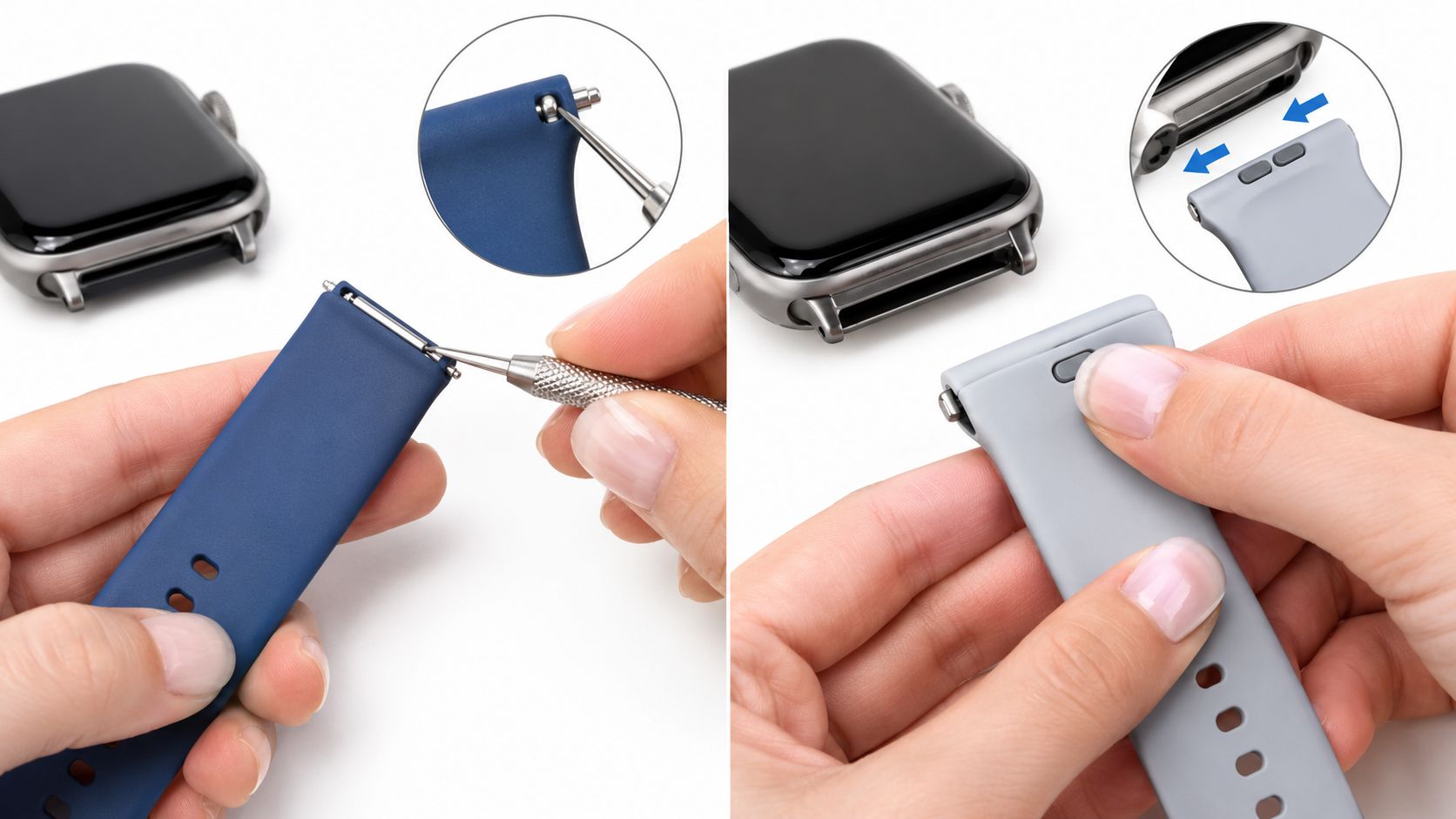
Silicone works the same way as leather, but it doesn't stretch like nylon, so choose the hole that holds the watch steady rather than one that only feels secure once pulled tight. If you'd rather switch to a different hole-based band altogether, the silicone sport band collection includes replacement styles for compatible watches.
If the strap needs a new hole between two existing ones, don't improvise with a sharp household object. The guide to punching a hole in a leather watch band covers that separate job.
If a strap pulls the watch case off-centre, check the chosen hole and how the strap sits through the buckle before blaming the band. Wearing the watch on the other wrist can also change how the holes line up with the buckle tongue.
How to Adjust a Magnetic Milanese Strap
A magnetic Milanese strap adjusts by sliding its clasp along the mesh, not by moving a buckle prong between holes. Every Milanese band sold by Nothing but Bands uses a magnetic sliding clasp, not a folding-clasp mesh.
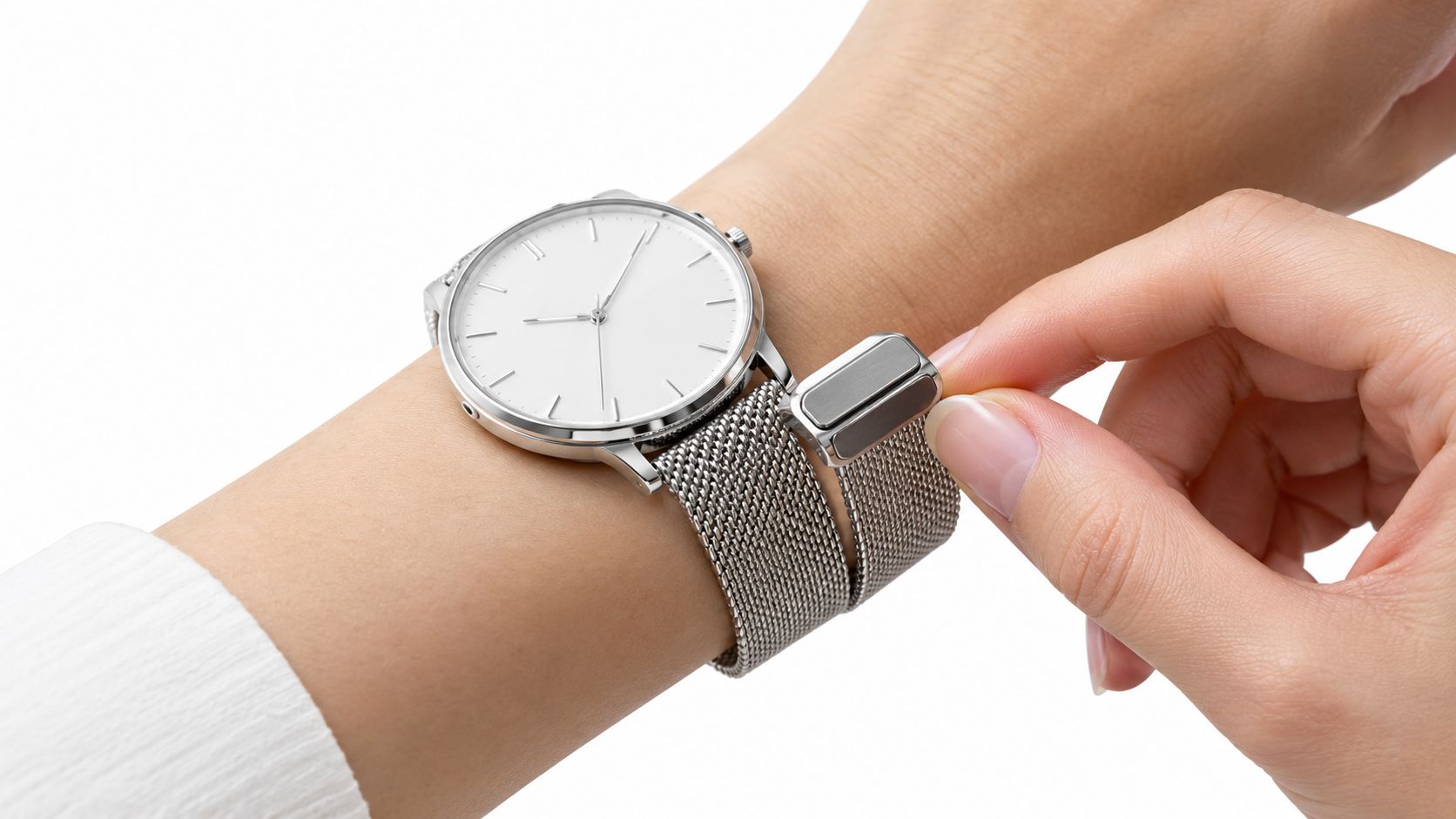
Lay the watch flat and hold the case steady. Lift the clasp off the mesh, then slide it to the position you want. Put the watch on, bring the band snug around your wrist, and let the magnet catch the weave. Check that the clasp is lying flat and that the mesh isn't twisted.
This closure allows small fit changes without choosing a different hole. That's handy when your wrist feels different through the day, though the clasp still needs to hold securely and the band shouldn't pinch when you move your hand.
Jack Baker, reviewing the Lurea — Magnetic Milanese — Fitbit Charge 3/4, wrote: "Totally worth the price for what you get! The Lurea Magnetic Milanese is not only super stylish, but it feels high-quality too. Adjusting the fit is a breeze and it’s comfy enough to wear all day. Honestly, couldn't be happier with this purchase—made my Fitbit feel like a whole new accessory!"
The Milanese watch band collection uses this sliding-clasp style. For a magnetic closure, the trade-off is straightforward: it makes small adjustments easy, but you should still check that the clasp is seated securely before wearing the watch.
How to Adjust a Hook-and-Loop Sport Loop
A hook-and-loop sport loop has no holes. Peel the closure apart, slide the nylon to the new position, and press it flat again. Work from both ends when the tail runs long, so the keeper stays near the underside of the wrist instead of leaving a tab sticking out toward your hand.
Set the tension on the wrist, not in your fingers. Nylon gives a little, so a strap that feels loose in the hand can grip once the case is against the arm. Smooth both faces of the closure until no hooks lift; raised edges catch sleeves and slowly peel open. If you need a replacement rather than a fit tweak, browse nylon watch bands.
How to Adjust a Stretch Loop
A stretch loop has no closure to move. The elastic itself is the adjustment, so pick the size that holds the case steady without squeezing; if it slips or bites, the fix is a different loop size.
A metal expansion bracelet is the exception: it's shortened by taking out some of its spring-loaded links. The guide to removing links from a stretch watch band covers that job.
How to Tell the Fit Is Actually Right
A properly adjusted watch stays in sensor contact without pinching, sliding down your wrist, or leaving the band uncomfortably tight. Check the fit at rest, when warm and active, and again after a workout; a setting that feels fine while you're sitting may feel restrictive once your wrist expands.
The case should sit about a finger's width above the wrist bone, and a finger should slide under the band without being forced. The optical sensor on the back must stay in contact with your skin, and the watch shouldn't shift when you swing your arm. If the case rotates or slides around, the band may be too loose; if you can't slip a finger beneath it comfortably, it may be too tight.
When the band is loose, the watch can slide down your wrist and let light leak beneath the optical sensor, causing heart-rate readings to drop out. When it's too tight, it can restrict circulation, leave an indentation, and trap sweat against your skin.
Wrists swell through the day and during exercise, so check your fit in the afternoon rather than relying only on how it feels first thing in the morning. For a workout, you may prefer the watch a little higher on your arm and the band a notch snugger than for all-day wear. If you need help with wrist measurement for a future replacement, use the separate guide to measuring your wrist for a watch.
Frequently Asked Questions About Adjusting Watch Band Size
What tool should I use for a spring-bar band?
For an ordinary spring-bar band, a cheap double-ended spring-bar tool does the job: forked on one end and pointed on the other. Apple Watch slide-in bands, Garmin QuickFit bands, many quick-release bands and Milanese bands need no tool. An Apple Watch band releases with the button on the back of the watch case, and a QuickFit band with its latch.
What should I do if a link pin won't come out?
People usually get stuck pushing a pin from the wrong side. Check for an arrow and push only in the indicated direction, keeping the pusher square to the link, and stop if a pin won't move under steady pressure rather than forcing it.
How can I check whether a band fits my smartwatch?
Check the exact watch model and its connector system, not just the band's stated width. Garmin QuickFit and Garmin Quick Release, for example, are different attachment systems, so a physically similar band may use a different connector. Confirm compatibility in the manufacturer's model-specific guidance before trying to force it into place.
Nothing but Bands offers replacement straps for compatible Apple Watch, Samsung Galaxy Watch, Garmin, Fitbit, and other smartwatch models, including Milanese, leather, silicone, and nylon styles. If you're ready to change the feel or closure of the band you're adjusting, browse Nothing but Bands and check the exact model compatibility before choosing a replacement.
Related posts

- October 22, 2026
A mixed metal Apple Watch band starts with one rule: keep finishes coherent. Learn how silver, black, rose gold and...

- October 21, 2026
Discover truly nickel free watch bands that won't irritate skin. Compare materials, avoid common myths, and find comfortable hypoallergenic options.
