


Watch strap width is the exact gap in millimetres between the inside faces of a watch's lugs, where the spring bar seats. It's expressed as a whole millimetre, and 18 mm, 20 mm, and 22 mm cover most ordinary watches, with 20 mm as the everyday default.
3 Key Takeaways: Watch Strap Width
Inside lug gap: Strap width is the gap between the inner faces of the lugs, in millimetres.
20mm leads: 18, 20 and 22mm cover most watches, and 20mm is the most common.
Don't round odd sizes: 19mm and 21mm are real widths. Rounding gives a poor fit.
That number isn't your wrist size, the diameter of the case, or the width of the buckle. It tells you whether the strap can physically sit between the watch's attachment points. Get the measurement right and strap shopping becomes straightforward. Get it wrong and the band may rattle, refuse to enter the lugs, or fail to hold the watch securely.
Table of Contents
- What Watch Strap Width Actually Measures
- Why Watch Sizes Are Whole Millimeters and Why 20mm Leads
- Odd Widths Like 19mm and 21mm Are Real and Should Not Be Rounded
- How Smartwatches Change the Width Equation
- Quick Release Spring Bars and the Width Question
- Matching Width to Sport, Dress, and Everyday Watches
- Common Width Mistakes and How to Avoid Them
What Watch Strap Width Actually Measures
Watch strap width is the precise distance between the inside faces of the watch's lugs, measured at the level where the spring bar sits. The lugs are the two projections extending from the case, and the strap end slips into the space between them. A spring bar passes through the strap and rests in the holes drilled through the lugs.
Think of the lug gap like the receiving slot in a seatbelt buckle. The belt tongue has to enter the slot cleanly, with enough room to move into position but not so much room that it rattles or disengages. A watch strap works in much the same way. The strap end, spring bar, and small amount of clearance around the bar all have to cooperate inside the fixed lug gap.
The measurement applies to the strap end that attaches to the case. A strap listed as 20 mm must fit a 20 mm lug gap, and its spring bars must be suitable for that attachment. Some straps taper toward the buckle, such as a 20/16 mm design. In that example, 20 mm is the fitting width at the watch and 16 mm describes the narrower buckle end, as explained in this watch lug width guide.
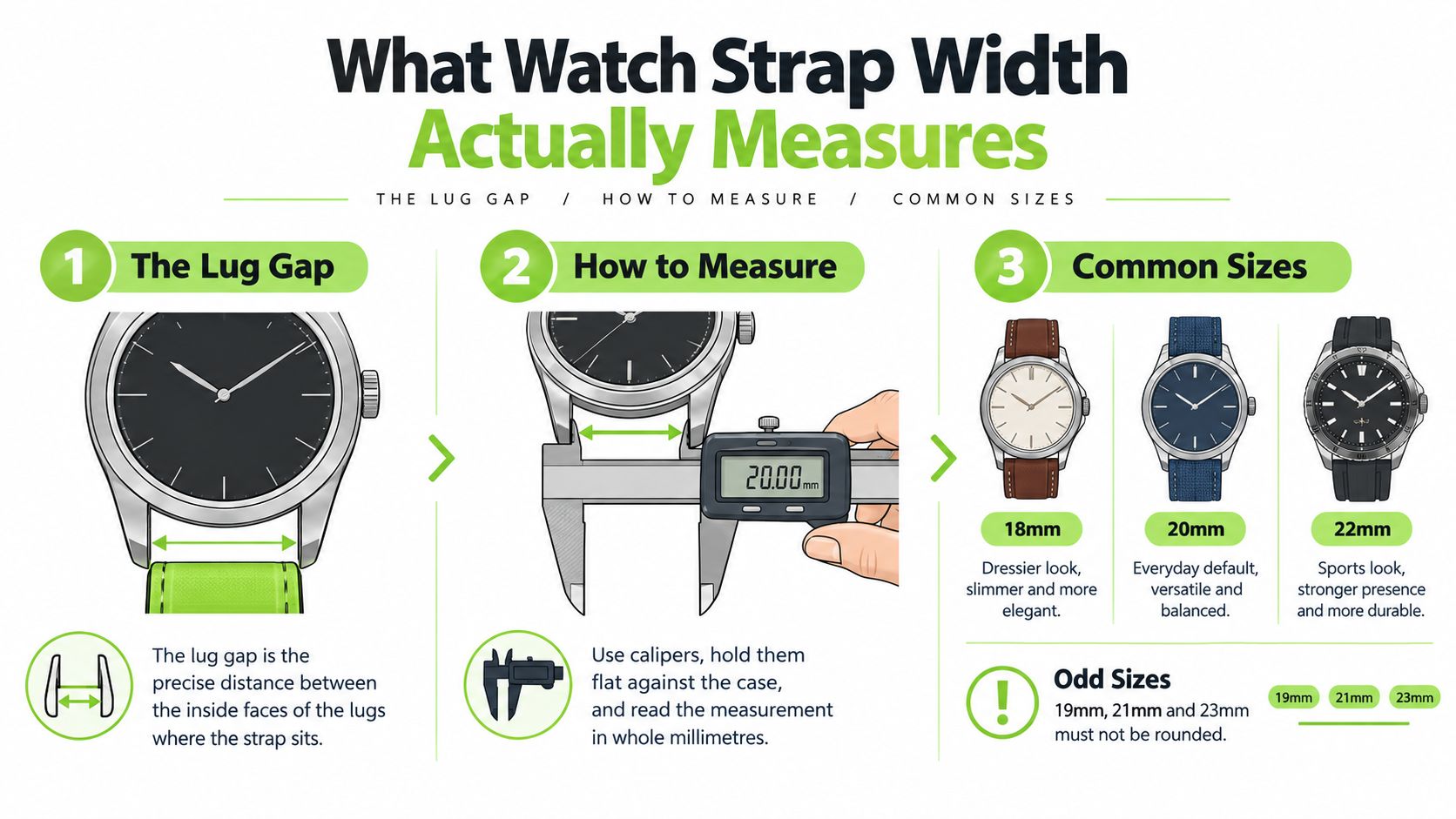
Practical rule: Measure the watch's lug gap, not the old strap, the case exterior, or the buckle.
Wrist size controls strap length and hole placement. Case diameter describes the size of the watch head. Neither one tells you the watch strap width. A large-looking watch can use a narrower strap than expected, while a compact case can have a relatively broad lug arrangement.
Why Watch Sizes Are Whole Millimeters and Why 20mm Leads
Watch strap widths are normally sold in whole millimetres, because the lug gap, spring-bar placement, and replacement strap sizes are built around standardized measurements. Industry sizing guidance identifies common widths in the 16 mm to 24 mm range, with 18 mm, 20 mm, and 22 mm appearing most often among ordinary watches.
That standardization gives shoppers a manageable set of choices. 20 mm is the everyday default for many men's and unisex watches, while 22 mm commonly serves larger sports and tool-watch designs. 18 mm tends to suit smaller, slimmer, or dressier watches, where a narrower strap keeps the proportions restrained.
| Width | Typical Watch Type | Example |
|---|---|---|
| 18 mm | Smaller or dress watches | Slim vintage-style watch |
| 20 mm | Everyday, field, and many sports watches | Seiko SKX |
| 22 mm | Larger sports, dive, and tool watches | Large chronograph |
A strap listing may also describe a tapered design rather than a single constant width. The first number identifies the lug end, while the second identifies the buckle end. That's why a 20/16 mm strap still belongs on a watch with a 20 mm lug gap.
Sizing logic appears in other retail categories too, although the measurements aren't interchangeable. Readers comparing how product specifications work may find a ring size 10 guide useful as an example of why a named size must match the item's own measurement system, rather than being guessed from appearance.
A band built for that everyday default, such as the Véllo Nylon Loop in 20 mm, is sized to the lug gap in exactly this way. Apple Watch owners should use the case-size compatibility system instead of applying these lug-based categories. For example, the Arden Nylon Loop for Apple Watch is designed exclusively for Apple Watch and uses its own case-based fitting approach.
Odd Widths Like 19mm and 21mm Are Real and Should Not Be Rounded
Odd widths such as 19 mm, 21 mm, and 23 mm are real sizes and should be purchased as measured, not rounded. Some watch cases use these dimensions because of their particular lug architecture or a legacy sizing standard.
The mechanical problem is simple. A 20 mm strap end is wider than a 19 mm gap, so it cannot enter the space between the lugs at all. An 18 mm strap leaves excess side clearance in that same 19 mm gap, allowing the band to move from side to side and potentially letting the spring bar slip out of position.
The same principle applies to 21 mm and 23 mm. Choosing 22 mm for a 21 mm watch doesn't create a “close enough” fit. The strap can press against the lugs, prevent proper spring-bar seating, or make installation impossible. Choosing a narrower size leaves unwanted movement at the attachment point.
A reading that lands on an odd number deserves a second check, especially if the case has curved lugs or a tight attachment area. Use a millimetre ruler or calipers held flat between the inner lug faces, then compare the result with the manufacturer's published specification. The attachment dimension is a precise fit requirement, not a style preference: the strap either matches the gap or it does not.
Nothing but Bands stocks quick-release straps in 18 mm, 20 mm, and 22 mm. If your watch measures 19 mm, 21 mm, or 23 mm, those stocked sizes aren't a substitute for the correct odd-width strap.
How Smartwatches Change the Width Equation
Apple Watch bands are selected by the watch's case-size group, Fitbit bands by model, and Samsung uses both standard lug widths and proprietary fittings depending on the model. A millimetre figure that works for an ordinary spring-bar watch may be irrelevant to a smartwatch.
Apple Watch bands don't use a conventional lug-width choice. The band connects through Apple Watch's case-specific interface, so a standard 20 mm watch strap isn't physically compatible just because the watch looks similar in size. The case group, not a measurement between traditional lugs, is the relevant shopping key.
Fitbit also requires model-based matching. Fitbit connectors differ across product families, so a generic 18 mm, 20 mm, or 22 mm listing doesn't establish compatibility. The model name and the strap's stated compatibility must agree.
Samsung is more complicated, because its models sit in both camps and the fitting requirement changes from one generation to the next. The Galaxy Watch4 through Galaxy Watch7 use standard 20 mm straps, while the Galaxy Watch Ultra uses its own fitting rather than a standard strap width, which is why model-by-model checking matters.
| Brand | Sizing System | Common Width |
|---|---|---|
| Apple Watch | Case-size group | No traditional lug-width selection |
| Fitbit | Model-specific connector | Model dependent |
| Samsung Galaxy Watch4 through Watch7 | Standard lug-based fitting | 20 mm |
| Samsung Galaxy Watch Ultra | Proprietary fitting | Not a standard lug-width choice |
The same caution applies to Garmin QuickFit models and other watches that use keyed or adapter-dependent connectors. Even where 20 mm and 22 mm are common, the connector can override the width. A standard number is useful only when the watch accepts a standard spring bar.
Quick Release Spring Bars and the Width Question
Quick-release spring bars don't change the strap width; they only change how the strap is removed and installed. A 20 mm quick-release strap still needs a 20 mm lug gap, just like a 20 mm strap with traditional spring bars.
A traditional spring bar contains a spring-loaded pin that must be compressed with a spring-bar tool. The tool retracts the pin from the lug hole, allowing the strap to slide out. A quick-release bar adds a small lever or pull-tab to the bar, so you can retract it with a fingernail instead.
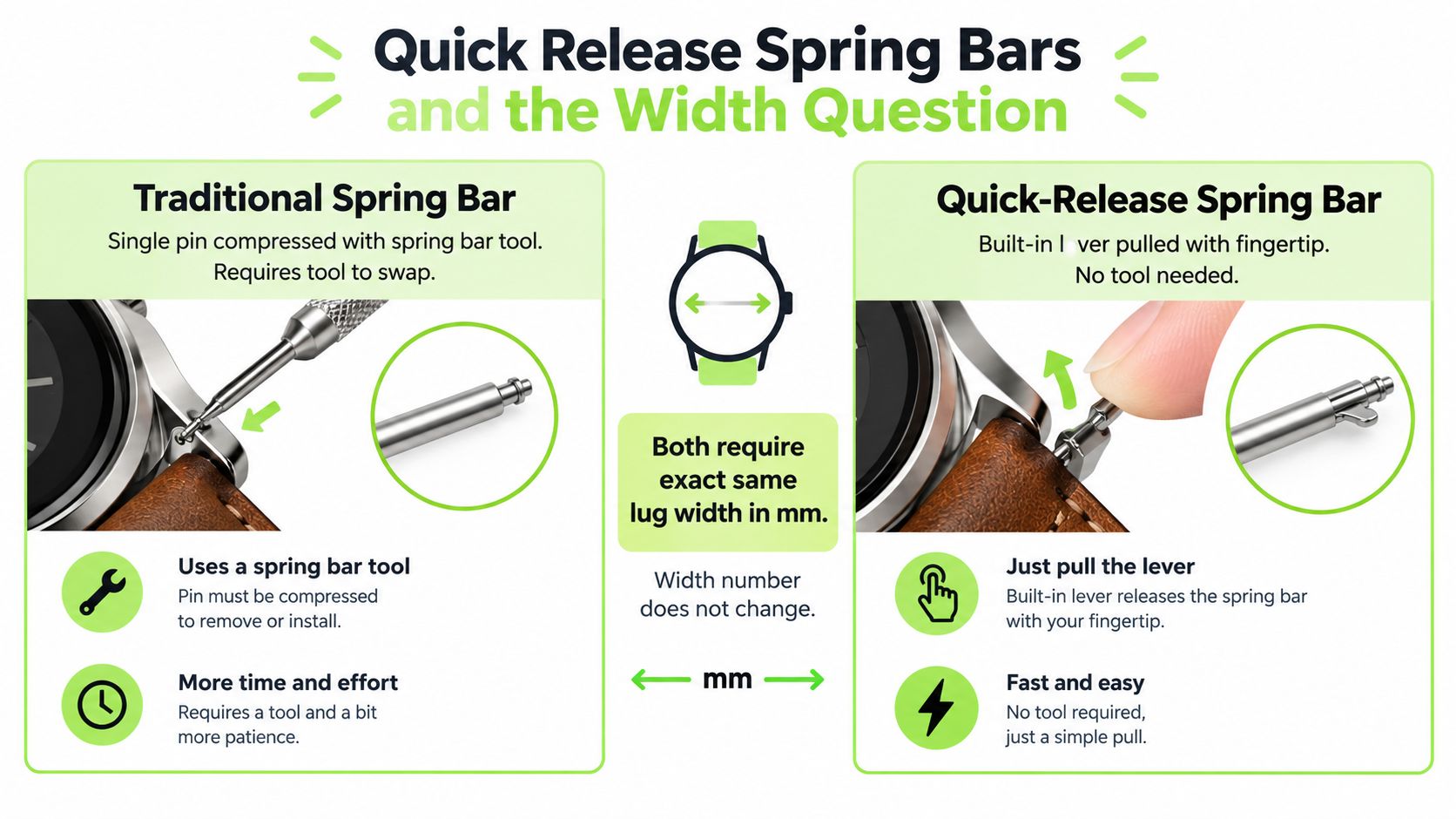
The width remains a fit question. The pin style is a convenience question.
| Feature | Traditional spring bar | Quick-release spring bar |
|---|---|---|
| Lug-width requirement | Must match the lug gap | Must match the lug gap |
| Removal method | Spring-bar tool | Built-in lever or tab |
| Main advantage | Familiar, tool-based fitting | Faster strap changes |
A quick-release bar is practical for someone who changes straps often, but it can't rescue an incorrect width. A 22 mm quick-release band won't fit a 20 mm lug gap, and a 20 mm fixed-pin band won't fit a proprietary smartwatch connector unless the required adapter is present.
See the explanation of a quick-release watch strap before buying, particularly if a retailer lists both the width and the connector type.
The following video demonstrates the difference between the two spring-bar approaches.
Matching Width to Sport, Dress, and Everyday Watches
Match the strap width to the watch's measured lug gap first, then use the width to judge visual balance. Width can make a correctly fitted watch look proportionate or awkward, but appearance never overrides the physical measurement.
An 18 mm strap usually gives smaller and dressier watches a lighter outline. It works naturally with slimmer cases and vintage-inspired designs, where a broad band can overwhelm the dial or sit heavily beneath a cuff.
A 20 mm strap is the practical center point for many ordinary watches. It suits everyday field watches and a broad range of mid-sized sports watches, provided the lug gap measures 20 mm. The width also leaves room for tapered designs that become narrower toward the buckle.
A 22 mm strap gives larger sports and tool watches more visual support. Divers, chronographs, pilot-style watches, and field designs often look balanced with a wider band, but the case's actual lug spacing remains the deciding factor.
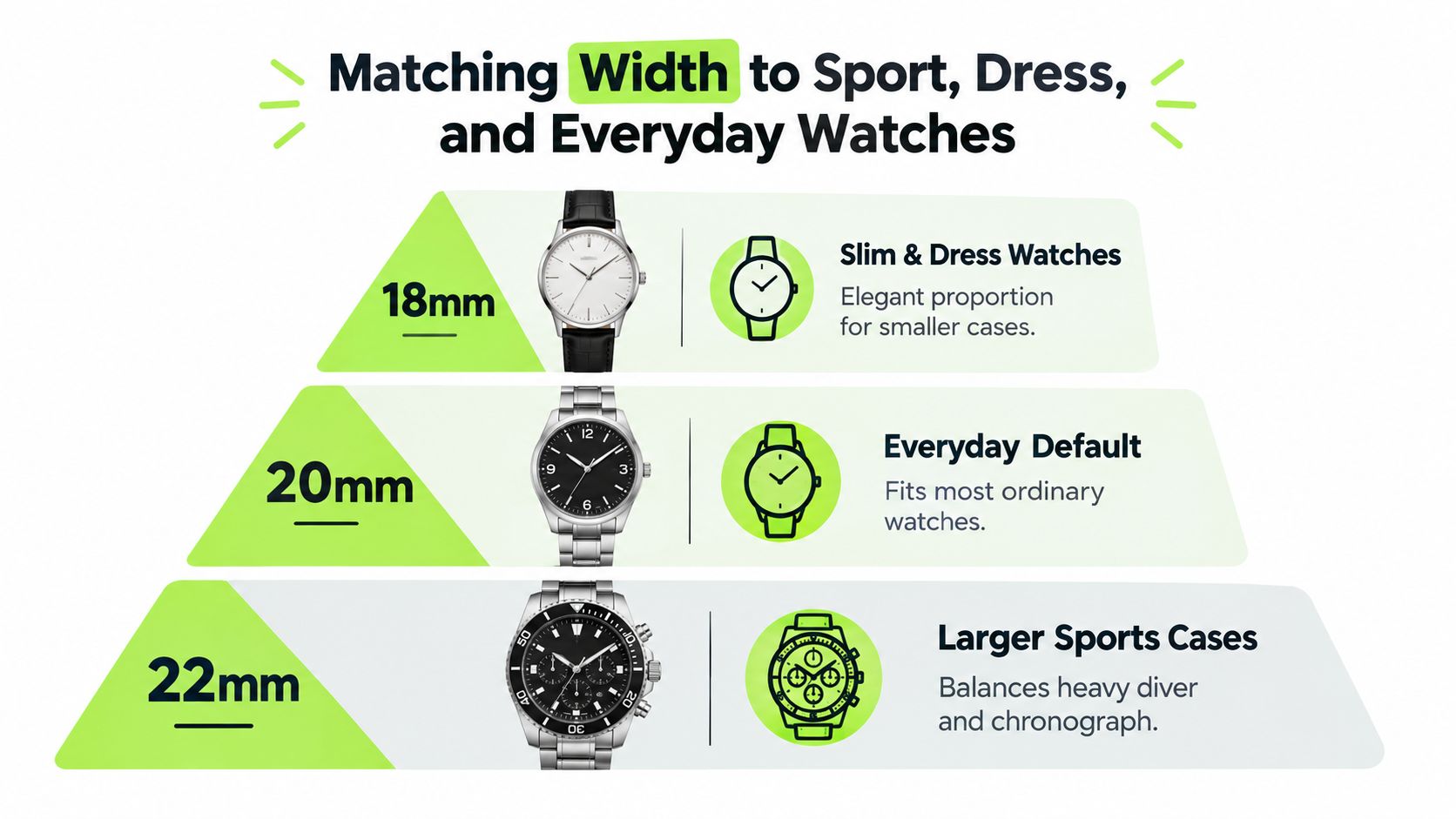
Use these two checks before choosing a replacement:
- Confirm the lug gap: Buy the exact measured width, including an odd size such as 19 mm or 21 mm.
- Confirm the fitting system: Check whether the watch uses standard spring-bar lugs, a proprietary connector, or an adapter-dependent design.
Nothing but Bands' quick-release watch bands are available in the stocked widths of 18 mm, 20 mm, and 22 mm. For an ordinary watch with matching standard lugs, shoppers can browse 20 mm watch bands or 22 mm watch bands, depending on the measured gap.
Common Width Mistakes and How to Avoid Them
Most sizing errors come from applying the right rule to the wrong object. The watch strap width belongs to the gap at the watch's lugs, so every check should begin there.
Mistake one is trusting the old strap
The old strap may have a printed size, but that marking isn't a substitute for checking the watch. A tapered strap can also confuse the issue because its buckle end is narrower than its lug end. Measure or verify the attachment end, not the section near the buckle.
Mistake two is holding the measuring tool at an angle
Calipers or a millimetre ruler should sit flat against the inner lug faces. If the jaws ride up the curved shoulder of the lugs, the reading can appear wider than the true attachment gap. A second reading from the opposite side can help confirm the number before you order.
If you still need the actual measuring procedure, follow the guide on how to measure watch band size rather than guessing from the case diameter.
Mistake three is forcing a millimetre size onto a smartwatch
Apple Watch bands use the case-size group. Fitbit bands use the model. The Galaxy Watch Ultra uses its own fitting. Garmin QuickFit models can also use keyed fittings, where a standard millimetre number doesn't describe the complete connection.
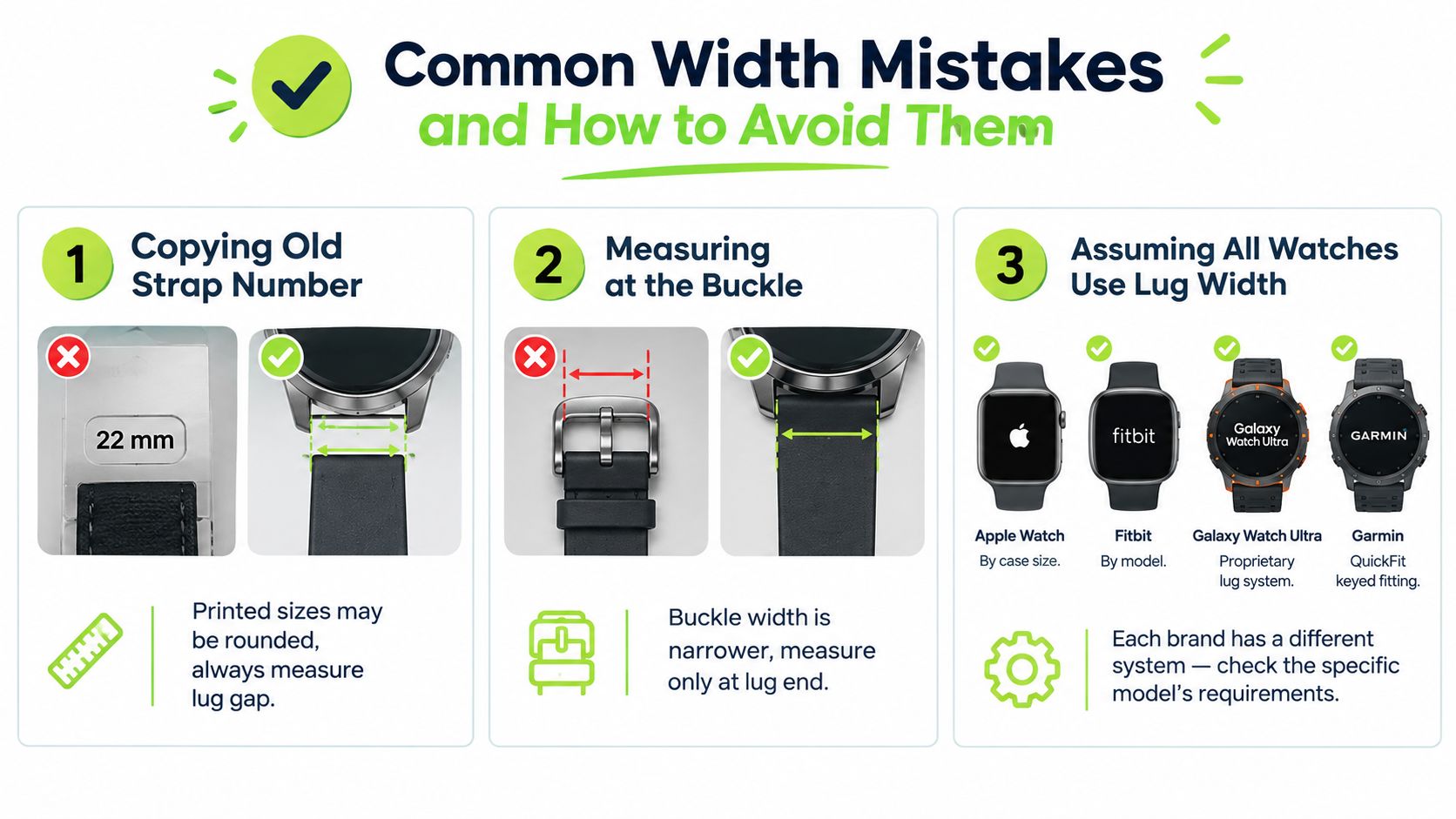
Before ordering: Check the watch model, confirm whether it has standard lugs, and match the strap's attachment width to the inner lug gap.
Nothing but Bands sells replacement straps rather than watches, including quick-release options in 18 mm, 20 mm, and 22 mm. If your measurement matches one of those sizes and your watch uses compatible standard lugs, visit Nothing but Bands to choose a replacement strap suited to your watch and swapping preference.
Ähnliche Beiträge

- October 07, 2026
Discover why comfortable watch straps feel different. Learn the materials, closures, and fit rules that actually matter for Samsung Galaxy...

- October 06, 2026
Clear installation instructions for smartwatch bands. Learn how to attach, verify, and troubleshoot Apple, Samsung, Garmin, and Fitbit straps safely.

- October 05, 2026
A practical guide to changing watch bands across Apple, Garmin, Samsung, and Fitbit, covering tools, fitment, daily rotation, and common...
