


A nylon watch band is cleaned by hand in lukewarm water no warmer than 30°C with a few drops of mild liquid soap, rinsed until no suds remain, and air-dried flat. That's the entire method, and it costs a soak of no more than 20 minutes plus a few hours of drying.
Most ruined nylon bands aren't ruined by sweat. They're ruined by over-treatment: a hot wash to kill bacteria, a bleach soak to shift a stain, a hairdryer to get the band back on the wrist faster. Water isn't the enemy here. Heat, chlorine and hard scrubbing shorten a band's life, and they go to work on the stitching, the closure and the dye long before they touch the fiber.
The rest of this guide answers how to clean nylon watch band straps at home, with the temperatures, timings and rinsing counts spelled out, plus the short list of things to keep away from nylon and the point at which cleaning stops being worth it.
Table of Contents
- Can You Clean a Nylon Watch Band by Hand?
- How to Hand-Wash a Nylon Watch Band Step by Step
- How Long Does a Nylon Watch Band Take to Dry?
- How Do You Get Sweat Odor Out of a Nylon Watch Band?
- Which Products and Methods Should You Avoid on Nylon?
- Can You Wash a Nylon Watch Band in the Washing Machine?
- When Should You Replace a Nylon Watch Band Instead of Cleaning It?
- Frequently Asked Questions
Can You Clean a Nylon Watch Band by Hand?
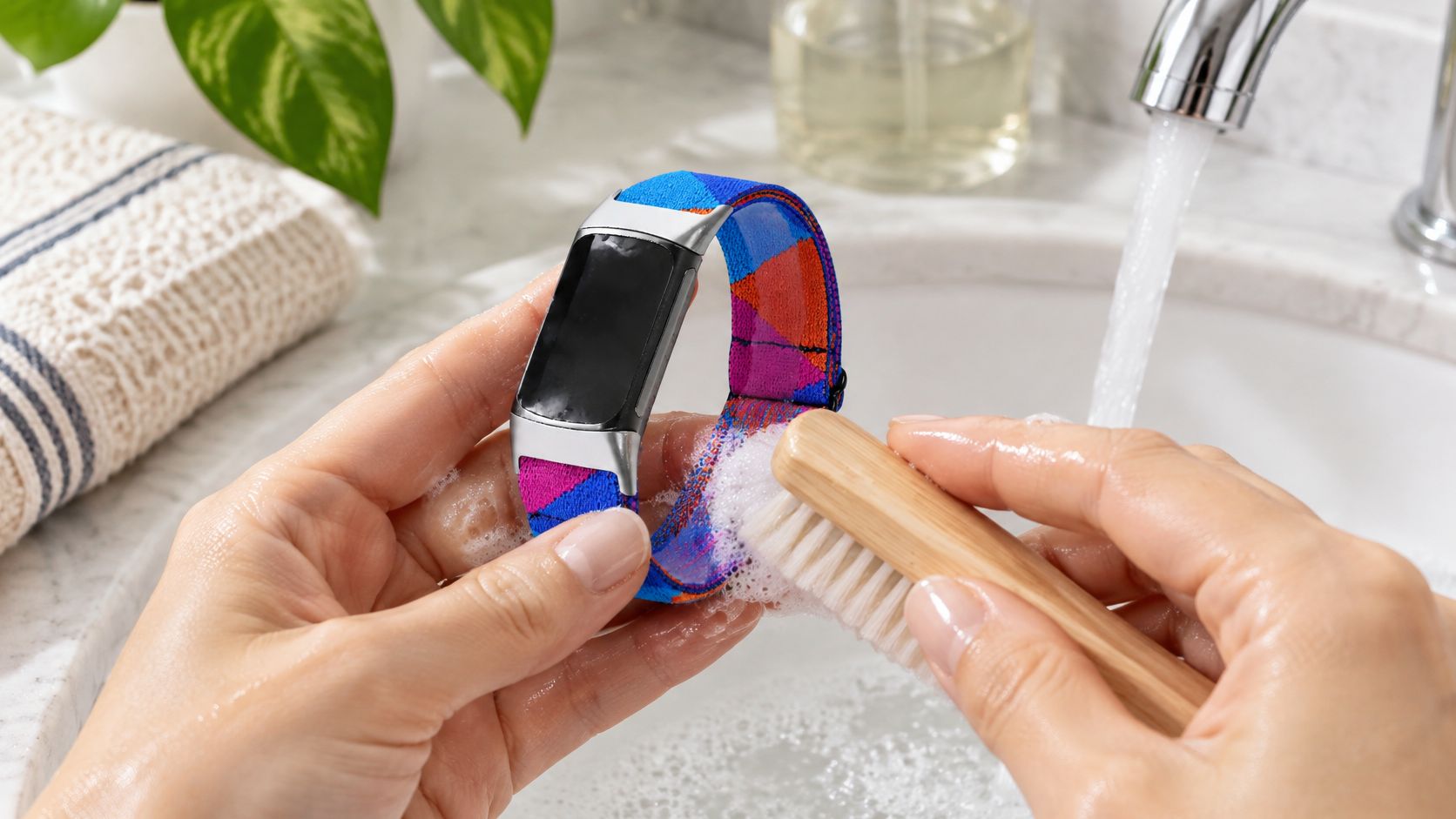
Yes. A nylon watch band can be hand-washed safely in lukewarm water with a few drops of mild liquid soap, rinsed clear and air-dried flat, and hand washing is what we recommend for every nylon band, whether it's a plain one-piece military strap or a two-piece with a closure.
The fiber earns that confidence. The American Chemical Society's account of Carothers' polymers records that the first nylon fiber made at DuPont was strong, elastic and unaffected by water or most solvents. Soap and water don't break the material down.
Does nylon absorb water?
Yes, a little. Nylon isn't moisture-proof, because it's hygroscopic: it absorbs and releases moisture as humidity changes. It's less absorbent than cotton or wool, but a band can feel dry on the surface while the core of the weave is still damp, which is why a full dry matters as much as the wash.
Everything fragile on a nylon band is something other than the nylon:
- Stitching at the edges, the keeper and the lug ends
- Printed markings and dyed patterns that can lift
- Hook-and-loop strips that lose grip when they soften
- Elastic sections on stretch styles
- Coated metal keepers and buckles that scratch and flake
Those parts set the ceiling on how warm the water gets and how hard you work the surface.
This guide covers nylon only. Rubber and silicone, leather, stainless steel and Milanese mesh each need a different routine, and our rubber watch band cleaning guide is the place to start for a sport strap.
By the end you'll have a wash routine with exact temperatures, a drying rule with a test you can run, an odor fix for a band that looks clean but doesn't smell it, a list of products to keep away, and a clear rule for replacing rather than cleaning.
How to Hand-Wash a Nylon Watch Band Step by Step
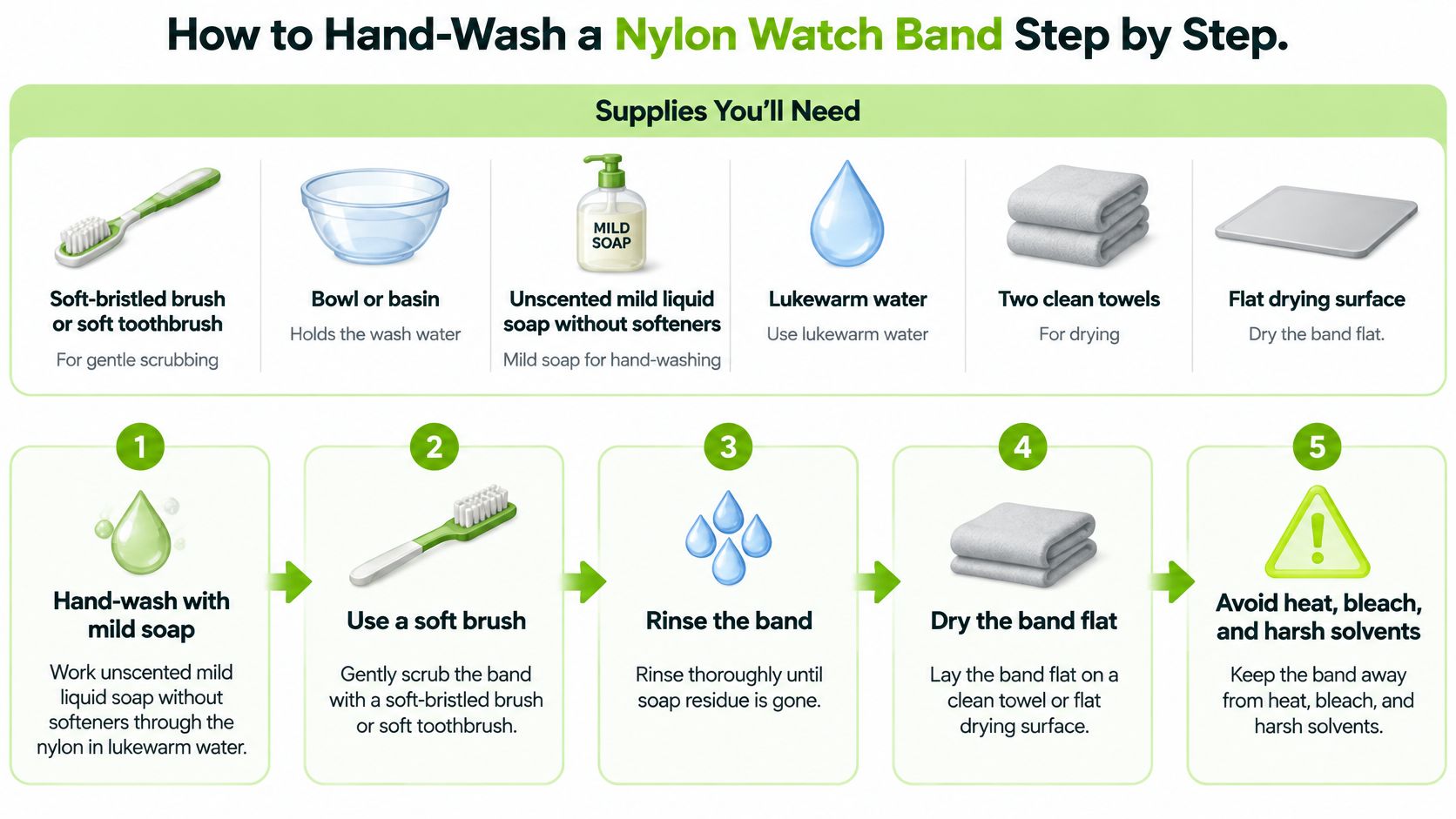
Hand-washing a nylon watch band takes about ten minutes of hands-on work. The weave itself tolerates water well, so the gentle routine exists for everything stitched, glued or hooked to it. Five moves: soak in lukewarm water with a few drops of mild liquid soap, work the suds through with your fingers or a soft brush, rinse until the water runs clear, press the band dry in a towel, then lay it flat. Whistles' nylon care guide puts the hand-wash ceiling at 30°C for nylon and the soak at up to 20 minutes, which is long enough to soften sweat, salt and skin oil.
What do you need before you start?
- Soft-bristled brush or soft toothbrush: for the inside face, the keeper loop and around the buckle, never for scrubbing the edges.
- Bowl or basin: wide enough to lay the band out rather than bunching it.
- Unscented mild liquid soap without softeners: hand soap or a mild dish soap. Skip anything labelled degreaser, heavily fragranced, or with added moisturizers.
- Lukewarm water: warm to the touch, never hot.
- Two clean towels: one to work on, one to press over the top.
- A flat drying surface: a dry towel on a counter, out of direct sun.
Here's the same flow as a single picture, from supplies through to the warning at the end.
The wash, step by step
- Take the band off the watch and open it up. Unhook the closure, slide out the keeper, and set any removable metal hardware aside. You get to the fabric that sat under the case, which is where most of the grime collects.
- Brush off the dry grit first. Work a soft brush from the center outward. Sand and salt crystals abrade the weave if you wet them and scrub.
- Add a few drops of soap to the bowl and fill it. Swish once to dissolve. More detergent doesn't clean a dense weave better; it just leaves more residue to rinse out.
- Lay the band in flat and press it under. Nylon floats until the weave fills with water, so hold it down for a few seconds, then leave it alone. Constant agitation during the soak does nothing the soap isn't already doing.
- Work the suds through with your fingers. Both faces first, then the inside face, keeper loop, stitching lines and the zone where the buckle sits, which is where skin oil collects. Don't scrub, twist or wring, because mechanical stress deforms woven nylon and speeds up pilling.
- Rinse under cool running water until it runs clear. Flex the band as you rinse so water moves through the folds, and keep going past the point where the surface looks clean. The core of the weave holds suds that keep releasing on later passes.
- Press the water out between two clean towels, then lay the band flat. Twisting stretches an open weave and puts load on the stitching.
If you'd rather watch the scrub-and-soak motion once before you start, this walkthrough shows it on a NATO-style strap. It uses hot water; we stick to lukewarm, for the reasons covered below.
Test a dyed or printed band first
Dab the diluted soap on a hidden section, blot it with a white cloth, and stop if any color transfers. That's the colorfastness test used on nylon fabrics, and it takes half a minute. Skip it on a new dark or striped band and you can end up with a pale patch under the keeper that no amount of rinsing fixes.
Practical rule: rinse longer than you washed. Soap left in the weave stiffens the band, holds odor and sits against your skin all day.
How Long Does a Nylon Watch Band Take to Dry?
Check dryness with a paper towel, not the clock. A band laid flat on a dry towel with air moving over both faces is usually ready to wear again by morning, and in a humid room a fan on low about a metre away speeds that up without adding heat.
- Do lay it flat on a towel or rack where air reaches both faces
- Do put a fan on low a metre away if the room is humid
- Don't use a radiator, hairdryer, tumble dryer or a sunny windowsill
- Don't hang it by the buckle, which pulls the weave out of shape
Seiko's care instructions for nylon and polyester fabric bands call for drying the band in an airy place out of direct sunlight, and warn that the band's texture may change if it is washed in water for a long time. In still room air, drying takes several hours. Flip it after a couple of hours so the underside and the keeper dry at the same rate as the face. Thicker weaves and stitched folds hold water longest, so give those areas extra time.
The dry test: press a folded paper towel against the inside face, then against the keeper and any stitched fold. Any damp mark at all means keep drying.
A band that goes back on slightly damp holds moisture against your skin all day, and that's what feeds the smell people blame on the soap. Store it only after the core passes the paper-towel test.
How Do You Get Sweat Odor Out of a Nylon Watch Band?
The fix is the same hand wash covered in the step-by-step: lukewarm water, mild soap, a soft brush on the inside face and keeper, then a rinse until no suds remain. Odor lives in the weave, so contact time and a thorough rinse matter more than which soap you pick.
Why does a tap rinse not fix odor?
Sweat and skin oil sit inside the weave, not on the surface. Running water passes over the top and leaves the deposit in the folds, under the keeper and along the stitching. You need contact time with soap to lift it.
Odor is a cleaning problem; disinfection is a separate job you rarely need on a wrist band. The CDC's guidance on laundry and bedding contaminated with body substances notes that contaminated textiles often contain high numbers of microorganisms from body substances, which is a reason to wash a sweaty band properly and dry it fully. A band worn to the office needs no antibacterial spray. Harsh chemicals damage dyes, coatings and hook-and-loop fasteners, and whatever is left ends up against your skin.
| Problem | Treatment | If it persists |
|---|---|---|
| Sweat odor on a band that looks clean | Full hand wash, brushing the inside face and keeper, rinse until no suds | Second soak in fresh water with a spoonful of baking soda, then a thorough rinse |
| Salt from seawater | Rinse under cool fresh water until no salt remains | Repeat the rinse; residual salt adds to odor and wear |
| Surface grime or a dark sheen | Mild soap, fingers through the weave, thorough rinse | Check edges and closure; if they are damaged, replace the band |
| Soap residue or a stiff feel | Rinse until the water runs clear with no suds left in the weave | Repeat the rinse series; residue holds odor and can irritate skin |
| Stain that will not lift | Dab diluted soap on a hidden area first, then work the stain gently with a soft brush and rinse | Stop if color transfers to a white cloth; never use bleach |
| Smell returns after drying | Make sure the band is dry right through the core before refitting, then rotate with a second band | Wash again; a damp core keeps odor alive |
If the smell survives the first wash, soak it another 15 minutes in fresh water with a spoonful of baking soda and rinse with unusual care, because powder lodges in a tight weave. A smell that returns a day after a full wash almost always means the band went back on the wrist damp inside.
What changes for running, cycling and gym use?
Rinse promptly. Cool running water as soon as the band comes off, before it goes in a bag or a pocket, then a full wash when odor or visible residue builds. Pay closest attention to the inside face, the keeper loop and the buckle contact zone, where body oils collect fastest.
Clean a sweat-heavy band promptly rather than letting residue set, and dry it completely before refitting it. The habits worth avoiding are prolonged soaking, abrasive brushing, incomplete rinsing and repeated heat.
A second band to rotate stops most recurring odor, because one dries fully while the other is worn. A nylon loop such as the Ridge Nylon Loop for Apple Watch is light enough that a second band doesn't feel like clutter in the drawer.
Which Products and Methods Should You Avoid on Nylon?
Avoid chlorine bleach, fabric softener, hot water above 40°C, tumble dryers, hairdryers, radiators, stiff brushes on the edges, acetone and petrol-based degreasers, abrasive powders, household disinfectants and long soaks. Nylon fiber itself tolerates water well. What these products attack is everything built around the fiber: the weave, the stitching, the dye and the hook-and-loop closure.
Which mistake causes the most damage?
Heat and chlorine bleach. Every dryer, heater and boiling-water shortcut falls into the same category, and air drying flat replaces all of them.
A Henkel textile-care guide for synthetics gives 60°C as the maximum washing temperature for nylon and other synthetics, with a 40°C cycle for a more cautious wash. For a band with stitching, elastic and a closure, stay well below that ceiling.
Bleach and softener are the two products reached for by mistake most often. Bleach weakens the fiber and strips dye. Softener coats the weave, traps odor and leaves a film against skin.
The harder you clean, the more wear the weave takes. A short, cool hand wash is the gentlest method you have.
| Avoid | Why it damages nylon | Use instead |
|---|---|---|
| Fabric softener | Coats the weave, holds odor and leaves residue against skin | Thorough plain rinsing |
| Acetone, nail-polish remover or petrol-based degreasers | Strips finish and dye | Mild soap only |
| Abrasive powders or scouring pads | Scratches hardware and roughs up the surface fibers | Fingers and a soft brush |
| Disinfectant sprays or antibacterial soaks | Harsh on dye and finish, and treats a problem a rinse already solves | Plain soap and water |
Solvents deserve a direct warning. Acetone and petrol-based degreasers dissolve the finish on the buckle and can pull dye out of the weave in patches, which looks worse than the stain ever did. Disinfection is also a separate job from odor removal, and on a watch band it carries more risk than benefit. A sweaty band needs residue rinsed out of the weave, and a disinfectant cannot do that job any better than soap while being far harder on the material.
Every trace of soap has to come out regardless. Residue left in a band is a common cause of skin irritation and gives odor something to cling to.
Can You Wash a Nylon Watch Band in the Washing Machine?
Hand washing is the method we recommend for a nylon watch band, and a machine wash is only worth considering when the band maker's own care label explicitly permits it. Sources disagree on machine washing, and care standards don't settle the argument for you either. Canada's Guide to Apparel and Textile Care Symbols has hand-wash symbols for washing gently by hand in water not exceeding 40°C or 30°C, and it also lists machine cycles at those same temperatures, including delicate/gentle settings.
Why do care labels disagree about machine washing?
The difference lies in construction: a plain woven strap and a padded strap with glued layers and coated hardware respond differently to agitation. A machine cycle tumbles the whole band, and a spin cycle loads stitching and closures in a way a bowl of water never does. A label that permits machine washing speaks only for that band's own construction, never for nylon bands in general.
If the label does allow it:
- Fasten the hook-and-loop strip shut or thread the band through a mesh laundry bag so it can't grab other laundry
- Use the gentle cycle and the temperature the label gives, with a mild liquid detergent
- Wash it alone or with a small load of lightweight items so the band isn't twisted against heavy fabric
- Air-dry flat afterwards, since machine heat is hard on the weave and the closure
Skip the machine if your goal is freshness rather than soil removal. Odor lifts out of nylon with a proper hand rinse, and a cool machine cycle won't disinfect the band anyway. Low-temperature washing clears surface dirt without reaching the heat that sanitizing requires, so the machine adds wear to stitching and hook-and-loop while delivering no hygiene gain over a bowl of water.
If the care label is missing or unclear, follow the maker's care page for that exact band rather than a general rule.
When Should You Replace a Nylon Watch Band Instead of Cleaning It?
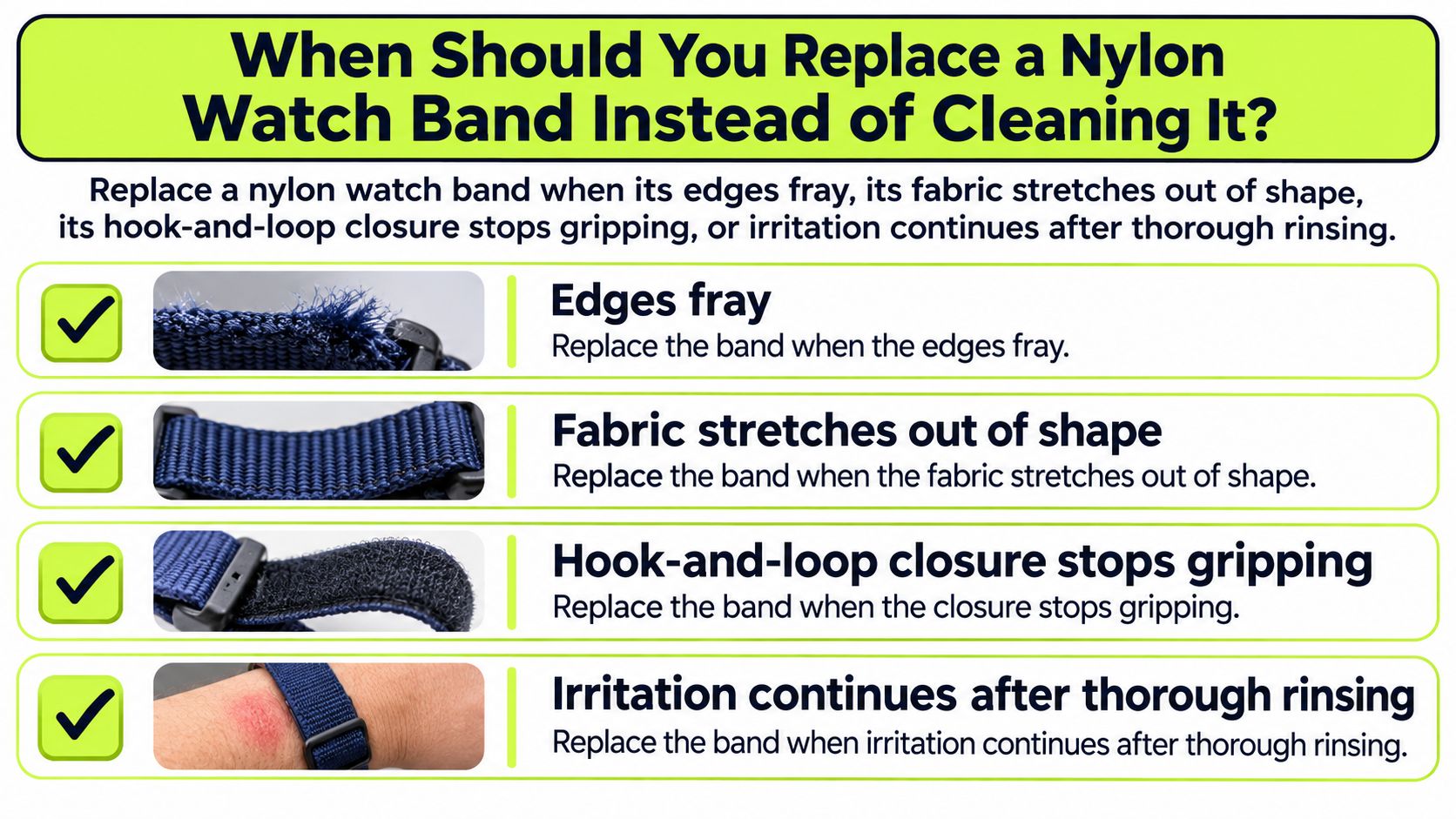
Cleaning has a hard stop on nylon: it removes soil, it cannot rebuild structure. Judge the band only after a full wash, a thorough rinse and a complete dry, because a damp strap can look worse than it is.
What cleaning can still fix
A band that looks dark and feels stiff is usually carrying sweat, sunscreen and skin oil rather than being worn out. Give it two proper soaks before you decide, then check it dry in good light. If the color comes back, the weave springs back when pinched and the closure still grabs under a light pull, keep wearing it.
- Keep cleaning when the band smells, feels waxy or looks dull after workouts, but the edges stay flat and the strap still holds its shape.
- Replace it when edges fray or lift, the fabric stretches enough to let the watch wander, the hook-and-loop stops gripping, or pilling, thin patches and holes remain after drying.
- Stop wearing it if skin stays irritated after a thorough rinse; residue usually flushes out, but a reaction that persists means the band is done.
The useful test is tension, not appearance. Pull the closure apart and press it back down, flex the strap near the spring bars, and run a fingertip along both edges. If anything shifts, snags or feels thinner than the rest of the weave, that is the part keeping the watch on your wrist.
How do you check the fit before you order?
Match by band width and connector format, then confirm the exact model on the watch maker's own support page. Lug widths differ, and a 20mm band won't seat in a case built for 22mm, so measure before you buy. The Watch Band Finder on the Nothing but Bands site helps you match your model, and on many watches the case size is printed on the back.
Browse the nylon watch bands collection to replace like with like, or start from the full watch bands collection if you fancy a change of material.
For a Fitbit Versa 3 or 4, or a Sense or Sense 2, the Neris Braided Loop for Fitbit Versa 3/4 and Sense 1/2 is a model-matched option to check when a washed band still fails the tension test.
Frequently Asked Questions
How often should you clean a nylon watch band?
Let the band's condition set the schedule. Wipe or rinse when it's visibly dirty, hand-wash when odor or stiffness appears, and rinse with fresh water after every swim in salt water or a chlorinated pool. Daily wear in hot weather shortens the gap between washes, while a band worn occasionally at a desk can go far longer. The signals to watch for stay the same either way: smell that survives airing out, fabric that dries stiff, and grime collecting along the edges and stitching.
Can you clean a nylon watch band without removing it from the watch?
Only when the band uses fixed bars or proprietary hardware you can't release safely. In that case, clean the exposed fabric with a damp cloth and a soft brush, keep running water away from the case, and never assume a water-resistance rating makes a watch safe to soak in soapy water. A removable band should come off, because the grime sits under the case.
Is dish soap safe on a nylon watch band?
Yes, as long as it's the mild, unscented kind. What nylon can't take is anything stronger: concentrated degreasers, heavily scented formulas and soaps with added moisturizers. All three are harder to rinse out of a dense weave, and whatever stays behind sits against your skin for the rest of the day. If the band still feels slick after rinsing, the soap hasn't cleared, so keep rinsing.
Nothing but Bands sells premium smartwatch bands and replacement straps in nylon, silicone, leather and Milanese, so when a band reaches the end of its cleaning life you can match the same width and connector format instead of guessing. Confirm your watch model and band size with the Watch Band Finder on the Nothing but Bands site before you order.
Ähnliche Beiträge

- November 24, 2026
Garmin Forerunner 165 vs 265 compared on display, battery, GPS, training features, price tier and bands, with a clear pick...

- November 23, 2026
Is Amazfit waterproof? See what 5 ATM and 10 ATM ratings really allow for swimming and showers, plus model-by-model guidance...
