


Amazfit watches aren't waterproof. They're water-resistant, and the amount of water they tolerate depends on the exact model. Amazfit's published ratings of 5 ATM, 10 ATM or 20 ATM correspond to pressure equivalent to roughly 50, 100 and 200 meters of water depth, and models rated only IP68 are meant for everyday splashes, not swimming. An ATM-rated Amazfit is built for rain, splashes and swimming in pools or shallow water. It is not built for diving unless the exact model's page says it is.
That gap between a number on a spec sheet and the activities it permits is where most owners get lost. A watch marketed with "50 meters" sounds like it belongs on a diver's wrist. It doesn't. The figure comes from a standardised pressure test, not a usable diving depth. And the rating describes the watch head only. The strap you chose, and how you care for it, is a separate decision the rating says nothing about.
The rest of this guide works through Amazfit's published rules model family by model family, then turns to the question almost no other answer addresses: what the rating does and doesn't mean for the band on your wrist.
Table of Contents
- Is Amazfit Waterproof or Just Water-Resistant?
- What Do Amazfit's 5, 10 and 20 ATM Ratings Actually Allow?
- Which Amazfit Models Are Rated for Swimming?
- Can You Swim With an Amazfit?
- Can You Shower With an Amazfit?
- Does Chlorine or Salt Water Damage an Amazfit or Its Band?
- Does the Water Rating Cover Your Amazfit Band?
- How Should You Care for an Amazfit After Water?
- Frequently Asked Questions
Is Amazfit Waterproof or Just Water-Resistant?
Amazfit watches are water-resistant rather than waterproof, and the rating depends on the specific model. Amazfit's own guidance draws the line clearly: it distinguishes between 5 ATM, 10 ATM and 20 ATM ratings, corresponding to pressure equivalent to approximately 50, 100 and 200 meters of water depth, respectively, as set out on Amazfit's published water-resistance support page.
Read that sentence again and notice what it does not say. It does not say a 5 ATM watch can go 50 meters down. Amazfit describes ATM-rated watches as suitable for swimming in pools and shallow water, but the stated depth is a pressure-test equivalence, not a recommendation for diving to that physical depth.
So where does that leave the practical question of whether an Amazfit is waterproof? Three plain rules cover most of it:
- Water-resistant means tested to a pressure limit. The watch passed a test at a given pressure. That's the claim, and it's a real one.
- Waterproof would mean impervious. Amazfit's own guidance sets limits on heat, steam and high-speed water, and seals can degrade with age, heat and impact.
- The activity list matters more than the number. Follow the approved activities for your exact model rather than reading the number as permission.
A model rated only for ingress protection, such as IP68, is a separate case. Amazfit says an IP68 rating only supports everyday water resistance and that swimming is not supported. If your watch's documentation lists IP68 and no ATM figure, treat it as a watch you take off before you get in the pool.
The rest of this guide explains what each rating allows in real activities, gives the published rating for the main Amazfit families, sets out the swimming and shower rules, and then covers the part the rating never touches: the strap and its aftercare.
What Do Amazfit's 5, 10 and 20 ATM Ratings Actually Allow?
An ATM rating tells you the watch passed a pressure test at that equivalence, so 5 ATM does not license diving to 50 meters. Amazfit's guidance maps the three ratings to roughly 50, 100 and 200 meters of water depth and pairs them with the activities it allows and the ones it rules out, as Amazfit's water-resistance guidance sets out.
| Amazfit rating | Pressure equivalence | Allowed per Amazfit's general guidance | Ruled out by Amazfit's general guidance |
|---|---|---|---|
| 5 ATM | About 50 m water depth | Swimming in pools and shallow water; bathing in room-temperature water on models that support it | Sauna steam, hot showers, high-speed water flow |
| 10 ATM | About 100 m water depth | Swimming in pools and shallow water; anything further only where the exact model's page lists it | Sauna steam, hot showers, high-speed water flow |
| 20 ATM | About 200 m water depth | Only the activities listed in the exact model's documentation | Any activity the model's documentation excludes |
| IP68 only | Everyday water resistance, not an ATM swim rating | Everyday splashes | Swimming |
Three caveats sit under that table, and each one explains a real failure.
Dynamic pressure beats static ratings. Swimming strokes, jumping into water, water jets and rapid movement can push pressure beyond the static conditions used for a pressure test. That's why the number on the case is not the depth you can take the watch to. Belly-flopping into a pool puts more stress on a seal than gliding at the same depth.
Heat, steam and force attack the seals. Amazfit tells owners not to wear the watch in a sauna, in a hot shower or in high-speed water flow. A watch can be suitable for swimming and still fail in a sauna. Those aren't contradictory claims; they describe different stresses.
The rating is a snapshot, not a warranty. Amazfit's T-Rex Pro guidance states that water resistance is not permanent and may weaken over time. Treat the figure as a condition to maintain, not a permanent property.
The practical step is simple. Find your exact model on Amazfit's product or support page and read the rating and the approved activities together, rather than guessing from the family name.
Rule of thumb: if the water is moving fast, hot enough to steam, or deeper than you can stand in, the ATM number isn't your permission slip.
Which Amazfit Models Are Rated for Swimming?
Amazfit's product pages list a 5 ATM rating for families such as the original Balance, Active and GTR, and a 10 ATM rating for the T-Rex Pro and Balance 2. That split is useful, but it only tells you the pressure category. Swim support still depends on the exact model and the activities Amazfit lists for it.
Think of the family rating like a jacket label. It tells you what the product was built to tolerate, while the manual tells you which conditions are approved. Two watches can share a rating and still have different activity limits. That is why the table below gives the published rating with a short note for each model, and why any model not listed here needs a look at its own Amazfit page.
| Amazfit model | Published rating | Key notes |
|---|---|---|
| Balance | 5 ATM | Check the exact model's page for swim support. |
| Balance 2 | 10 ATM | Amazfit also lists diving certification to 45 m for this model; follow its own page. |
| Active and Active 2 | 5 ATM | Check the exact model's page for swim support. |
| GTR | 5 ATM | Pool and beach use per Amazfit; no sauna, hot springs or diving; leather straps stay out of water. |
| T-Rex Pro | 10 ATM | Pools and shallow beaches only; resistance can weaken over time. |
The GTR shows why the model name and the activity list belong together. Amazfit's GTR support page rates the watch at 5 ATM, explains that the 50-meter figure comes from a standardised test (GB/T 30106-2013 / ISO 22810:2010), and says it suits water activities in shallow water, such as a swimming pool or the beach, but not saunas, hot springs or diving. In plain terms, the watch head has a water-resistance rating, but that rating does not turn every activity into a water activity.
The sentence that decides swim use is simpler than the rating chart suggests. An ATM-rated Amazfit is suitable for swimming in pools and shallow water, within the limits its own page lists. An IP68-only model should not be treated as swim-ready. The rating tells you what test category the watch belongs to. The manual tells you which activities Amazfit stands behind.
Before you swim: open the manual for your exact model name, not just the family. "Amazfit GTS" and "Amazfit GTS 4 Mini" are separate entries, and small name differences can change the guidance you should follow.
The band deserves its own check. A water rating protects the watch head, not the strap attached to it. If your strap is leather, keep it out of the water. If it is a silicone band, rinse and dry it after pool or beach use so grit and sweat do not sit against the material. Many Amazfit models use standard quick-release spring bars, so replacement straps are chosen by width; confirm your model's width and connector on Amazfit's page first.
Can You Swim With an Amazfit?
Yes, with conditions. Pool swimming and shallow-water swimming are allowed on ATM-rated models, within each model's limits, while IP68-only models stay out of the pool. Amazfit's T-Rex Pro support documentation is a good example: it states the 10 ATM rating as water resistance to 100 meters, allows swimming in pools and at shallow beaches, and rules out diving, water skiing, other high-speed-water activities and immersion in non-shallow water.
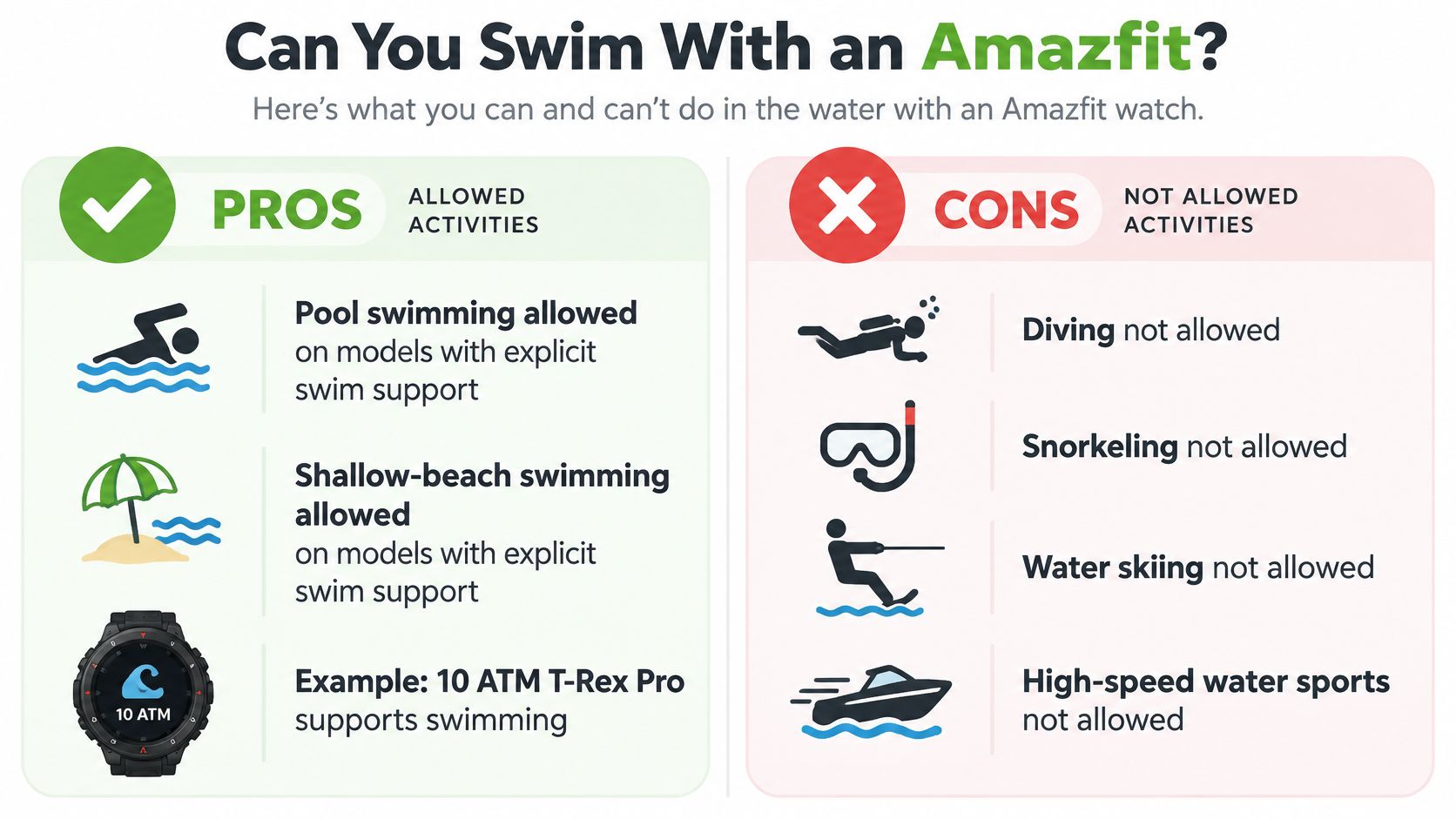
The same source advises against hot baths and saunas, says not to operate the watch underwater, and recommends wiping it with a clean, soft cloth after contact with water.
Here's the swim checklist we'd follow:
- Confirm the rating and approved activities for your exact model on Amazfit's page. Two minutes now beats a warranty argument later.
- Enter the water gently. Step in or lower yourself rather than diving or jumping, because impact pressure can exceed the conditions used for a pressure test.
- Don't press buttons or operate the watch underwater. Amazfit says so directly, and it makes sense: you're pushing against a seal.
- Wipe the watch with a clean, soft cloth afterwards. Salt, chlorine and sweat left sitting on the case and band do the slow damage.
On open water, Amazfit's guidance speaks of shallow water: pools and shallow beaches for the T-Rex Pro, the beach for the GTR. Surf conditions with duck dives and wipeouts are a different stress category from a pool lap, and high-speed water is on Amazfit's exclusion list. The water-resistance rule stays the same: follow the maker's spec, not the ocean's mood.
Water resistance is not permanent and may weaken over time, as Amazfit's T-Rex Pro guidance puts it. Don't assume the original rating remains unchanged indefinitely. Aging gaskets, a bumped bezel and a few hot showers all chip away at it. Treat it as a condition you maintain.
Can You Shower With an Amazfit?
Bathing in room-temperature water is acceptable only on models whose Amazfit guidance allows it. Hot showers, saunas, hot baths and high-speed water flow are excluded in Amazfit's guidance.
That's the whole answer in two sentences. The reasoning explains why the boundary sits where it does.
Heat is the condition that turns up again and again in Amazfit's exclusions: saunas, hot showers, hot springs, hot baths. Heat and steam are hard on the seals that keep water out. A sauna surrounds the watch in hot vapour for twenty minutes, which is a far harder test than a swim.
A strong shower jet is the second problem. Forceful water applies pressure to a seal in a way that gentle splashing never does, and it aims that pressure at the exact points designed to keep water out. A high-pressure head pointed at your wrist is not the same event as rain.
Soap: keep shampoo and shower gel away from the watch. Amazfit's guidance says to avoid detergents such as soap, hand sanitizer or shampoo when cleaning the watch, and notes it is not resistant to corrosive liquids. If you're unsure, take the watch off. It costs you nothing.
Practical rules for showering:
- Take it off for hot showers, hot tubs, saunas and steam rooms. Amazfit's guidance says not to wear the watch in a sauna or a hot shower.
- If your model allows bathing, keep the water at room temperature and keep the shower head away from the watch itself.
- Don't press buttons under the spray. Same reasoning as swimming: you're working the seal.
- Dry the watch with a soft cloth afterwards, then deal with the band as described in the care routine.
Where showering is unclear for your model, check its manual. Amazfit allows room-temperature bathing only "for devices that support it", which means it isn't universal.
Does Chlorine or Salt Water Damage an Amazfit or Its Band?
Amazfit's published guidance sets no specific chlorine or salt-water limit, so the safe step is to rinse the band in fresh water after pool or ocean use and wipe the watch with a soft cloth as the maker advises.
What does happen is residue. Chlorine and salt collect on the band surface, in the weave of a nylon strap and inside a metal clasp. Left there, they sit against your skin for hours after the swim. Rinsing takes thirty seconds and removes the problem before it starts.
Material behaviour differs here. Silicone rinses clean because it doesn't absorb water in the first place. Nylon and braided loops hold moisture longer, because the fibres trap it, so they need to dry fully before refitting.
The most common water mistake is blaming the wrong thing: blaming the band for a watch problem, or blaming the pool when soap and heat were the real issue. Say your watch misbehaves after a swim, or your wrist itches under the band. Before you blame the pool, ask two questions: was soap or a hot tub involved, and was the band refitted while still damp? Putting a nylon or Milanese band straight back on while it is still damp traps moisture against the skin and can cause odour or irritation.
A leather band that gets soaked and is then dried quickly near heat is the clearest example. It comes back stiff, warped and sometimes cracked. The fix is to keep leather out of the water entirely.
After every swim: rinse the band in fresh water, separate it from the watch where possible, dry both sides rather than just the visible face, and check the connector and clasp before refitting.
That routine covers the likely risks, with nothing required beyond fresh water and a cloth.
Does the Water Rating Cover Your Amazfit Band?
The ATM rating belongs to the watch body, not the strap, and a replacement band cannot increase the watch's water resistance. Amazfit's GTR water-resistance documentation warns that leather and leather-and-silicone mixed straps can't be worn while swimming, and Amazfit's general guidance adds that leather or rubber straps have no waterproof function of their own. That distinction matters because the case, buttons and seals are what the published rating covers, while the band is a separate part with its own weak points.
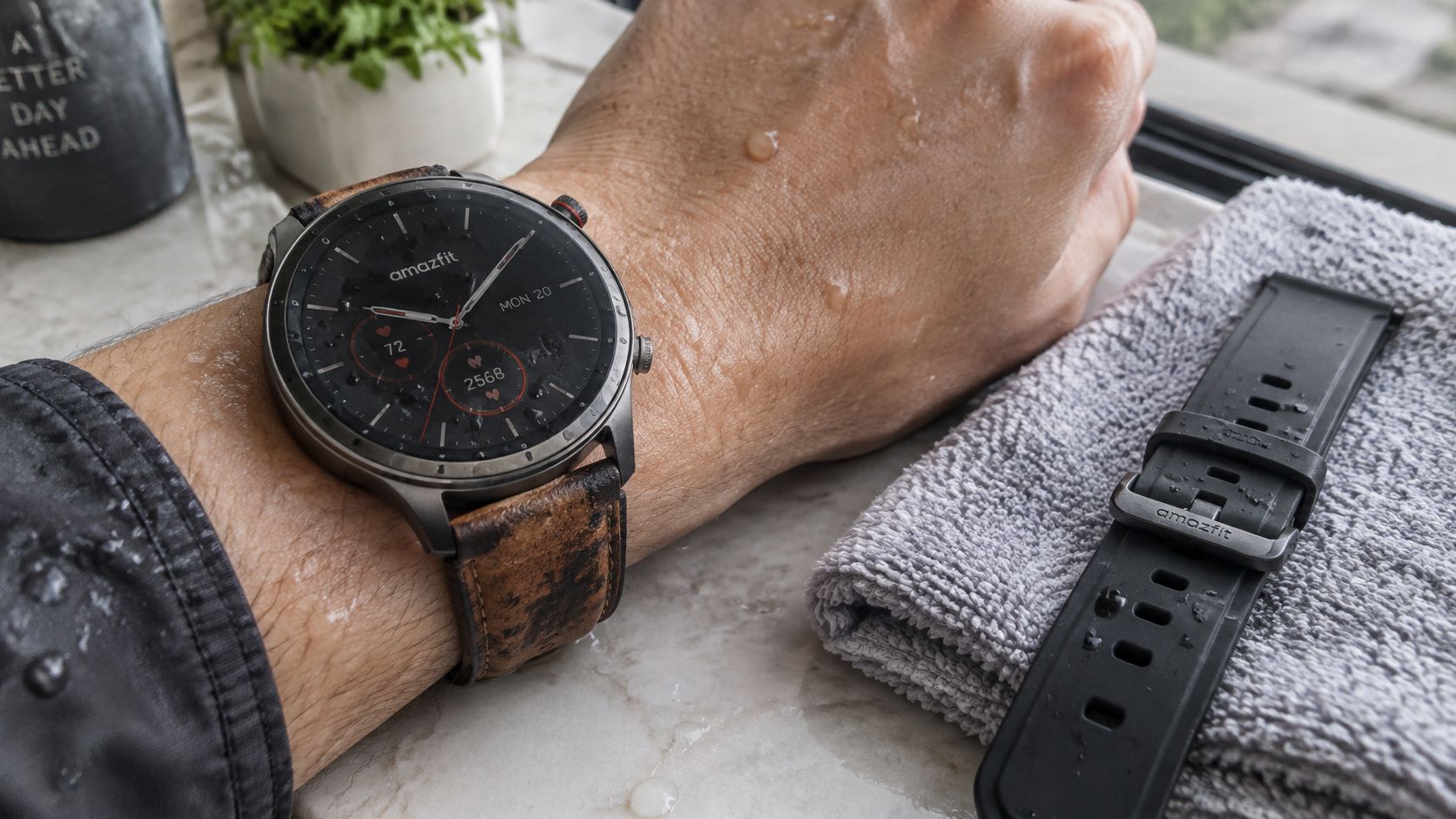
A useful analogy is a raincoat with a replaceable belt. The coat may be designed to shed rain, but the belt can still soak through, stiffen or rub against your skin. Your Amazfit band works the same way. The water rating describes the watch head, while the material, weave, clasp and connector decide how the strap behaves after pool, rain or sweat.
Silicone is our recommendation for regular swimming and sweaty workouts because it is soft, flexible and does not absorb water the way fabric or leather can. The waterproof watch bands guide compares band materials and the difference between waterproof and water-resistant in more detail.
Nylon and braided bands breathe well during activity, but their fibres stay damp for hours after a swim or heavy sweat. A magnetic Milanese band can look dry on the surface while the mesh and clasp remain damp, so it needs a wipe through the mesh. Leather belongs in dry wear, outside the swimming and shower routine, which matches Amazfit's own caution against swimming with leather or leather-and-silicone mixed straps.
For Amazfit owners, the Amazfit watch band collection groups our universal quick-release bands by width for Amazfit models that use standard spring bars. The silicone watch bands collection is the relevant starting point if water exposure is the main concern, since silicone is the easiest material to rinse and dry.
Fit depends on the exact Amazfit model, band width and connector format. Check Amazfit's page for your model before ordering, because band width differs across families and some models use their own fittings, and a close-looking strap only works when the width and connector match. The Watch Band Finder on our site can help you confirm your model's width.
How Should You Care for an Amazfit After Water?
Water care starts with a simple split: the watch head follows Amazfit's rating and manual, while the band needs your own cleanup routine. Treat the watch like a sealed instrument and the strap like clothing that touched chlorine, salt, sweat and skin. Fresh water, airflow and a soft cloth do most of the work.
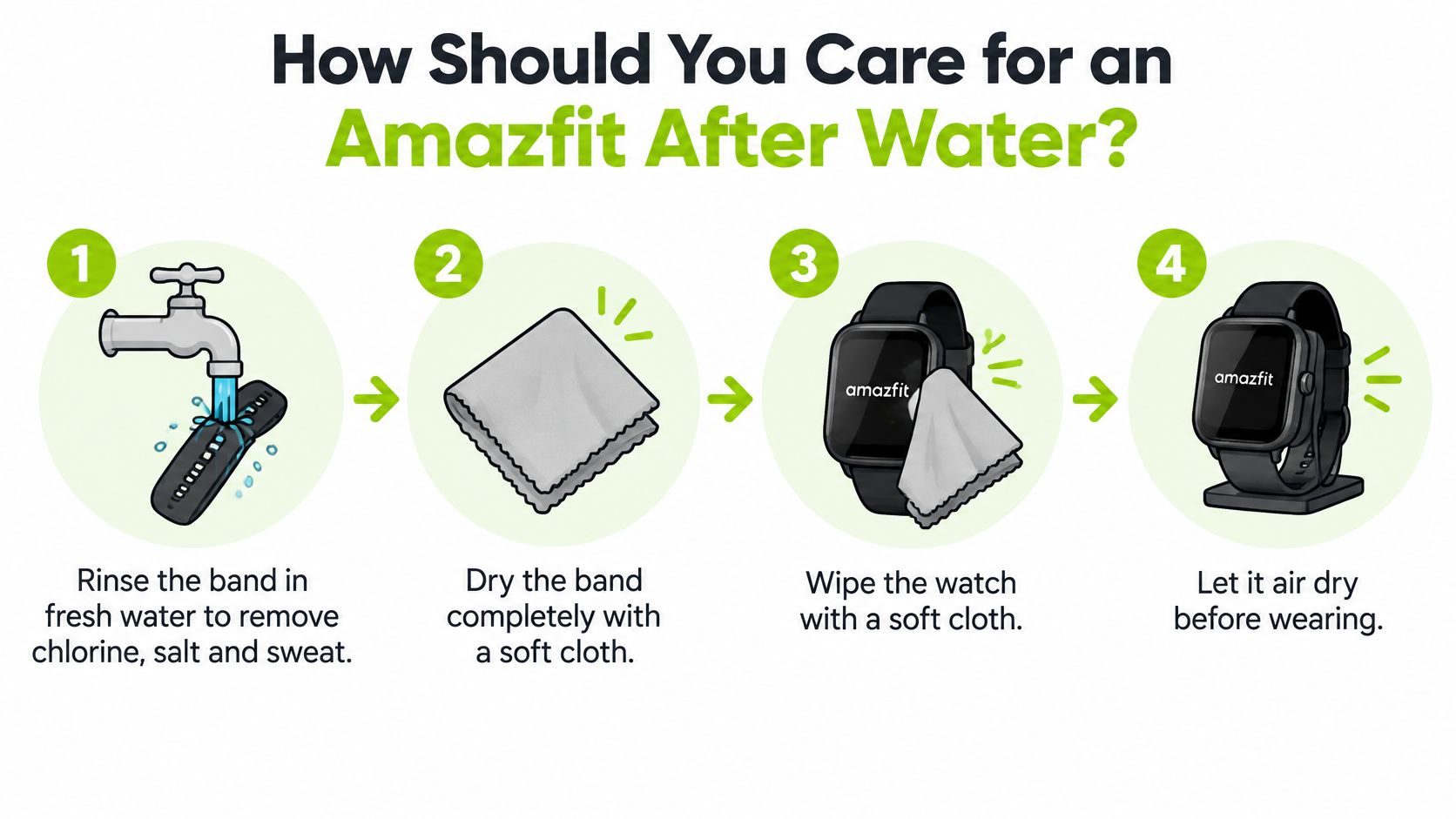
- Rinse the band in fresh water. This removes chlorine, salt and sweat from the material that sits against your skin. Wipe the watch itself with a clean, soft cloth, as Amazfit advises for models such as the T-Rex Pro.
- Remove the band from the watch where your model's band releases easily. Separation works like opening a window after a steamy shower: air reaches the lugs, the connector and both sides of the strap instead of being trapped against the case.
- Dry the band on both sides, not just the visible face. The underside holds moisture longer because it presses against skin during wear.
- Squeeze out nylon and braided loops, then let them dry fully before refitting. Refitting a damp loop holds moisture against the wrist, which is what brings odour.
- Dry Milanese mesh and the clasp thoroughly. Mesh can look dry on the surface while moisture remains between the metal strands and around the closure. Wipe through the mesh rather than only across it.
- Check the spring bars, connector and clasp for wear before putting the band back on. A loose connector can turn a normal wrist movement into a lost-watch risk, whether the watch has been in water or not.
Skip heat when drying a strap. Radiators, heaters and hair dryers can leave leather stiff, warped or cracked. Give the band a few extra minutes of airflow instead.
Two minutes after water exposure protects the part the rating cannot cover. Amazfit's published rating applies to the watch head under the maker's conditions. Your band still needs rinsing, drying and a quick fit check before it goes back on.
Frequently Asked Questions
Does 5 ATM mean I can dive to 50 meters with my Amazfit? No. A 5 ATM rating is a pressure-test equivalence, not a usable diving depth. Amazfit describes ATM-rated watches as suitable for swimming in pools and shallow water, so follow the approved activities for your exact model.
Can I swim with an IP68 Amazfit? No. Amazfit says an IP68 rating covers everyday water resistance only and that swimming is not supported. An IP rating does not automatically permit swimming.
Will a different band make my Amazfit more water-resistant? No. A replacement strap cannot increase the watch's water resistance. Choose the band for how it handles water: silicone for regular swimming, leather for dry wear.
Your Amazfit's water rating is fixed by the maker, but the band on it is your choice, and that choice matters once swimming or heavy sweating becomes routine. Nothing but Bands sells replacement bands by width for Amazfit models that use standard quick-release spring bars, with silicone for pool and sweat sessions and nylon, braided and magnetic Milanese styles for everyday wear. Confirm your model's width and connector first, then match a strap to how you use the watch.
Ähnliche Beiträge

- November 20, 2026
Find the right smartwatch with longest battery life for your routine: maker claims with their usage conditions, what drains charge,...

- November 19, 2026
Does Galaxy Watch Work with iPhone? Samsung lists which models pair with iOS, which features are limited, and how to...
