Across the 197 units ordered, woven nylon led with 94 units, 48% of units ordered, while Milanese mesh recorded 37 units, 19% of units ordered and silicone sport 32 units, 16% of units ordered. The main different styles of watch bands are silicone sport, woven nylon, Milanese mesh, stainless link, resin composite link, braided stretch, and leather, but the right choice starts with the fitting system, then moves to sweat, dress level, weight, and adjustment preference.
3 Key Takeaways: Different Styles of Watch Bands
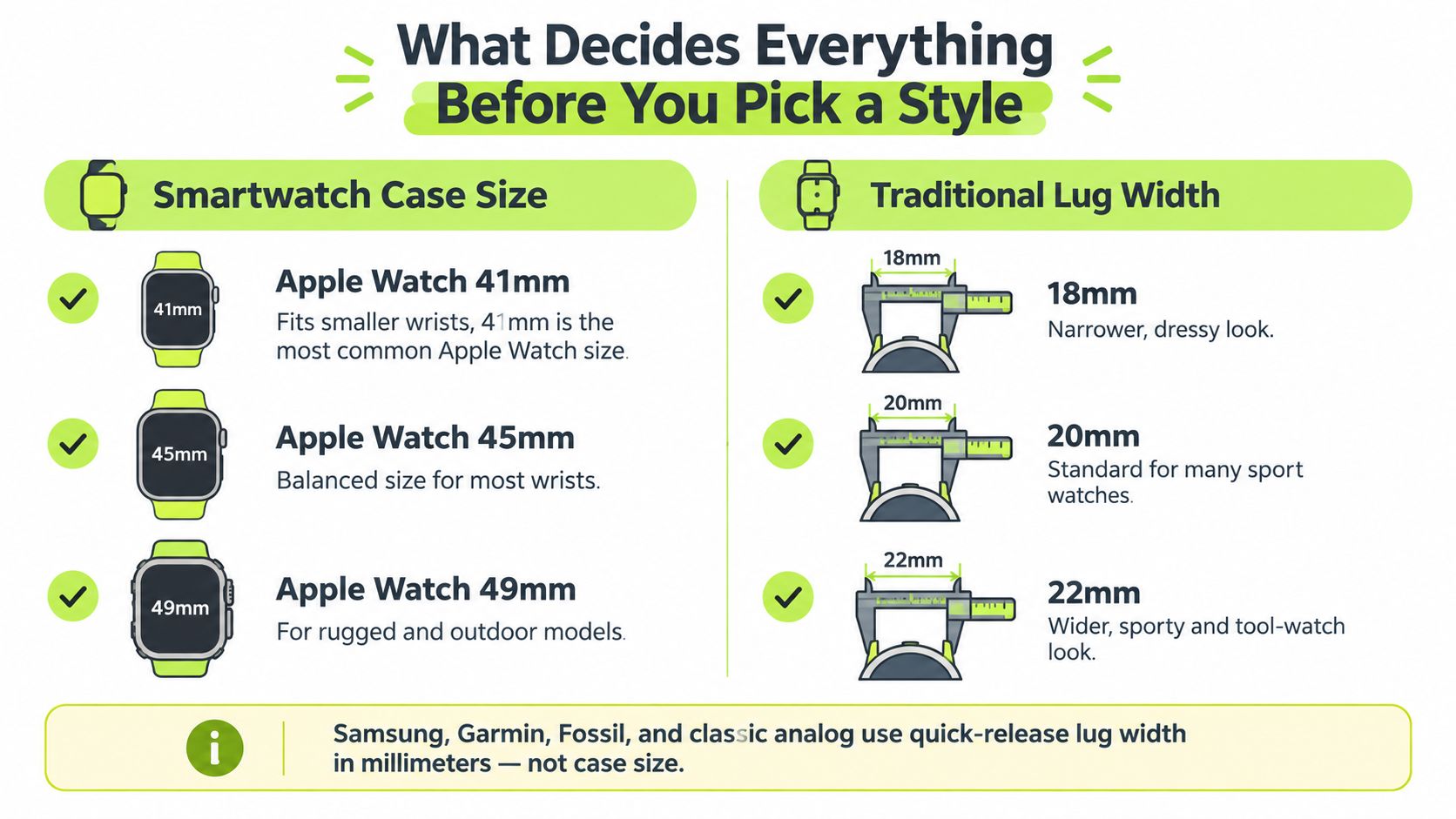
Fit before style: Apple Watch fits by case size. Most other watches fit by lug width.
Nylon is underrated: Woven nylon is comfortable and adjusts finely, and it's our most ordered style.
Each style has a job: Silicone for sweat, Milanese for polish, leather or braided for dress and slip-on wear.
That order mix is useful because shoppers often assume silicone dominates every replacement-band collection. Nylon's lead says comfort and fine adjustment deserve more attention, while the remaining families solve very different problems. A Milanese band changes the watch's formality, a resin composite link cuts bracelet weight, braided stretch removes the clasp, and leather still earns its place when appearance matters more than water resistance.
Nothing but Bands focuses on replacement bands and straps rather than watches, across device-specific and universal quick-release collections. That makes the practical question easier to answer: which band will you want on your wrist after several hours, through your commute, workout, office day, or evening out?
Apple Watch bands are selected by case-size compatibility, while Samsung Galaxy Watch, Garmin, Fossil, and classic analog watches generally require the correct quick-release lug width. Apple Watch bands fall into two fitting groups — one covering the 38/40/41/42mm cases and one covering the 42/44/45/46/49mm cases, with the Apple Watch Ultra taking 44/45/49mm bands — while traditional lug-based systems are checked at 18mm, 20mm, or 22mm widths. The difference matters because an Apple connector is proprietary to the watch case, whereas a standard quick-release band depends on the distance between the lugs.
Start by checking the watch case back or the manufacturer's product page. If the watch uses ordinary lugs, remove the existing band and measure the inside distance between the lugs with a ruler or digital caliper. The strap must match that measurement exactly. A mismatched width can compromise spring-bar seating and create an unstable fit, as explained in this watch band sizing guide and in any professional lug-width guide.
How to confirm the attachment system
Use this sequence before comparing materials:
Identify the watch family. Apple Watch uses case-size compatibility, not ordinary lug-width selection. Garmin models may use either the Quick Release or the QuickFit system, and the two are not interchangeable even though their widths look similar.
Record the exact width. Garmin Quick Release is available in 18mm, 20mm, and 22mm, with width determined at the watch connection point, according to Garmin's Quick Release guidance. Garmin QuickFit uses 20mm, 22mm, and 26mm widths, and compatibility also depends on the case and model family, as outlined in this Garmin QuickFit sizing reference.
Check the connector. A standard 20mm quick-release band won't automatically fit a proprietary Apple Watch connector or a model-specific Garmin QuickFit mount.
Check the wrist range. Match your wrist circumference to the band's stated range. A correct lug width doesn't guarantee that the band will wrap comfortably around your wrist.
Treat link sizing separately. Metal and composite bracelets may need links removed from the end or middle of the bracelet. That adjustment is different from selecting the case connector.
Practical rule: Write down your watch model, case size or lug width, connector type, and wrist circumference before you compare nylon, silicone, mesh, link, braided, or leather bands.
The fitting comes first because a beautiful strap that can't physically attach is useless. Lock the width and connector in writing, then choose the material that fits your routine.
Why Do Shoppers Underestimate Woven Nylon Bands
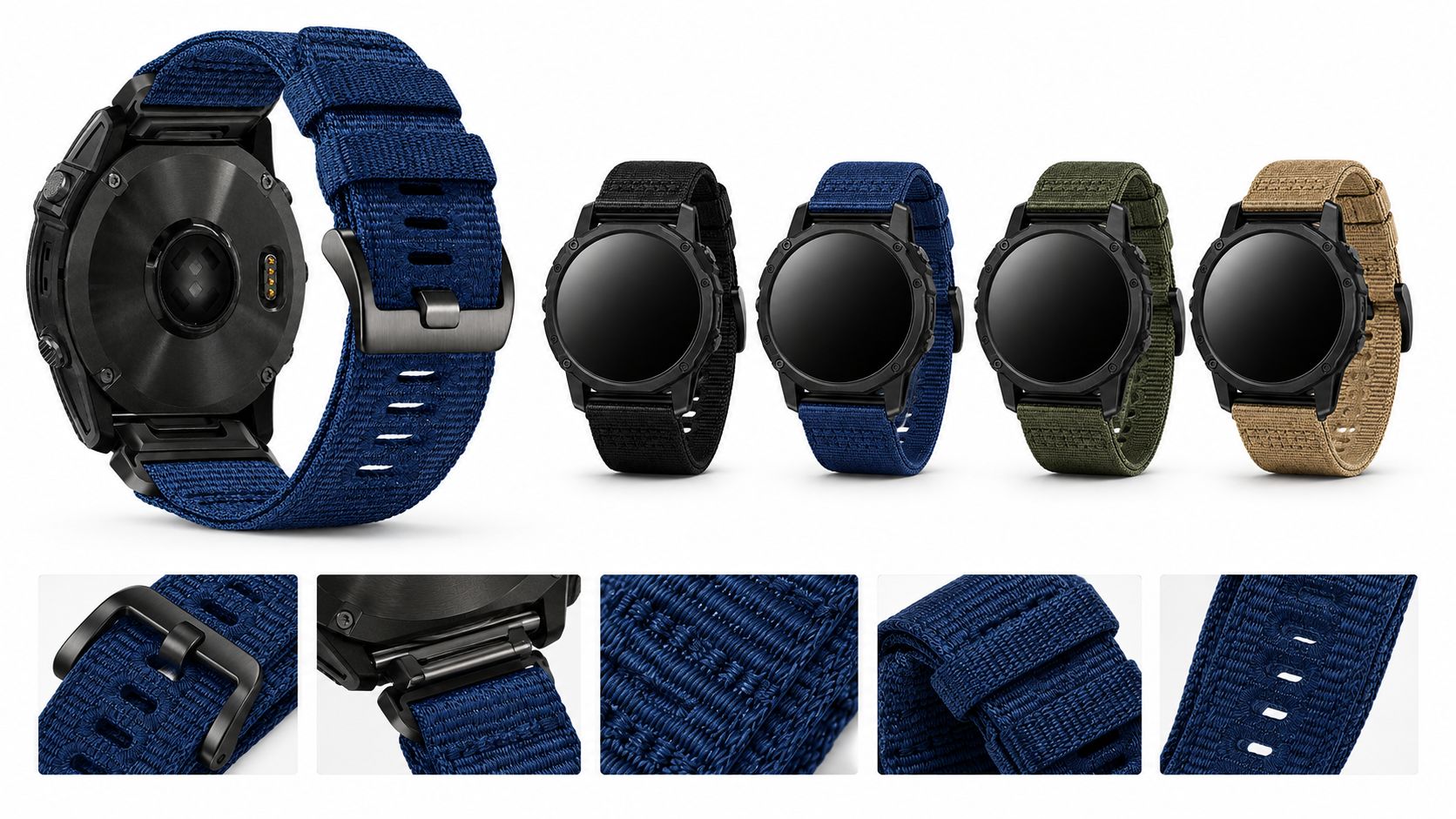
Woven nylon bands are the strongest technical choice for high-sweat, high-output use when airflow and drying speed matter. An open weave lets air move through the band instead of trapping it against the skin, so a nylon loop runs cooler than solid silicone and dries far faster once it is wet. We run no comparative bench test of our own, so treat that as how the materials behave rather than as a measured figure.
Helen Jackson's review of the Temlo Nylon Loop for Fitbit Versa 1/2 and Lite captures the appeal better than a product label can:
"The quality is top-notch, feels really sturdy but comfy at the same time. The material doesn’t irritate my skin like some other bands do, which is a big win in my book."
That experience fits the material. A woven loop has thousands of small gaps rather than a solid surface pressed against the wrist. Hook-and-loop adjustment grips in tiny increments, so you can set the band between two fixed holes instead of choosing between too tight and too loose. Nylon also feels soft, works across casual and office clothing, and offers broad color and print options. Wrist ranges vary by product, so check the stated range on the individual band rather than assuming every loop fits every wrist.
The trade-off is maintenance. Nylon absorbs sweat odor over time, can fade in direct sun, and may fray at cut edges if those edges aren't properly heat-sealed. For cleaning, follow the product's care instructions rather than treating every nylon weave the same way. The material is also a poor choice for heavy immersion, hot tubs, and chlorine-heavy use, where silicone is easier to rinse and dry.
Best for: everyday wear, casual outings, light workouts, warm conditions, and people who find firmer materials irritating. Worst for: black-tie dressing, heavy water immersion, and chlorinated hot tubs.
What Silicone Sport Bands Do Best on a Sweaty Wrist
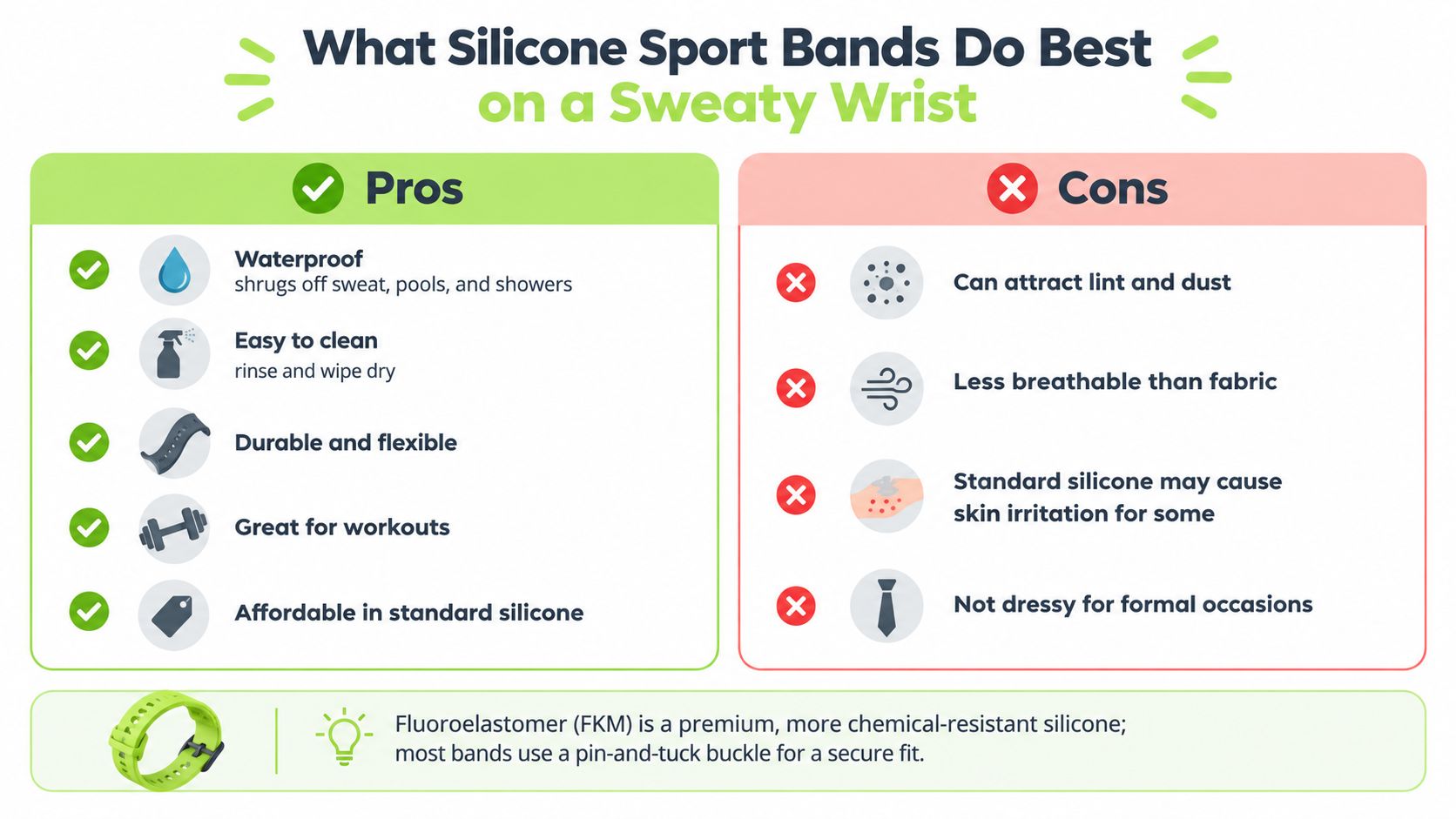
Silicone sport bands are the practical choice for sweat, showers, pools, and quick cleaning. Their non-porous surface keeps sweat and sunscreen from soaking in, so a tap rinse usually removes everyday grime. Standard silicone stays flexible and affordable, while fluoroelastomer, or FKM, provides greater chemical resistance. Silicone is also the material most smartwatches are supplied with, so it is the style most owners are replacing when they shop.
Most smartwatch silicone bands use a pin-and-tuck buckle. It is secure and easy to operate with one hand, but adjustment is limited to the available holes. Perforated sport designs improve airflow and drying over solid silicone, while preserving the material's easy-clean surface.
Choose silicone for gym sessions, swimming, hot work environments, and healthcare routines that require frequent wiping. It tolerates saltwater better than leather or nylon from a maintenance standpoint, though residue still needs rinsing. Citizen recommends wiping sweat with a soft absorbent cloth, cleaning heavier dirt with soapy water and a soft toothbrush, keeping water away from the case, and drying the watch thoroughly after washing in its watch care guidance.
Heat exposes silicone's weakness. Solid construction holds warmth and moisture against the skin, especially when the band is tightened during exercise. Some wearers experience irritation, while lint can collect around the lugs and hair may catch on the surface. Nylon feels cooler and offers finer adjustment. Silicone remains the better pick when fast cleaning and water exposure matter more than fabric comfort.
Best for: fitness, swimming, daily wear, parents, healthcare workers, and anyone who wants a band that rinses clean. Worst for: hot summer wrists under a shirt cuff and formal outfits where rubber looks too casual. For this workhorse category, browse the silicone watch band collection, or see a quick-release example in the Vornis silicone sport band in 22mm.
How Does a Milanese Mesh Band Actually Work
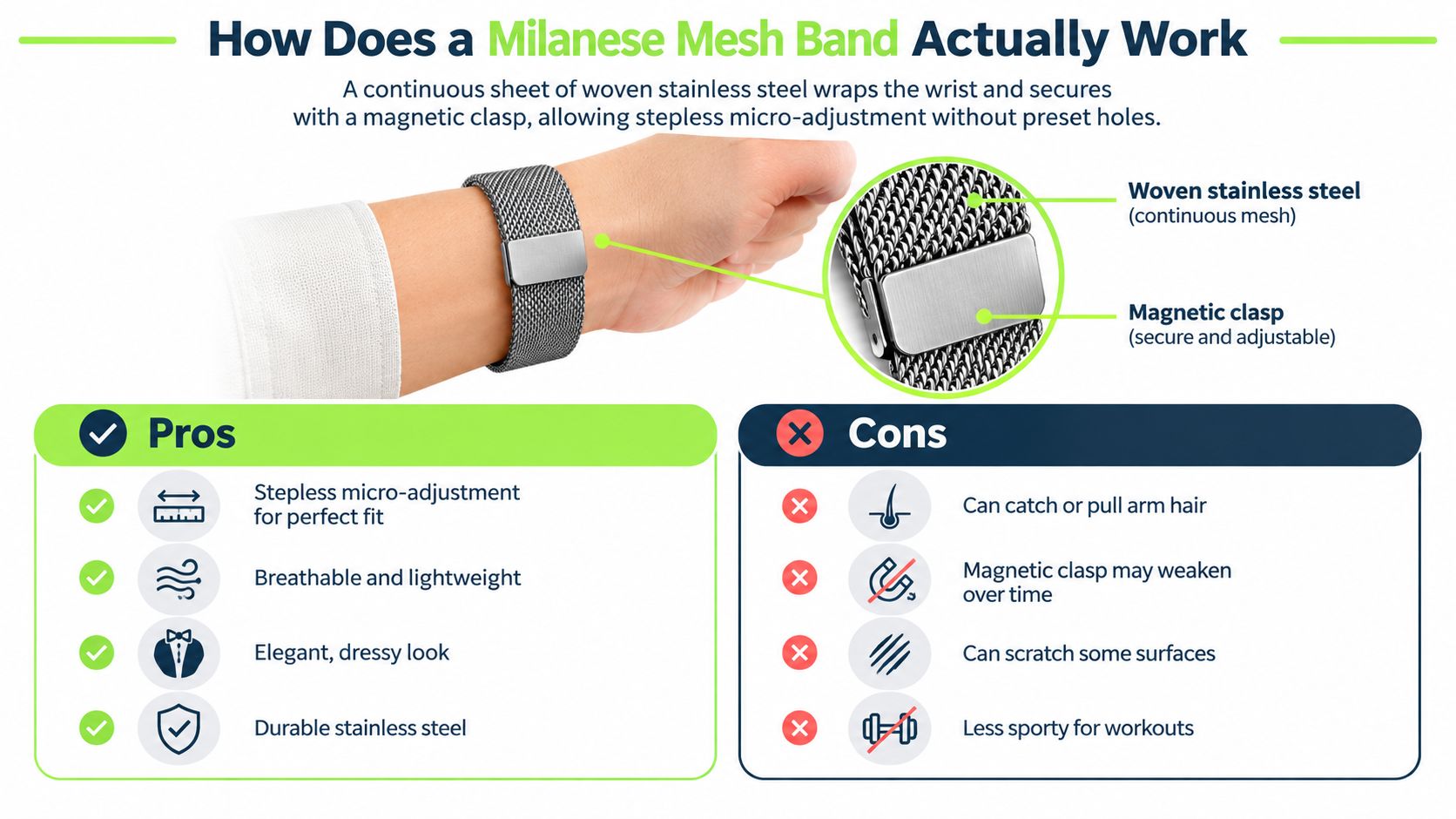
A Milanese mesh band uses a continuous sheet of woven stainless steel that wraps around the wrist and closes with a magnetic clasp. The magnet grips the mesh at almost any point, giving stepless adjustment without preset holes. You slide the clasp to set the tension, then fold or secure the clasp according to the band's design.
The woven steel feels cooler and more breathable than a solid strap because air can pass through the mesh. It also reads much dressier than nylon or silicone. The visual effect suits a slim case, office clothing, and evening wear, while the flexible surface follows the wrist better than rigid links. The cost is weight. Milanese mesh feels more substantial than fabric, and some clasp edges can catch arm hair.
A magnetic closure is useful for wrists that swell during travel or activity because you can loosen or tighten the band without hunting for another hole. The band commonly attaches through a standard lug or spring-bar system, but compatibility still depends on the watch's connector. Confirm that point before ordering, especially for smartwatches with proprietary fittings.
Milanese mesh has historical depth. Its roots are traced to chainmail weaving, and the bracelet was industrially popularised in Pforzheim, Germany in the 1920s. The style peaked in the 1970s before fading from fashion, then re-entered mainstream demand after Apple launched its Milanese Loop in 2015, as described in this history of watch clasps and mesh styles.
Best for: dress watches, offices, travel, and wrists that need precise tension adjustment. Worst for: heavy water exposure, people with implanted electronic medical devices who have been advised to avoid magnets, and anyone who dislikes metal contact or hair pull near the clasp.
Stainless Link Versus Resin Composite Link Bracelets
Choose stainless link when you want genuine metal weight and choose resin composite link when you want bracelet styling without that weight. Stainless steel gives a watch a polished or brushed finish, a substantial feel, and a conventional bracelet presence. Resin composite links can imitate ceramic, tortoiseshell, or steel-inspired looks while staying much lighter and cooler against the wrist.
Sizing separates these families. Stainless bracelets usually require removable links and may need a sizing tool or jeweler, especially when the fit needs careful adjustment around the clasp. Resin composite link bands can use a fold-over link system that separates without tools, making them easier to resize during travel or at home. That convenience comes at a cost: composite lacks the heirloom feel and dense permanence of steel.
Attribute
Stainless Link
Resin Composite Link
Wrist feel
Heavier, solid, premium
Lighter, cooler, less dense
Appearance
Polished or brushed metal
Ceramic, tortoiseshell, or modern bracelet look
Sizing
Remove links, often with tools
Remove links through a simpler fold-over system
Water routine
Wipe after sweat and dry between links
Rinse after saltwater and dry thoroughly
Best setting
Office, tool watches, formal casual wear
Everyday travel, summer wear, statement styling
Both styles can work for long days, but the weight difference becomes obvious on larger cases or smaller wrists. Stainless steel feels anchored, which some buyers want and others find tiring. Resin composite gives a similar bracelet silhouette with less pressure, making it the better choice for someone who likes link styling but doesn't want a heavy watch.
Best for stainless link: buyers who value real metal presence, polished finishes, and a traditional bracelet feel. Worst for stainless link: small wrists, heat-sensitive wearers, and anyone unwilling to deal with link sizing.
Best for resin composite link: lighter bracelet styling, travel, warm climates, and shoppers who want a distinctive surface. Worst for resin composite link: buyers seeking heirloom metal weight or the most traditional bracelet construction.
Braided Stretch Bands and Leather Straps for Dress and Slip-On Wear
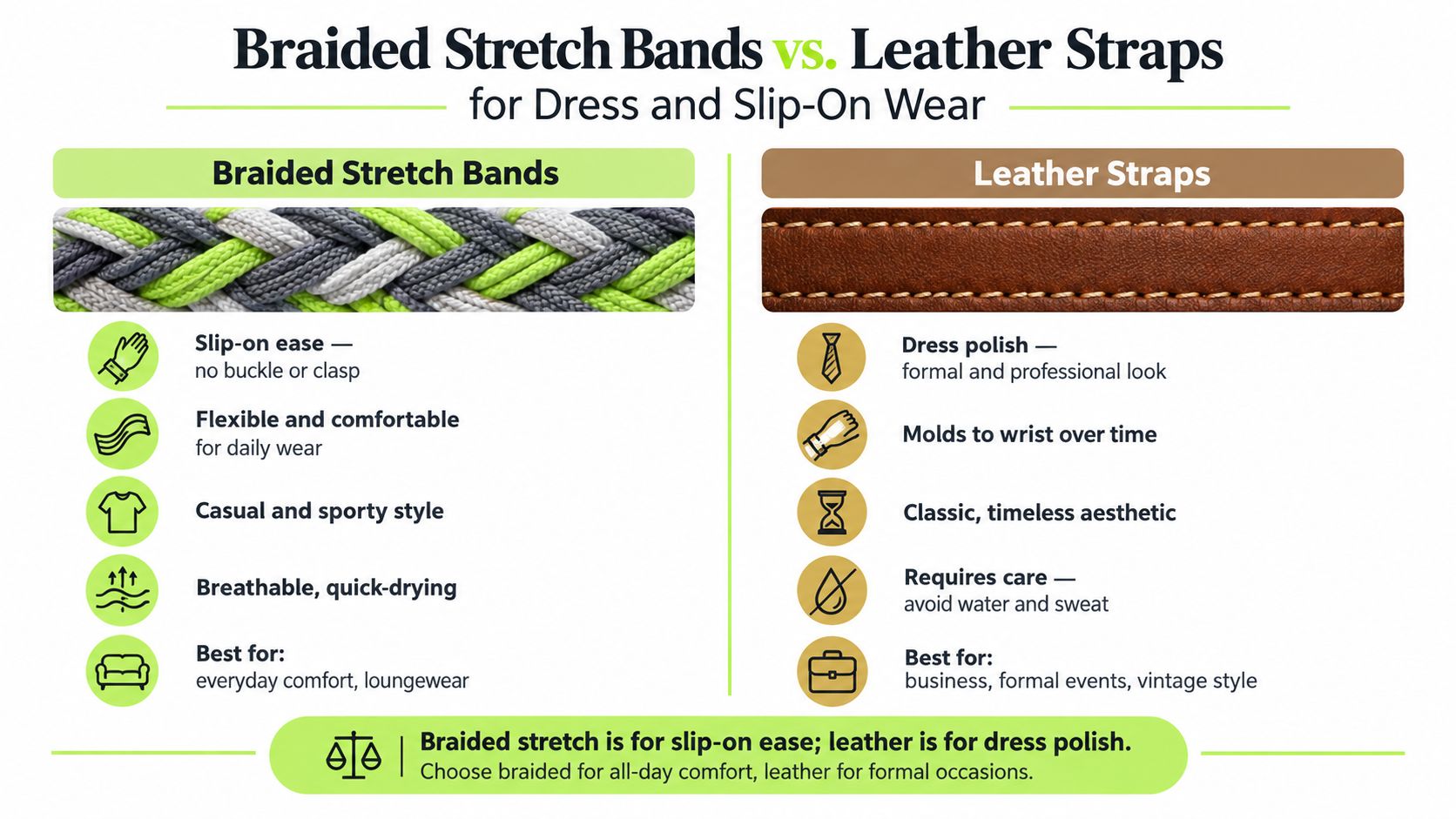
Braided stretch bands are the easiest slip-on option, while leather straps remain the stronger choice for dress polish. Braided bands use interwoven elastic or yarn strands that stretch over the hand and settle around the wrist without a buckle or clasp. They breathe better than a solid strap, suit quick on-and-off use, and create a relaxed, casual appearance.
The compromise is adjustment. A braided band doesn't offer the same fine control as a hook-and-loop nylon loop or magnetic mesh, so the stretch and size need to be right from the start. The weave can also hold moisture during prolonged activity. Braided bands attach through standard lugs when the watch supports that connector, but the band still needs to match the exact lug width.
Leather uses a buckle and holes, so its fit is more familiar but less instantly adjustable. Good leather softens and molds to the wrist over time, pairing naturally with classic cases, business clothing, and formal outfits. It doesn't belong in the gym. Sweat, water and heat all shorten a leather strap’s life, and the chemicals used to tan leather — chromium salts and formaldehyde among them — are a recognised cause of allergic contact dermatitis in a minority of wearers.
Keep leather for desk days, dinners, and formal events. Switch to braided stretch, nylon, or silicone for training, wet weather, and humid conditions. That rotation protects the dress strap and gives you a more suitable surface for active wear.
Best for braided stretch: slip-on convenience, everyday comfort, relaxed clothing, and people who dislike buckles. Worst for braided stretch: precise tension requirements, long immersion, and formal dressing.
Best for leather: business, formal events, vintage styling, and classic watch cases. Worst for leather: swimming, heavy workouts, hot climates, and anyone who won't maintain the strap. We carry genuine-leather bands across Fitbit, Apple Watch, Garmin QuickFit and Samsung fittings in the leather watch band collection.
Which Watch Band Style Is Right for You
Choose silicone for sweat and water, woven nylon or braided stretch for soft all-day wear, Milanese mesh or leather for dress, and nylon, braided, or magnetic mesh when tool-free adjustment matters most. The final choice depends on two practical questions: how the band attaches and how much maintenance your routine allows.
The order data makes woven nylon the useful surprise. In the recorded mix of 197 units ordered between 2025-12-04 and 2026-09-17, nylon accounted for 94 units, 48% of units ordered, Milanese for 37 units, 19% of units ordered, and silicone for 32 units, 16% of units ordered. Leather recorded 21 units, 11%, braided 8 units, 4%, stainless link 3 units, 2%, and resin composite link 2 units, 1%. These records show what shoppers selected, not why. They still challenge the assumption that silicone automatically dominates.
Band Style
Sweat & Water
All-Day Comfort
Dress & Weight
Tool-Free Ease
Silicone sport
Strong, easy to rinse
Flexible but warmer
Casual, light
Moderate, hole-based
Woven nylon
Breathable, dries quickly
Excellent for many wrists
Casual to smart casual, light
Excellent with hook-and-loop
Milanese mesh
Handles moisture, needs rinsing
Flexible, cooler metal feel
Dressier, moderate weight
Excellent with magnetic adjustment
Stainless link
Durable, rinse and wipe
Stable but heavier
Polished, substantial
Limited, link removal
Resin composite link
Rinse after exposure
Light and cool
Bracelet look, light
Moderate, link removal
Braided stretch
Breathable, but retains moisture
Soft and easy to slip on
Casual, light
Excellent for on and off
Leather
Poor match for regular water
Molds to the wrist
Most traditionally dressy, light
Moderate, buckle holes
Match the band to the problem
You sweat heavily or swim. Pick silicone, especially a perforated sport design if heat bothers you. It rinses clean quickly and does not hold odor as readily as fabric.
Your skin dislikes firm or sealed materials. Start with woven nylon. Braided stretch feels softer and slips on faster, while nylon gives you more precise tension control.
You need a polished office look. Choose Milanese mesh for adjustable metal or leather for classic formality. Mesh flexes with wrist movement. Leather gives the more traditional finish.
You hate fiddly sizing. Nylon loops, braided stretch, and Milanese magnetic bands avoid fixed holes and repeated link removal.
You want a bracelet silhouette without heavy steel. Resin composite link gives you link styling with a lighter feel.
You want one band for every situation. Choose woven nylon when comfort and adaptability lead. Choose silicone when water resistance and quick cleaning matter more. Keep a formal mesh or leather option for settings where either casual material looks out of place.
A small rotation beats forcing one band through every environment. Use silicone or nylon for training and wet conditions, then switch to mesh, leather, braided, or a link style when the setting and clothing call for it.
Before ordering, verify the Apple Watch case size or the exact lug width and connector. Nothing but Bands offers device-specific and universal quick-release replacement collections spanning silicone, nylon, Milanese, leather, resin link, and braided styles. Compare the material only after confirming fit. Start with the nylon collection or the silicone collection, then choose a second style for the part of your routine the first band handles poorly.
Visit Nothing but Bands after checking your Apple Watch case size or lug width, then filter the replacement collections by the style that matches your routine. Choose nylon for daily work and adaptable wear, and add mesh, braided, leather, or resin composite link when you want a different fit and finish without changing watches.
Written by Alex· Published September 22, 2026
· 15 min read
· Updated October 7, 2026
About the author
Alex — Founder, Nothing but Bands
Alex runs Nothing but Bands from Austin, TX. Every fit claim in these guides is verified against manufacturer specs — including the watches our bands don't fit. More about Alex →