


Finding the right watch band is more about comfort and precision than it is about style. A band that's too loose will slide around all day, while one that's too tight will pinch your skin. It’s a frustrating experience that completely ruins the look and feel of your watch.
3 Key Takeaways: Watch Band Size and Lug Width
You need two numbers: Your wrist circumference sets the band length, and the lug width sets whether the band attaches to the watch at all.
Measure the lug width exactly: Check the back of your old strap, or measure between the lugs with a ruler or calipers. Even 1mm too narrow leaves a gap and strains the spring bars.
Know your brand's system: Apple uses two slide-in size groups, most Samsung watches take 20mm or 22mm, Garmin QuickFit comes in 20, 22 or 26mm, and each Fitbit line has its own connector.
The secret to avoiding all that? Just two simple measurements. Forget the complicated jargon and guesswork. We're going to walk you through exactly what you need to know to find a band that feels like it was made just for you.
This guide assumes you're ready for the technical side — wrist circumference plus your watch's exact lug width and connector type. If you haven't measured your wrist yet, start with our complete wrist-fit guide or the quick version first.
Table of Contents
- Getting Your Watch Band Size Just Right
- Nailing Your Wrist Circumference Measurement
- Finding Your Watch’s Lug Width
- Sizing Guides for the Big Smartwatch Brands
- Common Watch Sizing Mistakes to Avoid
- Answering Your Watch Band Sizing Questions
Getting Your Watch Band Size Just Right
Getting the right watch band size is about so much more than looks. It's the secret to all-day comfort and making sure your watch stays securely where it belongs. We’ve all experienced it—a band that’s too tight digs in and leaves marks, while one that's too loose just slides around and becomes a constant annoyance.
The good news? You only need to know two key numbers to nail the fit every single time.
The Two Measurements That Matter Most
Before you even start browsing for that new strap, grab a flexible measuring tape and your watch. We're going to find your wrist circumference and your watch's lug width. These two figures are your roadmap to a perfect purchase.
Here are the only two numbers you need to find a watch band that fits flawlessly.
| Measurement Type | What It Determines | Why It Is Essential |
|---|---|---|
| Wrist Circumference | The length of the strap | Ensures the band wraps comfortably around your wrist with enough tail to tuck neatly into the keeper. |
| Lug Width | The width of the strap | Dictates the exact width needed to connect securely to the watch case. It’s a non-negotiable measurement. |
With these two dimensions, you eliminate all the guesswork.
One of the most common mistakes I see is people focusing only on their wrist size and completely ignoring the lug width. A band that's even a single millimetre too narrow will leave an unsightly gap and put extra stress on the spring bars, which can lead to them failing completely.
Having a bit of context helps, too. For example, knowing the average male wrist size in the UK is 18.42cm helps you understand why standard band lengths are what they are. This figure is a benchmark for retailers when fitting everything from an Apple Watch to a Samsung Galaxy Watch.
In fact, detailed fitting data shows that about 65% of UK men have wrists between 17.5cm and 19.5cm, which is why most standard 'gents' bands are designed to fit this range. For a deeper dive into how this all comes together, check out this excellent watch size guide from Beaverbrooks.
By taking a few moments to get these measurements, you can shop with confidence. Whether it's a durable silicone band for your Garmin Fenix or a sophisticated leather strap for a dress watch, you'll know it's going to click into place perfectly.
Nailing Your Wrist Circumference Measurement
Getting your wrist size right is the absolute first step to finding a watch band that feels like it was made just for you. Get this wrong, and you're stuck with a band that’s either uncomfortably tight or slides around all day. The good news is you can get an accurate measurement in less than a minute with things you’ve already got lying around the house.
This simple guide shows the two key measurements you'll need for any watch band purchase.
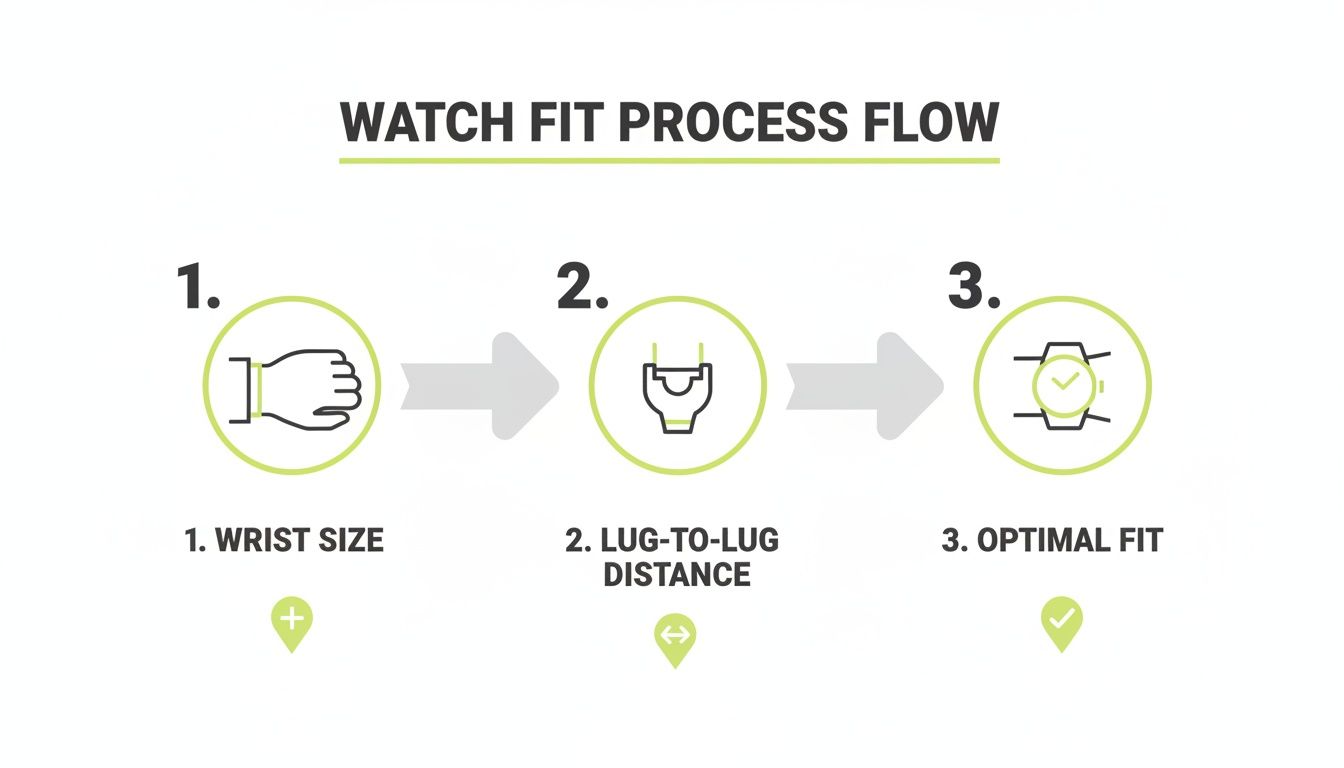
As you can see, both your wrist size and the watch's lug width are equally important. Let's start by getting that first measurement spot-on.
Using a Flexible Tape Measure
If you have one, a flexible tailor's tape measure is easily the best tool for the job. It’s designed to wrap smoothly around curves, which is exactly what we need here.
Simply wrap the tape around your wrist right where you’d normally wear your watch. For most people, that's just above the prominent wrist bone. The trick is to pull it snug, but not tight. You don't want to be pinching your skin, but there shouldn't be any sag or gap either.
Read the number where the end of the tape meets the rest of the strip. That's it—your true wrist circumference. I'd suggest noting it down in both millimetres (mm) and centimetres (cm), as you'll find different brands use different units.
The String and Ruler Method
No flexible tape measure? No problem at all. You can get an equally accurate result with a bit of string and a regular ruler. Honestly, almost anything flexible will do the trick—a phone charging cable, a thin strip of paper, even dental floss works in a pinch.
Just as you would with a tape measure, wrap your chosen "string" around your wrist at the same spot, just above the bone. Keep it snug without digging in. Then, use a pen to carefully mark the point where the end overlaps.
Now, just unwrap the string and lay it flat against a ruler. Measure from the end to the mark you just made. That length is your wrist circumference. It's a surprisingly simple and effective workaround.
A Quick Tip from Experience: For a truly comfortable fit, I always suggest adding a little bit of breathing room. Try adding about 0.5cm (or a quarter-inch) to your raw measurement. This small buffer prevents the band from feeling restrictive, which is especially important for thicker materials like leather or metal bracelets that don't have much natural stretch.
This little bit of slack makes a world of difference for all-day comfort, especially as your wrist naturally swells a tiny bit throughout the day. With this number sorted, you're one step closer to that perfect-fitting strap.
Finding Your Watch’s Lug Width
While your wrist size determines the length of your strap, the lug width is the one measurement you absolutely can't get wrong. It dictates whether a strap will even attach to your watch in the first place.
Think of it as the crucial connection point. It's the precise internal gap between the two 'horns' (the lugs) that extend from the watch case where the strap connects.
Nailing this measurement is essential. I’ve seen it time and again: a strap that’s even a single millimetre too narrow leaves an awkward gap and puts extra strain on the spring bars. One that's too wide? It simply won't fit, no matter how much you try to squeeze it in.
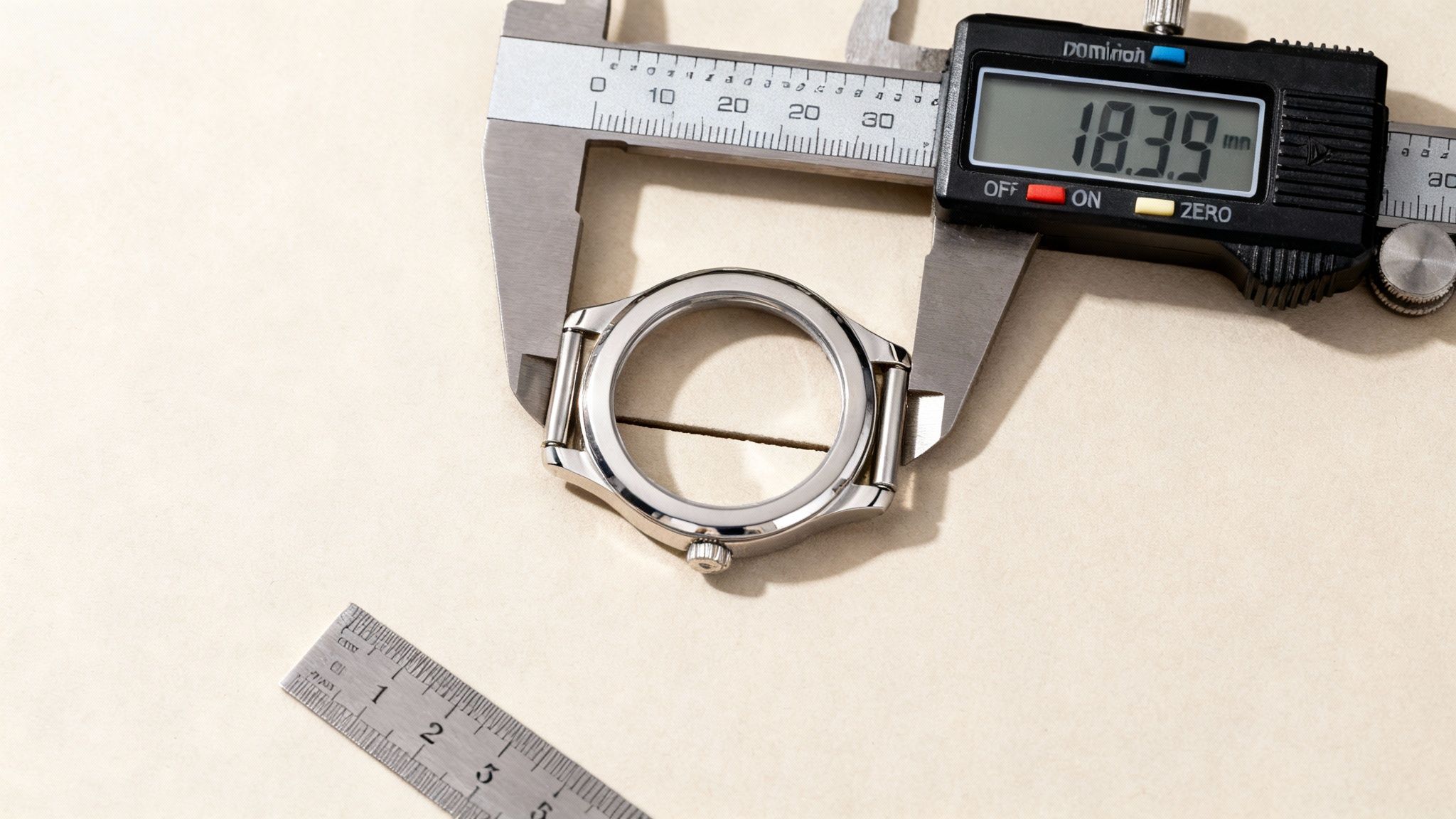
The good news is that figuring out this number is quite simple. You've got a few options, depending on what you have handy.
Three Easy Ways to Measure Lug Width
You don't need a watchmaker's toolkit to get this done. Here are three straightforward methods that work every time.
-
Check Your Old Strap: The quickest and easiest method is often just to flip over the band you're about to replace. Many watch bands have the width stamped right onto the underside, usually near where the spring bars sit. Look for a number like "20" or "22"—that's your width in millimetres.
-
Grab a Ruler: If there's no marking, a simple ruler with millimetre markings will do the trick. Just lay the ruler across the gap between the lugs and carefully measure the internal distance. Try to be as exact as you can, because every millimetre counts here.
-
Use Digital Callipers: For total, foolproof accuracy, nothing beats a pair of digital callipers. They give you a perfect reading down to a fraction of a millimetre, taking all the guesswork out of the equation. Just open the jaws, gently place them against the inner surfaces of the lugs, and let the display give you the precise number.
In the UK, a few standard lug widths are far and away the most common. 20mm is the leader, found on about 45% of modern smartwatches. Taking a moment to measure accurately with callipers, especially for a watch like the Garmin Venu, can save a lot of hassle—mismatched sizes are the culprit behind a large share of watch band returns.
Once you know your lug width, you've opened the door to a massive world of customisation. It's the key that lets you shop confidently for any compatible strap, knowing it will snap into place perfectly and look like it was made for your watch.
For instance, most Samsung Galaxy Watch models use a standard 20mm or 22mm lug width, which makes finding new straps a breeze.
Be aware, though, that some brands play by their own rules. Apple is the big one here, using proprietary connectors instead of traditional lugs. With an Apple Watch, you’re looking at the case size, not the lug width. For a deep dive into this, our guide on Apple Watch sizes and band compatibility will show you exactly how to match the right band to your specific model.
Sizing Guides for the Big Smartwatch Brands
So, you've got your wrist measurement and maybe even your watch's lug width. That's a solid start. But when you step into the world of smartwatches, you quickly realise it’s a whole different ball game. The big players often use their own unique connectors, so the standard rules don't always apply.
Getting to grips with these brand-specific quirks is the final piece of the puzzle. It’s what separates a perfect fit from a frustrating return. Let's break down exactly what you need to know for your specific device.
Nailing Apple Watch Sizes
Apple did away with the traditional lug-and-pin system entirely. Instead, they created a clever slide-in connector that, while proprietary, makes life incredibly simple for finding a compatible band.
The key is knowing which of the two size families your watch belongs to.
- The Smaller Family: 38mm, 40mm, 41mm and newer 42mm models share the smaller connector. A 38mm Series 3 band, for example, fits a 41mm Series 9.
- The Larger Family: Older 42mm models, 44mm, 45mm, 46mm and 49mm Ultra share the larger connector. For 42mm, Series 1–3 is large; Series 10 onwards is small.
Thanks to this system, you’ve got a massive catalogue of straps to explore, no matter which model you own.
The Good News About Samsung Galaxy Watches
For the most part, Samsung makes things easy by sticking to industry-standard lug widths. This is great because it opens up a huge universe of third-party band options that aren't tied to a special connector.
Most modern Galaxy Watch models use either a 20mm or a 22mm spring bar system. The popular Galaxy Watch 4 and 5 series, for example, typically use a 20mm lug width. This standardisation means you can explore all sorts of materials and styles. Getting familiar with the options for Galaxy Watch 4 straps will show you just how much variety is out there.
A quick word of advice: Always double-check your specific model. While most are standard, some older or less common versions might have a different size. A quick search for "[Your Galaxy Watch Model] lug width" will give you a definitive answer in seconds.
Decoding Garmin and Fitbit Connectors
Garmin and Fitbit are all about function, catering to everyone from marathon runners to everyday fitness fans, and their band systems reflect this diversity.
Garmin is famous for its QuickFit and Quick Release systems, which are brilliant for swapping bands on the fly without any tools. QuickFit bands, often found on their high-end Fenix and Epix lines, are sold in very specific widths like 20mm, 22mm, and 26mm. You absolutely have to buy the correct QuickFit size for your watch – a 22mm band simply won't attach to a watch built for a 26mm connector. On the other hand, their Forerunner and Venu series often use the more universal Quick Release spring bars.
Fitbit is in a similar boat, using proprietary connectors that are specific to each model line (like Versa, Charge, or Sense). A strap made for a Fitbit Versa 4 is not going to work on a Charge 6. When you're shopping for a Fitbit band, the most important thing is to make sure the product description clearly says it’s compatible with your exact model. That little bit of diligence is what guarantees a secure, seamless fit.
Smartwatch Sizing Cheat Sheet
Feeling a bit overwhelmed? It's a lot to remember. This table gives you a quick reference for the most common models to get you pointed in the right direction.
| Smartwatch Brand | Common Connector or Lug Width | Helpful Sizing Tip |
|---|---|---|
| Apple Watch | Proprietary Slide-In Connector | Match the band family; for 42mm, check the generation. |
| Samsung Galaxy | 20mm or 22mm Standard Lugs | Watch4–7 use 20mm; Watch8 and Ultra need their own fittings. |
| Garmin | QuickFit (20/22/26mm) or Quick Release | The connector is model-specific; a Fenix uses QuickFit, a Venu uses Quick Release. |
| Fitbit | Proprietary Connectors | Match the connector family, such as Charge 5/6. |
Remember, this is just a starting point. The golden rule is to always confirm the specific requirements for your exact watch model before you buy. Our Watch Band Finder does that in a few seconds: search your model to see its band width and connector.
Common Watch Sizing Mistakes to Avoid
Knowing how to measure for a watch band is half the battle; dodging the common pitfalls is what really seals the deal for a perfect fit. I’ve seen it time and again—small missteps can lead to a band that’s either uncomfortably tight or annoyingly loose. Let's walk through these frequent errors so you can get your sizing spot-on the first time.
One of the biggest mistakes people make is pulling the measuring tape way too tight. You’re looking for a snug measurement, not a constricting one. If you cinch it too hard, you’ll end up with a band that digs into your skin, which only gets worse as your wrist naturally swells a bit throughout the day.
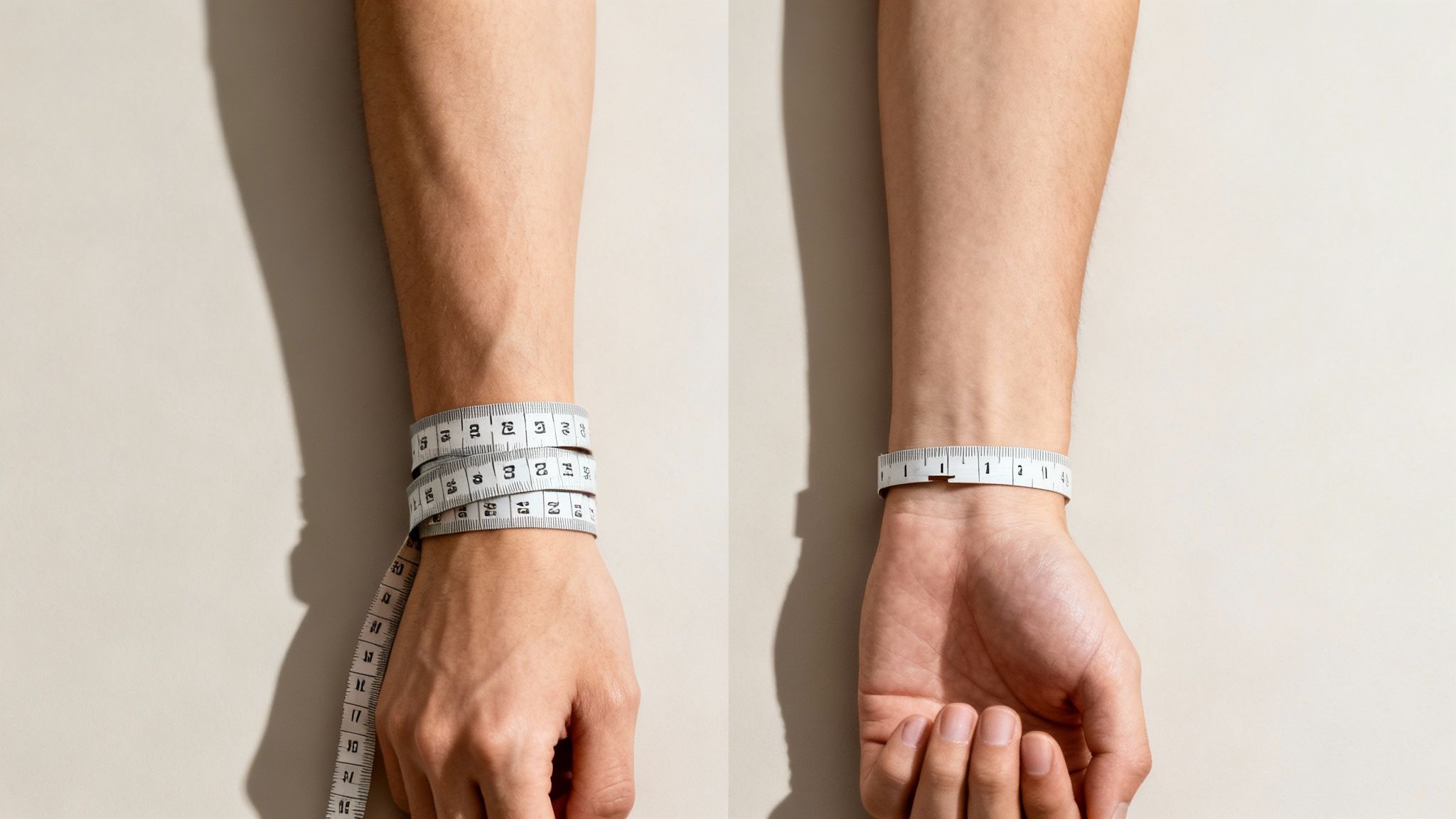
On the flip side, leaving the tape too loose is just as bad. This mistake leads to buying a strap that slides all over the place. You’ll find yourself cranking it to the last buckle hole, which not only looks a bit off but also puts unnecessary strain on the band. A good rule of thumb is to leave just enough space to comfortably slide one finger between the tape and your wrist.
Forgetting About Band Material and Thickness
It's easy to focus only on length, but overlooking the band's material is a classic rookie error. The thickness and flexibility of a strap have a massive impact on how it actually feels, even if the length is technically correct. A chunky, padded leather strap, for instance, will feel much tighter than a slim silicone band of the same length because it has less give and takes up more room as it curves around your wrist.
Here’s a quick rundown of how different materials tend to fit:
- Leather: A thick, padded leather band needs a little extra breathing room. If you find your wrist is between two sizes, it's usually wise to size up.
- Silicone/Nylon: These materials are incredibly forgiving. Their flexibility means they offer a comfortable fit even if your measurement isn't absolutely perfect.
- Stainless Steel: Metal bracelets can be finicky. While they are adjustable, you might find that removing one link makes the band too tight, while adding it back makes it too loose.
If you’ve got a metal band that’s almost right, you’ll need to make some fine adjustments. Learning how to remove links from a watch band is a skill that can turn a sloppy fit into a custom-feeling one.
Handling "In-Between" Wrist Sizes
So, what do you do when your wrist measurement lands squarely between two standard sizes? It’s a common headache, but there are a few clever workarounds. Don't just settle for a fit that’s "good enough."
Your best bet is to look for a band style that offers near-infinite adjustment. Think about a Milanese loop with its magnetic clasp or a sport loop with its hook-and-loop system. These designs allow for tiny, precise adjustments, so you can find the absolute perfect tension for your wrist.
Another option is to seek out traditional buckle straps that have more closely spaced adjustment holes. More holes mean a better chance that one of them will hit that sweet spot for you. If you know your wrist is a tricky size, it’s best to steer clear of bands with limited adjustment points from the get-go. This simple, proactive choice can make all the difference.
Answering Your Watch Band Sizing Questions
Let's wrap things up by tackling some of the most common questions people have when they're trying to find that perfect watch band. Getting these final details right is the key to choosing a new strap with complete confidence.
What if I’m Between Two Sizes?
This is a classic dilemma, but thankfully, the solution is usually simple. If you're on the fence, I almost always recommend going for the slightly larger size. A band that’s too tight is a real pain – it’s not just uncomfortable, it can also dig in and affect your circulation as your wrist naturally expands and contracts during the day.
Most straps with a classic buckle have a good range of adjustment holes, so you have some wiggle room. But if you want to absolutely nail the fit every single time, look for a band that allows for tiny, precise adjustments.
- Milanese Loops: These are brilliant. The magnetic clasp lets you secure it at any point for a truly custom fit.
- Sport Loops: The hook-and-loop system offers the same kind of micro-adjustability, making it easy to get things just right.
These styles take all the guesswork out of the equation, which is perfect if you often find yourself caught between standard sizes.
Can I Swap Bands Between Different Watch Brands?
That’s a great question, and the answer is a classic "it depends". It all comes down to the connection system the watchmaker uses.
If two different watches happen to share the same lug width (say, 20mm) and both use a standard spring bar, then you can absolutely swap the bands between them. This is pretty common for brands like Samsung and a lot of traditional watch manufacturers. The problem is, many of the big smartwatch brands have created their own unique connection systems.
Be aware that devices like the Apple Watch, most Fitbits, and some Garmin models use proprietary connectors. You simply can't attach a standard 22mm leather strap to an Apple Watch, for example. We make sure our product descriptions are crystal clear about compatibility, so you know you're getting a band that will click in securely and look seamless.
How Do I Know Which Length to Buy?
This is where that wrist measurement you took earlier really comes into play. The length of the band you need is tied directly to your wrist circumference. When you look at a product online, you'll almost always see a size range specified, something like 'Fits wrists from 150mm to 200mm'.
All you have to do is take your wrist measurement and make sure it sits comfortably within that range. It’s the single most reliable way to guarantee the strap will buckle up properly, leaving just the right amount of tail to tuck neatly into the keeper loop.
Does the Material Affect the Size I Should Choose?
While your core measurements for wrist size and lug width stay the same, the material of the band definitely changes how it feels on your wrist. A thick, padded leather strap or a heavy stainless steel bracelet is going to feel much snugger than a soft, flexible material like silicone or nylon.
This doesn't mean you need to order a different size, but it's something to keep in mind for your own comfort. If your wrist measurement is right at the top end of a band's recommended size range, a more flexible material will offer more give and probably feel better than a rigid one.
Buying this as a gift and can't measure their wrist directly? Our gift-sizing guide covers how to estimate discreetly, and which styles are the safest bet when you're not 100% sure.
Ready to find a band that feels like it was made just for you? At Nothing But Bands, we have a huge selection of premium straps for all the top smartwatch brands, with clear sizing and compatibility info on every product.
Explore our collections and find your perfect fit today at Nothing But Bands
Related posts

- October 06, 2026
Clear installation instructions for smartwatch bands. Learn how to attach, verify, and troubleshoot Apple, Samsung, Garmin, and Fitbit straps safely.

- October 05, 2026
A practical guide to changing watch bands across Apple, Garmin, Samsung, and Fitbit, covering tools, fitment, daily rotation, and common...

- October 02, 2026
Everything to know about the Coros Pace 4 nylon band including sizing, quick-release installation, cleaning tips, and compatible third-party options.

