


If a leather watch band has been on your wrist for a long time, removing it can feel harder than fitting it was. The leather compresses into the lug gap, curves around the case, and hides the small shoulder of the spring bar you need to catch. To remove a leather watch band without damage, first identify whether it uses a traditional spring bar, a quick-release bar, or a proprietary smartwatch fitting, then use the correct release method on a soft surface.
Traditional leather straps usually need a forked spring-bar tool. Quick-release straps need only a lever or slider, while Apple Watch, Fitbit, Garmin, and Galaxy Watch bands often use their own brand-specific connectors. The safest removal is controlled and deliberate, not forceful.
Table of Contents
- What Is Actually Holding Your Leather Strap On
- Which Tools You Actually Need for Leather Straps
- How to Remove a Traditional Spring-Bar Leather Band
- When Your Watch Uses a Quick-Release Mechanism
- What to Do When a Leather Strap Won't Budge
- Fitting a New Band and Checking for Wear
What Is Actually Holding Your Leather Strap On
A traditional leather watch strap is held between the watch lugs by a spring bar, while a quick-release or smartwatch band uses a built-in lever, slider, button, or proprietary connector. Check the underside of the strap and the lug area before using any tool, because the attachment type determines the safe removal method.
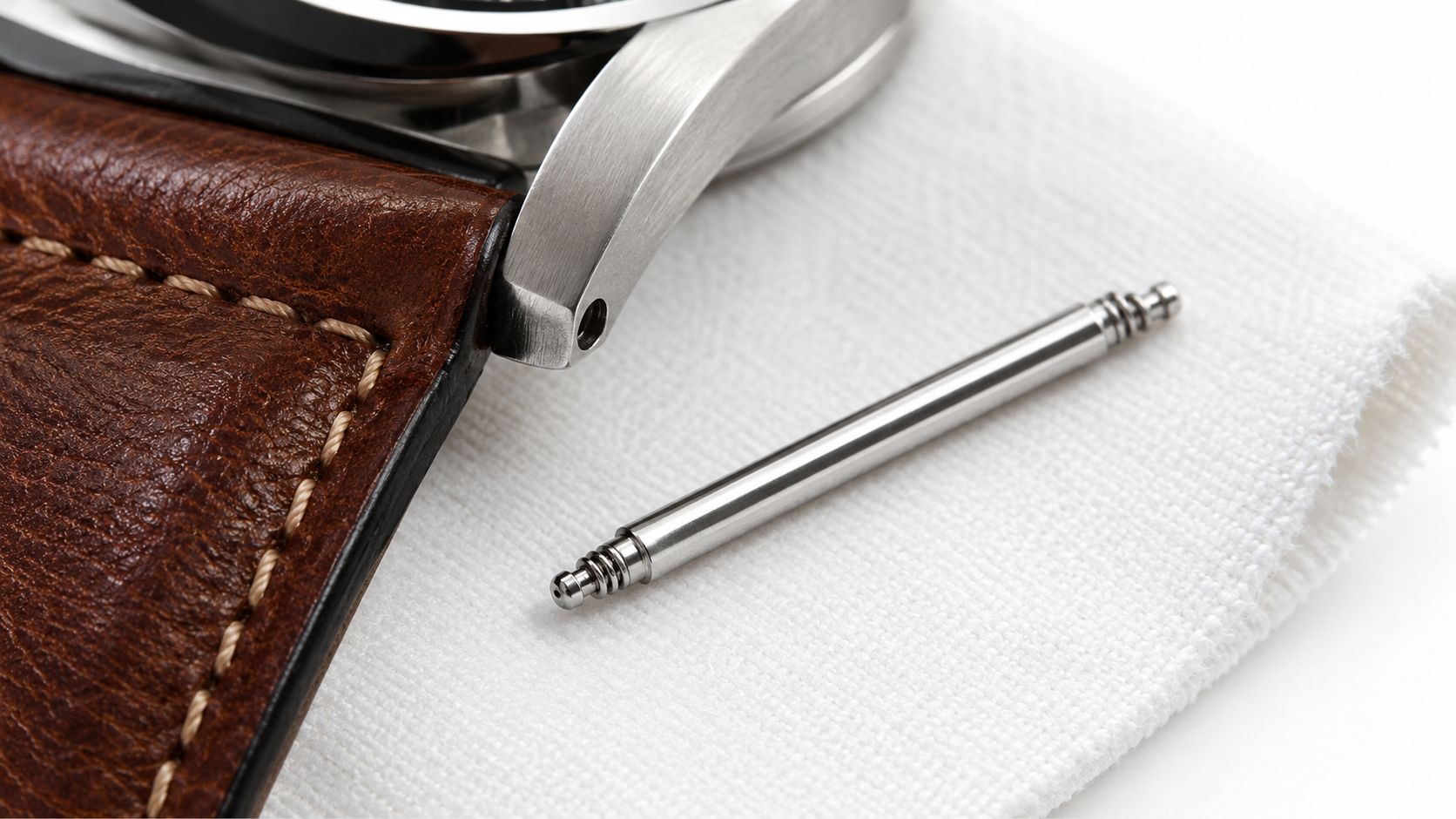
For most traditional watches, the spring bar is a small metal pin with a spring-loaded centre. It sits between the lugs and passes through the strap end. Drilled lug holes let you see the spring-bar ends from the outside of the case, while non-drilled lugs require you to reach the bar through the narrow gap between leather and lug. A standard leather band commonly uses spring bars at both ends.
Leather makes this job unusually awkward. A strap worn for a long time moulds around the spring bar and can fill nearly all the space beside it. The shoulder, or small groove where the forked tool must sit, may be hidden beneath the leather. If you press blindly, the tool can slide onto the polished lug and leave a scratch.
Check for a release before reaching for a tool
Turn the watch face down on a soft cloth and inspect the underside of the strap. A small metal tab or slider usually indicates a quick-release spring bar. Pulling or pressing that tab retracts the bar, allowing the strap to move away without compressing a hidden shoulder with a fork.
Quick-release spring bars turned strap removal from a tool-based job into a faster hand operation. The important distinction isn't the leather. It's the hardware holding the leather to the case.
Apple Watch bands are a separate case. Apple Watch bands slide out of a channel in the case once you hold the band release button on the back of the watch case. Don't treat that connector like a traditional spring bar.
Which Tools You Actually Need for Leather Straps
A traditional leather strap needs a double-ended spring-bar tool, a soft work surface, and good lighting. The forked end compresses the bar, while the pointed end can help create a small viewing gap without forcing the leather away from the case.
The fork matters because it can catch the spring-bar shoulder while keeping pressure directed at the bar. A pointed end is useful for gently folding a thick strap back or probing for the bar, but it shouldn't become a substitute for the fork when the bar is ready to release.
Practical rule: Keep the tool square against the spring-bar shoulder and push toward the centre of the bar. Never use the watch case as a fulcrum.
Place the watch crystal-down on a clean, soft cloth. That protects the crystal and bezel from a hard surface, while the cloth also helps contain the tiny spring bar if it escapes when one side releases. The band-changing guide from Chronometer Check recommends the same face-down start on a soft towel or microfibre cloth.
Tools to refuse
Don't use a kitchen knife, craft blade, fingernail clippers, or a random precision screwdriver. A screwdriver can slip into the leather, concentrate pressure on the case, or bend the spring bar. Improvised tools also tend to be too broad or too sharp for the narrow space beside a padded strap.
A proper spring-bar tool is inexpensive and simple, but the instrument still needs careful handling. Our separate spring-bar tool walkthrough covers the tool itself, so the key point here is selection: use the forked end for compression and avoid levering against the lug.
Nothing but Bands stocks watch bands rather than watch tools. You'll need to have a suitable spring-bar tool before starting a traditional removal.
How to Remove a Traditional Spring-Bar Leather Band
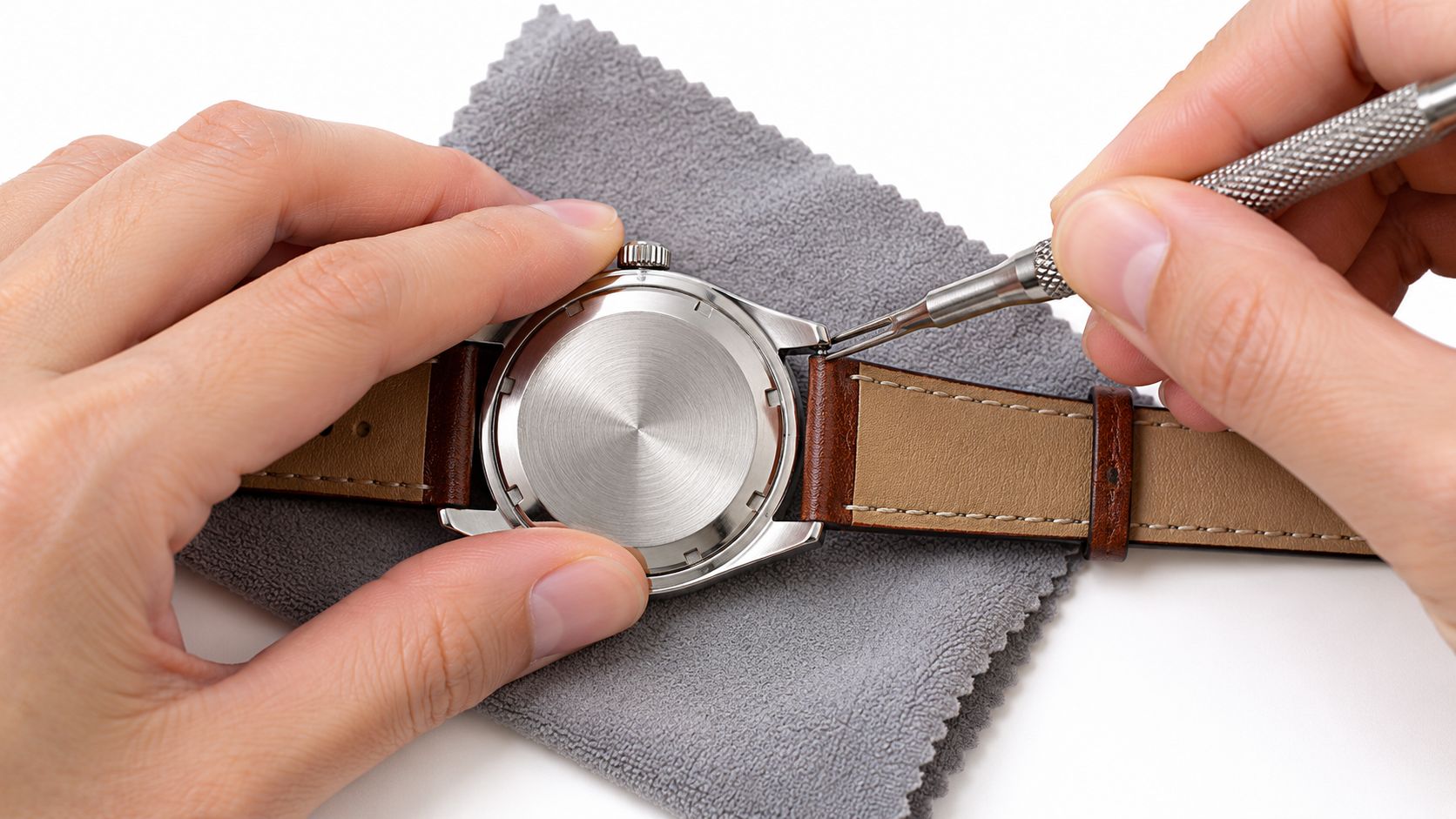
To remove a traditional leather band, place the watch face down, fold the strap back to expose the spring-bar shoulder, then compress one side of the bar toward the centre with a forked spring-bar tool. Once the first end clears the lug, swing the strap away and release the other end.
Start with the watch resting securely on a soft cloth. Position the buckle or loose end so the strap can fold back toward it. Thick, padded leather often presses tightly against the lug, leaving no room to position the fork.
Work one side at a time
- Find the working gap. Look between the strap end and the lug. If the leather blocks your view, fold it firmly back toward the buckle. The aim is to expose a few millimetres of the bar, not to bend the strap sharply against its grain.
- Locate the shoulder. Use the pointed end only to move the leather aside if necessary. The fork must catch the shoulder of the spring bar, not the inner face of the lug.
- Compress inward. Hold the fork squarely against the shoulder and press toward the centre of the spring bar. Use direct pressure rather than twisting or levering. The bar should retract into the strap end.
- Swing the strap clear. As soon as one end releases, move the strap away from that lug. Don't pull hard while the bar is still engaged, because tension makes the tool more likely to slip.
- Remove the bar carefully. With the strap clear on one side, control the spring bar as you release the remaining end. Work slowly so the small metal part doesn't bounce away.
Curved-end leather straps can need a slightly angled approach because the strap tip follows the shape of the case. The tool still compresses toward the centre, but the strap may need to move out at an angle rather than straight down.
The short demonstration below shows the hand position and release motion:
If the fork slips, stop and reposition it. Repeated attempts from the wrong angle are how polished lugs become scratched and spring bars become bent.
When Your Watch Uses a Quick-Release Mechanism
A quick-release leather strap comes off by pressing or sliding its built-in lever, while an Apple Watch band comes off through its release button and slide-in connector. Inspect the fitting first, because forcing either system with a traditional spring-bar technique can damage the connector.
For a conventional quick-release strap, turn the watch face down and find the small tab on the underside of the leather. Press or slide the tab toward the centre of the strap with a fingernail. Keep the tab retracted while lifting that end of the strap away from the lug, then repeat on the other side.
Don't insert a forked tool just because the strap is leather. The release mechanism is designed to retract the spring bar internally. A tool can catch the lever, deform it, or scratch the case when no compression tool is needed.
Smartwatch fittings are not interchangeable
Our own genuine leather watch bands are a different job from the one above. The Fitbit range covers Charge 3, Charge 4, Charge 5, Charge 6, Versa 3, Versa 4, Sense, and Sense 2. Those bands use the watch's own fitting rather than the traditional drilled-lug spring-bar method, so removal follows the relevant Fitbit connector. The Ryder genuine leather band for Fitbit Versa 3/4 and Sense 1/2, for example, comes off by its Fitbit connector, not with a spring-bar tool. Model-specific options are grouped in the Fitbit band collection and Fitbit Versa band collection.
Apple Watch Avelin bands, Garmin QuickFit 20, QuickFit 22, and QuickFit 26 bands, and Galaxy Watch 8 and Galaxy Watch Ultra bands also use their respective watch fittings. Examples in the range include Alder and Langford for Garmin, and Calder and Varden for Galaxy Watch. These aren't traditional lug-and-bar bands, so don't apply the procedure in the previous section to them.
Apple's own cleaning guidance also tells you to take the band off before cleaning the watch, holding the band release button and sliding the band out. The broader compatibility issue is why identifying the connector matters more than applying extra force.
What to Do When a Leather Strap Won't Budge
When a leather strap won't budge, stop increasing force and diagnose the obstruction, because thick leather, a curved strap end, a non-drilled lug, or a seized bar each needs a different approach. A hard pull can tear the lug hole, bend the bar, or damage the case before the strap releases.
A padded strap is often difficult because the leather fills the gap beside the bar. Fold the strap hard back toward the buckle to create a narrow line of sight, then place the fork against the shoulder. If you still can't see or feel the shoulder, don't push the fork blindly into the case.
Match the method to the fitting
- No drilled lug holes: Work entirely from inside the gap between the leather and lug. The forked end is essential because the bar can't be pushed from the outside.
- Curved-end leather: Follow the angle of the strap tip as it leaves the case. Forcing the strap straight down can keep the bar loaded against the lug.
- Old or seized spring bar: Use patience, not force. Dirt or corrosion may keep the bar from retracting smoothly, and levering hard can tear the lug hole.
- Screw bars: Stop if the attachment has a screw head. Screw bars resemble spring bars but require a jeweller's screwdriver and a counter-hold on the opposite side.
Don't apply oil, water, heat, or household penetrating fluid to a leather strap as a shortcut: leather does not like getting wet, and care and conditioning belong in our separate guide to cleaning a leather watch strap.
If the tool keeps slipping, the watch case is more valuable than a fast strap change. Put it down and use a watchmaker.
A professional is the sensible choice when the bar is seized, the lugs are highly polished, the strap is too tight to expose the shoulder, or the watch has a delicate finish. The removal problem is often one of compatibility and access, not strength.
Fitting a New Band and Checking for Wear
To fit a replacement traditional band, seat the spring bar inside the strap, place one end into the lug, compress the other end, and guide it into the opposite lug hole before releasing the tool. For a quick-release or smartwatch band, align the brand-specific connector and confirm that the release mechanism has returned to its locked position.
Inspect the old leather before deciding whether to reuse it. The critical failure point is the fold around the spring bar. If the leather has cracked at that fold, the strap has reached the point of no return. The material may still look acceptable elsewhere, but a crack at the attachment point compromises the area carrying the watch.
Check the fit before wearing the watch
With the replacement installed, pull gently on the strap near each lug and inspect both ends of the bar. The spring bar should sit fully inside the lug holes, not partly across the edge. A band that looks attached but hasn't seated properly can detach when the watch is worn.
Measure the lug width before ordering a replacement, but don't assume a measured width guarantees smartwatch compatibility. Traditional lug width and proprietary smartwatch fittings are different systems.
For product photography, a clean, face-down arrangement of the watch, removed strap, and tool can also make a useful instructional image. A guide to selling with flat lay images can help present that setup clearly without confusing the old fitting with the new one.
Nothing but Bands offers genuine leather bands made for specific Fitbit, Apple Watch, Garmin QuickFit, and Galaxy Watch fittings, plus quick-release 20mm and 22mm leather straps. If you're replacing a worn strap, browse the genuine leather watch band range and pick the fitting that matches your watch brand.
Artículos relacionados

- October 07, 2026
Discover why comfortable watch straps feel different. Learn the materials, closures, and fit rules that actually matter for Samsung Galaxy...

- October 06, 2026
Clear installation instructions for smartwatch bands. Learn how to attach, verify, and troubleshoot Apple, Samsung, Garmin, and Fitbit straps safely.
