


Pick the Garmin Forerunner 165 if you want the lighter, lower-priced AMOLED running watch with Garmin's core training guidance; pick the Garmin Forerunner 265 if you will act on Training Readiness and Training Status, want multi-band GPS, or train for triathlon. Would you change a training decision because of what a watch tells you on a Tuesday morning? That question, not the spec sheet, is what separates these two models.
Every spec below comes from Garmin's own product pages and owner manual, and what follows is what those numbers mean across a training week.
Table of Contents
- Which Forerunner Should You Buy, the 165 or the 265?
- How Do the Forerunner 165 and 265 Compare on Specs?
- Which Forerunner Has Better Battery and GPS?
- Which Runner Profile Fits Each Forerunner?
- Do the Forerunner 165 and 265 Share Watch Bands?
- Confirm Your Model Before You Buy
- Frequently Asked Questions
Which Forerunner Should You Buy, the 165 or the 265?
Buy the Forerunner 165 if you want a lighter, lower-priced AMOLED running watch and won't act on training-load data each week. Buy the Forerunner 265 if you will, or if you need multi-band positioning or a triathlon profile. That is the short verdict. The rest of the comparison explains why those thresholds matter more than the headline spec count.
Garmin sells the 265 in two sizes on one product page: the Forerunner 265, with a 46.1 mm case, and the smaller Forerunner 265S, with a 41.7 mm case and the same feature list (Garmin's Forerunner 265 product page). The 165 comes in a single 43 mm case and weighs 39 g, against 47 g for the standard 265 and 39 g for the 265S. Screens follow the same pattern: a 1.2-inch panel on the 165, 1.3 inches on the standard 265, and 1.1 inches on the 265S (Garmin's Forerunner 165 product page).
The practical split is narrower than the spec count suggests. The 265 carries the larger display, the longer stated smartwatch battery, deeper training analysis and a different band width from the 165. Those additions matter only if the runner uses them. A runner following a fixed weekly plan may gain little from extra readiness detail, while someone adjusting pace, rest or long-run length from daily load data gets more value from the 265.
The key differentiator: the 165 is the smaller, lighter everyday running watch; the 265 is the deeper training platform.
Before choosing, review the past month of training and ask whether a daily readiness or training-status score would have changed a session. Would it have made an easy run slower, pushed a hard day to rest, or shortened a long run? If the answer is yes, the 265's premium has a training use. If the likely response is to glance at the score and run the planned session anyway, the 165 covers the same core job with less data to manage.
How Do the Forerunner 165 and 265 Compare on Specs?
The Forerunner 265 is the larger watch with the bigger display, 22 mm bands, 8 GB of memory with music storage and the longer stated smartwatch battery, while the Forerunner 165 is the 43 mm, 39 g option with 20 mm bands and 4 GB of memory. Those are the differences you notice in daily use. The rest of Garmin's published figures sit in the table below.
Forerunner 165 vs 265 specifications as Garmin lists them
| Spec | Forerunner 165 | Forerunner 265 |
|---|---|---|
| Case dimensions | 43 x 43 x 11.6 mm | 46.1 x 46.1 x 12.9 mm (265S: 41.7 x 41.7 x 12.9 mm) |
| Weight | 39 g | 47 g (265S: 39 g) |
| Display | 1.2-inch AMOLED, 390 x 390 px | 1.3-inch AMOLED, 416 x 416 px (265S: 1.1-inch, 360 x 360 px) |
| Band connector | 20 mm quick release (industry standard) | 22 mm quick release, industry standard (265S: 18 mm) |
| Wrist circumference | 126-203 mm | 135-205 mm (265S: 115-178 mm) |
| Smartwatch battery | Up to 11 days | Up to 13 days (265S: up to 15 days) |
| GPS-only battery | Up to 19 hours | Up to 20 hours (265S: up to 24 hours) |
| Multi-band GPS | Not listed | Listed, with SatIQ |
| Water rating | 5 ATM | 5 ATM |
| Memory | 4 GB | 8 GB, with music storage |
| Price tier | The lower-priced model in Garmin's listing | The higher-priced model; check Garmin's store page for the current price |
Two rows carry more weight than the others. Water resistance doesn't separate these watches at all: Garmin lists 5 ATM for both, and its owner manual for the 265 gives the rating as "Swim, 5 ATM", which Garmin defines as withstanding pressure equivalent to a depth of 50 metres (Garmin's Forerunner 265 owner manual specifications). Memory does: the same manual lists up to 8 GB of media storage on the 265, while the 165's product page lists 4 GB and no music storage, which matters only if you plan to load music onto the watch rather than carry a phone.
Weight is where the two diverge before you even fasten one. DC Rainmaker's published comparison lists the standard 265 at 47 g and both the 165 and the 265S at 39 g (DC Rainmaker's spec comparison), matching Garmin's own spec pages. Garmin lists the smartwatch figures as up to 11 days for the 165 and up to 13 days for the 265.
The 265S row matters for buyers with smaller wrists, since Garmin fits it with an 18 mm band, a 1.1-inch screen and a wrist range starting at 115 mm rather than shrinking nothing but the case.
What the table can't show is how a 46 mm case sits on a slim wrist during a 20-mile long run, or how much brighter the 1.3-inch panel feels at arm's length in low light. Try both sizes on if you can. Price is the one row left deliberately at tier level: the 165 is the lower-priced model in Garmin's listing and the 265 sits above it, and the live figure belongs on Garmin's store page, not in a comparison that will age.
Which Forerunner Has Better Battery and GPS?
The Forerunner 265 has the stronger satellite system and the longer stated smartwatch endurance, while the Forerunner 165 lists a Battery Saver smartwatch mode estimate and no multi-band mode. Garmin rates the 265 for up to 13 days in smartwatch mode with multi-band GPS available, and the 165 for up to 11 days without it. The chart below puts the two paper advantages side by side.
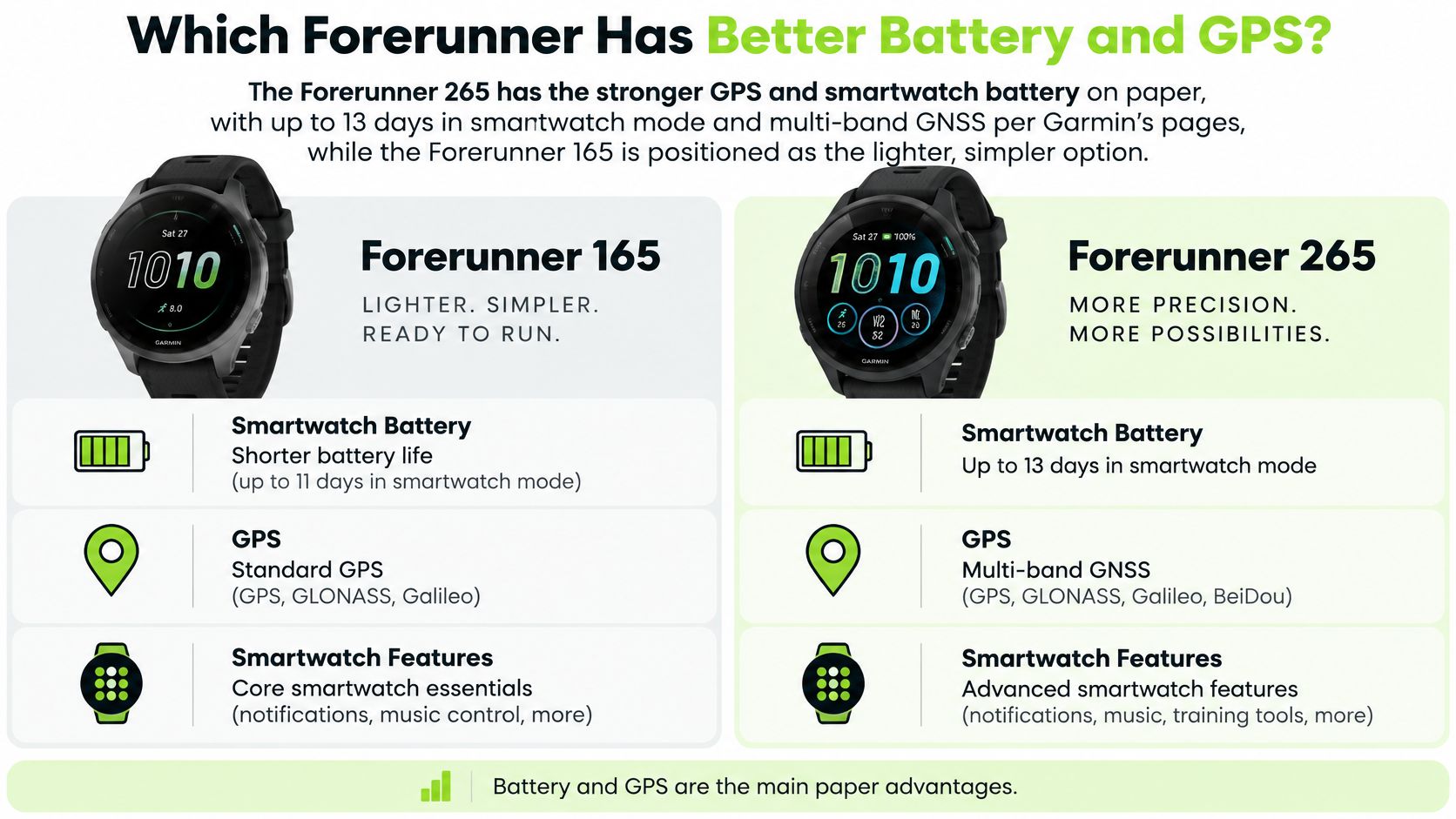
Mode by mode, Garmin's 265 page lists up to 13 days in smartwatch mode, up to 20 hours in GPS-Only GNSS mode, up to 16 hours in SatIQ mode and up to 14 hours in All-Systems GNSS mode with Multi-Band (Garmin's Forerunner 265 product page). The 165's page lists up to 11 days in smartwatch mode, up to 20 days in Battery Saver smartwatch mode, up to 19 hours in GPS-Only GNSS mode and up to 17 hours in All-Systems GNSS mode (Garmin's Forerunner 165 product page). The smaller 265S is rated higher than the standard 265 on the same page: up to 15 days and up to 24 hours GPS-Only.
The GNSS modes are not like-for-like, so compare the mode you would actually use rather than the headline number. If your long outings are hikes, ultra-distance efforts or full days on the move, check the hours for that mode on each page. If your week is 45 to 90 minute runs, any of these figures covers it.
The GPS half of the answer is where the 265 pulls clearly ahead. Garmin lists multi-band GPS and SatIQ technology for the 265, which picks a positioning mode automatically to balance accuracy against battery drain, while the 165's spec list names GPS, GLONASS and Galileo with no multi-band GPS or SatIQ. Multi-band tends to earn its keep in dense city blocks, under heavy tree cover, and anywhere signals bounce off buildings and cliffs.
Every figure above is an "up to" estimate: real endurance depends on how you set and use the watch, including always-on display, the GNSS mode, music playback, notifications and connected sensors.
Software moves the picture after purchase too. The independent site Garmin News reported a firmware update shared across the Forerunner 165, 265 and other models that fixed inaccurate battery-saver estimates when the always-on display is enabled, alongside smoother widget performance (Garmin News). A corrected estimate makes the remaining-runtime number trustworthy; it doesn't add physical capacity.
Practical rule: size the battery to your longest typical run plus your charging routine, then check the GNSS mode list on Garmin's spec pages before you decide. Nobody buys a watch for its all-systems GNSS rating.
Which Runner Profile Fits Each Forerunner?
Training Status and Training Readiness decide this pairing more than ability does. The Forerunner 265 suits runners who will change a session when the data says fatigue is high. The Forerunner 165 suits runners who want a plan, a suggested workout and clear post-run feedback without a second layer of load analysis.
The split comes down to how much decision-making the runner wants from the watch. Garmin lists Garmin Coach running plans, VO2 max, HRV Status, Training Effect, Daily Suggested Workouts, Race Predictor and wrist-based running dynamics for the 165. That is a complete guidance loop for a runner trying to train consistently. The 265 adds Training Status, Training Readiness, lactate threshold, improved intervals with auto detection, smart trainer control, Garmin cycling coach plans and a Triathlon multisport profile. The number of features matters less than the behavior behind it: a runner who ignores readiness has bought extra screens, not extra value.
Pick the Forerunner 165 If
- You follow Garmin Coach or Daily Suggested Workouts: the 165 already builds a week for you, and a beginner gains more from completing sessions than from reading a readiness score.
- You want a light watch without paying for the deeper analysis: Garmin lists the 165 at 43 mm and 39 g. If you want the 265's features in a small case, the 265S also weighs 39 g.
- You run on open roads and park paths: positioning without multi-band usually holds up where buildings and canopy are less of a problem.
- You want fewer settings to manage: a shorter feature list means less to configure and fewer screens to scroll mid-run.
Pick the Forerunner 265 If
- You would change a session based on readiness: if a low score makes you swap intervals for an easy run, the metric earns its keep.
- You train in city canyons or under heavy tree cover: multi-band positioning and SatIQ are the clearest technical advantage in the whole comparison.
- You race triathlon or mix disciplines: Garmin lists a Triathlon multisport profile for the 265, which the 165's activity list does not include.
- You want music on the watch: Garmin lists music storage for the 265; the standard 165's page does not, so on the 165 side that means the separate 165 Music.
Training features by model as Garmin's pages describe them
| Training feature | Forerunner 165 | Forerunner 265 |
|---|---|---|
| Garmin Coach and Daily Suggested Workouts | Listed for the 165 | Listed for the 265 |
| VO2 max estimate and HRV Status | Listed for the 165 | Listed for the 265 |
| Training Effect and Race Predictor | Listed for the 165 | Listed for the 265 |
| Running Dynamics (wrist-based) | Listed for the 165 | Listed for the 265 |
| Training Status | Not listed for the 165 | Listed for the 265 |
| Training Readiness | Not listed for the 165 | Listed for the 265 |
| Lactate threshold | Not listed for the 165 | Listed for the 265 |
| Smart trainer control | Not listed for the 165 | Listed for the 265 |
| Triathlon multisport profile | Not listed for the 165 | Listed for the 265 |
The table shows where the price gap can pay off. A runner following a plan gets most of the daily workflow from the 165. A runner managing fatigue, load and discipline mix gets more context from the 265. That second group has to act on the context. A low Training Readiness score only changes training if the runner treats it as a reason to adjust.
That makes the buying test practical: will the extra metrics be read, understood and used on a normal week? A structured runner tracking fatigue gets a useful feedback loop. A recreational runner who wants a suggestion each morning already has that on the 165.
The 265's premium rests mainly on how often the owner reads the extra data and changes a decision because of it. Having a metric does not prove better race results.
Confirm every feature on Garmin's product pages before buying, because listed feature sets shift between software versions.
Do the Forerunner 165 and 265 Share Watch Bands?
No. The Garmin Forerunner 165 takes 20 mm quick-release bands, the Garmin Forerunner 265 takes 22 mm and the smaller Forerunner 265S takes 18 mm, so a band fitted to one will not fit the other. The release works the same way on both, but the width does not.
Garmin's product pages spell out the physical difference. The Forerunner 165 measures 43 x 43 x 11.6 mm, weighs 39 g, uses a 1.2-inch AMOLED display at 390 x 390 pixels and takes industry-standard 20 mm quick-release bands for wrists from 126 to 203 mm (Garmin's Forerunner 165 product page). The Forerunner 265 measures 46.1 x 46.1 x 12.9 mm, weighs 47 g, has a 1.3-inch display at 416 x 416 pixels, and takes industry-standard 22 mm quick-release bands for wrists from 135 to 205 mm, with 18 mm bands on the 265S (Garmin's Forerunner 265 product page). A 20 mm band does not fit the 265, and a 22 mm band does not fit the 165.
Both are ordinary quick release, which means you slide the spring-bar tab and the band comes free, no tool required. It's worth being precise about what that is not. Standard quick release and Garmin QuickFit are separate fitting systems, so a QuickFit 20 or QuickFit 22 band fits neither watch.
Width mismatch can't be fixed by swapping the bar. A narrower band leaves the lugs exposed and shifts on the wrist, and a wider one won't seat at all.
Strap choice itself is the same for both watches; only the width changes. Silicone is the default for hard sessions, hot weather and wet runs because it does not absorb sweat and dries in minutes. A nylon loop is the more breathable option with fine hook-and-loop adjustment, good for long easy runs, but it holds sweat and takes hours to dry, so it suits runners who rotate two bands. Leather, Milanese and metal are for after the run, not during it.
Here's the three-step check before you order anything:
- Identify the exact model and case size: 165 at 43 mm, 265 at 46.1 mm, or 265S at 41.7 mm.
- Confirm the fitting width on Garmin's page: 20 mm, 22 mm or 18 mm respectively.
- Measure your wrist and compare it with Garmin's listed range for that exact model.
For this pair, choose bands for the Garmin Forerunner 165, bands for the Garmin Forerunner 265 or the wider Garmin Forerunner bands collection, and pick the listing that matches the width you confirmed. Owners of other Forerunner models can start from our guide to Garmin Forerunner bands.
Confirm your exact model and case size on Garmin's page, or use the Watch Band Finder on nothingbutbands.com, before ordering.
Confirm Your Model Before You Buy
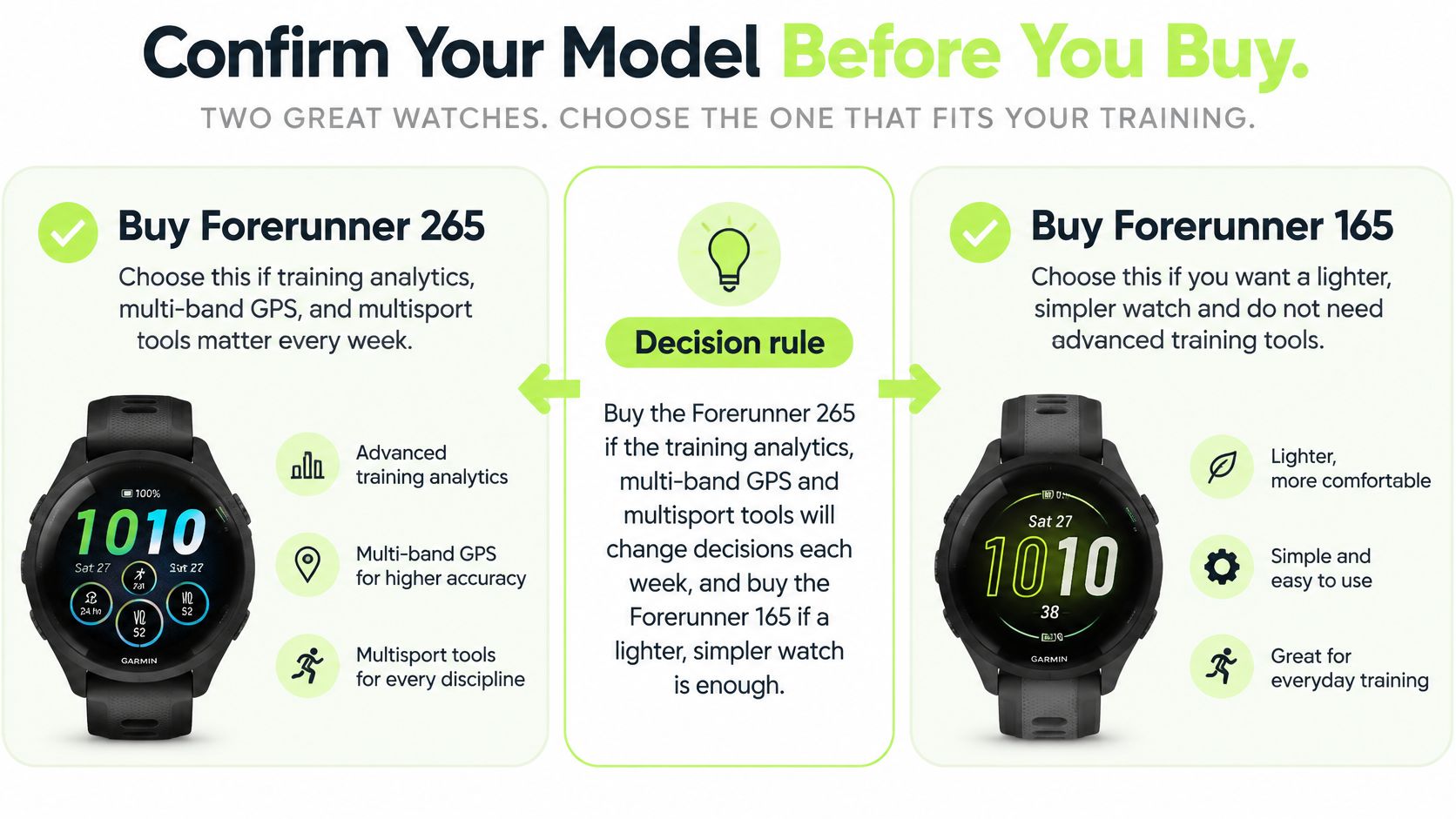
Buy the Forerunner 265 if the training analytics, multi-band GPS and multisport tools will change a decision each week. Buy the Forerunner 165 if a lighter, lower-priced watch with the same core running features is enough. Everything after that is admin, and it takes five minutes.
The summary below is the whole argument in one frame.
Before you order either watch, work through these checks in order:
- Confirm the exact model and case size on Garmin's product page: 165 at 43 mm, 265 at 46.1 mm, or 265S at 41.7 mm.
- Measure your wrist and compare it with the circumference range Garmin lists for that model.
- Confirm the band width: 20 mm for the 165, 22 mm for the 265, 18 mm for the 265S, using Garmin's page or the Watch Band Finder.
- Check the current price on Garmin's store page. Prices change; the tier is what this comparison relies on.
- Then choose a band in the confirmed width. If you're unsure how lug width is measured, our watch lug width guide walks through it.
The spec sheet settles the hardware; how you train settles the choice, and that is the one variable Garmin's pages can't supply.
Frequently Asked Questions
Does the Forerunner 265S have the same features as the standard Forerunner 265?
Garmin lists the Forerunner 265S with the same feature set as the standard Forerunner 265, including the training-load and readiness tools that justify the 265's higher tier. The hardware differs in ways that matter for fit and readability: a 41.7 mm case, a 1.1-inch display and 18 mm quick-release bands, and Garmin rates it for longer battery life than the standard 265. A 22 mm strap from the standard 265 will not fit the 265S, so the smaller model needs its own band size.
That difference has a practical consequence. If the 265S fits your wrist better, the smaller case can be the better version of the 265, provided you still want the deeper training data. The value sits in the reporting, not in the larger case.
Is the Forerunner 165 Music the same watch as the Forerunner 165?
The Forerunner 165 Music is a separate model name in Garmin's range, so compare it on its own listing rather than assuming it matches the standard Forerunner 165. Check its features, storage and price on Garmin's product page.
Band fit is the practical detail to settle before ordering. Confirm the width on the listing instead of assuming that every 165 variant shares the same strap setup. For a runner choosing between the 165 and 265, this matters because the 165's appeal is simpler guidance at a lower tier. You want the purchase to stay simple at the band stage too.
Does the Forerunner 165 have multi-band GPS?
Garmin's Forerunner 165 page does not list multi-band GPS, so the 165 does not offer the multi-band positioning found on the Forerunner 265. On open roads and in parks, that difference rarely surfaces in the route record. In dense city streets or under heavy tree cover, the more capable positioning system on the 265 gives you the better case for route accuracy.
This is one of the clearest ways to separate the two watches by use. A runner who mainly trains in open areas may get little day-to-day benefit from the 265's positioning hardware. A runner who repeats the same urban loops, runs near tall buildings, or tracks workouts under trees has more reason to pay for the stronger system.
The same logic applies to the 265's extra training insight. Its added value is strongest when you plan to act on training load and readiness data. If your weekly routine is built around a few steady runs and a simple long run, the 165's lighter, lower-priced setup is easier to justify. It gives you guidance without adding a second layer of data to interpret.
Can I reuse my Forerunner 165 straps if I upgrade to the 265?
No. Both watches use Garmin's ordinary quick release rather than QuickFit, but not the same width: the 165 takes 20 mm, the 265 takes 22 mm and the 265S takes 18 mm. A 165 owner's 20 mm straps are too narrow for the 265's lugs and too wide for the 265S. What carries over is the swap itself, the same slide-the-tab release with no tool. Where a favourite style is sold in several widths, as with universal quick-release lines, the same style can simply be bought again in 22 or 18 mm.
If you've settled on either watch, the band is the part you'll touch every day, and the width is the one detail that decides whether it fits. Nothing but Bands stocks replacement bands for the Garmin Forerunner 165 in 20 mm and the Forerunner 265 in 22 mm, plus 18 mm options for the smaller 265S, in silicone, nylon, Milanese and braided styles, with genuine leather in 20 and 22 mm. Start with the Garmin Forerunner bands collection, confirm your case size first, and swap the strap rather than the watch when you want a different feel on the wrist.
Artículos relacionados

- November 23, 2026
Is Amazfit waterproof? See what 5 ATM and 10 ATM ratings really allow for swimming and showers, plus model-by-model guidance...

- November 20, 2026
Find the right smartwatch with longest battery life for your routine: maker claims with their usage conditions, what drains charge,...
