Amazfit is a good brand if you care about battery life, value, and ordinary strap compatibility more than app polish. It suits someone who wants solid daily wear without paying for a prettier software experience than they need. If notifications, app selection, voice features, and tight phone integration matter more, Garmin, Apple, or Samsung will feel better.
3 Key Takeaways: Is Amazfit a Good Brand?
-
Great value: Amazfit wins on battery life, price and solid fitness tracking.
-
Less polished software: Garmin and Apple still lead on app quality and training depth.
-
Easy strap swaps: Most models use standard 20mm or 22mm quick-release bands, so check yours first.
Amazfit earns its reputation the hard way, by shipping watches that do the basics well. The hardware usually feels like a smart buy, and the standard quick-release strap fitting keeps aftermarket options wide open, which is a big deal if you care about replacing bands without hunting for brand-only parts. If you are still deciding on fit, choosing a tracker for your goals is a useful filter before you narrow the brand list.
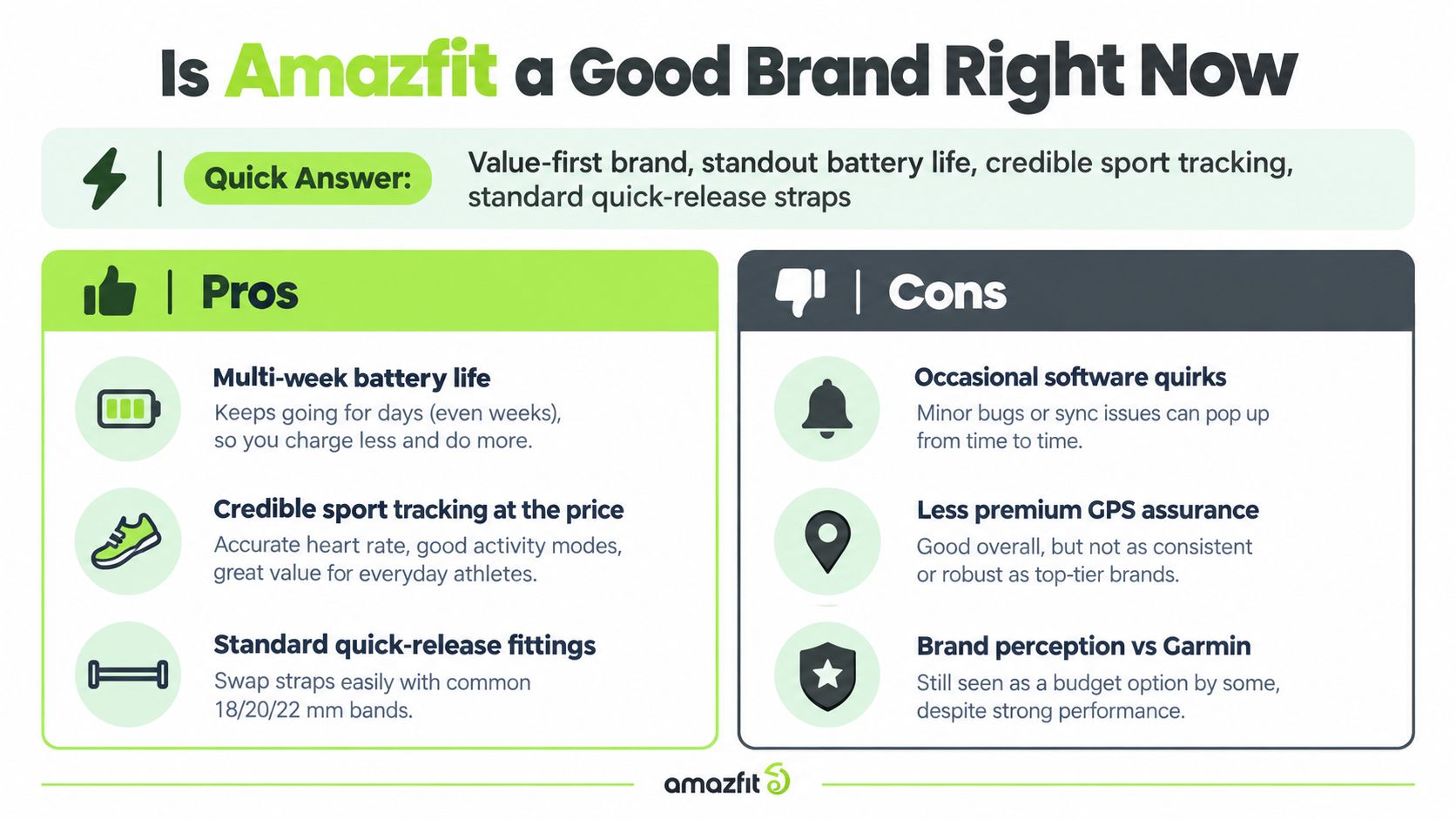
The brand is not some fly-by-night label. It has real scale in wearables, and that usually means broader distribution, longer product continuity, and a better shot at finding accessories later. The trade-off is simple. Amazfit gives you strong value and long battery life, but the app experience still trails the biggest names, third-party ecosystem depth is thinner, and support can vary by region and retailer.
Practical rule: buy Amazfit for battery, price, and fitness tracking, not for ecosystem bragging rights.
That makes Amazfit an easy yes for buyers who hate charging their watch all the time and do not need a premium software stack. It is a poor fit for people who expect the smoothest companion app or the deepest smartwatch feature set. That is the honest read.
Table of Contents
How Amazfit Got Here and Where It Stands
Amazfit is a real contender in the budget-to-mid-range wearable space, but it is still not a premium smartwatch brand. Zepp Health says Amazfit started as its consumer smartwatch brand in 2015, and the company traces its roots back to Huami in 2013 (Zepp Health about us). That matters because the brand was built around wearables first, not as an afterthought bolted onto a phone ecosystem.
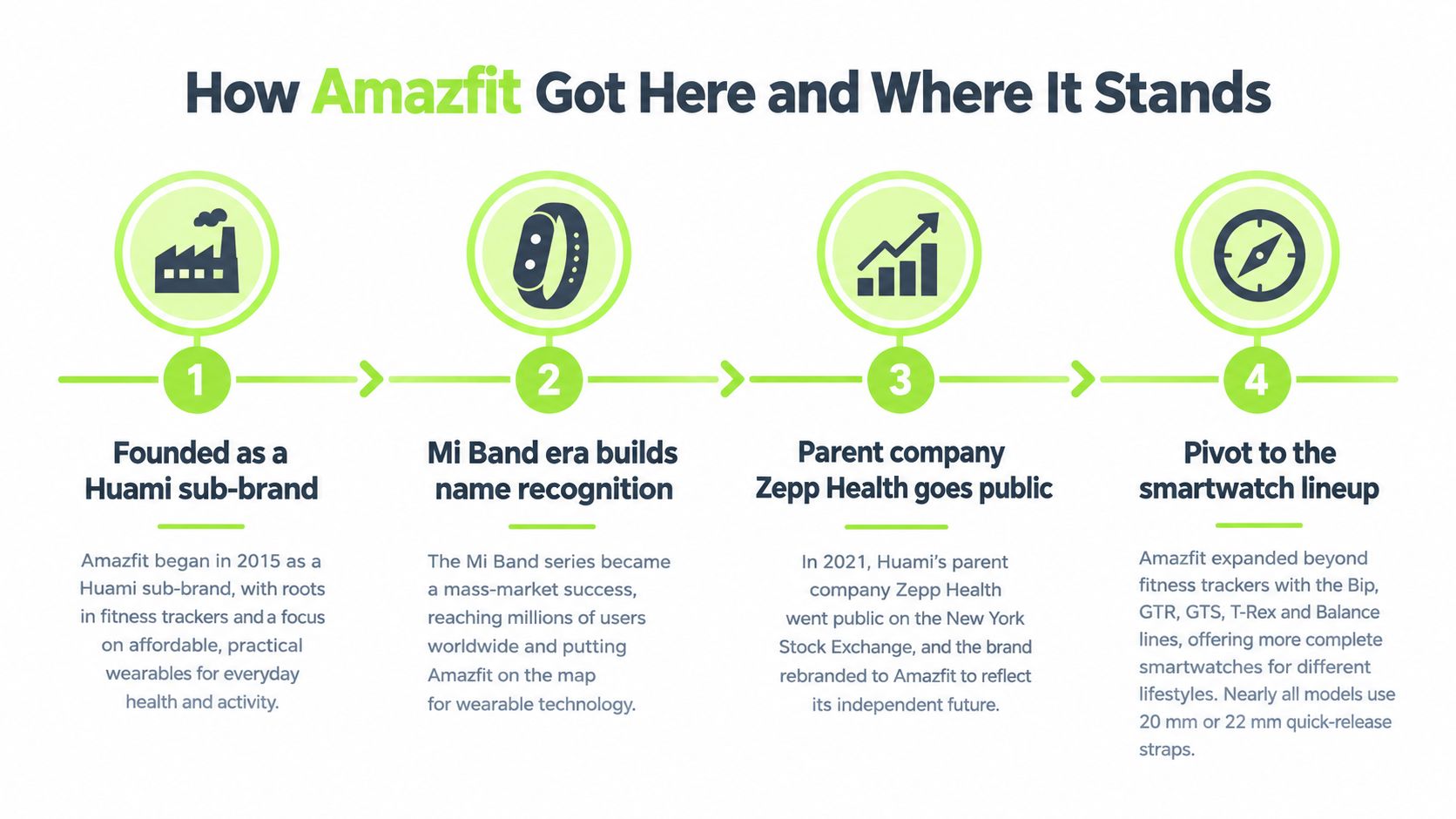
Amazfit's identity is still shaped by the same things that made it attractive early on, lower prices, long battery life, and watches that do the basics well without making you babysit them. Zepp Health also says Amazfit products are available in more than 90 countries across the Americas, EMEA, and APAC (Amazfit press release). That global spread is part of why the brand now feels familiar to shoppers who compare it against Garmin, Fitbit, or the budget Xiaomi-style crowd.
Where it sits against the big names
Amazfit is strongest in the budget fitness-watch lane, credible in the mid-range, and much less convincing as a full smartwatch substitute. Garmin still wins on software depth and training maturity. Apple and Samsung win on ecosystems and phone integration. Amazfit's pitch is simpler, it gives you a lot of the useful stuff, without the price or the charging habits that make pricier watches feel like a chore.
Buyer takeaway: Amazfit makes sense when the watch is a tool first and a lifestyle device second.
That's the cleanest way to read the brand. If you want a wearable that behaves like a practical fitness gadget, Amazfit belongs in the conversation. If you want the watch to feel like an extension of your phone, the brand is still playing catch-up.
Where Amazfit Wins and Where It Falls Short
Amazfit earns its reputation on battery, price, and practical strap support. Independent reviews keep singling out battery life as the headline strength, with runtimes that are unusually long for the price. Exact figures vary by model and settings, so check the rated battery life on Amazfit's own page for the model you are considering. That kind of battery life matters. It cuts charger anxiety and makes these watches easier to live with on trips or during heavy training weeks.
The good part is real, but it has limits
The hardware is solid for the class, not magical. Reviewers who checked the Active 3 Premium's heart-rate readings against a chest strap found they reflected workout intensity and training load well, while also noting that its single-band GPS trails dual-band systems in accuracy. That is the right expectation. Amazfit is dependable for steady runs, gym sessions, daily health tracking, and general training, but it is not the best choice if route precision in crowded cities is your top concern.
Amazfit also keeps things simple in a way that helps a lot of buyers. You get useful fitness features without the premium-price baggage or the constant charging routine that makes some higher-end watches annoying to own.
The weak spots show up after the sale
Owner reviews on Trustpilot include complaints about device failures, battery problems, and slow or unhelpful responses on refunds and warranty claims. That does not mean every purchase goes sideways. It does mean the brand is a better fit if you care more about the watch itself than about polished after-sales support. If you want warranty help to feel effortless, Amazfit is a shakier bet than the big ecosystem brands.
| Category |
Amazfit Performance |
Typical Rival at Same Price |
| Battery life |
Often much longer than expected for the class |
Usually shorter, especially on fuller smartwatch platforms |
| Sport tracking |
Solid for steady training and everyday use |
Often more polished on premium brands |
| App polish |
Functional, but not elite |
Smoother on Garmin, Apple, and Samsung |
| After-sales support |
Mixed, region-dependent |
Usually more predictable on bigger brands |
Which Amazfit Watch Actually Fits You
Amazfit makes sense for a specific buyer, and the choice comes down to how you train and how much polish you expect from the software. Buy it for battery, training, and value. Buy something else if you want a richer app ecosystem or a more refined smartwatch feel. That is the clean way to judge the brand.
Runners and outdoor athletes
The Cheetah and T-Rex families are the first models to look at if outdoor training and GPS matter most. As noted earlier, Amazfit handles steady running well and stays useful for general fitness, but route tracking can be less dependable in dense city environments and other situations that stress GPS. Serious runners should care about where they run, not just how rugged the watch looks.
Everyday users and gym-goers
The GTS and GTR Mini are the easy daily-wear picks. They sit lighter on the wrist, keep the battery life Amazfit is known for, and cover the health basics without making the watch feel like a brick. Gym users should also look at the Balance and Active lines if they want a watch that stays out of the way and does not need constant charging.
For all-day wear on a lighter watch, a soft, breathable strap makes a bigger difference than most buyers expect. Nylon watch bands are a good daily option, and the Véllo — Nylon Loop — Quick Release 20mm is one worked example: it fits any watch with 20 mm lugs and quick-release spring bars.
| User Type |
Best Pick |
Budget Alternative |
What to Skip |
| Runner |
Cheetah or T-Rex line |
GTR or GTS if you mostly run casually |
Entry models if you want the cleanest GPS experience |
| Gym user |
Balance or Active line |
Bip series for basics |
Premium smartwatch tiers if you only want fitness features |
| Everyday wearer |
GTS or GTR Mini |
Bip 5 style simplicity |
Bulky outdoor models if you want something subtle |
Short version: pay more only when the extra sensors or GPS behavior matter to your workouts.
Does Amazfit Use a Normal Strap Fitting
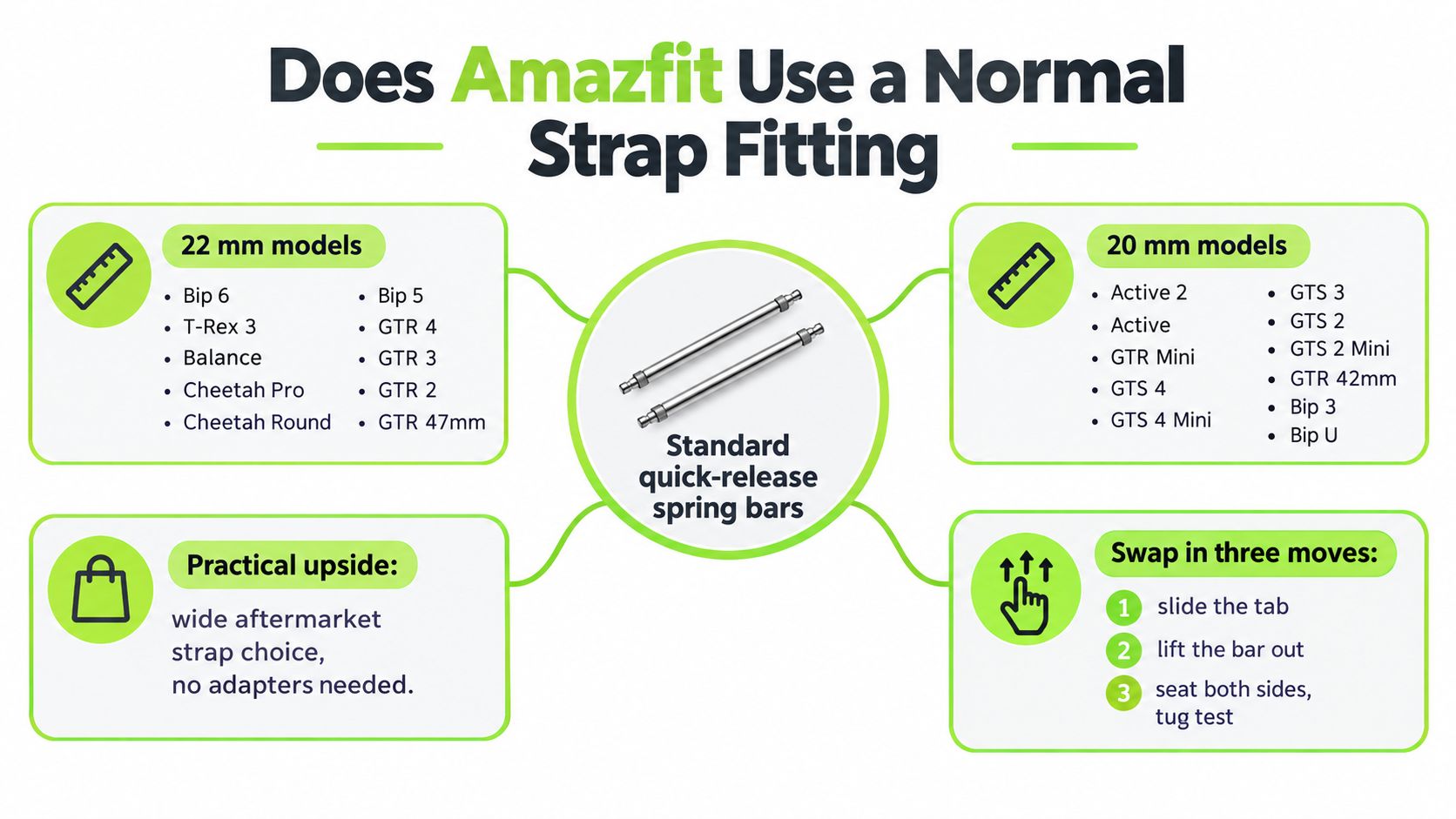
Amazfit uses a normal quick-release spring-bar fitting, so yes, Amazfit watches are easy to strap-swap without adapters. That's one of the most underrated reasons the brand is easy to live with. You're not locked into a weird bracket, and that keeps third-party strap options wide open, including ordinary quick-release watch bands in every common width.
The swap is simple
A standard Amazfit strap comes off in three moves, slide the tab, lift the spring bar out, seat both sides on the new strap, then do a tug test. That's why Amazfit is good news for anyone who wants to rotate between silicone, nylon, or something dressier without tools or a trip to a repair shop.
The practical upside is obvious, aftermarket straps are easy to find, and the fitting itself isn't proprietary. Amazfit's own strap-size guidance matters because fit comes down to width, not brand logo. If you wear your watch daily, that makes maintenance simpler and cheaper, since replacing a worn strap is easier than replacing the watch.
Check the model, not the vibe
Amazfit's own sizing pages are the place to verify your watch before ordering. For the Active 2 family and several smaller models, you're in the 20 mm lane, while larger models such as the Bip 6, T-Rex 3, Balance, and the GTR family use 22 mm straps. Send readers to the maker's list for their exact model before they buy.
For a model-specific fit check, Amazfit Active 2 watch band size is the right reference if you own that watch. The same goes for Amazfit Bip 6 band size if you're shopping for that model.
| Fit type |
What it means |
Why it matters |
| 20 mm quick-release |
Fits any watch with 20 mm lugs and quick-release spring bars |
Broad aftermarket choice |
| 22 mm quick-release |
Fits any watch with 22 mm lugs and quick-release spring bars |
Same convenience, larger fit family |
| Proprietary bracket |
Not used on the mainstream Amazfit watches covered here |
Limits strap choice |
Which Amazfit Models Take 22 mm and Which Take 20 mm
Amazfit keeps this simple: buy by lug width, not by model name. The brand's own strap-size page is the cleanest reference, and it beats guessing from case shape or series family. If you want the safest order, remove the old strap and measure the lug width yourself.
The 22 mm group
Amazfit puts Bip 6, T-Rex 3, Balance, Cheetah, Bip 5, GTR 4, GTR 3, and GTR 2 in the 22 mm camp. These are the watches that take the wider, fuller-looking strap profile.
The 20 mm group
Amazfit lists Active 2, Active, GTR Mini, the GTS line, GTR 42mm, Bip 3, and Bip U as 20 mm models. These sit in the narrower-fit group, which suits smaller cases and lighter wrists better.
| Strap Width |
Models |
Bracelet Type |
Aftermarket Availability |
| 22 mm |
Bip 6, T-Rex 3, Balance, Cheetah, Bip 5, GTR 4, GTR 3, GTR 2 |
Quick-release spring bar |
Broad |
| 20 mm |
Active 2, Active, GTR Mini, GTS line, GTR 42mm, Bip 3, Bip U |
Quick-release spring bar |
Broad |
A model-specific check is still smarter than assuming the whole family matches. If you own a Bip 6, use the Bip 6 band size guide linked above for the exact fit call. For an Active 2, use the earlier guide for that watch instead of relying on a broad series label.
Measure the lug width with the strap removed, then confirm the model number on the back before you order.
Watch Out for These Amazfit Strap Traps
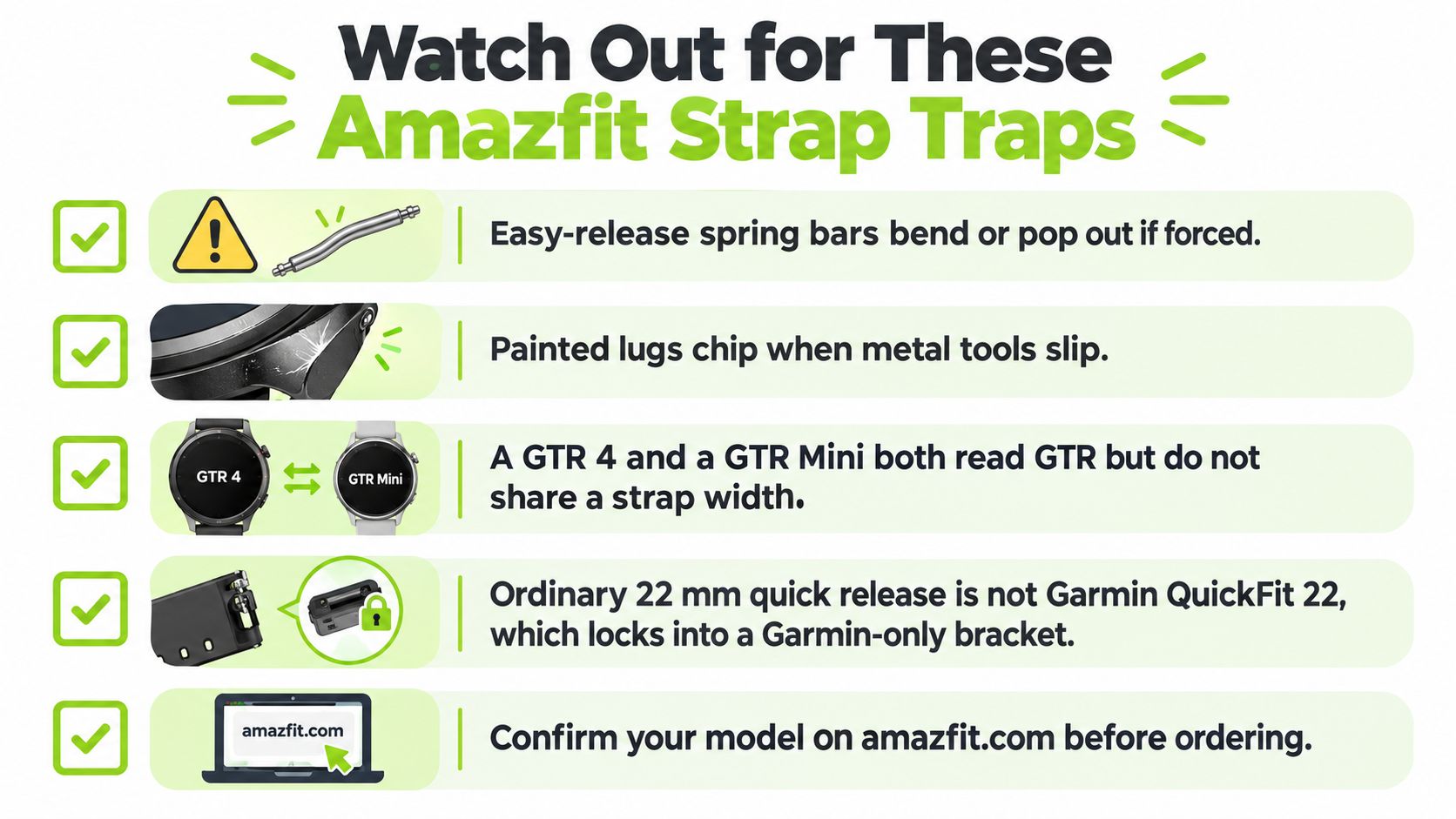
The biggest Amazfit strap mistake is assuming the model family tells you the width. A GTR 4 and a GTR Mini both sound like they belong in the same camp, but they don't share strap width, and that's enough to ruin an otherwise simple order. Amazfit watches may use ordinary quick-release fittings, but the width still has to match.
The traps are practical, not dramatic
Some spring bars bend or pop if you force them. Painted lugs can chip if you jab at them with the wrong metal tool. And a cheap silicone strap can feel fine in a five-minute try-on but get irritating once you wear it through a long run or a sweaty workday.
Another easy miss is confusing ordinary 22 mm quick-release with Garmin QuickFit 22. They look similar from a distance, but they are not the same fitting, and Garmin's bracket system is its own thing. That distinction matters because the wrong assumption can turn a simple strap swap into a return.
Buy like someone who's been burned before
Confirm the lug width in millimetres. Look for quick-release pins rather than fixed bars. If the strap arrives and the fit feels off, test it on the wrist before you tear into the packaging too much so returns stay simple.
You don't need brand loyalty to get this right. You just need the correct width, the correct fitting, and a little patience before you click buy.
Quick Answers About Amazfit as a Brand
Is Amazfit a reputable brand?
Yes, Amazfit is a legitimate wearable brand with a long operating history and global distribution. Zepp Health says Amazfit launched in 2015, and its filing says the company has shipped over 200 million units in more than 90 countries and regions (PR Newswire filing). Reputation-wise, it's solid on hardware value and more mixed on support.
Who owns Amazfit?
Amazfit is Zepp Health's consumer smartwatch brand. Zepp Health says the company began as Huami in 2013 before becoming Zepp Health later (Zepp Health about us).
Is Amazfit better than Fitbit or Garmin?
Amazfit usually wins on battery and value, while Garmin usually wins on training depth and app polish. Fitbit and Garmin feel more refined as platforms, but Amazfit is often easier to justify if you just want a capable watch without paying for premium software extras.
Does Amazfit work with iPhone?
Yes, Amazfit watches can work with iPhone, but the experience won't feel as smooth as Apple Watch. If you live inside Apple's ecosystem and care about frictionless notifications, app support, and services, Apple Watch is still the cleaner fit.
Do you need the Zepp app?
Yes, for the full experience, the Zepp app is part of the setup. If you want basic watch use without deep syncing, you'll still get the core hardware value, but the app is what turns the watch into a proper fitness and health tracker.
What's the bottom line?
Amazfit is a strong pick for budget-to-mid buyers who care about battery and strap flexibility, and a weaker choice for people locked into Apple or Google ecosystems. If your main concern is band swaps, the strap sections above matter more than the brand hype.
Buy an Amazfit and your strap options stay open: browse Nothing but Bands' Amazfit watch bands for ordinary 20 mm or 22 mm quick-release straps that match your model, swapped in seconds.


