


Most current Fitbit trackers are water-resistant to 50 metres and swimproof, not waterproof. Fitbit still advises against showers, hot tubs, saunas and high-velocity water, so a pool is a yes and a soapy shower is a take-it-off.
That split surprises people because the shower feels gentler than lap swimming. It isn't, on Fitbit's rules. Clean pool water at shallow depth sits inside the rating, while soap, shampoo, conditioner, heat and fast-moving water sit outside it. The second catch is on your wrist, not inside the tracker. The rating belongs to the Fitbit device, not to every strap you can clip to it, so the same swim can be fine for a Charge 6 and wrong for the leather band holding it on. If you're asking are Fitbit waterproof before you get wet, you need two answers: one for your exact model, one for your exact band.
Table of Contents
- Are Fitbits Waterproof or Only Swimproof
- How Do You Check a Fitbit Water Rating?
- Can You Swim Shower or Use a Hot Tub With a Fitbit
- Which Fitbit Band Should Stay On for Water?
- How Should You Dry a Fitbit After It Gets Wet
- Does a Swim Rating Cover Water Damage
Are Fitbits Waterproof or Only Swimproof
Fitbit trackers are water-resistant, not waterproof, and most current Fitbit models are swimproof for pools and sweaty workouts. According to Google's Fitbit support documentation, most Fitbit devices are water-resistant to 50 meters, including the Charge 3, Charge 4, Charge 5, Charge 6, Flex 2, Inspire series, Luxe, Sense series, and Versa series.
Think raincoat, not submarine hatch. A raincoat is built and tested to keep water out in normal use, but a torn seam, worn coating or badly fastened opening changes what it can handle. A Fitbit seal works the same way. The 50-metre figure is a lab pressure rating for a device in good condition, not a promise that every seal stays perfect after years of knocks, and it's not permission for every kind of water you can find.
Which Fitbit families carry the 50-metre swim rating
Use the table as a lookup, then confirm your exact model name. Older Fitbits don't inherit the newer swim rating just because they share a family name.
| Model family | Published rating | Generally suitable | Still ruled out |
|---|---|---|---|
| Charge 3 and Charge 4 | Water-resistant to 50 metres; swimproof | Pools and sweaty workouts | Showers, hot tubs, saunas, high-velocity water |
| Charge 5 (FB421, IPX8) and Charge 6 | 50 metres; Charge 6 also cited at 164 feet with automatic swim tracking | Pools and swim tracking | Showers, hot tubs, saunas, high-velocity water |
| Versa series, including Versa Lite and Versa 3 (FB511, IPX8) | 50 metres; Versa 4 listed IP68 and passed an independent dunk test | Pools and sweaty workouts | Showers, hot tubs, saunas, high-velocity water |
| Sense series | Water-resistant to 50 metres; swimproof | Pools and sweaty workouts | Showers, hot tubs, saunas, high-velocity water |
| Luxe | Water-resistant to 50 metres; swimproof | Pools and sweaty workouts | Showers, hot tubs, saunas, high-velocity water |
| Flex 2, Inspire series, Ace 2 and Ace 3 | Water-resistant to 50 metres | Pools on those swim-rated models | Showers, hot tubs, saunas, high-velocity water; Inspire 3 passed a dunk test with no IP rating listed |
| Original Ace | Showerproof only | Light shower-level exposure, not swimming | Swimming and submersion |
| Early Charge | Splash and rain proof | Sweat and rain | Showering, swimming and submersion |
| Fitbit Air | IP68 and 5 ATM when it leaves the factory; not permanent | Shallow water while the seal is intact | Do not treat a worn or repaired unit as still rated |
Two rows deserve extra care. The original Ace is showerproof only, so don't put an original Ace in a pool because Ace 2 and Ace 3 sit in the swim group. An early Charge is splash and rain proof only, with showering, swimming and submersion ruled out, so don't borrow the Charge 3 to Charge 6 rating for it.
Why a good rating can still go bad
Water resistance can decline after drops, impacts, repairs, or prolonged wear. A cracked case, a screen that's lifting, a back that's been opened, or a hard knock on tiles can compromise the seal even if the tracker still charges and tracks normally. If your Fitbit has that history, keep your Fitbit dry. Don't test a questionable seal in the deep end to find out.
Decision rule: A swim-rated Fitbit in undamaged condition can swim. A damaged, repaired or unknown Fitbit stays out until you can verify the model and its condition.
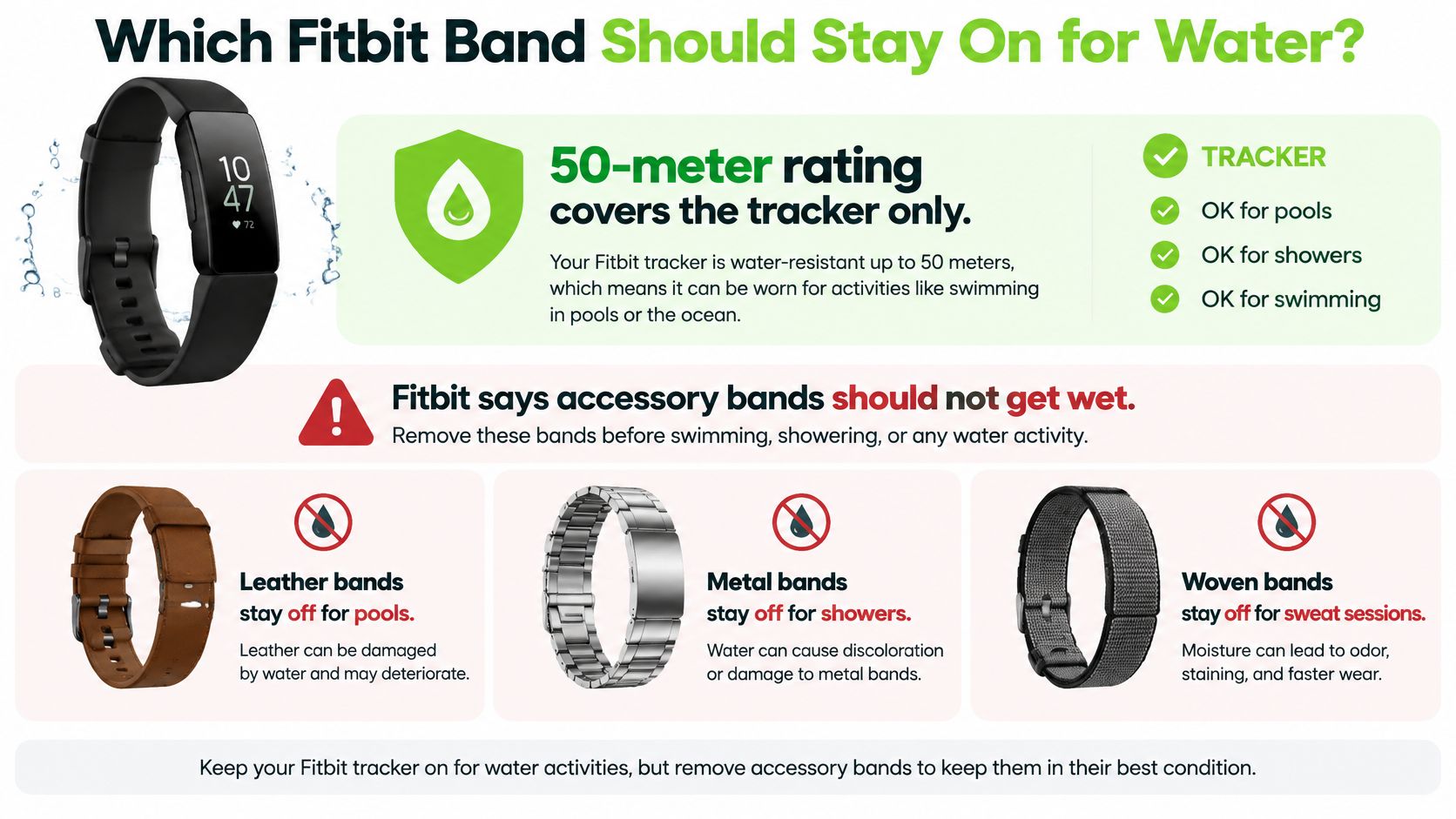
The rating also stops at the tracker body. Fitbit warns that leather, metal, and woven accessory bands may not be suitable for getting wet, so a swimproof Versa, Sense, Luxe or Charge doesn't make every strap swimproof. Verify the band material every time you swap.
That model-first habit matters beyond water, too. Runners who train on heart rate and recovery data often pair tracker trends with blood work, and if that interests you, you can explore personalized lab testing as a separate check on what your training is doing. It doesn't change your Fitbit rating, and it doesn't make a leather strap pool-safe. Check the activity, then choose the band.
How Do You Check a Fitbit Water Rating?
One document settles this question: the official manual for your exact Fitbit model. Find the model name, open that model's manual, and look for a 50-metre or swimproof line before any water exposure. The brand, the family resemblance, and a friend's lucky swim with a similar-looking tracker are all unreliable shortcuts, because Fitbit protection changed a lot by generation.
The Charge 5 manual states water resistance up to 50 meters and identifies model FB421 as IPX8 under IEC 60529. Later Versa and Sense manuals use the same 50-metre wording, while earlier trackers in the same families shipped with weaker protection. The model number on your unit decides which paperwork applies to you.
What should you look for in the manual
Run this lookup in order. It takes two minutes and beats guessing.
- Find the exact model name: Check the box, receipt or Fitbit app. If you're still not sure which device is on your wrist, use our guide to identify which Fitbit model you have before you look up any rating.
- Open the official manual for that model: Use the manual for your own generation, since a newer Charge, Versa or Inspire with a similar case can carry a different rating.
- Look for the depth wording and IP code: You want an explicit 50 metres, water-resistant or swimproof statement, plus any IP code the manual prints.
- Read the care restrictions on the same page: The exclusions for showers, heat and high-velocity water are part of the rating, so give them the same weight as the depth line.
- Check the band material: The 50-metre line covers the tracker body only. The strap makes its own decision: leather, metal and woven come off before the water, and a silicone band is the one that stays on.
An IP code is a lab classification for how the sealed device performed under test conditions when new. It gives you the starting point for that model. It can't certify your specific unit today after drops, impacts, repairs, disassembly or ordinary wear have had a chance to open a path for water.
Independent dunk tests have recorded recent Fitbits surviving a controlled submersion, including models sold with no published IP rating. A passed dunk is encouraging context. Intended use still comes from the manual for your model, and that manual is the only document worth trusting here.
If the manual for your Fitbit doesn't say 50 metres or swimproof, keep your Fitbit out of the pool.
That rule holds hardest for cracked, repaired or unidentified units, where the cautious reading is the only safe one.
Can You Swim Shower or Use a Hot Tub With a Fitbit
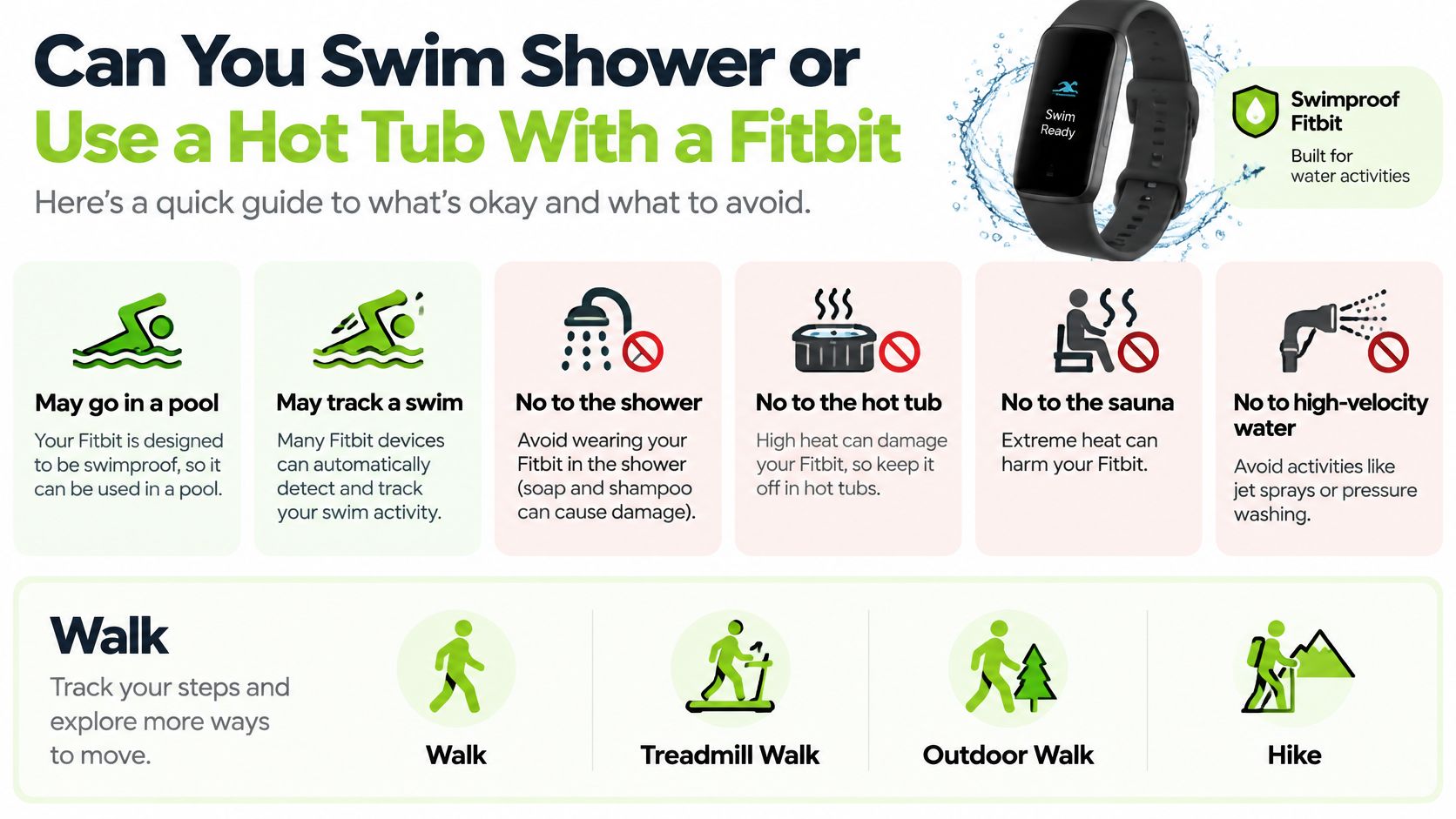
A swimproof Fitbit can go in a pool and can track a swim, and Fitbit still says no to the shower, the hot tub, the sauna and high-velocity water. Google's Fitbit guidance warns that resistance can decline after drops and exposure to sunscreen, lotions, soaps, or high-velocity water such as water sports, and it advises against hot tubs and saunas.
Can you swim laps in a pool with a Fitbit
Yes, a swimproof Fitbit can be worn for lap swimming in a pool. That's the core use the 50-metre rating supports: shallow swimming and swim tracking, with your arms moving through water at normal swimming pressure. Use water-lock if your model has it, since water-lock stops accidental screen or button taps underwater. Water-lock doesn't strengthen the seal, so don't use water-lock to justify putting a non-swimproof or damaged model in the water.
A chlorinated pool is treated as swimming, not as a chemical bath that needs a second rating. Swim your laps, then rinse the tracker and band with fresh water afterward. Chlorine left to dry on the case, connector and strap is the problem you can control, so rinse it off rather than letting it sit.
The sea gets a narrower yes. Calm, shallow salt water doesn't come with an extra depth rating, and it isn't a surf clearance. If your swim-rated Fitbit goes in the sea, rinse your Fitbit with fresh water afterward and dry your Fitbit and your skin before you put it back on for the day. Breaking waves, bodyboarding and getting dumped by surf push you toward high-velocity, high-impact exposure, which is different from a calm swim.
Can you shower with a Fitbit on
No, take a Fitbit off before a shower with soap, shampoo or conditioner. Fitbit's reason is specific: soap, shampoo and conditioner can degrade water resistance, and sunscreen and lotions sit in the same warning. The shower also adds heat and direct spray to the chemical exposure. A quick rinse of the tracker under fresh water after a swim is not the same thing as wearing it through your whole shower routine.
Hot tubs are a no and saunas are a no. The problem is heat and rapidly changing temperature, not depth. You can be sitting still in shallow hot water and still be outside the rating, because heat stresses seals and adhesives in a way cool pool water doesn't. Leave the Fitbit with your towel.
Water sports are a no where water hits fast or hard. Surfing, jet spray, water skiing and similar high-velocity water can force water past a seal at pressures a calm lap swim never creates. Fitbit names high-velocity water as an exclusion, so don't argue that the surface is shallower than 50 metres.
Snorkeling and diving don't get cleared by the metre figure. The depth number is a lab pressure rating for shallow-water use, not a dive clearance and not a spec for repeated descents, equalizing, mask clearing and knocking the case against gear. Don't use a Fitbit as dive equipment.
Sweat and gym sessions sit inside the rating for swim-capable models. Train hard, then rinse the band. If you also swim with other watches, our broader guide to swimming with a smart watch covers that wider picture, and our Apple swim guide handles Apple devices separately, so don't import Apple rules onto a Fitbit.
| Activity | Fitbit's published line | What to do |
|---|---|---|
| Pool laps and swim tracking | Inside the 50-metre swimproof rating | Swim, then rinse with fresh water |
| Chlorinated pool | Treated as swimming, not as a soapy shower | Rinse with fresh water afterward |
| Sea and salt water | No extra depth rating; rinse non-fresh water | Rinse and dry; not a surf clearance |
| Shower with soap, shampoo or conditioner | Advised against; these can degrade water resistance | Take the Fitbit off |
| Hot tub | Advised against because of heat | Leave it out |
| Sauna | Advised against because of heat | Leave it out |
| Surfing, sprays and high-velocity water sports | Advised against | Leave it out |
| Snorkeling or diving | The depth figure is not a dive clearance | Do not use it as dive gear |
| Sweat and gym sessions | Inside the rating for swim-capable models | Rinse the band afterward |
Which Fitbit Band Should Stay On for Water?
A Fitbit tracker with a 50-metre rating is covered for swimming, while leather, metal and woven Fitbit accessory bands should not get wet, so those bands come off before pools, showers and hard sweat sessions. Silicone is the band that stays on. That is the whole decision, and everything else is drying time.
Our Fitbit bands cover Charge 3 through Charge 6, Versa 1 through Versa 4, Sense 1 and Sense 2, Luxe and Fitbit Air. The rating belongs to the tracker in your hand. The strap is the variable you control at the pool door.
Is silicone the best Fitbit band for swimming
Yes, a silicone Fitbit band is the safest default for repeated pool and sweat exposure. Silicone does not absorb water, it rinses clean under fresh water, and you can wipe it dry and put it straight back on. Our silicone bands are soft, flexible, and sweat-resistant, which is exactly the combination you want when the band will be wet several times a week.
Start with our silicone sport bands if you're building a swim and gym rotation. For Charge 3 and Charge 4 owners, the Zera Silicone Sport Band for Fitbit Charge 3/4 is the direct fit for that family.
Charge 5 and Charge 6 owners need the fitting for that family, and a Charge 3/4 strap should not be forced onto different connectors. The Kalen Silicone Sport Band for Fitbit Charge 5/6 is a textured soft-touch silicone band with a breathable design, Quick Release connection and a classic buckle. Match the family name on the product page to your tracker before you buy, because a band made for one Fitbit family may not fit another.
Can a nylon Fitbit band get wet
Yes, a nylon Fitbit loop can handle activity and splashes, with one condition: it needs a full dry before it goes back on. Nylon absorbs water in a way silicone doesn't, so the cost is time between sessions. If you train again before it's dry, you'll be putting a damp strap back on, so keep a second band for the gap.
Our nylon loops suit runners and gym users who like a softer, adjustable fit. Treat nylon as a workout band with patience built in, and pick silicone when laps are a four-mornings-a-week habit.
Which Fitbit bands come off before water
Braided and woven bands come off first. Fitbit flags woven accessory bands as unsuitable for getting wet, and braided loops hold water in the weave against your skin. Keep braided and woven straps for dry days, office wear and evenings out.
Milanese mesh suits occasional splashes only, and laps are a bad trade. Water sits in fine mesh where a quick wipe misses it, and the magnetic clasp area is the part your wrist notices later.
Stainless link stays dry. Fitbit flags metal bands, and a link bracelet has pins, joints and a clasp that trap chlorinated or salty water in places you can't reach fast. Don't swim in a stainless link band to save thirty seconds of swapping.
Leather never goes swimming or showering. That rule covers our Fitbit leather straps and the leather straps in our wider range for Apple, Garmin QuickFit and Samsung. Water soaks in, heat makes the damage worse, and a soaked leather band is a reason to swap straps before the next wet session.
| Band material | Water use | Better call |
|---|---|---|
| Silicone | Safest for repeated pools and sweat | Rinse, wipe, wear again |
| Nylon loop | Fine for activity if it dries fully | Wear only after a full dry |
| Braided or woven | Comes off before swimming | Keep for dry wear |
| Milanese mesh | Occasional water only | Switch before laps |
| Stainless link | Keep dry; Fitbit flags metal bands | Treat as a dry-weather strap |
| Leather | Out of swimming and showers | Swap to silicone before water |
For the fuller material-by-material breakdown across watch brands, our guide to waterproof watch bands owns that comparison. For your Fitbit today, the action is shorter: confirm your family, choose silicone for any wet session, keep the dress strap dry, and browse our Fitbit bands by model so the connector matches first time.
Poolside rule: Silicone stays on your Fitbit. Leather, metal and woven come off your Fitbit before the water, every time.
How Should You Dry a Fitbit After It Gets Wet
Your tracker will forgive a swim. Your wrist won't forgive a wet band. Odour and under-band irritation come from water trapped under a strap, in the connector and around the clasp, where it stays warm and wet for hours. Water on bare skin dries on its own. Water pressed against skin is the environment your wrist reacts to.
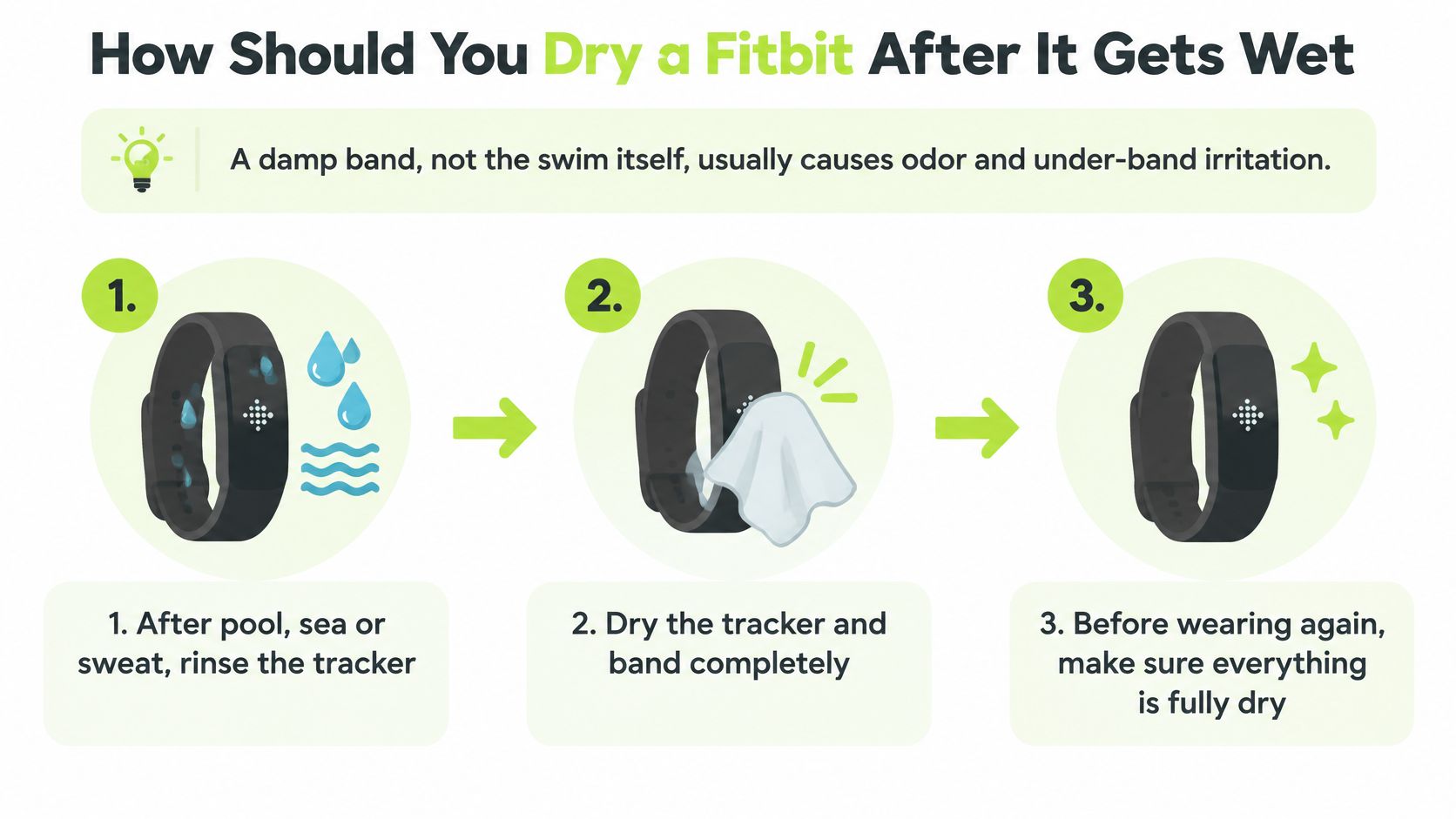
Fitbit's product care guidance sets the routine after pool, sea or sweat exposure: clean the band and your wrist regularly, especially after workouts and sweating, and after contact with anything other than fresh water, rinse and dry the tracker properly. A quick towel over the screen doesn't count as drying it.
What is the after-swim routine for a Fitbit
Run these five steps in order after a swim, a sea dip or a heavy workout.
- Rinse with fresh water: Rinse the tracker and the band with fresh water to remove chlorine, salt and sweat.
- Use a soap-free cleanser: Clean the band and your wrist with a soap-free cleanser. Fitbit names Cetaphil, and a soap-free cleanser is a different product from shower gel, shampoo or hand soap.
- Dry with a lint-free cloth: Wipe the case, the screen, both sides of the band and your wrist with a lint-free cloth.
- Unclip the band: Separate the band from the tracker where your model allows it, so the underside, pins and connector dry, instead of only the visible face.
- Wait until it's fully dry: Refitting a damp band traps the moisture you just rinsed away. Dry skin plus a dry band is the combination that prevents most irritation.
Step 4 is the one people skip. The face of a band can look dry while moisture sits in the connector recess and around the pins. Unclipping takes seconds on Charge, Versa, Sense and Luxe bands, and it lets air reach the exact spots that stay wet longest.
How long does each Fitbit band take to dry
Silicone is the fastest. Rinse it, wipe it with the cloth, check the connector, and it can go straight back on a dry wrist. That speed is exactly why silicone stays on for daily swimming while every other material works around its dry time.
A nylon loop takes hours. Press the water out against a towel rather than twisting the weave, then lay the band somewhere flat and leave it until it stops feeling cool against your skin. If you train twice a day, keep a second band ready, because a nylon strap that's still damp at the next session isn't ready.
Milanese mesh hides water inside the weave itself. Run the cloth over both faces of the mesh, open the clasp and dry the contact points, since those are the spots that hold moisture against your wrist the longest. Leather shouldn't have been in the water at all, and no drying routine undoes that decision.
Materials age at different rates depending on chlorine, salt, sweat, sunscreen and how well you rinse. Judge your band by its condition: stiffness, cracking, persistent odour, loose connectors and a clasp that no longer holds are replacement signals. A silicone strap that stays supple, rinses clean and dries fast keeps its place in the water. Any strap that can't dry fully between sessions is inviting back the irritation this routine exists to prevent.
The water rating lives inside the tracker case, sealed where you can't reach it. The band against your wrist is the variable you control, so keep it rinsed, keep it dry and keep silicone on for anything wet.
Before your Fitbit goes back on, check the connector and the clasp, both sides of the band, and your wrist. All four dry, then wear it.
Does a Swim Rating Cover Water Damage
No, a swimproof label doesn't turn a later water failure into a covered warranty repair. According to Google's Fitbit Air safety and warranty documentation, accidental damage may not be covered by warranty, warranty terms vary by country or region, and damage from misuse, external causes or operation outside intended uses can be excluded.
That gap between the rating and the warranty is where most disputes start. A 50-metre rating describes what the tracker was built to handle. The warranty describes what a failure will cost you, and the two documents answer different questions. A tracker that swam fine for a year can still produce a refused claim, because claims are judged on the written terms and the device's own history.
What mistakes lead to a refused water claim
Two misdiagnoses cause most of the confusion, and neither needs a damage tally to explain.
- Blaming the band for a tracker fault: A soaked strap can't let water into a sealed tracker case. If the screen dies after a swim, question the case seal first. The silicone on your wrist never touched the electronics.
- Blaming the pool for shower and heat exposure: If the history is daily shower gel, shampoo and a weekly hot tub, the pool swim that finally killed the device may have been the last exposure in a long line of them.
Know what a new strap can and can't do. A sweat- and rinse-friendly band improves comfort, hygiene and drying time on your wrist. It cannot restore a Fitbit seal, rebuild lost water resistance or expand your warranty coverage, so skip any strap marketed as tracker protection: a band listing that claims it adds waterproofing or makes an aging Fitbit safe to swim again is describing a job no wristband can do.
So protect the claim you might need to make. Keep a cracked or repaired Fitbit out of the water and never test a damaged unit to see whether the seal held. Inspect an aging case for lifting edges or damage, skip the shower gel and the hot tub, and keep your proof of purchase where you can find it. Terms vary by country and region, so read Fitbit's published warranty language for where you live and take any dispute through that channel first.
A cracked, repaired or chemically worn case stays out of the water. The label on the box doesn't change that.
If your Fitbit is cleared to swim but your current strap is leather, metal or woven, fix the one variable you control and put a rinse-and-wipe silicone band on for wet sessions while your dress strap stays dry. Shop by your exact Charge, Versa, Sense, Luxe or Fitbit Air family at Nothing But Bands and set up a two-band rotation, so the next pool, sea or gym session never starts with the wrong strap on your wrist.
Ähnliche Beiträge

- November 02, 2026
Apple makes no yellow Apple Watch case, so a yellow band is the only way to get the look. Fit,...

- October 29, 2026
Stainless Steel Watch Band 22mm explained: how to measure lug width, pick a steel construction, and tell spring-bar fits from...
