


Pick a Suunto when your priority is long GPS runtime in the mode you use and following a downloaded route without a phone, and pick a Garmin when you want a wide choice of sport and outdoor series or a QuickFit latch that makes strap changes fast. Both makers publish the specifications that decide those cases, and both list running, cycling, multisport and hiking coverage across their own product pages.
The gap most comparisons miss sits at the wrist. A Suunto 22 mm strap and a Garmin QuickFit 22 strap share a number and nothing else, so the fitting question arrives before the material question. Everything below stays with what Suunto and Garmin publish for their own models.
Table of Contents
- Which Brand Should You Choose for Outdoor and Sport Use?
- How Do Suunto and Garmin Compare Side by Side?
- How Do Navigation and Mapping Differ Between Suunto and Garmin?
- How Do Battery Life and Training Features Compare?
- Who Should Pick a Suunto Watch?
- Who Should Pick a Garmin Watch?
- Can You Swap Bands Between a Suunto and a Garmin?
- Frequently Asked Questions
Which Brand Should You Choose for Outdoor and Sport Use?
Which matters more for your outdoor watch: the way you train, the information you use, or how you find your route? Those priorities help distinguish Suunto and Garmin more reliably than a general brand ranking.
Start with the sport you train in, then compare the training data, navigation features and price of the specific models you're considering. Suunto's heritage page credits its Finnish founder, Tuomas Vohlonen, with inventing a liquid-filled compass with a steadier needle in 1936, a story it sets in deep snow and Arctic darkness. Garmin's history centers on GPS and satellite positioning. These different starting points offer context, but the model's features matter more to your choice.
A strap adds another practical consideration. The same 22 mm width can refer to different connectors, so check the fitting as well as the watch's sport features before choosing a replacement band.
Prices vary with promotions and can differ within a series. Check the manufacturer's page for the exact model's current price rather than relying on a comparison figure.
How Do Suunto and Garmin Compare Side by Side?
The connector can matter as much as the watch's size: two bands marked 22 mm may use different fittings. Compare the exact model's strap system before treating a band as interchangeable.
Suunto and Garmin at a glance
| Factor | Suunto | Garmin |
|---|---|---|
| Band connector | Strap width and fitting vary by model | QuickFit on compatible models; standard quick release on others |
| Size options | Case size varies by model; check the listed size in millimeters | Case size varies by model; check the listed size in millimeters |
| Smartwatch battery (named model) | Suunto Race: up to 16 days in daily use with heart rate on | Garmin Forerunner 265: up to 13 days in smartwatch mode |
| GPS battery (named model) | Suunto Race: up to 50 hours (Performance mode) to up to 200 hours (Tour mode) | Garmin Forerunner 265: up to 14 hours (All + Multi-Band) to up to 20 hours (GPS Only) |
| Water rating | Varies by model; check the stated water-resistance rating | Varies by model; check the stated water-resistance rating |
| Price tier | Varies by model and current offer | Varies by model and current offer |
The chart summarizes the same comparison fields.
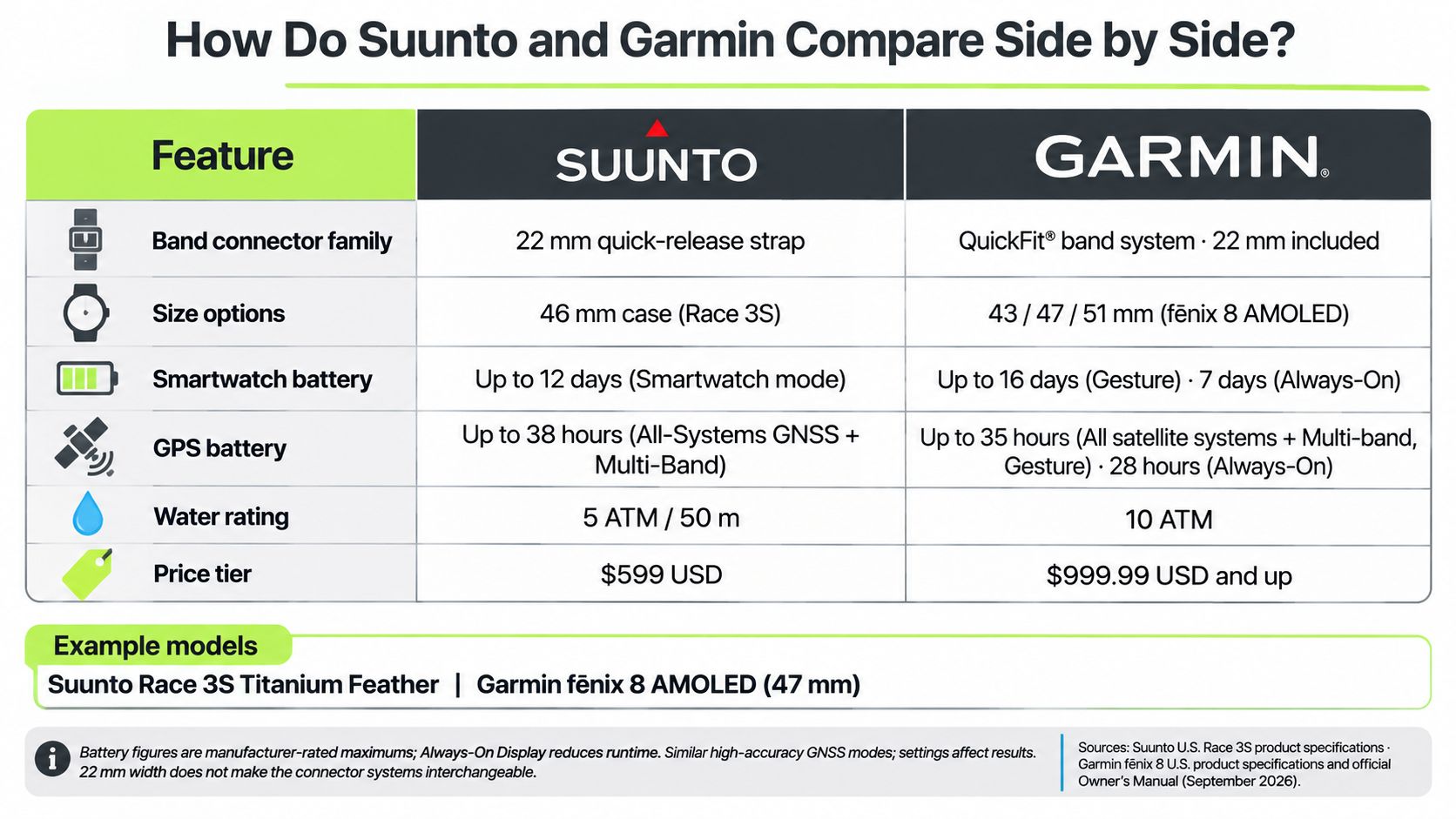
Start with the connector, then compare case size. A 22 mm strap width alone does not establish a fit: the connector type must match too. Water resistance belongs to the watch, not the band, and the maker's rating is specific to each model.
Battery figures in the table name the Suunto Race and Garmin Forerunner 265. Treat them as model-specific: GPS endurance depends on the selected settings, so compare the mode you expect to use rather than relying only on a headline figure.
Model names also matter when checking dimensions and price. Suunto's range includes Race, Vertical, 9 Peak and 5 Peak, while Garmin organizes watches into lines such as Fēnix, Forerunner and Venu. Both brands offer different sizes and price points within their ranges; check the exact model's current listing and stated measurements before deciding.
How Do Navigation and Mapping Differ Between Suunto and Garmin?
How much map detail do you need on your wrist? Suunto's Race product page lists free offline maps and route guidance, letting you follow a planned route without a phone connection. Garmin mapping and navigation features vary by model, so check the exact model page for topographic maps and additional navigation modes rather than assuming every watch offers them.
For a long trail day, confirm that the watch can store the maps you need and display your planned route offline. On technical terrain, check whether the specific model shows topographic information at a useful level of detail. The difference is practical: route-following, map detail and navigation tools matter more than a brand-wide label.
Map detail and route features are more useful comparison points than a single accuracy figure. Terrain, satellite mode and firmware affect how either watch behaves on a route, so a general brand ranking cannot settle which model will suit your plans.
Check these points on each model page:
- Offline map support: Can the watch store maps, and which regions are included?
- Route import: Which file formats are supported, and how many routes can be stored?
- Map detail: Does it show topographic contours, trails or only a breadcrumb line?
- Multi-band GNSS: Is dual-frequency mode listed, and how does it affect battery use?
- Navigation features: Are turn prompts, rerouting, a compass and barometric altitude listed?
How Do Battery Life and Training Features Compare?
A long outing makes battery mode more useful than a headline maximum. Compare the runtime for the session type you expect to use on the exact model's maker page. The Suunto Race figures in the table above come from Suunto's Race product page and the Forerunner 265 figures from Garmin's Forerunner 265 owner's manual, which notes that actual battery life depends on the features enabled; Runner's World's comparison of the Suunto Race and Garmin Forerunner 265 also treats runtime as specific to those models, not as a brand-wide difference.
GPS mode, display brightness, always-on settings and sensor use all affect runtime. The figure for a particular mode is more relevant to race-day planning than the watch's headline maximum. The image below compares the two named models across battery and training features.
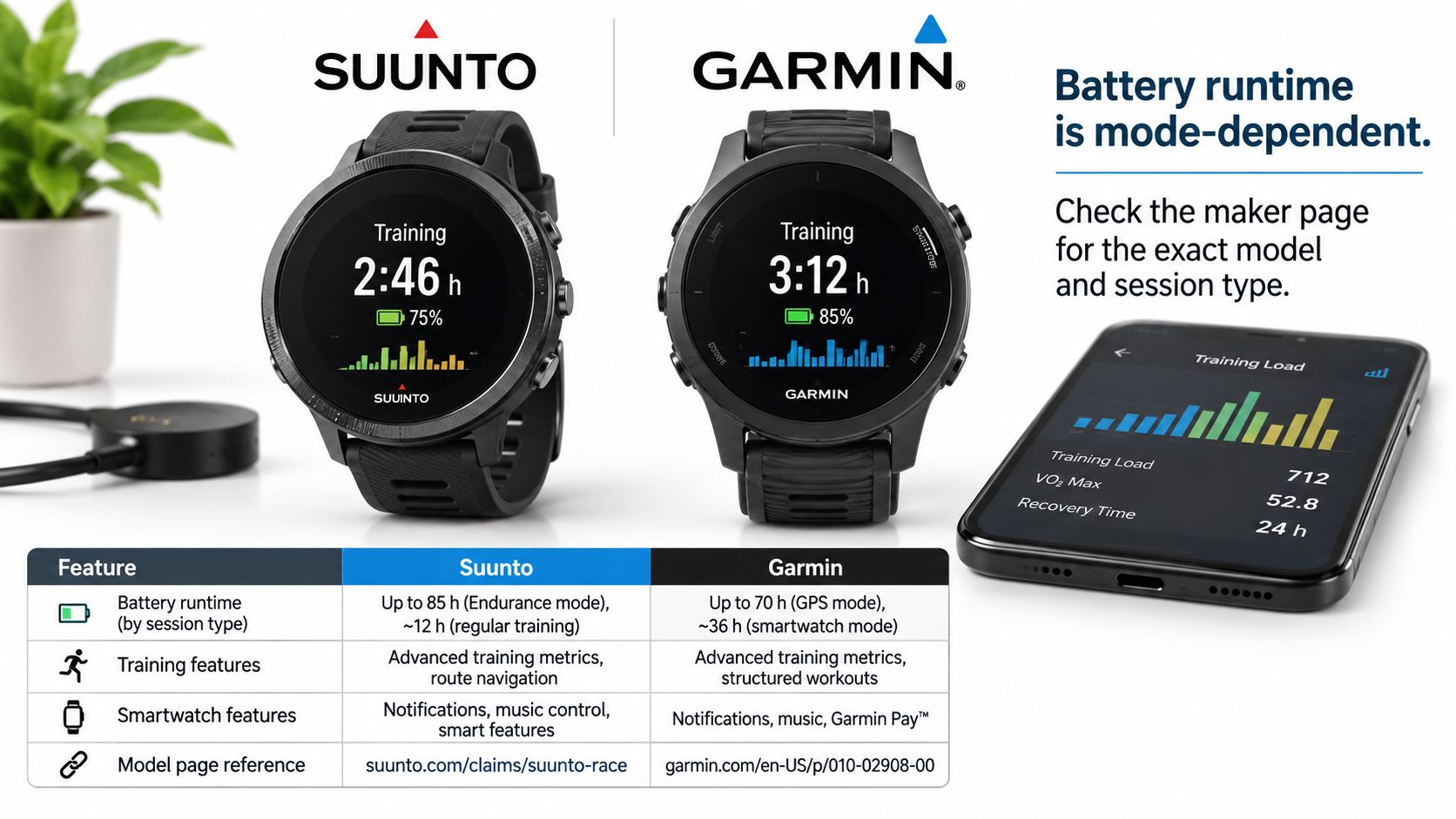
Dual-frequency runtimes vary by model. Check each maker's product page for the exact watch and GNSS mode before comparing figures.
Practical rule: Compare watches in the GNSS mode you expect to use, then leave a margin for cold weather and heavy sensor use.
Use four steps:
- Set your longest typical session: for example, a mountain run, a hike or a multi-day route.
- Choose the likely GNSS mode: check the options listed for the exact model.
- Compare runtime in that mode: avoid relying on maximum-endurance figures or comparing different modes.
- Leave a margin: cold weather, navigation and wrist heart-rate tracking can reduce runtime.
Training features also vary by model. Check each watch's published metrics rather than treating a brand's features as consistent across generations. A strap does not change battery life or training metrics, but a secure fit helps keep the watch in contact with your wrist during intervals and long efforts, when sensor readings matter.
Who Should Pick a Suunto Watch?
Pick a Suunto when your main use is endurance or expedition-style outdoor activity, where long GPS modes and offline route-following matter more than the broadest set of smartwatch features. That describes a narrower group than the marketing suggests, so check whether you're in it:
- You plan the route before you leave: the track is downloaded the night before and the watch's job is to keep you on it.
- Your longest day outlasts a small watch: you compare runtime in the mode you'll use, not the maximum-endurance mode.
- You want one clear line over a map you have to read: route-following beats contour study when you're moving tired.
- You buy for the terrain you train in: mountain and trail days reward endurance features; a flat park loop doesn't.
On budget, compare the Suunto model you're weighing against its listed price on Suunto's own product page. Tiers move between models and promotions, so a number quoted in someone else's comparison is a snapshot, not a specification. The same applies to bundle pricing and regional variation.
Choose by the full model name, not the series name, because strap width depends on the exact model.
The Suunto 9 and the Suunto 9 Peak make that point: they sound like one family and take different strap widths. Check the exact name on the Suunto page before ordering any band.
There's an honest caveat. If your sessions are mostly road running or gym work with a phone in your pocket, the route features you're paying for may go unused, and a simpler model from either maker does the job for less. Suunto's case is strongest when the watch is doing navigation work in places where a phone gives up.
For a race that runs through the night, the margin matters more than the spec sheet. A battery mode that covers your finish time removes a decision from your day, and one that doesn't adds charging to a route where charging isn't convenient.
Who Should Pick a Garmin Watch?
Would Garmin suit your sport routine better if you need a choice of watch series, or if you prefer one family of connectors for changing straps? Those are separate reasons to choose the brand, and the right one depends on the exact model.
Where the series spread helps
Garmin groups watches into series such as fēnix, Forerunner, Venu, Instinct and Epix, with different case sizes and features across the range. That variety can suit someone who runs, cycles and hikes but wants to stay within one maker's watch lineup. Case size and strap fit can also vary within a series: the Venu 3 takes a 22 mm quick-release band and the Venu 3S an 18 mm one.
Garmin is a large company with products across aviation, marine, automotive and fitness. Its size helps explain the breadth of its watch lineup, but it does not by itself establish that any particular model is the right choice.
The connector question comes first
For Garmin, identify the connector before choosing a strap material. QuickFit and standard quick-release watches use different fittings.
A Garmin QuickFit watch uses the matching Garmin latch system in QuickFit 20, 22 or 26. Other Garmin models use standard quick-release spring bars. A 22 mm measurement alone does not establish that a strap will fit: the connector type matters too.
Budget and the ecosystem you live with
Garmin's range includes different price points within a series. Compare the exact model and its current price on Garmin's own product page rather than assuming that a series name indicates a fixed tier.
Consider the software and account settings alongside the watch. Check Garmin's support pages for the options that matter to you, including data export, account deletion and third-party sharing.
If your priority is a long event, compare the exact model's GPS runtime in the mode you plan to use. A watch's listed maximum may refer to a different mode, so check Garmin's model page before deciding.
Can You Swap Bands Between a Suunto and a Garmin?
Start with the connector, not the width. A Suunto band and a Garmin band can both be labeled 22 mm yet use different fittings, so the number alone cannot tell you whether they will attach.
Suunto's strap listings place the Race, Vertical, 9 Peak, 9 Peak Pro and 5 Peak on 22 mm straps, and the Suunto 9, 9 Baro, Spartan Sport and Suunto 7 on 24 mm straps. The Suunto Core has its own sizing. Garmin uses QuickFit fittings in 20, 22 or 26 mm on compatible models, while other Garmin watches use standard quick release. For example, the Venu 3 is 22 mm and the Venu 3S is 18 mm.
Strap fit by model family
| Model family | Strap width | Connector and check |
|---|---|---|
| Suunto Race, Vertical, 9 Peak, 9 Peak Pro, 5 Peak | 22 mm | Suunto strap family; confirm on the Suunto model page |
| Suunto 9, 9 Baro, Spartan Sport, Suunto 7 | 24 mm | Suunto strap family; confirm on the Suunto model page |
| Suunto Core | Own sizing | Confirm on the Suunto Core page before ordering |
| Garmin QuickFit 20, 22, 26 watches | 20, 22 or 26 mm | Garmin latch system; match the QuickFit width |
| Garmin Venu 3 | 22 mm | Standard quick release; confirm on the Garmin model page |
| Garmin Venu 3S | 18 mm | Standard quick release; confirm on the Garmin model page |
A Suunto 22 mm strap is not a match for a Garmin QuickFit 22 watch: the width is the same, but the connector is different, so identifying the connector is as important as checking the measurement.
Use these four checks before ordering:
- Find the exact model name: Read it from the caseback or the watch's settings menu, rather than relying on a shop's shortened listing title.
- Check the strap width: Use the exact model's specifications. Suunto's 22 mm and 24 mm families are a starting point; Garmin's width depends on the model.
- Identify the connector: Match both width and fitting. A Garmin QuickFit band and a standard quick-release band of the same width are not interchangeable.
- Confirm on the maker's page: Check the model's width and connector on Suunto's or Garmin's product page, then browse the Suunto watch bands collection or Garmin watch bands collection. The Watch Band Finder on the Nothing but Bands site can also match a band to your exact model.
Nothing but Bands sells Garmin QuickFit bands in 20, 22 and 26 mm and universal quick-release bands in 18, 20, 22 and 24 mm; there is no Suunto-specific band, so a Suunto owner chooses a quick-release band by the width Suunto lists for the watch. If your exact watch is not listed, check its maker's page before choosing a replacement.
After fit is settled, choose a material for how you wear the watch. Silicone suits swims and sweaty sessions and dries in minutes; nylon offers a breathable option for warm-weather wear, though in our experience it can take hours to dry after heavy sweat or a swim. For winter use over a shell, measure your wrist with the sleeve in place before choosing a band length.
The Suunto Core band-size guide covers sizing for that model. Confirm the exact watch model on the maker's page before ordering.
Frequently Asked Questions
Does a Garmin QuickFit band fit any 22 mm watch?
No. A QuickFit 22 band uses a Garmin latch system, so it fits watches built for QuickFit 22 rather than every watch with a 22 mm lug width. A standard quick-release band in 22 mm is the fitting for watches with 22 mm spring-bar lugs, and the two are not interchangeable even though both are sold as 22 mm.
Can a standard quick-release band go on a Suunto Race?
A 22 mm quick-release band matches the width Suunto lists for the Race, but confirm the lug and connector on the Suunto model page before ordering, because width alone doesn't guarantee a fit. Suunto's own 22 mm straps are sold as quick-release straps and list the Race among the compatible watches.
How do I find the exact model name of my watch?
Read it from the caseback engraving or from the watch's own settings menu, where the maker prints the full model name rather than the series. Suunto 9 and Suunto 9 Peak, for example, sound related and take different strap widths, so the full name is the only safe search term on the maker's page.
The strap decision is the one part of a watch purchase you can get right before the watch arrives, and it's where the two brands diverge most: same width, different connector. Nothing but Bands stocks Garmin QuickFit 20, QuickFit 22 and QuickFit 26 bands, plus universal quick-release bands in the widths Suunto lists for its watches. Match the exact model name and connector first, then choose the material for your sport.
Podobne artykuły

- November 16, 2026
Apple Watch SE 3 vs Series 11: sizes, battery, health features and price tier from Apple's specs, with a clear...

- November 13, 2026
Garmin vs Samsung watch compared on fitness depth, battery, phone ecosystem and band fit. Pick the right brand and confirm...
