


Galaxy Watch 8 Classic or Galaxy Watch Ultra: which one belongs on your wrist?
The spec sheet alone settles less than you might expect. One detail outweighs any spec row once the watch is on your arm: the fitting. Samsung puts the Watch 8 and Watch 8 Classic on one band system and the Ultra on another, so the two watches never share a strap. The band you commit to often decides which model stays practical to own.
Every figure below comes from Samsung's own product, buying-guide or support pages, with the condition Samsung attaches to it. Where a figure could not be found on a Samsung page, the table says to check Samsung's page for your exact model before you pay.
Table of Contents
- Which Galaxy Watch 8 Classic or Ultra Should You Buy?
- Galaxy Watch 8 Classic and Ultra Specs Side by Side
- Which Model Is More Comfortable to Wear All Day?
- Who Should Pick the Galaxy Watch 8 Classic?
- Who Should Pick the Galaxy Watch Ultra?
- Do the Galaxy Watch 8 Classic and Ultra Take the Same Bands?
- Choose Bands and Confirm Your Model Before Ordering
- Frequently Asked Questions
Which Galaxy Watch 8 Classic or Ultra Should You Buy?
Pick the Classic if you want the rotating bezel and a stainless-steel watch that dresses up; pick the Ultra if the 10ATM rating, the larger battery or the titanium case is the deciding factor. The Classic suits an everyday mix of desk, gym and dinner, and the Ultra earns its place for buyers who specifically need its water rating, endurance or rugged build.
Samsung describes a 3 nm, five-core processor for both watches on its product pages, so the decision rests on physical differences: case size and material, water rating, battery endurance, and the band system you commit to.
Four factors settle it, and each is checked against Samsung's pages below. Wrist comfort comes down to case size and thickness rather than a weight figure on paper. Battery is a question about whether the watch gets through a night of sleep tracking and a long GPS session without a charger. Water and outdoor use depends on the rating attached to the specific model rather than the family name. Band availability is the factor buyers overlook, and it keeps costing money after purchase: Samsung puts the Watch 8 Classic and the Ultra on different fittings, so a strap bought for one does not fit the other.
Confirm the exact model and variant on Samsung's page, and on any band listing, before you commit. The model name decides both the specification and the fit.
Galaxy Watch 8 Classic and Ultra Specs Side by Side
Galaxy Watch 8 Classic vs Ultra specs as Samsung lists them
| Spec | Galaxy Watch 8 Classic | Galaxy Watch Ultra |
|---|---|---|
| Case material | Stainless steel | Titanium |
| Case size | 46mm | 47mm |
| Water resistance | 5ATM, IP68 | 10ATM, IP68 |
| Durability standard | MIL-STD-810H | MIL-STD-810H |
| Display | 1.34-inch | Confirm on Samsung's page |
| Battery capacity (typical) | 445 mAh | 590 mAh |
| Stated battery life, Always On Display on | Up to 30 hours | Up to 60 hours |
| Stated battery life, Always On Display off | Confirm on Samsung's page | Up to 80 hours |
| Processor | 3 nm, five-core | 3 nm, five-core |
| Rotating bezel | Yes | No |
| Band system | Shares the Galaxy Watch 8 band fitting, per Samsung | Ultra-dedicated band fitting, per Samsung |
| Weight and dimensions | 63.5 g, 46.4 x 46.0 x 10.6 mm | Confirm on Samsung's page |
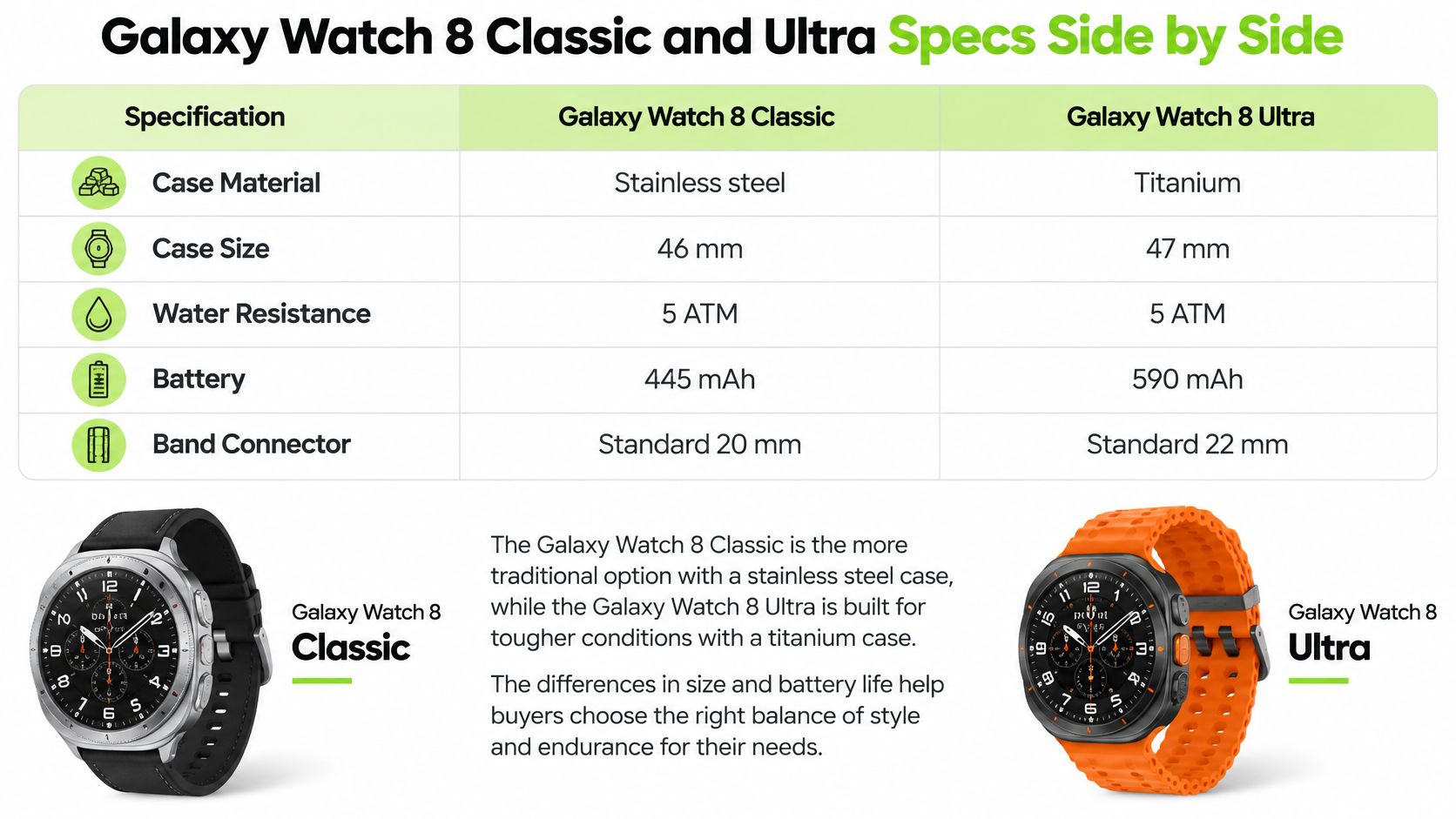
Case material is the first fork that changes daily wear. Samsung's buying guide to the Galaxy Watch8 and Watch8 Classic describes the Classic's stainless-steel case and grooved rotating bezel, lists it at 46mm and 63.5 g, and describes the Ultra as made from titanium. Stainless steel holds a shine and suits a dressier watch; titanium suits a watch built for outdoor use.
Battery is the next row that changes a decision. Samsung lists the Classic's battery at 445 mAh (typical) and the Classic at up to 30 hours with Always On Display on. On its Galaxy Watch Ultra product page, Samsung lists the Ultra at 590 mAh (typical), up to 60 hours with Always On Display on and up to 80 hours with it off in normal mode, and up to 100 hours in power saving mode, which switches off features such as Wi-Fi. Samsung notes that battery life varies with usage and settings.
The real gap: durability and endurance, not processing power. Samsung describes the same class of processor in both watches, so a bigger battery and a higher water rating are the Ultra's actual advantages.
One caution on that table. Samsung's regional pages do not all show every row, and some figures for the Ultra (display size, weight, exact dimensions) were not on the Samsung pages consulted here, which is why those cells say confirm. Trust the product page for the specific model and variant you're buying.
The water-resistance row needs a translator if you're comparing it against other gear. The digits after IP describe dust and water ingress under test conditions the maker states, not a dive depth, and this explanation of IP67 versus IP68 ratings sets out how the two ratings differ. For the watch itself, read Samsung's own footnote for your model.
Anyone upgrading rather than choosing between these two should read how the Galaxy Watch 7 and Galaxy Watch 8 differ first. The Classic versus Ultra question only bites once you've settled on the generation.
Which Model Is More Comfortable to Wear All Day?
Samsung lists the Classic at 46mm, 63.5 g and 10.6 mm deep, and sells the Ultra as a 47mm titanium watch. Both are large cases, so compare your wrist against Samsung's product page for the exact model rather than a single number quoted in a comparison, and check the Ultra's weight and depth on Samsung's page for your variant.
What a Taller Case Changes on the Wrist
A case that stands taller pushes the watch body further from your skin, and two things follow. The watch can rock side to side when the strap isn't sitting right, and the case edge catches on shirt cuffs and jacket sleeves. Cranking the strap tighter rarely fixes either problem; it just moves the pressure to the underside of your wrist.
- Wear it above the wrist bone. A watch sitting on the bone tilts with every hand movement and reads loose even when the strap length is correct.
- Check that it sits flat. Look at the gap under the lugs. Light showing evenly on both sides means the case is sitting square on your wrist.
- Feel where the strap leaves the case. A stiff band that fights the case angle lifts the whole watch off your arm. A softer band follows the case instead.
- Check the clasp underneath. A clasp pressing into the skin is usually a length problem, not a tightness problem.
The strap earns its keep in daily wear, and the two watches don't share fittings. The Classic falls under the same band fitting as the standard Galaxy Watch 8, while the Ultra takes its own strap format, so a band that settles the Ultra on your wrist isn't one you could carry over to a Classic anyway. For the Ultra, a flexible silicone band supports exercise and rinses clean, while a finely adjustable nylon loop helps everyday comfort when you want the watch to stay put without pressure.
Trying the watch on before you order is still the best check available, because wrist shape matters as much as circumference.
Who Should Pick the Galaxy Watch 8 Classic?
A Tuesday that runs desk to gym session to dinner reservation is the week the Classic is built for: a stainless-steel case that dresses up, a rotating bezel that scrolls notifications without covering the screen, and buttons you can find without looking down. Anyone who wants a watch that reads as a watch at a formal event gets more from those details than from anything the Ultra adds.
The quieter advantage is the band system. Samsung states that bands are mutually compatible between the Galaxy Watch8 and the Watch8 Classic, so a single set of straps serves both watches. A household running one standard Watch 8 and one Classic keeps one band drawer. The Ultra sits outside that arrangement entirely, which matters once bands enter the budget.
Where the Classic Sets the Limit
Samsung's buying guide lists the Classic at 5ATM + IP68 + MIL-STD-810H and describes the Watch8 series as water resistant and suitable for swimming and similar activities, while the Ultra carries the higher 10ATM rating. Read the activity limits and footnotes Samsung prints for your exact model before deciding how far the watch goes with you. For price, go to Samsung's own page for the variant you want, because prices move with region, variant and promotion.
Who Should Pick the Galaxy Watch Ultra?
A multi-day trip with no charger in the bag. A long run or hike with GPS and music going. Outdoor work where the watch takes knocks. Sleep tracking every night, with charging squeezed into a shower. When that is the shape of your week, the Galaxy Watch Ultra is the model Samsung built for it.
The case for the Ultra rests on its stated protection: Samsung lists 10ATM and IP68, says the Ultra has been tested under MIL-STD-810H, and gives an operating range of -20 °C to 55 °C. Samsung also cautions that the Ultra is not suitable for high-pressure water activities and diving, and that water resistance is not a permanent condition and can diminish over time. Samsung sells the Ultra as a 47mm titanium model, and a buyer whose routine is mostly desk-bound pays for ruggedness that never gets used.
What the Ultra Costs You in Daily Use
There is no rotating bezel, so navigation runs through swipes and buttons. The footprint is large, which is the reason to put it on your wrist before buying rather than trusting the spec sheet. The band decision is separate too: the Ultra's fitting does not take Galaxy Watch 8 straps, so money set aside for bands belongs to the Ultra alone and does not stretch across two watches.
Skip the Ultra if you mainly want notifications and step counts, if a large case rocks on your wrist, or if you planned to share straps with a Galaxy Watch 8 in the house.
Do the Galaxy Watch 8 Classic and Ultra Take the Same Bands?
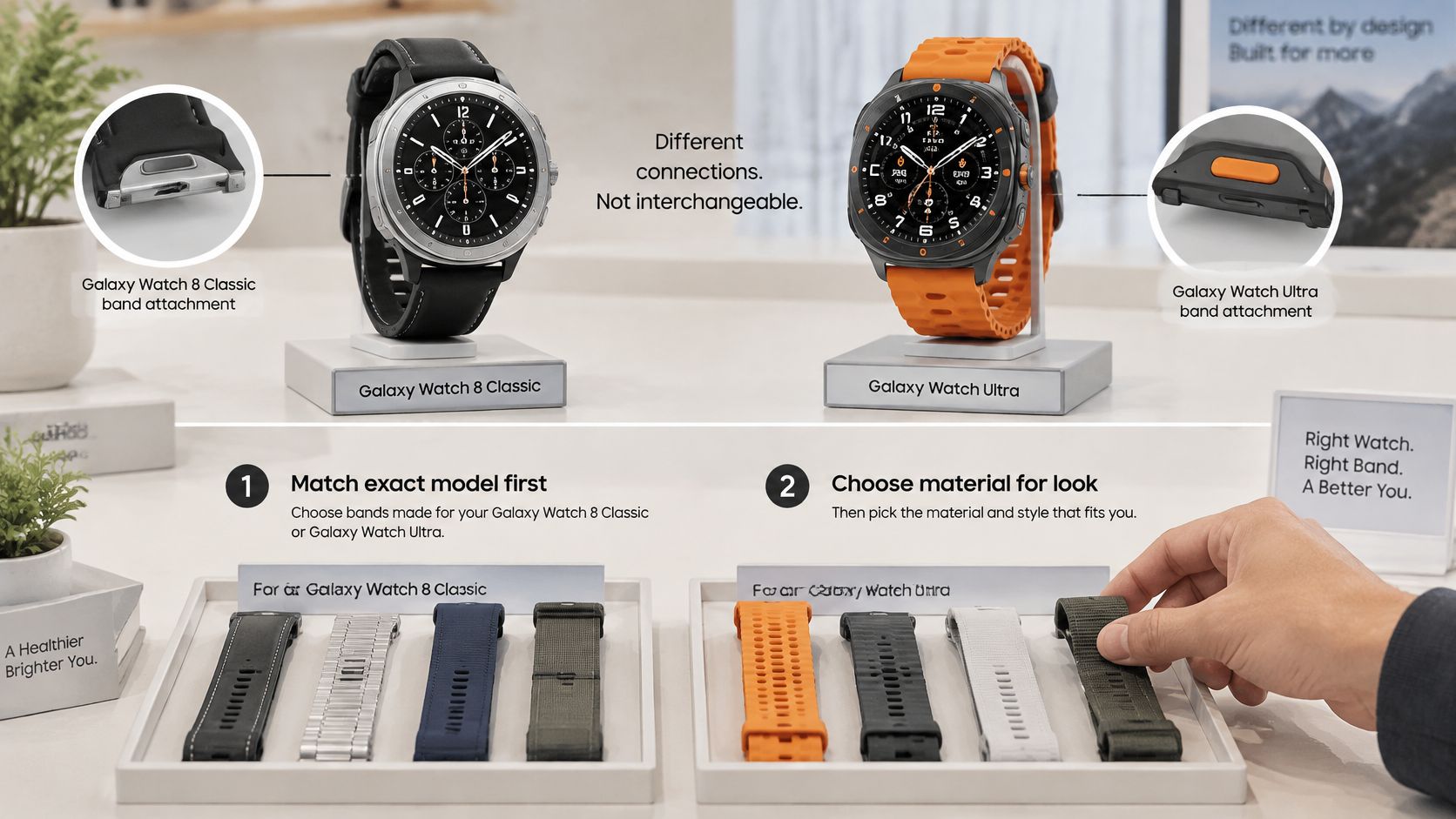
No. Samsung's support answer on Galaxy Watch band compatibility states that bands are mutually compatible between the Galaxy Watch8 and Galaxy Watch8 Classic, and that the Galaxy Watch Ultra can only be used with its dedicated bands.
That split has a practical consequence a spec table will not show. A Galaxy Watch 8 owner who adds a Classic later keeps every strap already bought. An Ultra buyer starts a separate collection. Anyone upgrading from a Galaxy Watch 7 should check rather than assume: the same Samsung page says the Watch8 series is not compatible with bands from previously released models.
| Watch | Band fitting | Example bands listed for this fitting | Confirm before ordering |
|---|---|---|---|
| Galaxy Watch 8 and 8 Classic | Shared Watch 8 band fitting, per Samsung | Vornis Silicone Sport Band, Oryn Magnetic Milanese, Rovan Magnetic Silicone Sport Band, Varden Genuine Leather | Exact model named on the listing |
| Galaxy Watch Ultra | Ultra-dedicated band fitting, per Samsung | Teral Nylon Loop, Kryos Stainless Link | Listing names Galaxy Watch Ultra |
The connector is the check that matters. Samsung's support answer names the Ultra's 34 mm band connection and says it is incompatible with any previously released Galaxy Watch bands, so read the model and connector format printed on each listing rather than guessing from case diameter. A generic strap or an older Galaxy Watch strap can fail to attach on either model.
To confirm the fit for your exact model, the Watch Band Finder on our site asks which watch you wear and narrows the field before you read individual listings.
Nothing but Bands sells replacement bands for both systems: the Galaxy Watch 8 and 8 Classic band collection and the Galaxy Watch Ultra band collection. The straps are aftermarket replacements rather than Samsung-made parts, so confirm the exact model named on the listing before you order.
Choose Bands and Confirm Your Model Before Ordering
A strap chosen for its color can arrive unable to lock. The Galaxy Watch 8 Classic and the Galaxy Watch Ultra use different fittings, so the band question is settled before style enters it: pick the fitting that matches your watch, then pick the material. Because the two models share no straps, the fitting you buy into is the one every future band must match, which makes the band system part of the purchase decision rather than an afterthought.
For the Classic's dressier case, the Watch 8 range runs from genuine leather to the Kryos stainless link and the Oryn magnetic Milanese, with silicone covering sweat and water. The Ultra side pairs its rugged case with silicone and nylon bands built for its own dedicated fitting. Genuine leather and stainless steel are offered on both sides, so an Ultra owner can still dress the watch up.
On the Watch 8 and 8 Classic side specifically, the Vornis Silicone Sport Band is the trail option: a flexible silicone strap built for sweat and water. The Rovan Magnetic Silicone Sport Band for Galaxy Watch 8 and 9 adds a magnetic closure to the same brief.
The trail-to-dinner swap takes five steps if you keep two bands for the same fitting.
- Rinse and dry the trail band so sweat and grit don't travel into the drawer.
- Wipe the watch fitting itself so no grit goes in.
- Release the current band. On the Galaxy Watch 8 and 8 Classic, Samsung describes its Dynamic Lug System as letting you change bands in a snap; the Ultra uses its own fitting, so follow that one.
- Attach a band built for the same fitting, never the other watch's.
- Tug the new band gently to confirm it has locked before you put the watch on.
Prices sit on each product page, since they change. Confirm the exact model named on the listing before ordering: a band named for Galaxy Watch 8 or 8 Classic fits that fitting, a band named for Galaxy Watch Ultra fits the other, and nothing crosses over. If a spec in this article decides your purchase, verify the watch variant on Samsung's page before buying.
Frequently Asked Questions
Does the Galaxy Watch 8 Classic work with an iPhone?
Samsung states that the Galaxy Watch8 series must be paired with a smartphone running Android 11.0 or above with at least 1.5 GB of memory, and its Galaxy Watch Ultra page notes that the Galaxy Wearable app is not supported on iOS. Check Samsung's compatibility details for your phone before you plan around either watch.
Do the Galaxy Watch 8 Classic and Galaxy Watch Ultra both offer cellular connectivity?
Samsung lists LTE versions of both the Galaxy Watch 8 Classic and the Galaxy Watch Ultra. Cellular functions need carrier support, and a Bluetooth-only variant can't use them. Confirm which variant you're buying on Samsung's page before ordering, because the model name differs between the Bluetooth and LTE versions.
Whichever watch you choose, the strap is the part you'll change most often, and the fitting is what makes that easy or expensive. Nothing but Bands stocks replacement bands for the Galaxy Watch 8 and 8 Classic fitting and for the Ultra fitting, in silicone, nylon, genuine leather and stainless steel, with each listing naming the model it fits. Match a band to your exact watch before you order.
Podobne artykuły

- November 25, 2026
Learn how to clean nylon watch band straps by hand with mild soap, a soft brush and full air drying,...

- November 24, 2026
Garmin Forerunner 165 vs 265 compared on display, battery, GPS, training features, price tier and bands, with a clear pick...
