


If you're looking at titanium Apple Watch bands, you're usually trying to solve a very specific problem: you want the watch to keep that metal, technical look without adding the heft of steel. Titanium Apple Watch bands are worth considering if you want a lighter metal band, strong resistance to sweat and salt water, and a nickel-free material, but they cost more and the finish quality matters as much as the metal itself.
3 Key Takeaways: Titanium Apple Watch Bands
Lighter metal: Titanium keeps the metal look with less weight than steel.
Handles sweat well: It suits sweat, salt air and daily wear, but quality varies.
Want mesh? Choose Milanese: For a flexible magnetic fit, stainless Milanese is often the better pick.
That's the honest frame for this guide. Nothing but Bands sells replacement bands only, not watches, and it doesn't sell a titanium band, so the useful way to approach this is as a material explainer rather than a product pitch. If you're also wondering why metal bands often cost more than they first appear to, this breakdown of why Apple Watch bands can be expensive gives good background on the design and manufacturing side.
Table of Contents
- What Are Titanium Apple Watch Bands and Are They Worth It
- What Grade and Finish Does a Titanium Apple Watch Band Use
- Is Titanium Better Than Stainless Steel or Silicone for Daily Wear
- Is a Titanium Apple Watch Band Good for Sensitive Skin and Workouts
- Will a Titanium Apple Watch Band Fit My Apple Watch and Wrist
- How Do You Care for a Titanium Apple Watch Band and Spot Quality
- Should You Buy Titanium or Choose Stainless Milanese Instead
What Are Titanium Apple Watch Bands and Are They Worth It
You notice the difference the first time you wear one all day. A titanium Apple Watch band keeps the cold, solid feel of metal, but it usually feels less tiring on the wrist than a comparable steel link band.
That is the main reason to consider titanium. It is a replacement band material used for linked bracelets, solid hardware, and some premium-style designs where the goal is a metal look without as much weight. Titanium is less dense than stainless steel, which helps explain why it can feel noticeably lighter in daily wear while still feeling rigid and substantial, as noted in this titanium wearables materials explainer.
Worth it depends on what you are buying for.
If you want a lighter metal band that handles sweat, salt air, and regular wear well, titanium can make sense. If you mainly want the flexible mesh look with magnetic adjustment, titanium is often the wrong target. In that case, a stainless Milanese band is usually the more sensible choice because that style is already strongly associated with fine steel mesh construction, and the buying question becomes style and fit, not titanium as a material.
Titanium also gets oversimplified. Shoppers often hear “premium metal” and assume every titanium band is automatically tough, skin-friendly, and beautifully finished. Real-world quality is messier. The comfort can be excellent, but scratch visibility, link tolerances, clasp quality, and surface finishing still decide whether a band feels refined or disappointing. That is part of why metal bands can vary so much in price, as this explanation of why Apple Watch bands can be expensive makes clear.
Nothing but Bands does not sell a titanium band, so the honest answer here is not “yes” for everyone. Titanium is worth it for buyers who specifically want a lighter metal bracelet and understand the trade-off. You usually pay more, and you still need to check the grade, finish, and build quality before you buy.
For our part, titanium isn't forbidden in the range. It simply hasn't met our sourcing, quality and price standards yet.
What Grade and Finish Does a Titanium Apple Watch Band Use
A titanium Apple Watch band can use very different titanium grades and finishes, and those choices affect how the band marks, looks, and feels far more than most product listings admit.
What do Grade 2 and Grade 5 mean on a titanium Apple Watch band
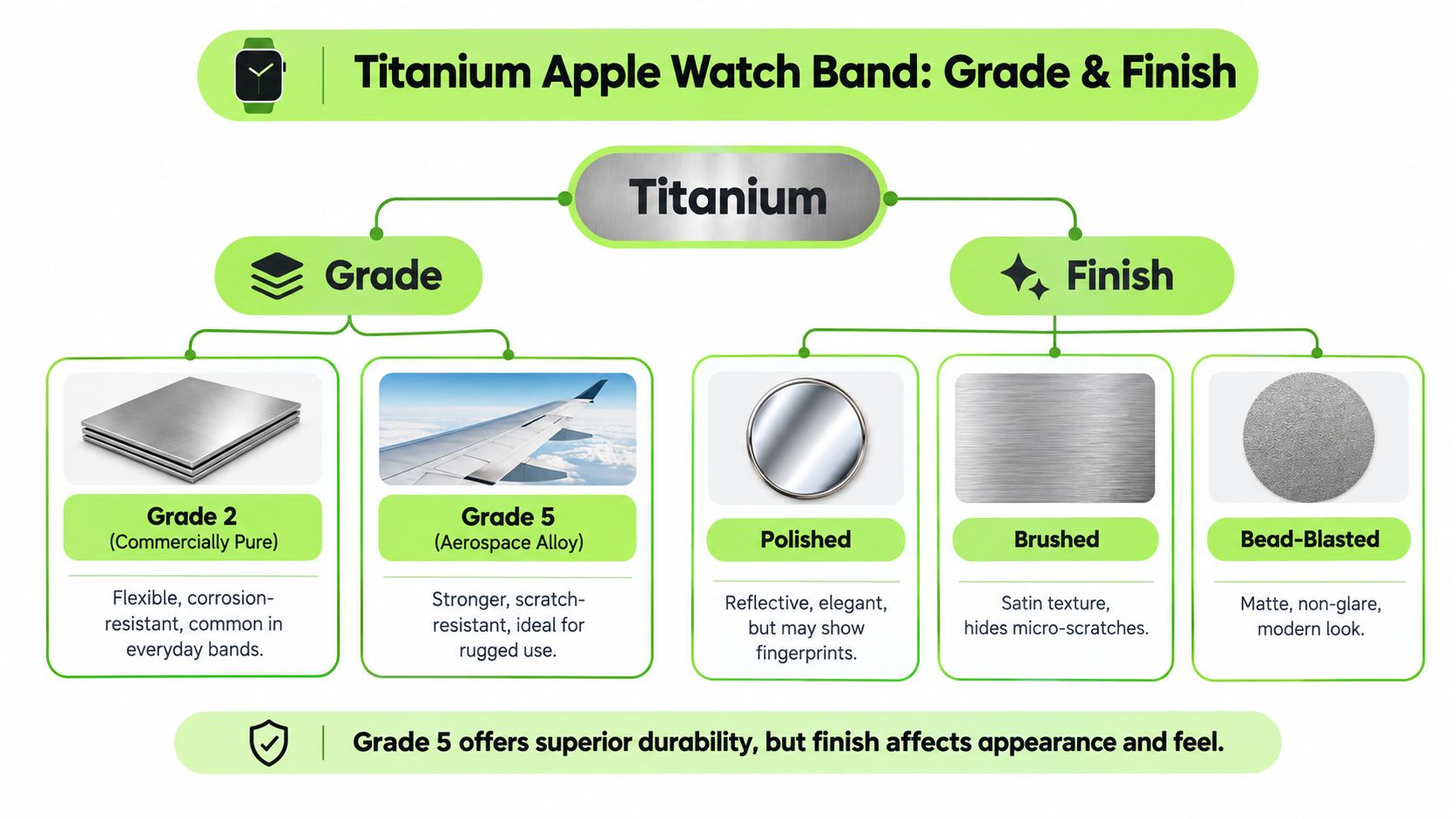
A titanium Apple Watch band labeled Grade 2 usually means commercially pure titanium, while a titanium Apple Watch band labeled Grade 5 usually means a harder aerospace alloy.
That difference matters in plain English. Grade 2 is unalloyed, commercially pure titanium: it is commonly used when a maker wants corrosion resistance and lower cost, but it tends to mark more easily. Grade 5 is the Ti-6Al-4V alloy, roughly 6 percent aluminium and 4 percent vanadium, and it is both harder and stronger than commercially pure titanium, so it is usually the more rugged-feeling option. In the Apple Watch world, third-party titanium bands for Ultra are commonly described with those grades, and better listings say which one they use and where.
Cheap listings often stop at the word “titanium,” which isn't enough information. If a seller won't say which grade they use, assume you're buying the look first and the exact material performance second.
Why do most titanium Apple Watch bands look brushed or matte
Most titanium Apple Watch bands look brushed, matte, or bead-blasted because titanium takes those finishes better than a mirror polish.
That's why the classic titanium look is a soft gray, slightly darker and warmer than shiny steel. A high polish is possible in limited use, but it's rarely where titanium looks most convincing. The material suits a technical finish better than a jewelry-like one, and that's one reason titanium pairs naturally with Apple Watch Ultra styling.
If you want a broader primer on how different metal constructions behave, this guide to metal watch strap types helps separate bracelet, mesh, and clasp choices from the base material itself.
A titanium finish can hide certain signs of wear well, but it won't always age in the same forgiving way as brushed steel.
Is “titanium look” the same as solid titanium
A titanium-look Apple Watch band is not the same as a solid titanium Apple Watch band.
Some bands use stainless steel underneath and borrow the color language of titanium through coating or finishing. That isn't automatically bad. In fact, for some buyers, it's the more sensible choice because the appearance is what they wanted all along. For example, Vayra, Magnetic Milanese, Apple Watch is a stainless steel Milanese mesh band, not titanium, and its case for consideration is straightforward: some people want a polished, adjustable metal band for work and daily wear, not a titanium bracelet with removable links or a bead-blasted tool-watch look.
That's the key question to ask before you buy. Are you choosing a material, or are you choosing an appearance?
Is Titanium Better Than Stainless Steel or Silicone for Daily Wear
Titanium is the better daily-wear pick if you want a metal band that feels lighter on the wrist. Stainless steel makes more sense if you want a dressier shine, simpler cosmetic cleanup, and often a lower price. Silicone is still the easiest answer for workouts, heat, and pure comfort.
A good way to decide is to start with what bothers you most in real use. If a steel bracelet feels heavy by mid-afternoon, titanium solves that problem. If you care more about a polished look or easier refinishing after scuffs, steel still has an edge. If you want a band you can rinse and forget, silicone stays the low-fuss option.
Titanium vs Stainless Steel vs Silicone at a Glance
| Criterion | Titanium | Stainless Steel | Silicone |
|---|---|---|---|
| Everyday feel | Light for a metal band | Heavier, more substantial | Soft and flexible |
| Sweat and water exposure | Usually very good | Good in normal daily use | Very good in normal daily use |
| Skin concerns | Often preferred by nickel-sensitive wearers | May bother some nickel-sensitive wearers | Usually comfortable, though some people dislike trapped sweat |
| Scratch behavior | Finish matters a lot, scuffs can show | Brushed steel is often easier to tidy visually | Won't scratch like metal, but can collect grime or age |
| Style | Technical, matte, tool-watch look | Dressier, classic metal look | Casual, sporty |
| Adjustment style | Often links or clasp-based | Links, clasps, or mesh | Usually pin-and-hole or tuck style |
| Cost pattern | Usually higher | Wide price range | Usually lower |
Weight is the clearest reason people choose titanium. Two bands can look similar in photos, but on the wrist they do not behave the same. Steel feels more like a bracelet. Titanium feels closer to a scaled-down tool, still solid, just less noticeable over a long day of typing, commuting, or walking.
Does titanium resist sweat and pool water better than steel
Usually, yes.
Titanium is known for handling sweat, humidity, and salt exposure well because it forms a protective oxide layer on its surface. In plain terms, that surface film works like a shield that reforms after minor wear. That helps explain why titanium has such a strong reputation in watches, eyewear, and other items that stay against skin.
That does not mean stainless steel is fragile. Good stainless bands hold up well in ordinary daily wear. The difference is more about margin. If you sweat heavily, spend time near the ocean, or want a metal band for hot weather, titanium is often the safer material choice over time. For a broader comparison of how strength and real-world wear differ, Everti's material strength insights are useful.
What does stainless steel still do better
Stainless steel still wins on finish variety and repairability.
A brushed steel band can often be cleaned up visually with light refinishing. Titanium can hide wear well in some bead-blasted or matte finishes, but once a scratch cuts across the grain or creates a shiny mark, home touch-up is less predictable. That trade-off matters if you are hard on your watch band and want something easier to freshen up.
Steel also gives you more style paths. If you like a mesh look, the answer usually is not titanium at all. It is a stainless Milanese design, because Milanese mesh is traditionally a steel format and it offers the smooth drape many buyers want. Nothing but Bands does not sell titanium bands, so if your goal is that woven metal appearance rather than the material itself, a stainless Milanese band will serve you better than a titanium search will.
Silicone, by comparison, is the practical option. It will not give you the feel or look of metal, but it stays the easiest choice for exercise, quick cleaning, and all-day flexibility.
Is a Titanium Apple Watch Band Good for Sensitive Skin and Workouts
A titanium Apple Watch band is a strong choice for sensitive skin and workouts when the goal is a metal band that's nickel-free, less bothered by sweat, and lighter on the wrist than steel.
That “metal band for sensitive skin” use case is more common than many listings admit. Some buyers react to steel, or don't enjoy how a heavier bracelet feels once sweat and movement enter the picture. Titanium is often attractive here because the grades used in watch bands — commercially pure Grade 2 and the Grade 5 Ti-6Al-4V alloy — carry no nickel. Apple lists a Titanium Milanese Loop among its own band materials and says its bands fall below the nickel restrictions set by European REACH regulation, in its band materials support guidance.
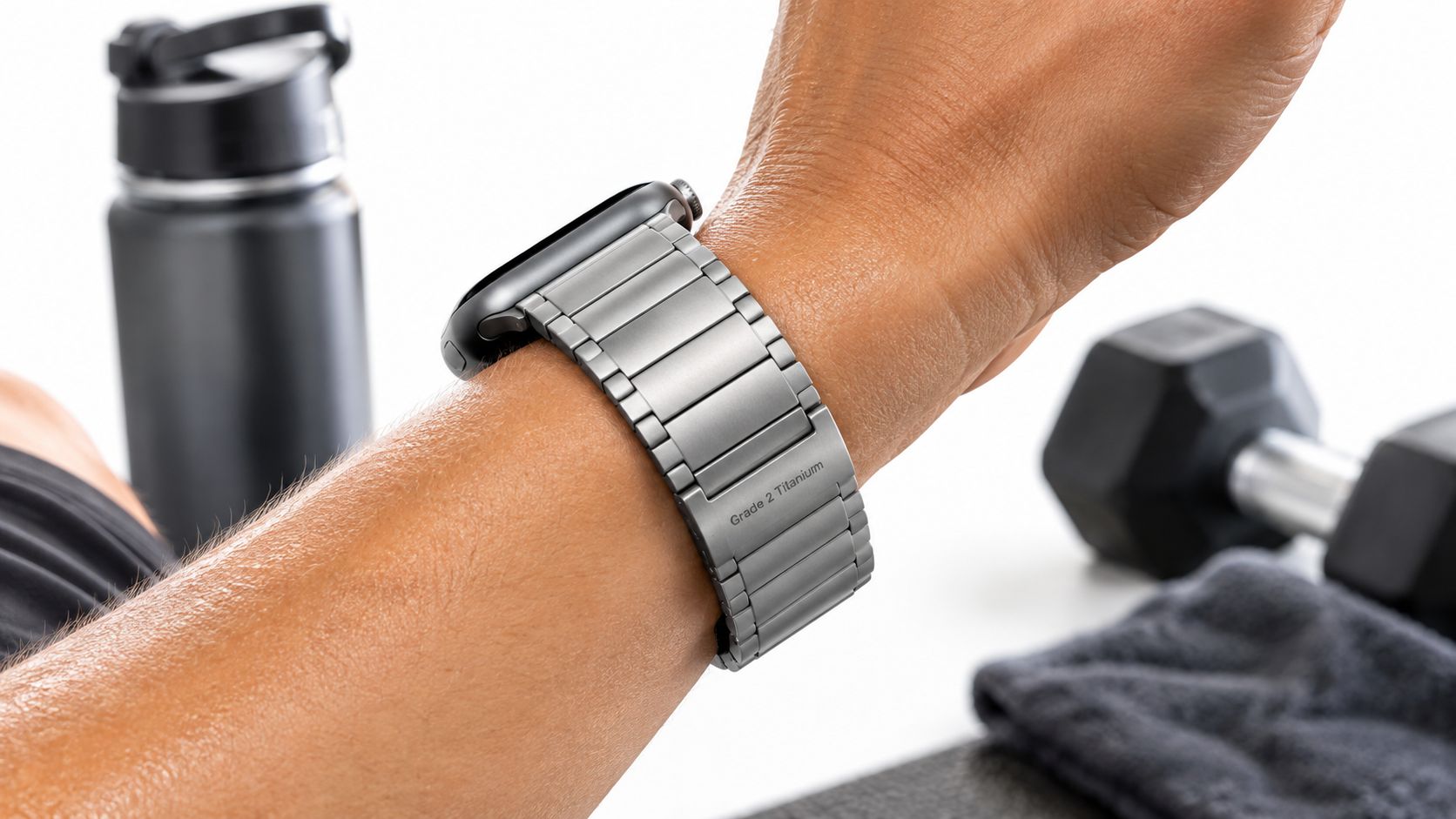
That doesn't mean every titanium band is automatically comfortable. Comfort still depends on the shape of the links or mesh, whether the clasp creates a pressure point, and whether the band sits too tight after your wrist warms up during exercise.
When someone writes to us about a rash, we first try to separate an allergy from trapped moisture, soap residue or a band worn too tightly. If there's a known metal allergy, we point people toward a woven nylon loop with a hook-and-loop closure, because no metal buckle sits against the skin, and if the problem is mainly sweat, silicone can be easier because it wipes clean and dries quickly. We do steer known nickel-sensitive customers away from Milanese mesh and stainless links.
Does a titanium Apple Watch band stay comfortable during workouts
A titanium Apple Watch band can stay comfortable during workouts if the fit is right and the design doesn't pinch, but a titanium Apple Watch band won't feel as soft or forgiving as silicone.
For gym use, the material itself is only one part of the equation. Titanium's corrosion resistance helps if you sweat heavily or move between fresh water, humidity, and outdoor use. But if the band has stiff links, rough edges, or a poor clasp, the comfort benefit of titanium shrinks fast.
Clean metal bands after sweaty sessions. The material may resist corrosion well, but dried salt and grime can still make any band feel harsher against the skin.
A quick visual walk-through can help if you're deciding between metal styles and how they wear:
Who should skip titanium for workouts
Some Apple Watch owners should skip titanium for workouts and choose silicone or nylon instead.
Skip titanium if you want the softest possible contact during running, circuit work, or long training sessions. Skip titanium if you know you're sensitive to the feel of any metal once you heat up. Titanium helps most when you want a metal look without the usual steel downsides, not when you want a sport band replacement in every sense.
Will a Titanium Apple Watch Band Fit My Apple Watch and Wrist
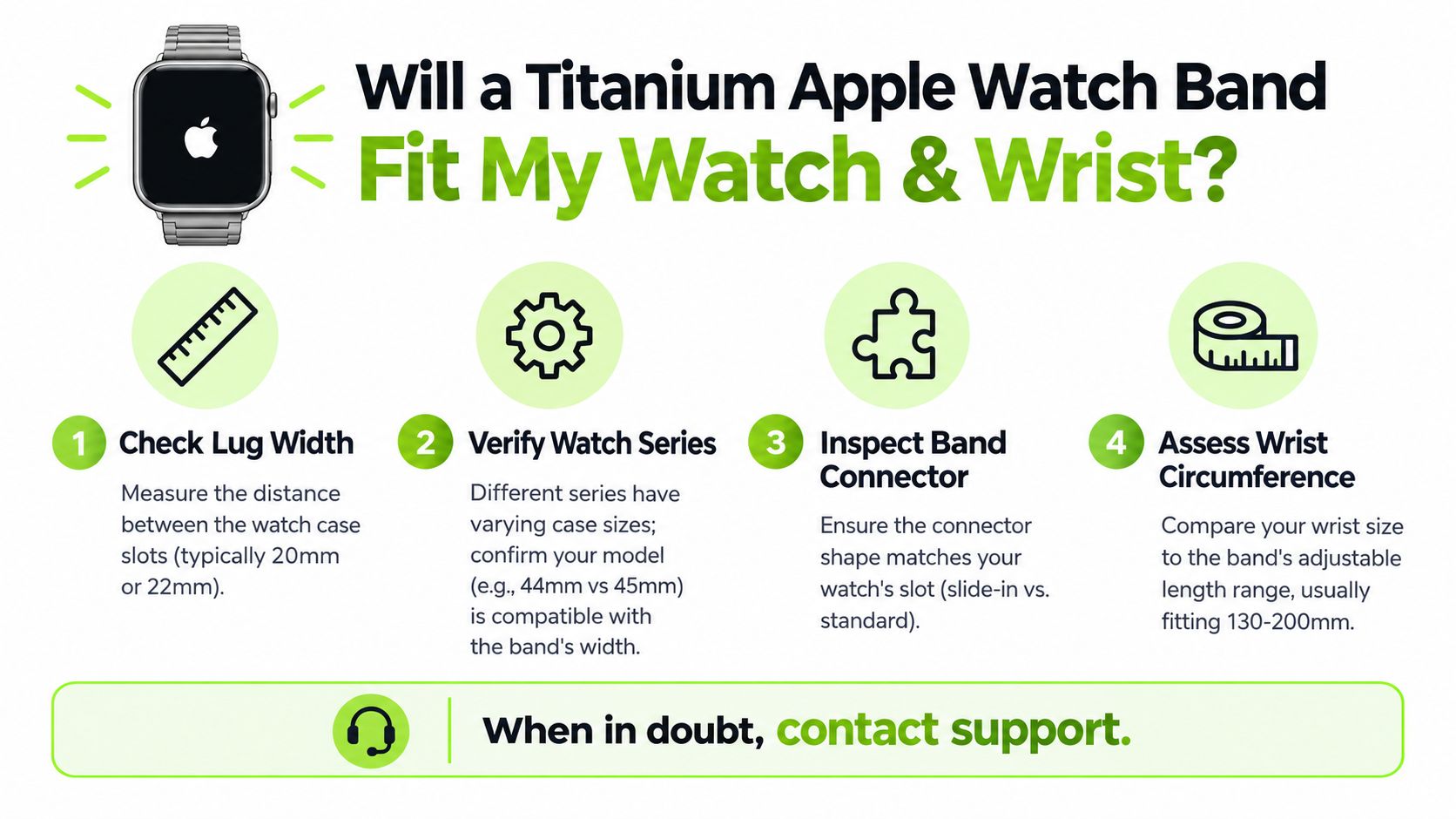
A titanium Apple Watch band will fit your Apple Watch only if the case family and the slide-in connector match, and it will fit your wrist only if the maker's stated length range suits your actual wrist measurement.
Compatibility is where titanium bands cause the most buyer mistakes. The metal isn't the problem. The connector and size family are.
That matches what we see in customer messages: Apple Watch customers often confuse the case size with the band family.
Does a 46mm titanium Apple Watch band fit a 44mm Apple Watch
A 46mm Apple Watch band fits 44mm, 45mm, and 46mm Apple Watch cases, according to Apple's band compatibility guidance.
That's the cleanest buying rule to remember on the larger side. Apple states that bands for 42mm, 44mm, and 45mm cases are compatible with each other, and bands for 46mm cases are compatible with 44mm, 45mm, and 46mm cases. If a product page claims much broader compatibility than that, treat the listing carefully unless it explains the connector family clearly.
Which Apple Watch case families matter when choosing titanium
Apple Watch band sizing is grouped by case families, and titanium Apple Watch bands should be bought by those families rather than by vague “fits most” claims.
Apple's own band compatibility guidance splits its case sizes into a small family and a large one. Bands for 38mm, 40mm, and 41mm cases are compatible with each other. Bands for 42mm, 44mm, and 45mm cases are compatible with each other. The large end then overlaps: bands for 46mm cases fit 44mm, 45mm, and 46mm cases, bands for 49mm Ultra cases fit 44mm, 45mm, or 46mm cases, and bands for 44mm, 45mm, or 46mm cases fit 49mm Ultra cases. Nothing in that list is about the metal, which is exactly the point — a titanium band is bought into a case family first.
The important trap is the 42mm size. The original Series 1–3 42mm belongs to the larger band family, while the newer Series 10 and 11 42mm belongs to the smaller family.
If you're browsing general Apple Watch bands or more rugged-looking Apple Watch Ultra bands, that case-family mindset is the one to keep. Start with the watch case size. Only then worry about material.
How do I choose the right wrist size in a titanium Apple Watch band
You choose the right wrist size in a titanium Apple Watch band by matching your measured wrist circumference to the seller's stated fit range, not by assuming all metal bands adjust the same way.
Titanium band makers publish a wrist range for each size rather than a single length, and those ranges vary between brands and between generations of the same band. That's a big reason buyers get caught out. One “large-case titanium band” may still wear very differently from another, even when both are sold for the same watch.
Use a soft tape or a strip of paper around your wrist where you wear the watch. Then compare that number to the listing's range.
Buying shortcut: On third-party titanium Apple Watch bands, the real quality test is often the slide-in connector tolerance, not the word “titanium” in the title.
A loose connector ruins the experience faster than a slightly softer grade of metal.
How Do You Care for a Titanium Apple Watch Band and Spot Quality
You care for a titanium Apple Watch band by rinsing off sweat or salt, drying it fully, and protecting the finish from needless knocks, and you spot quality by checking the connector, clasp, and finishing details before you trust the material claim.
Routine care is simple. After sweaty wear, a rinse with clean water and a soft dry-down is usually enough. If the band has a bead-blasted or coated surface, avoid abrasive scrubbing because the finish can look patchy even when the base metal is fine.
What should I inspect before buying a titanium Apple Watch band
A titanium Apple Watch band should be inspected first at the connector and clasp, because that's where cheap bands usually disappoint.
Look for:
- Connector fit: The Apple Watch slide-in piece should sit flush and lock cleanly, without side play.
- Clasp action: A clasp should close positively and open without gritty resistance.
- Edge finishing: Sharp inner edges matter more in daily comfort than the headline material.
- Surface consistency: Bead-blasted or brushed areas should look even, not cloudy in spots.
Those are close to the points we look at ourselves in basic incoming and dispatch checks on the bands we do sell: visual finish, clasp operation, connector movement, pin seating and whether the band sits squarely in the fitting. Suppliers run their own checks as well, but we don't treat a supplier's general assurance as a laboratory certificate.
The cost difference between titanium and steel often comes from manufacturing reality, not just branding. Titanium is harder on tooling, it work-hardens, and machining links, mesh, and clasps is slower and dearer. Grade matters here too. Grade 5 generally costs more to work with than Grade 2.
Can you refinish a scratched titanium Apple Watch band easily
A scratched titanium Apple Watch band is not usually as easy to tidy cosmetically as a brushed steel band.
That's one of titanium's least glamorous truths. Brushed steel often gives you more room to blend back everyday scuffs. Titanium can still age well, especially in matte finishes, but once a mark disrupts the surface character, home touch-up is less predictable. If you know cosmetic maintenance matters to you, that should weigh into the buying decision as much as weight or corrosion resistance.
Should You Buy Titanium or Choose Stainless Milanese Instead
You should buy titanium if you specifically want titanium's lighter weight, nickel-free skin contact, and technical matte-metal character. You should choose stainless Milanese instead if what you really want is the metal mesh look, magnetic closure, and easy on-the-fly adjustment.
That second group is bigger than many shoppers think. A lot of people start searching for titanium because they've bought an Apple Watch Ultra or another metal-case Apple Watch and want the band to look more cohesive. But once you strip the decision back, what they want is often a clean mesh band that adjusts anywhere along the wrist and works with both casual and smarter clothes.
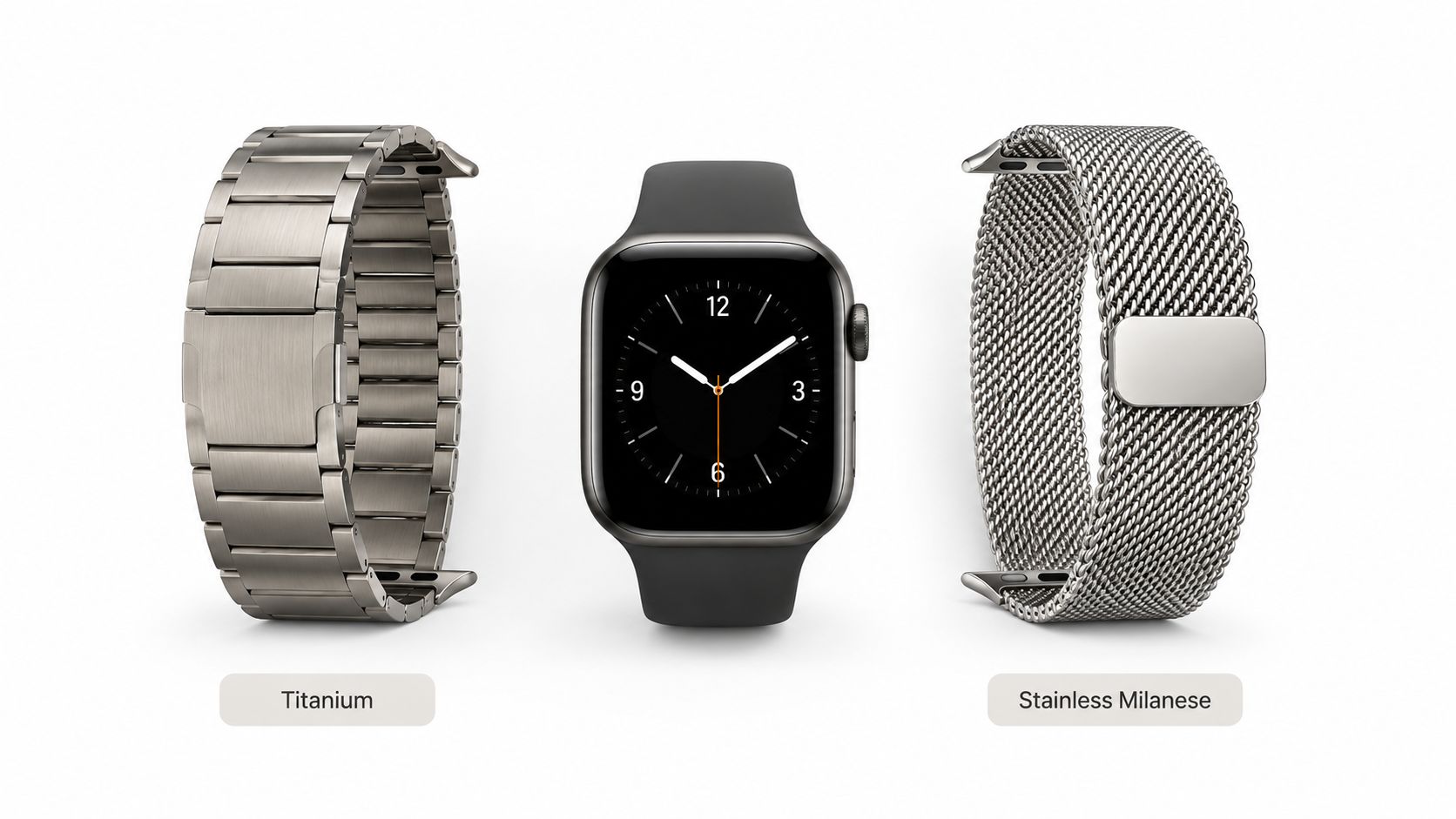
That's where stainless Milanese becomes the honest alternative. Nothing but Bands doesn't sell titanium bands, but it does sell stainless mesh styles such as the Lunor Magnetic Milanese and a wider range of magnetic Milanese bands. If you'd rather leave metal altogether, genuine leather exists in the range too, including Avelin.
We stock Milanese because it gives customers a dressier metal look without fixed holes. We wear samples ourselves, and it's comfortable and smart for office wear, with two caveats: water sits in the mesh and around the clasp longer than people expect, and a magnetic metal band can catch arm hair if the edge or clasp is rough.
Christine White, verified buyer of the Lunor — Magnetic Milanese — Apple Watch: "This magnetic Milanese band is just what I needed. The quality feels solid, like it’ll last through my day-to-day hustle. Love the way it looks on my Apple Watch, super sleek and classy without being too fancy. Would definitely buy again and tell friends to check it out!"
So the final filter is simple. Buy titanium for the material. Choose Milanese for the look and the adjustment style.
Nothing but Bands focuses on replacement straps, not watches, so it's a practical place to compare Apple Watch band styles when you've decided what matters most. If titanium helped you narrow the material question but you've realized a magnetic mesh design is the better fit, you can browse the wider selection at Nothing but Bands.
Post correlati

- October 06, 2026
Clear installation instructions for smartwatch bands. Learn how to attach, verify, and troubleshoot Apple, Samsung, Garmin, and Fitbit straps safely.

- October 05, 2026
A practical guide to changing watch bands across Apple, Garmin, Samsung, and Fitbit, covering tools, fitment, daily rotation, and common...

- October 02, 2026
Everything to know about the Coros Pace 4 nylon band including sizing, quick-release installation, cleaning tips, and compatible third-party options.


