


In a Garmin vs Samsung watch choice, pick Garmin if your priority is structured training, long GPS sessions and battery life measured in days. Pick Samsung if you want a watch that works closely with a Galaxy phone for calls, notifications, payments and everyday apps.
3 Key Takeaways: Garmin vs Samsung Watch
Garmin for training: Choose it for structured training, long GPS sessions and multi-day battery.
Samsung for daily smarts: Choose it to work closely with a Galaxy phone for calls and notifications.
Check the band system: QuickFit, standard quick release and Samsung's Dynamic Lug don't interchange.
Table of Contents
- Which Is Better, Garmin or Samsung?
- How Do Garmin and Samsung Specs Compare?
- Should You Pick Garmin for Serious Training?
- Should You Pick Samsung for Daily Smart Features?
- Do Garmin and Samsung Bands Fit Each Other?
- Which Band Material Suits Sport or Daily Wear?
- Confirm Your Model Before You Choose a Band
- Frequently Asked Questions
Which Is Better, Garmin or Samsung?
Garmin describes its Forerunner 201, introduced in 2003, as the world's first GPS fitness watch on its Forerunner 20th anniversary page. Samsung's Galaxy Watch line grew out of a consumer electronics and smartphone business years later. That origin gap still shapes what each brand makes today.
Garmin built around training, navigation and endurance. Samsung built around staying connected through a Galaxy phone. You're comparing a specialist sports instrument with a smartphone-centered smartwatch platform, so the honest answer depends on your week. A runner building toward race distance gets more from Garmin's training focus. Someone who wants to handle calls and apps from the wrist all day gets more from Samsung.
What should you compare first?
Four criteria settle this, in this order:
- Fitness depth: Do you follow a training plan, or do you mainly record workouts?
- Battery: Can you charge often, or do you need days between charges?
- Phone ecosystem: Do you want the watch to handle daily phone tasks?
- Style: Does the watch need to suit training only, or work and weekends too?
Add a fifth check before you commit: the band connector. Garmin QuickFit, ordinary quick release and Samsung's Dynamic Lug are different systems, and the exact watch model decides which bands fit. A band you want can rule a model in or out before the feature lists even matter, so check the connector while you compare, not after you've bought.
Judge the watch you'll actually wear and charge every week, not the longest feature list.
This guide compares what each maker publishes and what each product line is built for, since we sell replacement bands rather than watches. Before you read further, note three things: your main activity, your phone, and the exact model printed on the back of the watch you own or plan to buy. Those three answers will settle most of the Garmin vs Samsung watch decision.
How Do Garmin and Samsung Specs Compare?
Pick the model before you read the spec sheet. Garmin and Samsung publish numbers per watch, sometimes per case-size variant, so a single brand-level spec doesn't exist. Line up the exact models on your shortlist and compare cell by cell.
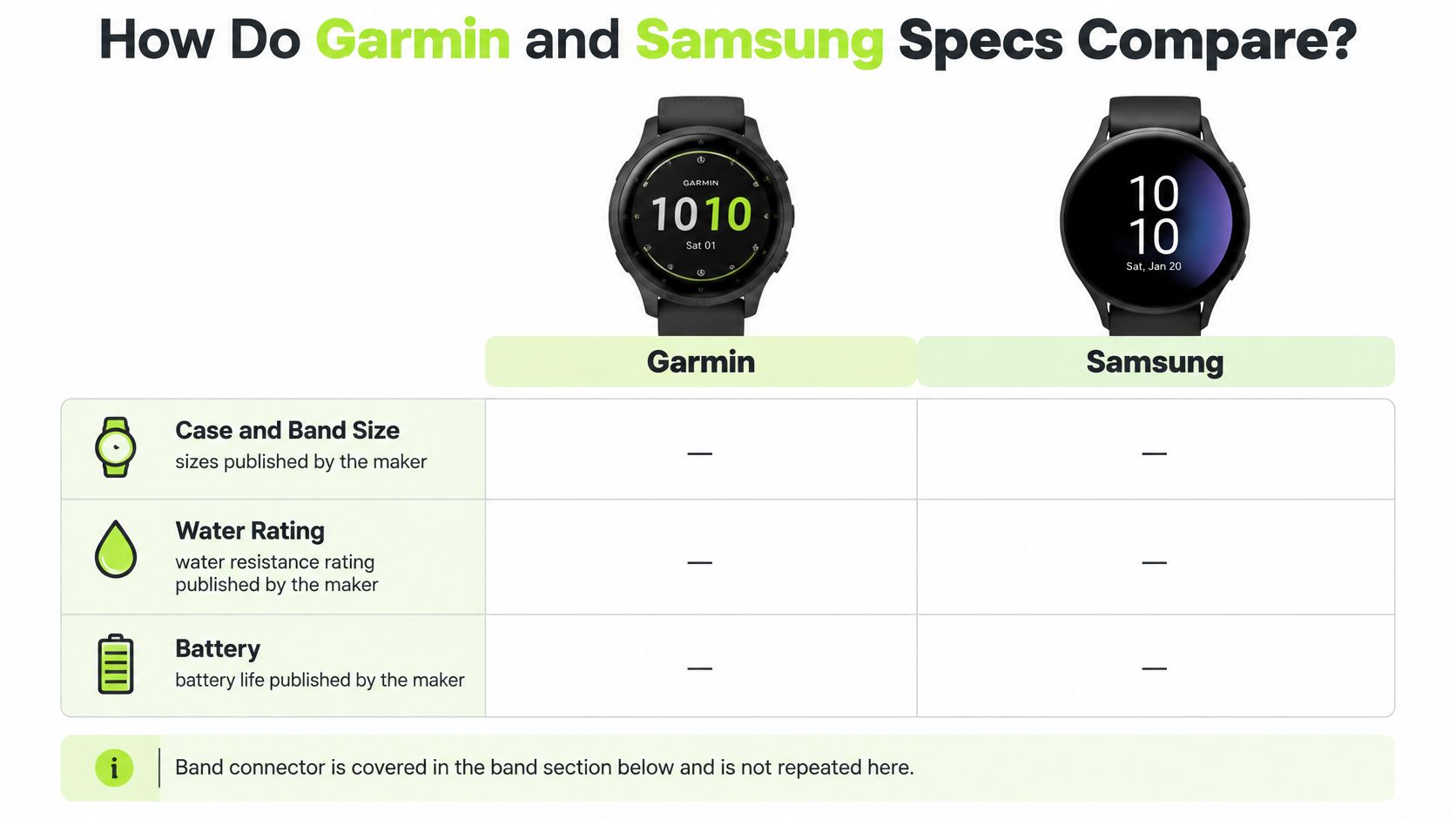
| Spec | Garmin | Samsung Galaxy Watch |
|---|---|---|
| Band fitting | QuickFit widths of 20, 22 or 26 mm, set by model; some models use ordinary quick release | Ordinary quick release or Samsung's Dynamic Lug fitting, depending on the model |
| Water rating | Forerunner 265: 5 ATM; fēnix E: 10 ATM | Galaxy Watch7 and Galaxy Watch8: 5 ATM with IP68 and MIL-STD-810H; Galaxy Watch Ultra: 10 ATM with IP68 |
| Battery, smartwatch mode | Forerunner 265: up to 13 days | Galaxy Watch Ultra: up to 100 hours in Power Saving mode; Galaxy Watch7: up to 40 hours with Always On Display off, up to 30 hours with it on |
| Battery, GPS mode | Forerunner 265: up to 20 hours GPS only | Galaxy Watch Ultra: up to 48 hours in Exercise Power Saving mode; Galaxy Watch7: a shorter GPS window than the Ultra |
Two verdicts fall out of that table. The Forerunner 265 leads on days between charges in smartwatch mode. The Galaxy Watch Ultra leads on stated workout runtime, though Samsung's figure uses its Exercise Power Saving mode.
All of these are maker test figures, and a water rating covers immersion under test conditions rather than clearing a watch for diving or high-pressure water sports.
Garmin's Forerunner 265 product page rates that model at 5 ATM with up to 13 days in smartwatch mode and up to 20 hours of GPS only GNSS tracking, while Garmin's fēnix E product page lists the fēnix E at 10 ATM. On Samsung's side, Samsung's Galaxy Watch Ultra support page gives the Galaxy Watch Ultra up to 100 hours in Power Saving mode and up to 48 hours in Exercise Power Saving mode, while Samsung's Galaxy Watch7 product page lists up to 40 hours with Always On Display off and up to 30 hours with it on. Treat every figure as a model-specific limit and don't transfer a rating to a sibling model.
How do you complete a missing cell?
Open the maker's page for your exact model and case-size variant. Copy the stated water rating and each battery mode onto your own shortlist. Garmin figures can differ between configurations, so match the page to the precise model you're buying rather than the product family.
The connector gets no column above because fitting takes more than a width number. QuickFit, ordinary quick release and Samsung's Dynamic Lug are three separate systems, so two watches can match on battery and water rating yet take completely different bands. If you already own straps you want to keep, check the fitting first. It can rule a model out before its features get a say.
Should You Pick Garmin for Serious Training?
Garmin is the stronger pick when structured training, long GPS sessions or multi day battery life are your main needs. If training comes first and phone features come second, start with Garmin.
Consider a runner building a week around pace, distance and route data. That runner needs a watch that records session after session without a charging stop becoming part of the plan. A cyclist on long rides has the same problem, with less tolerance for a flat battery partway through a route.
A triathlete moving between swim, bike and run needs sport modes to be the centre of the watch, not an extra app. An outdoor user travelling or camping for several days also benefits when charging isn't a daily task. In each case, battery life isn't a convenience figure. It determines whether the watch is ready when the session starts.
Practical rule: If missing a charge would cost you a recorded race, long ride or full training day, weight battery life ahead of apps.
Garmin's design priority follows its sports watch lineage. Training and activity functions lead. Apps, messaging and payments aren't the main reason to choose most Garmin models. That's a strength if you want fewer interruptions during training, and a weakness if you expect the watch to act as a second phone.
Be honest about that trade off. If you want to answer calls from your wrist, use a wide range of everyday apps and treat payments as essential, a Garmin may feel restrained. Don't buy a training watch and then judge it mainly as a phone companion.
If you also move health data between platforms, the Oura API integration for wellness platforms from Zee Palm is useful background on how wearable data can connect beyond one device. That doesn't change the watch choice, but it helps if your training records need to sit alongside other wellness data.
Does Garmin match your routine?
Shortlist Garmin if most of these statements describe you:
- Frequent training: You train several times a week.
- Regular GPS use: You use GPS for most sessions.
- Infrequent charging: You want charging once a week or less.
- Actionable metrics: You want training information you'll use to adjust effort or recovery.
If three or four apply, Garmin is your likely fit. Then check whether your chosen Garmin model uses QuickFit or ordinary quick release, because that fitting decides which replacement bands you can buy.
Should You Pick Samsung for Daily Smart Features?
Samsung Galaxy Watch models are the better pick when you want a smartwatch that works closely with a Galaxy phone for calls, notifications, payments and everyday apps. If the watch is part of your daily phone routine, start with Samsung.
A commuter who reads messages, pays and checks travel updates from the wrist gets clear value from that phone first design. A Galaxy phone owner who wants the phone and watch to work as one set is the natural audience. Setup and daily use make more sense when both devices belong to the same ecosystem.
Samsung also suits someone who wants one watch for work, weekends and exercise. A casual gym user who records workouts but doesn't need long GPS sessions may prefer that balance. You give up Garmin's training first focus, but you gain a watch built around daily communication and apps.
The Galaxy Watch Ultra is the exception you shouldn't lump in with mainstream Galaxy models. Samsung positions the Ultra for outdoor and endurance use, so compare the Ultra directly with a Garmin model built for similar use. Compare mainstream Galaxy Watch models with each other on daily features, size and charging routine.
Do more health features mean better guidance?
No, a longer health feature list on a Samsung Galaxy Watch doesn't automatically mean better guidance for your routine. Samsung offers wellness tracking such as heart rate and activity tracking, but some health features depend on country, phone and model. Check Samsung's page for your region before you treat any feature as a reason to buy.
A single readiness or summary score can make a decision feel simple while hiding uncertainty underneath it. Ask what you'd change after seeing a metric. If you wouldn't alter sleep, training or a conversation with a clinician, that metric shouldn't drive the purchase.
Confirm your exact phone on Samsung's compatibility page. Don't assume every feature works on every phone, and don't assume a feature available in one country is available in yours.
Try this closing test. Write down the three things you'd use the watch for most. If calls, payments and notifications lead your list, Samsung fits. If training sessions and charging freedom lead instead, your answer points the other way.
Do Garmin and Samsung Bands Fit Each Other?
Mostly no. Garmin QuickFit bands and Samsung's Dynamic Lug and Ultra bands fit only their own systems; the overlap is limited to Garmin and Galaxy models that both take ordinary quick release in the same width. Either way, the band must match the exact watch model. If a specific band matters, treat the connector as a filter before specs, because a band choice can rule out a model before features even matter.
The biggest confusion is Garmin QuickFit versus ordinary quick release. QuickFit 20, 22 and 26 is a latch that locks into a Garmin-only bracket. An ordinary 22 mm quick release band uses a spring bar with a small tab. Both can be called 22 mm, and neither fits the other's watch. Width alone doesn't make them compatible.
Not every Garmin uses QuickFit. The Venu 3 and Venu 3S, for example, take ordinary quick release bands in 22 mm and 18 mm. Read the model name before you shop by series name alone.
| Watch family | Fitting | Band width or fitting | Band to match |
|---|---|---|---|
| Garmin QuickFit models | QuickFit latch into Garmin bracket | 20, 22 or 26 mm | Garmin QuickFit band in the same width |
| Garmin models with quick release, such as Venu 3 and Venu 3S | Ordinary quick release spring bar | 22 mm and 18 mm | Quick release band in the stated width |
| Galaxy Watch4 to Watch7 | Standard 20 mm quick release spring bar | 20 mm | Any 20 mm quick release band |
| Galaxy Watch8 | Samsung Dynamic Lug | Dynamic Lug band | Band made for Dynamic Lug |
| Galaxy Watch Ultra | Ultra-only band fitting | Ultra-only band | Band labelled for the Ultra only |
| Older 46 mm Galaxy Watch, Watch3 45 mm and Gear S3 | Quick release | 22 mm | 22 mm quick release band |
On the Samsung side, Galaxy Watch4 to Watch7 take standard 20 mm quick release bands. Galaxy Watch8 uses Samsung's Dynamic Lug, and Galaxy Watch Ultra bands fit only the Ultra. The older 46 mm Galaxy Watch, Watch3 45 mm and Gear S3 take 22 mm bands.
Samsung adds another model check: Watch4–7 use standard 20 mm bands, while Watch8/Classic and Ultra require their specifically matched attachments.
If the spring bar itself is unfamiliar, our guide to the quick release mechanism shows how that fitting differs from a latch system. The same measure-before-ordering habit shows up in the Thermo Recovery Wear XXL sizing guide: confirm the exact size or connector before buying rather than trusting a label.
Nothing But Bands sells bands for Garmin models across the Approach, D2, Descent, Enduro, Epix, Forerunner, Foretrex, Fēnix, Instinct, MARQ, Quatix, Tactix, Venu, Vívoactive, Vívomove and QuickFit series. Start with our Garmin watch bands if your model is Garmin. For Samsung, the range covers Galaxy Watch 9, Galaxy Watch 8 and 8 Classic, Galaxy Watch Ultra and Ultra 2, Galaxy Watch 7, Galaxy Watch 6 and 6 Classic, Galaxy Watch 5 and 5 Pro, Galaxy Watch 4 and 4 Classic, Galaxy Watch FE, Galaxy Watch 3, Galaxy Watch (2018), Galaxy Watch Active and Active 2, Gear S3, Gear S2 and Gear Sport in our Samsung Galaxy Watch bands collection.
Our bands are replacement bands, separate from official Garmin or Samsung products. Fit is stated by width and connector format, so confirm your exact model before ordering.
Which Band Material Suits Sport or Daily Wear?
Silicone suits sweat, swimming and hot weather, nylon suits breathable all day wear and long training days, Milanese suits office and smart casual settings, and leather suits dry casual or dress occasions. Match the fitting first, then pick the material.
The image below shows how different the four main material families look beside one watch.
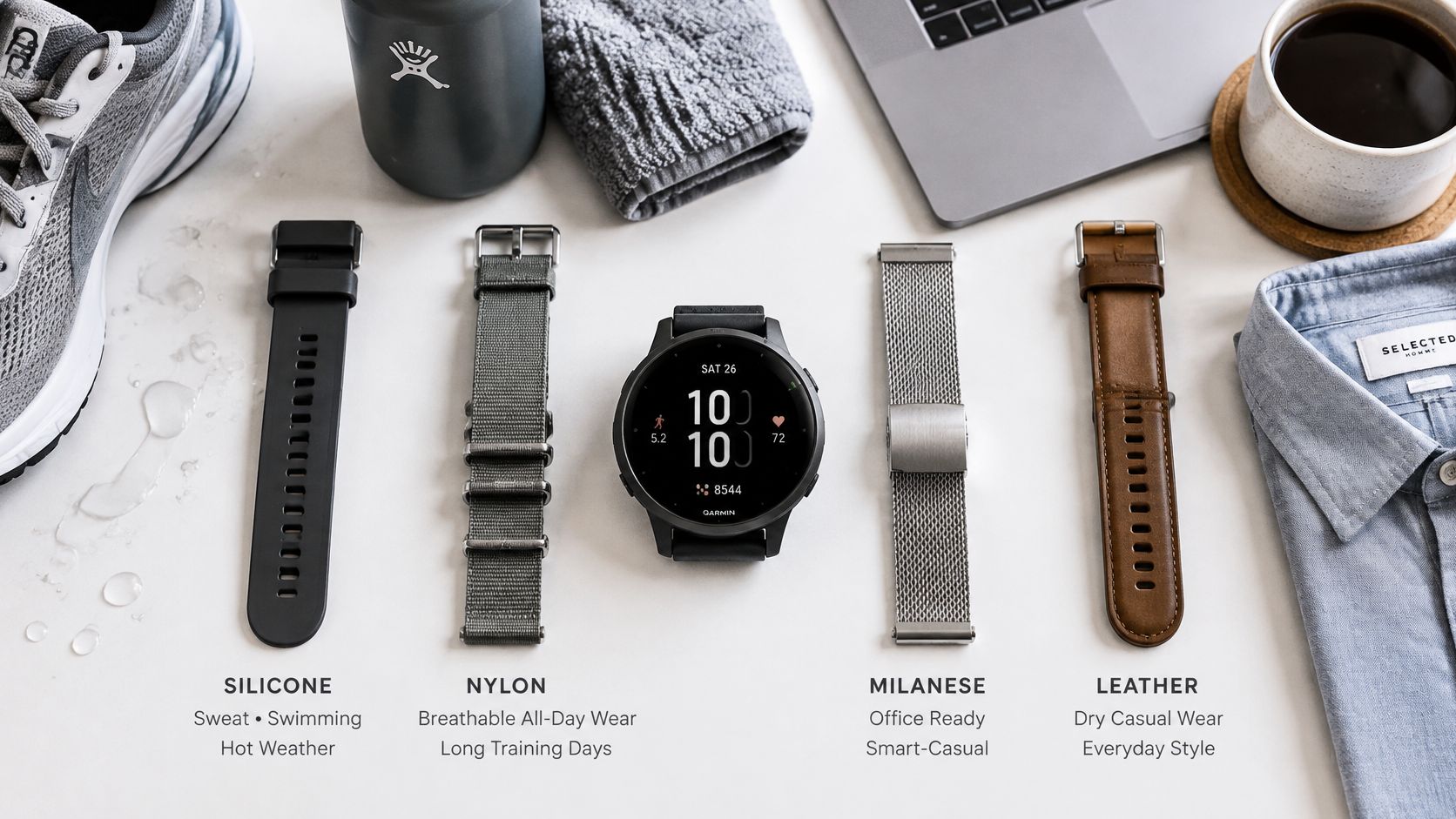
| Material | Sweat and water | Drying time | Best for | Watch for |
|---|---|---|---|---|
| Silicone | Handles sweat and water well | Dries in minutes | Gym, swimming, hot weather | Can feel slightly sticky in very hot weather |
| Nylon | Breathes well in daily wear | Stays damp much longer, hours after a swim or heavy sweat | All day wear and long training days | Slow to dry after heavy sweat |
| Milanese | Comfortable in dry conditions | Water sits in mesh and around clasp | Office and smart casual wear | Not ideal for pools or heavy sweat |
| Leather | Not suited to sweat or water | Slow to dry if wet | Dry, casual or dress occasions | Keep away from sweat and water |
| Magnetic metal | Finish and clasp determine water handling | Dries as metal does | Office wear | Rough edge or clasp can catch arm hair |
My verdict is simple. If you train hard or swim, silicone wins and it is not close. Nylon is the pick for a band you wear from morning to night, provided you accept that it holds water after a heavy session. Milanese and leather are daily and dress materials, and both lose their appeal fast once sweat gets involved.
For a closer material comparison, read our guide to silicone vs nylon watch bands before you settle on one band for every activity. Many active users do better with two bands, one for sweat and one for dry daily wear.
The video below is useful if you want to see band handling before choosing a material for regular swaps.
Which examples match each fitting?
Fitting decides the band, material decides the feel. Both our Garmin and Samsung collections carry silicone, nylon, Milanese and other materials, but the right product depends on whether your watch takes QuickFit, ordinary quick release or Samsung's Dynamic Lug fitting.
Two concrete examples show how specific this gets. The Rovan Magnetic Silicone Sport Band is made for Galaxy Watch 8 and 9, and the Vornis Silicone Sport Band is made for Galaxy Watch Ultra and Ultra 2. Neither is interchangeable with the other Samsung fittings, and the same logic applies on the Garmin side, where a QuickFit band only fits a QuickFit watch.
These are our replacement band names, not official Garmin or Samsung products. Confirm your exact model and the fitting stated on the listing before you order.
Confirm Your Model Before You Choose a Band
Confirming your exact watch model before ordering prevents the most common band mistake, matching width while missing the connector. Follow the steps in order.
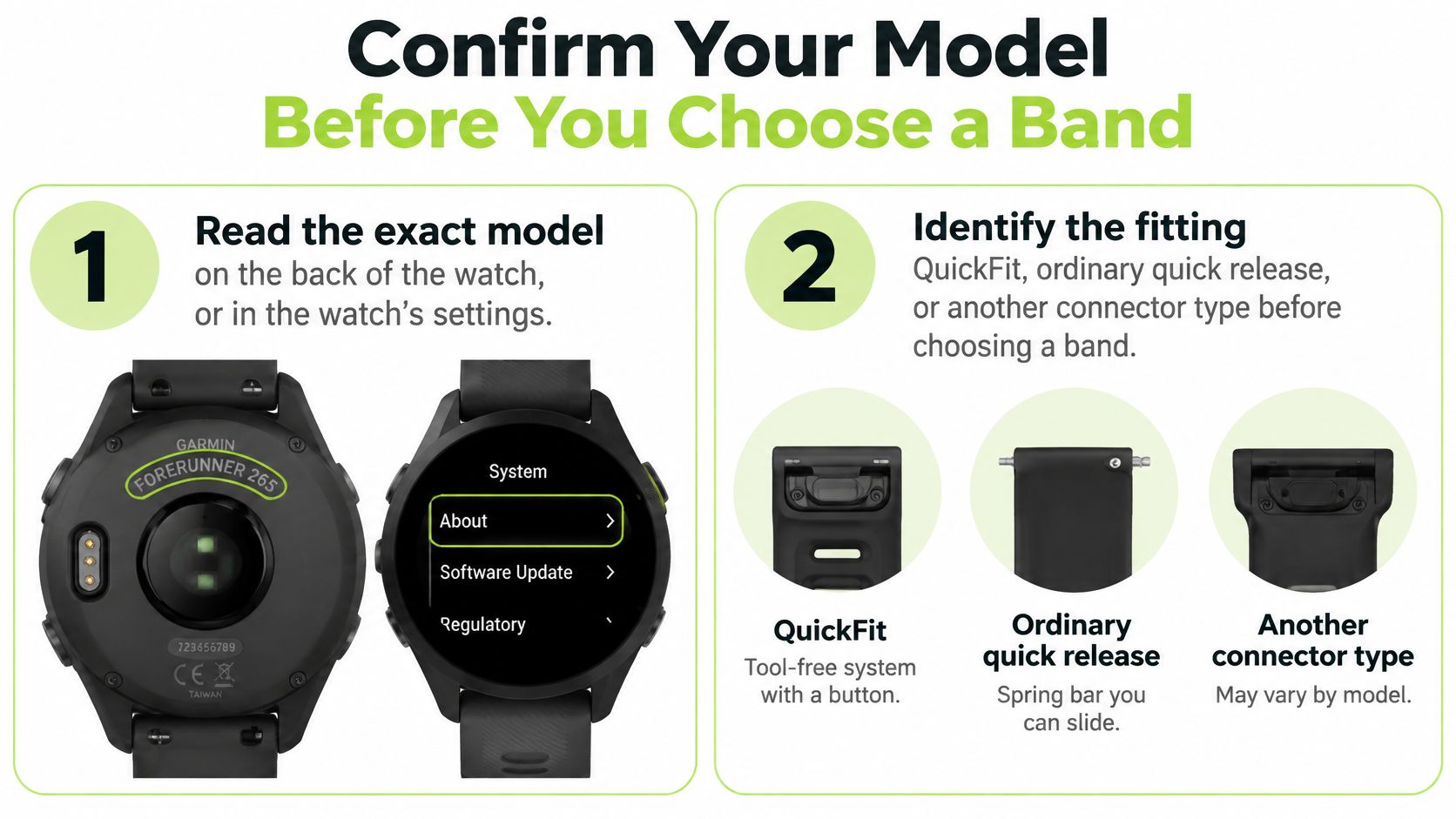
- Read the exact model: Find the model on the back of the watch or in the watch settings.
- Identify the fitting: Decide whether your watch uses QuickFit, ordinary quick release, Samsung Dynamic Lug or an Ultra only fitting.
- Match the band width: Use the 20, 22 or 26 mm width stated for that model, or the exact width stated for a smaller quick release model.
- Choose by activity: Pick silicone, nylon, Milanese, leather or metal for the way you'll wear the band most.
- Confirm the fit: Check the maker's model page or use the Watch Band Finder at /pages/watch-band-finder on our store site.
- Browse the matching collection: Use the Garmin collection for QuickFit and Garmin quick release models, and the Samsung collection for Galaxy models.
If you're measuring an existing band or lug gap, our guide on how to measure watch band size explains where to measure and what to record. Measure the fitting area, not the widest part of the strap.
For QuickFit models, we sell Garmin QuickFit 20, QuickFit 22 and QuickFit 26 bands. We also carry bands for Garmin's Legacy Hero and Legacy Saga editions, including First Avenger, Darth Vader, Captain Marvel and Rey, but those watches take ordinary quick release bands rather than QuickFit: 22 mm for First Avenger and Darth Vader, 18 mm for Captain Marvel and Rey.
If the fitting still looks uncertain after step five, stop and ask. Don't guess from the brand name.
Contact support by email or phone with the exact model name before you order. A two minute check is cheaper than returning a band that was the right width on the wrong connector.
Frequently Asked Questions
Can you use an adapter to put a Samsung band on a Garmin watch?
No, an adapter can't be assumed to make a Samsung band work on a Garmin watch, because Garmin QuickFit and Samsung fittings are different systems. Buy only a band or adapter listed for your exact Garmin model. Confirm that listing against the maker's product page before ordering. If the listing doesn't name your model and fitting clearly, don't buy it.
Ready to match a replacement band to your exact Garmin or Samsung model? Visit Nothing But Bands to browse by fitting, width and material, then confirm your model before you order so your next band suits training, work or daily wear from the first wear.
Post correlati

- November 12, 2026
Smartwatch or Fitness Band? Compare health tracking, workouts, battery, screens, straps and price, then pick the right type for your...

- November 11, 2026
COROS Pace 4 vs Pace 3 compared on maker specs: battery, size, GPS, training, bands and price, so you can...
