


A good Garmin watch strap is so much more than a fashion statement; it's a vital piece of your performance gear. The strap you choose has a direct impact on how comfortable your watch feels during a workout, the style you project every day, and even the accuracy of its health data. Finding the perfect strap makes sure your investment is working as hard as you do.
3 Key Takeaways: Garmin Watch Straps
Know which system you have: Venu, vívoactive and most Forerunner models use standard quick-release pins. Fenix, Epix, Enduro and Tactix use Garmin's more secure QuickFit latch.
Get the width exactly right: Common Garmin sizes are 20mm, 22mm and 26mm. Check your old strap, measure between the lugs or look up your model before you buy.
Match the strap to the activity: Silicone or nylon for running, swimming and cycling, a nylon loop or leather for everyday wear, and stainless steel for the office.
Table of Contents
- Why Your Garmin Strap Is a Critical Piece of Gear
- Understanding Garmin Strap Sizes and Systems
- Choosing the Right Strap Material for Your Lifestyle
- How to Change and Care for Your Garmin Strap
- Finding Quality Straps Without the Premium Price
- Still Have Questions? Let's Clear Things Up
Why Your Garmin Strap Is a Critical Piece of Gear
Your Garmin is a powerful little computer, but all that data-gathering prowess relies on something surprisingly simple: the strap. A strap that doesn't fit well or isn't right for the job can mess with everything from your heart rate readings to your general comfort, turning a top-tier device into a bit of a nuisance.
Think of it like the tyres on a high-performance car. You wouldn't slap budget tyres on a Ferrari and expect it to grip the track properly, would you? It's the same idea here. The strap that came in the box might be fine, but the right one can unlock your watch's full potential for whatever you're doing. A snug, secure fit is absolutely essential for accurate biometrics, as the optical heart rate sensor on the back needs to stay in close contact with your skin to get a proper reading.
More Than Just an Accessory
Choosing the right Garmin strap is all about matching the material and design to your life. A sweaty HIIT session calls for a different strap than a formal dinner, which is exactly why so many Garmin owners end up with a small collection.
- For the Athlete: A silicone or nylon strap is the way to go. They offer durability, water resistance, and flexibility—perfect for running, swimming, or cycling.
- For Everyday Wear: A breathable nylon loop or a classic leather strap will keep you comfortable all day long without irritating your skin.
- For a Professional Look: A stainless steel link bracelet or a smart leather strap can instantly elevate your watch, making it fit right in at the office or on a night out.
When you look at why your Garmin strap is a critical piece of gear, you'll see that a comprehensive triathlon watch guide often puts a huge emphasis on durability and a secure fit across different sports, really driving home the strap's role in peak performance.
A great watch strap isn't just about keeping the device on your wrist. It's about ensuring data integrity, providing comfort that lasts all day, and adapting the watch to every part of your life. It turns a tool into a seamless part of your daily routine.
This focus on specialised performance is a huge reason for Garmin's surging popularity. Here in the UK, we're seeing a big shift away from general-purpose smartwatches, with Garmin making serious ground among fitness enthusiasts. People are looking for better battery life and richer, more detailed tracking for activities like running and cycling. You can read more about why UK consumers are choosing Garmin for their fitness goals. This guide will help you find the perfect strap to get the most out of that incredible capability, and you can browse our full Garmin watch strap collection once you know what you're after.
Understanding Garmin Strap Sizes and Systems
At first glance, the world of Garmin watch straps can seem a bit overwhelming. With so many different models, sizes, and connection types, it's easy to get tangled up. But once you get your head around the two main systems Garmin uses, you'll find it's actually pretty straightforward.
Think of it like smartphone chargers. For years, most gadgets used a standard connector like micro-USB, while Apple had its own thing going on with the Lightning port. Garmin straps follow a similar logic: one system is an industry standard, and the other is Garmin's own unique design. The key is simply knowing which one your watch uses.
As you can see below, the right strap isn't just about looks—it's the foundation for comfort, accuracy, and performance.
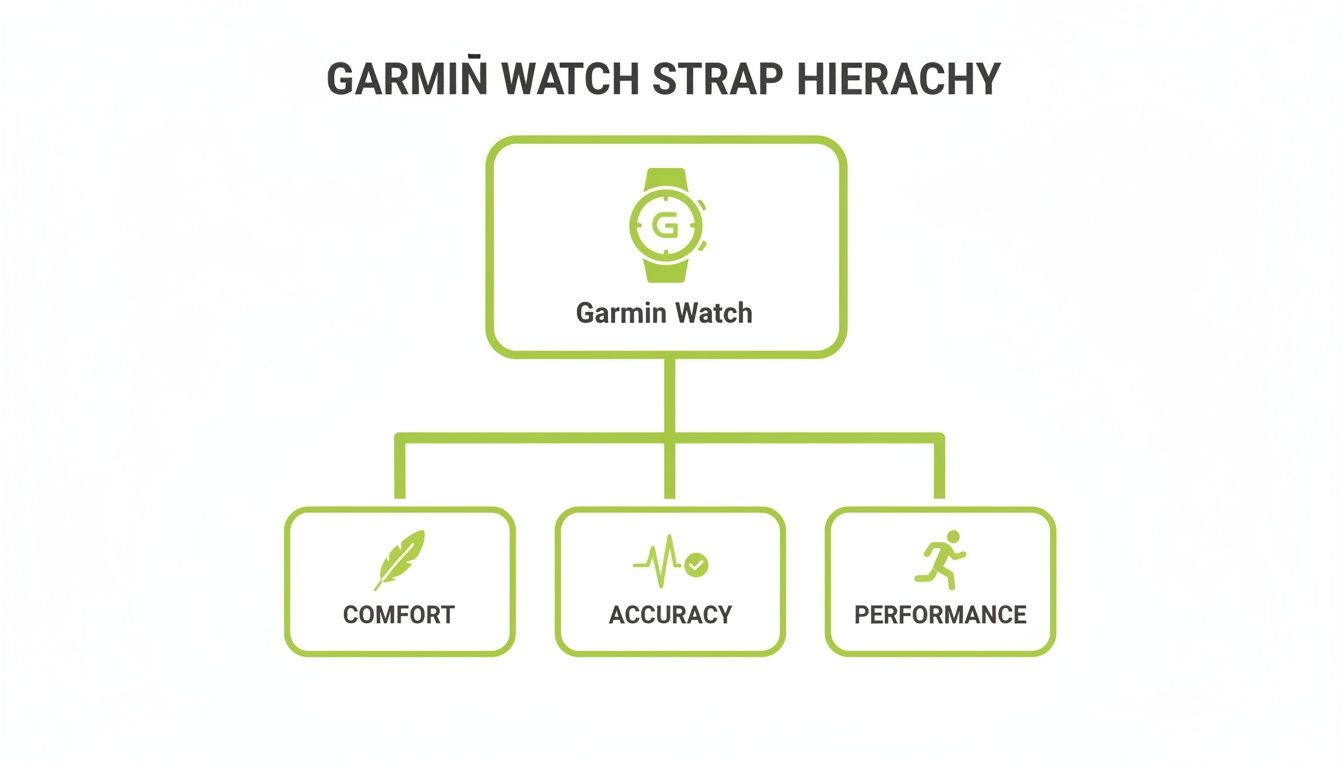
A well-chosen strap is a crucial functional component, not just an accessory. It's what allows your watch to do its job properly.
The Quick Release System
First up is the most common type: the Quick Release system. This isn't a Garmin-only thing; it's an industry standard. It works using small spring bars that have tiny levers you can flick with a fingernail to pop the strap off the watch lugs. Easy.
You'll find this system on many of Garmin's lifestyle and running-focused watches. It's popular because it's so simple and opens the door to a massive range of third-party straps.
- Models: Common on watches like the Venu, vívoactive, and many in the Forerunner series.
- Mechanism: A tiny pin on the back of the strap retracts the spring bar for quick removal.
- Advantage: Universal design means you have an almost endless choice of straps from all sorts of makers.
Because it's a standard, you aren't tied to one brand. That gives you incredible freedom to find the perfect material, colour, and style for any occasion. Just check your exact model first: widths vary even within one range, and the 11 Venu models in our compatibility data use four different widths, from 18mm to 24mm.
The QuickFit System
The second system is Garmin's own invention, called QuickFit. It was built specifically for their high-performance outdoor and adventure watches. This thing is seriously robust, designed for durability and letting you swap straps in seconds, even if you're wearing gloves.
Instead of a fiddly little pin, the QuickFit system uses a much larger latch that clips securely onto the watch's built-in bar. It's a design that's been engineered to take a beating, ensuring your pricey watch stays put whether you're hurtling down a mountain trail or catching a wave.
The QuickFit system is all about maximum security. That satisfying 'click' when it locks into place gives you total peace of mind that your watch isn't going anywhere, no matter how wild things get.
You'll generally see this system on the premium models built for serious endurance and exploration.
- Models: The go-to system for the Fenix, Epix, Enduro, and Tactix ranges.
- Mechanism: A heavy-duty latching mechanism that clicks directly onto a fixed pin in the watch lugs.
- Advantage: Unbeatable security and lightning-fast strap changes, making it perfect for multi-sport athletes.
Measuring for the Perfect Fit
Knowing your system is half the battle, but you also need the right size. The measurement that matters is the lug width—that's the distance between the two points where the strap connects to the watch case. It's always measured in millimetres (mm).
Common Garmin sizes are 20mm, 22mm, and 26mm. Be precise here. A strap that's even a millimetre too narrow will leave an ugly gap and won't be secure, while one that's too wide just won't fit at all.
To find your lug width, you can:
- Check Your Old Strap: The size is often stamped on the back of your original Garmin strap.
- Grab a Ruler: Carefully measure the space between the lugs on the watch case itself.
- Look it Up: A quick online search for your specific Garmin model will give you its official lug width.
For a more detailed walkthrough, our guide on how to measure your watch strap size provides foolproof, step-by-step instructions.
To make things even easier, here's a quick reference table for some of the most popular Garmin models.
Garmin Strap System and Size Reference
Use this table to quickly find the correct strap system and width for popular Garmin watch models.
| Garmin Watch Model (Example) | Strap System | Required Strap Width (mm) |
|---|---|---|
| Fenix 7X / Enduro 2 | QuickFit | 26mm |
| Fenix 7 / Epix (Gen 2) | QuickFit | 22mm |
| Fenix 7S | QuickFit | 20mm |
| Forerunner 955 / 965 | Quick Release | 22mm |
| Forerunner 255 / 265 | Quick Release | 22mm |
| Venu 2 / vívoactive 4 | Quick Release | 22mm |
| Venu 2S / vívoactive 4S | Quick Release | 18mm |
Once you know your system (Quick Release or QuickFit) and your lug width (e.g., 22mm), you're all set. You've just unlocked a massive world of strap options and can now confidently pick out the perfect new look for your Garmin from our Garmin watch straps collection.
Choosing the Right Strap Material for Your Lifestyle
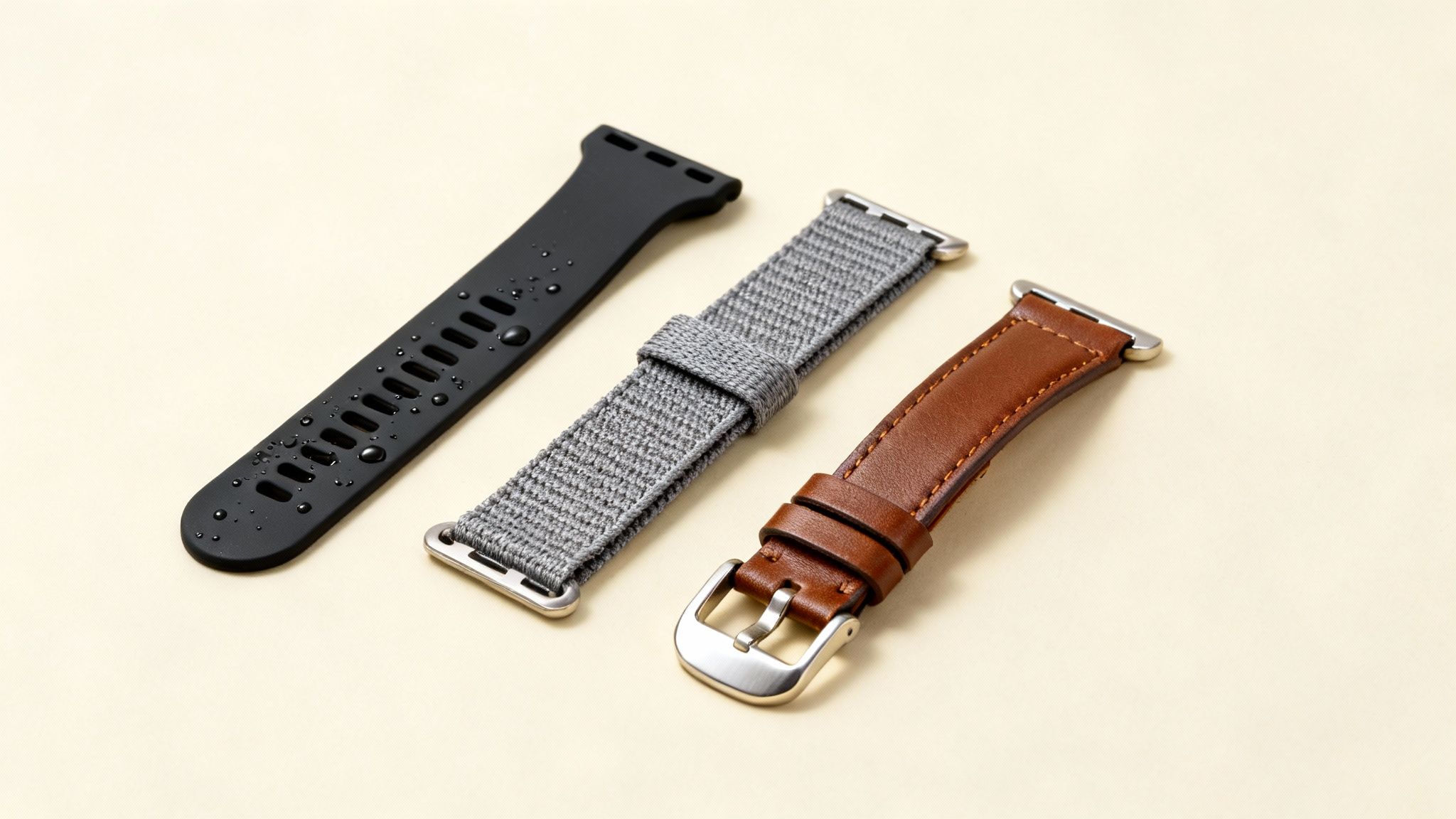
The strap on your Garmin does so much more than just keep it on your wrist—it defines the watch's character, comfort, and what it's capable of. With a quick swap, your rugged performance tool can become a sophisticated accessory fit for a night out. The secret is to think of your straps like a wardrobe for your watch, with different options for different parts of your life.
It's all about matching the material to the activity. You wouldn't wear your hiking boots to a black-tie dinner, and the same logic applies here. Each material has its own strengths, and knowing when to use which is the key to getting the absolute most out of your Garmin.
Silicone for Peak Performance and Durability
When you're pushing your limits, silicone is the undisputed champion. It's the go-to material for a reason: it's soft, flexible, and completely waterproof, ready for anything you can throw at it. From sweat and rain to a swim in the sea, it's built to handle it all without breaking down.
One of the best things about a silicone Garmin watch strap is how ridiculously easy it is to clean. For anyone who works out regularly, this is a game-changer. A quick rinse under the tap is all you need to get rid of sweat and grime, preventing the nasty buildup that can irritate your skin. This makes it the perfect partner for runners, cyclists, swimmers, and gym-goers.
Silicone's non-porous and hypoallergenic nature makes it a fantastic choice for sensitive skin. By preventing moisture and bacteria from getting trapped, it provides a clean and comfortable fit that lasts through the toughest sessions.
Its sheer durability means it can take the bumps and scrapes of an active life while keeping your watch securely in place. That snug fit is vital for accurate data, as it ensures the heart rate sensor stays in constant contact with your skin.
Woven Nylon for All-Day Comfort
For everyday wear, from the office to the sofa, breathability is king. This is where woven nylon straps really come into their own. Made from tightly interlaced threads, these straps are incredibly lightweight and let air flow freely, stopping that clammy, sweaty feeling you can get with other materials.
This constant airflow makes nylon a brilliant choice for long days, casual weekends, and even for sleeping. Since many Garmin users track their sleep, a comfortable, barely-there strap is essential for getting good data without it waking you up. In fact, Garmin's own data shows users who get 8 to 8.5 hours of sleep have the highest average sleep scores—and a comfy strap can definitely help with that.
Here's why nylon is a go-to for daily comfort:
- Lightweight Feel: You'll often forget you're even wearing it.
- Superior Breathability: Keeps sweat buildup to a minimum and your skin dry.
- Soft Texture: It's flexible and won't dig into your wrist.
- Quick Drying: If you do get it wet, it dries out much faster than leather.
The sheer versatility of a nylon Garmin watch strap makes it a staple for any collection, perfectly bridging the gap between a hardcore sports strap and a relaxed, casual look.
Leather for a Touch of Classic Style
Nothing elevates the look of your Garmin quite like a classic leather strap. It's the perfect way to transform your high-tech gadget into something that looks right at home in a professional or formal setting. A good quality leather strap brings a warmth, character, and timeless appeal that other materials just can't match.
Leather straps are ideal for the office, dinners out, or any event where you want your watch to feel more like a traditional timepiece. Over time, genuine leather also develops a unique patina—a subtle ageing that tells a story and makes the strap truly yours.
Just remember that leather and water are not the best of friends. You'll definitely want to swap it out for a silicone or nylon strap before you hit the gym or go for a swim. A little bit of care will go a long way in making sure it lasts.
Stainless Steel for Unmatched Elegance
For the ultimate in sophistication, a stainless steel strap is the top choice. Whether it's a sleek Milanese loop or a classic link bracelet, metal adds a sense of weight and premium quality to your Garmin, making it ready for even the most formal occasions.
Stainless steel is incredibly tough, resisting scratches and corrosion with ease. It creates a completely different look, turning your rugged Fenix or versatile Venu into a real statement piece. Much like leather, it's best saved for less sweaty activities where style is the main goal.
Picking the right material is all about balancing function, comfort, and style. Each one has its place, allowing your Garmin to adapt seamlessly to every part of your life. By having a few different options ready to go, you can make sure your watch is always perfectly dressed for the occasion—whether that's a gruelling triathlon or an important board meeting. This adaptability is what makes your Garmin a true 24/7 companion.
How to Change and Care for Your Garmin Strap
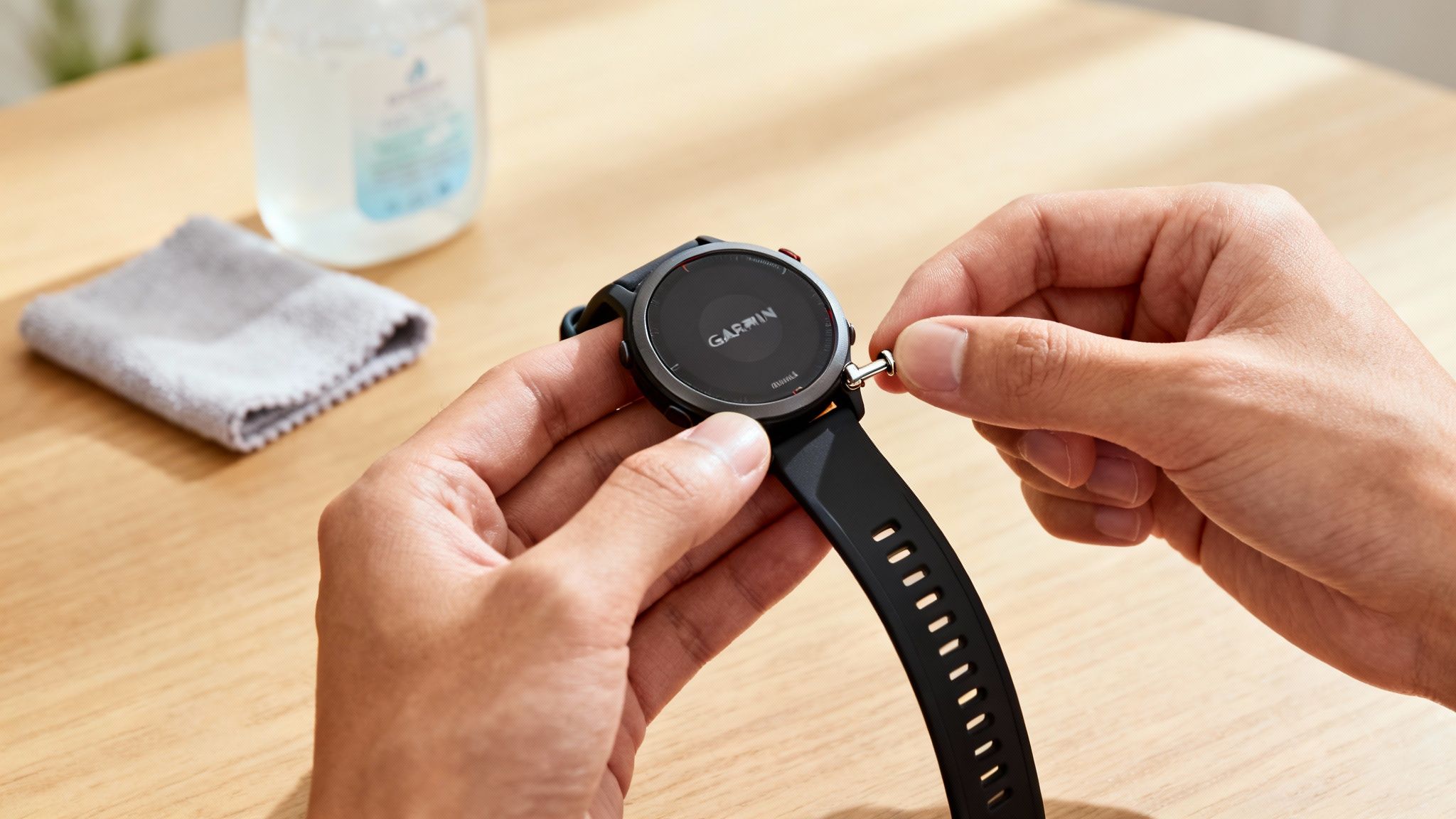
One of the best things about a Garmin watch is just how easy it is to give it a fresh look. Swapping a strap isn't some fiddly job that sends you hunting for special tools; it's a quick tweak you can do in moments. This flexibility means you can effortlessly match your watch to your activity, your outfit, or even just your mood.
Whether your watch has the Quick Release or the beefier QuickFit system, the whole process is designed to be straightforward. And once you've got your new strap on, a little bit of care will keep it looking and feeling great for years.
Changing a Quick Release Strap
The Quick Release system is the standard for models like the Forerunner and Venu series. It relies on a tiny, spring-loaded pin that you can move with just a fingernail.
- Find the Pin: Flip your watch over and look for the small metal lever on the underside of the strap, right where it connects to the watch body.
- Slide and Remove: Use your fingernail to slide that lever inwards, toward the centre of the strap. This pulls the pin back, letting you gently ease the strap away from the watch lug.
- Attach the New Strap: Grab one side of your new strap and slot one end of its spring bar into the lug hole. Then, just pull the lever back again, line up the other end of the pin with its hole, and let go. You should hear a soft click as it locks in.
Give the strap a gentle pull to make sure it's secure before you do the other side.
Swapping a QuickFit Strap
You'll find the QuickFit system on the more rugged models, like the Fenix and Epix ranges, where speed and security are paramount. Its chunky latch mechanism is even simpler to use.
- Press the Latch: Spot the textured latch on the part of the strap that clips onto the watch.
- Slide and Detach: Push down firmly on the latch and just slide the strap away from the watch's built-in pin. It unclips with a smooth action.
- Click in the New Strap: Line up the new strap with the pin and simply press it on until you hear and feel a solid click.
That satisfying click from the QuickFit system is your all-clear. It tells you the strap is locked in and ready for anything. For high-intensity sports where you can't afford an equipment mishap, that confirmation is everything.
Keeping Your Straps in Top Condition
Looking after your straps properly really extends their life and keeps them comfortable. Different materials, of course, need slightly different care.
- Silicone: After a sweaty run or gym session, just rinse your silicone strap under lukewarm water with a drop of mild soap. Pat it dry with a soft, lint-free cloth. For a really deep clean, our guide on how to clean silicone watch straps will get them looking brand new again.
- Nylon: These can be hand-washed in the same way, using mild soap and cool water. Gently squeeze out the excess water and let it air dry completely before you put it back on.
- Leather: Whatever you do, don't soak a leather strap. A quick wipe with a slightly damp cloth is all you need to lift surface dirt. Always let it air dry, well away from direct heat.
- Stainless Steel: A simple wipe with a microfibre cloth is usually all it takes to buff away fingerprints and smudges, keeping that shine.
A bit of regular maintenance is a small price to pay for a watch that always looks its best, especially as more of us are personalising our tech. The UK smartwatch market is flying, with the wearable tech sector forecast to hit USD 12.23 billion by 2030. This boom is driving huge demand for accessories like straps, proving that users want to customise and care for their gear.
Finding Quality Straps Without the Premium Price
Giving your Garmin a fresh look doesn't mean you have to shell out for the premium prices that often come with official branded accessories. The market is actually full of high-quality third-party straps that offer the same durability, comfort, and style, but at a much friendlier price point. The trick is knowing what to look for.
A top-notch strap isn't defined by the logo on its buckle; it's all about the quality of its construction. We're talking about robust materials, like high-grade silicone that won't tear after a few tough workouts, or stainless steel clasps engineered to click shut securely every single time. These are the little details that really count when a watch strap has to keep up with an active life.
Once you start looking beyond the manufacturer's own range, you open up a whole world of choice and fantastic value. It's entirely possible to find straps that match the official quality without the hefty price tag, letting you build a versatile collection for any occasion.
What to Look for in a Quality Alternative
Finding a great deal isn't just about the lowest price. True value comes from a mix of a quality product and dependable service that makes you feel confident in what you're buying.
Here are a few key things to seek out:
- Strong Satisfaction Guarantees: Look for companies that stand by their products. A clear return policy, like a 30-day money-back guarantee, shows they believe in the quality they're selling.
- Positive User Reviews: Check what other Garmin users are saying. Real-world feedback is often the best way to gauge a strap's long-term comfort, durability, and fit.
- Multi-Buy Offers: Retailers that run multi-buy offers make it far more affordable to build a collection of straps for different activities and styles — so it is worth keeping an eye out for them.
"I was hesitant to buy a non-Garmin strap for my Fenix, but the quality is amazing. The silicone is soft but tough, and the fit is perfect. I've since bought three more in different colours—it's like having a new watch for every workout." - Mark T., Verified Buyer
This kind of feedback is gold. It confirms you can get that high-end experience without breaking the bank. The UK watch market, including smartwatches, was valued at USD 3.05 billion in 2024, and it's set to keep growing. As more people buy smartwatches, they're also looking for affordable ways to personalise them, which is driving the demand for great third-party straps.
At the end of the day, it's about finding that sweet spot between price and performance. By focusing on material quality, customer guarantees, and genuine user reviews, you can easily find a fantastic new Garmin strap that fits both your wrist and your budget. With a bit of savvy shopping, you can explore an extensive collection of Garmin watch straps and discover the perfect match, proving a premium feel doesn't always need a premium price.
Still Have Questions? Let's Clear Things Up
Even with all the details covered, you might still have a few things you're wondering about. That's perfectly normal. When you're picking out a new strap for your Garmin, you want to be 100% sure you're making the right call. Think of this as the final check-in to clear up any lingering doubts.
We've pulled together the most common questions we hear from Garmin users and given them straight, simple answers. The goal is to help you lock in your choice with total confidence, knowing your next strap will be the perfect fit for your watch, your lifestyle, and even your skin.
Are All Garmin Watch Straps Interchangeable?
This is easily the most frequent question, and the short answer is no. Garmin straps aren't a one-size-fits-all deal. It's a bit like phone chargers before USB-C came along – different models needed their own specific plug.
Garmin mainly uses two different connection systems. The first is Quick Release, which is a widely used, industry-standard mechanism you'll find on watches like the Forerunner and Venu series. The second is QuickFit, Garmin's own super-secure system built for their tougher, high-performance models like the Fenix and Epix. You have to match the system to your watch.
But it's not just about the system; the size has to be spot on, too. This refers to the lug width, which is measured in millimetres (20mm, 22mm, 26mm, etc.). A strap that's too narrow will be insecure and wobbly, while one that's too wide just won't fit at all. Always double-check your watch's specific system and lug width before you buy.
The quickest way to get both right is to look up your Garmin model in our Watch Strap Finder, which covers 167 Garmin smartwatches.
Can I Use a Third-Party Strap on My Garmin Watch?
Absolutely! And honestly, it's one of the best ways to get exactly what you want. As long as a third-party strap is made for the right connection system (Quick Release or QuickFit) and matches your watch's exact lug width, it will work just as well as an official one.
Many people go this route to find a much broader range of styles, materials, and colours than what Garmin offers directly. You'll find that reputable brands make straps from top-notch materials that are every bit as durable and comfortable as the originals, often at a much friendlier price. It lets you build out a whole collection without a huge outlay.
Choosing a quality third-party strap is all about getting more bang for your buck. You can find fantastic craftsmanship, diverse styles, and reliable performance, giving you the freedom to make your device truly your own.
This is how you can have a tough silicone strap for your workouts, a smart leather one for the office, and a comfy nylon strap for the weekend, all without breaking the bank.
What Is the Best Garmin Strap for Sensitive Skin?
If you have sensitive skin, the material is everything. The wrong one can cause redness, itching, and general discomfort, especially when you start sweating during a workout. Your two best bets here are, without a doubt, hypoallergenic silicone and woven nylon.
A high-grade, soft-touch silicone is a brilliant choice. It's non-porous, which means it won't soak up sweat, oils, or bacteria that can trigger skin reactions. Its smooth finish and the fact that it's dead easy to clean make it a hygienic and comfortable option for all-day wear.
Woven nylon straps are the other hero for sensitive skin. Here's what makes them so good:
- Breathability: The woven fabric lets air flow right through, keeping your skin drier and stopping moisture from getting trapped.
- Lightweight Comfort: Nylon is so light you'll barely notice it's there.
- Soft Feel: It's a soft, flexible material that moves with you, so it won't chafe or dig into your wrist.
If you have a known metal allergy, it's also a good idea to check that the buckle is made from a material like stainless steel, which is generally well-tolerated. Getting the material right is the key to wearing your Garmin 24/7 for sleep tracking and all-day health monitoring without any issues.
How Should I Clean My Garmin Strap After a Workout?
Keeping your strap clean is crucial, not just for hygiene but for its lifespan too. After a tough workout, sweat and grime can build up, which can irritate your skin and slowly break down the strap's material. How you clean it really depends on what it's made of.
For the most common sports materials, it's a simple job:
- Silicone Straps: These are the easiest of all. Just give the strap a quick rinse under lukewarm water. If it needs a bit more, use a tiny drop of mild soap (nothing with moisturisers in it) and gently rub it with your fingers, then rinse it completely. Pat it dry with a soft, lint-free cloth.
- Nylon Straps: You can hand-wash a nylon strap in cool water with a little bit of mild soap. Give it a gentle swirl, rinse it thoroughly, and squeeze out the extra water. Let it air dry fully before putting it back on your watch.
With dressier materials, you need a gentler touch. A stainless steel strap just needs a wipe with a microfibre cloth to get rid of fingerprints. A leather strap should never be dunked in water; simply wipe it down with a slightly damp cloth and let it air dry well away from any direct heat. A little regular cleaning will keep your strap feeling fresh and looking its best for years.
Ready to find the perfect strap for your device? At Nothing But Bands , we offer a curated selection of high-quality straps designed for comfort, style, and performance. Explore our full Garmin watch straps collection and discover your new favourite look today.
Related posts

- October 23, 2026
Learn how to adjust watch band size on metal link, Milanese, leather, silicone, and stretch straps with pro tips for...

- October 22, 2026
A mixed metal Apple Watch band starts with one rule: keep finishes coherent. Learn how silver, black, rose gold and...

- October 21, 2026
Discover truly nickel free watch straps that won't irritate skin. Compare materials, avoid common myths, and find comfortable hypoallergenic options.


