


A patch-tested nickel sensitivity affects 17.5% of more than 44,000 tested patients, while the EU benchmark for prolonged skin contact is no more than 0.5 micrograms of nickel release per square centimetre per week. The practical answer is simple: if you're avoiding nickel, choose a band with no metal touching your skin, including the closure, pin, adapter, and watch-side hardware.
3 Key Takeaways: Nickel Free Watch Bands
Allergy or irritation: Only a dermatologist's patch test confirms a nickel allergy. Damp skin causes many rashes.
Check every part: Buckles, pins and connectors touch skin too. Stainless steel, even 316L, isn't nickel free.
Safest materials: Woven nylon with a metal-free closure avoids metal most. Silicone also works well.
You may be looking at a red, itchy patch beneath your watch and wondering whether the strap is made with nickel. Sometimes it is a genuine allergy. Often, though, trapped sweat, soap residue, friction, or a band worn too tightly causes ordinary irritation. Stainless steel doesn't solve the nickel question automatically, because stainless steel, including 316L, carries nickel bound into the alloy.
Nickel free watch bands therefore need to be assessed as a complete contact system, not by the strap fabric or silicone alone. The material against your wrist matters, but so do the buckle, spring bar, pins, adapters, connectors, and the underside of the watch case.
Table of Contents
- Is It a Nickel Allergy or Just Irritation
- Which Watch Band Materials Avoid Metal on the Skin
- Why Stainless Steel Is Not Nickel Free
- How to Verify a Nickel Free Claim Before You Buy
- Matching the Right Style to Your Wrist and Your Day
- Care Routine to Keep Irritation From Coming Back
- Trust Signals That Separate Honest Shops From Hype
Is It a Nickel Allergy or Just Irritation
A genuine nickel allergy is confirmed by a dermatologist with a patch test, while ordinary watch-band irritation often improves after washing, drying, and loosening the fit. A red wrist by itself can't identify the cause.
Nickel is a significant contact allergen. A North American Contact Dermatitis Group analysis of more than 44,000 patch-tested patients covering 1994 to 2014 found an average nickel-sensitivity rate of 17.5%, and 55.5% of those positive reactions were judged clinically relevant. A separate meta-analysis of 28 studies involving more than 20,000 patch-tested people estimated pooled contact-allergy prevalence at 20.1%, with nickel identified as the most common allergen. These were patch-tested groups, not a complete census of every consumer, so they shouldn't be treated as the exact prevalence in every country. (StatPearls: Nickel Allergy, NCBI Bookshelf)
The pattern can still provide a useful shopping clue:
- Recurring rash: Symptoms return in the same contact area whenever you wear the watch or band.
- Buckle-focused itching: The reaction begins beneath a buckle, pin, clasp, or connector rather than across the whole strap.
- Persistent symptoms: Washing the band and loosening the fit doesn't settle the problem.
- Moisture-related redness: The irritation appears after exercise, heat, or prolonged damp contact and improves when the skin and band stay dry.
A watch worn continuously can keep sweat and residue against the skin. The clinical literature also notes that sweat can increase metal leaching, making damp, prolonged contact more relevant when assessing a watch band or its hardware. (Missouri Medicine review on contact dermatitis and allergen avoidance)
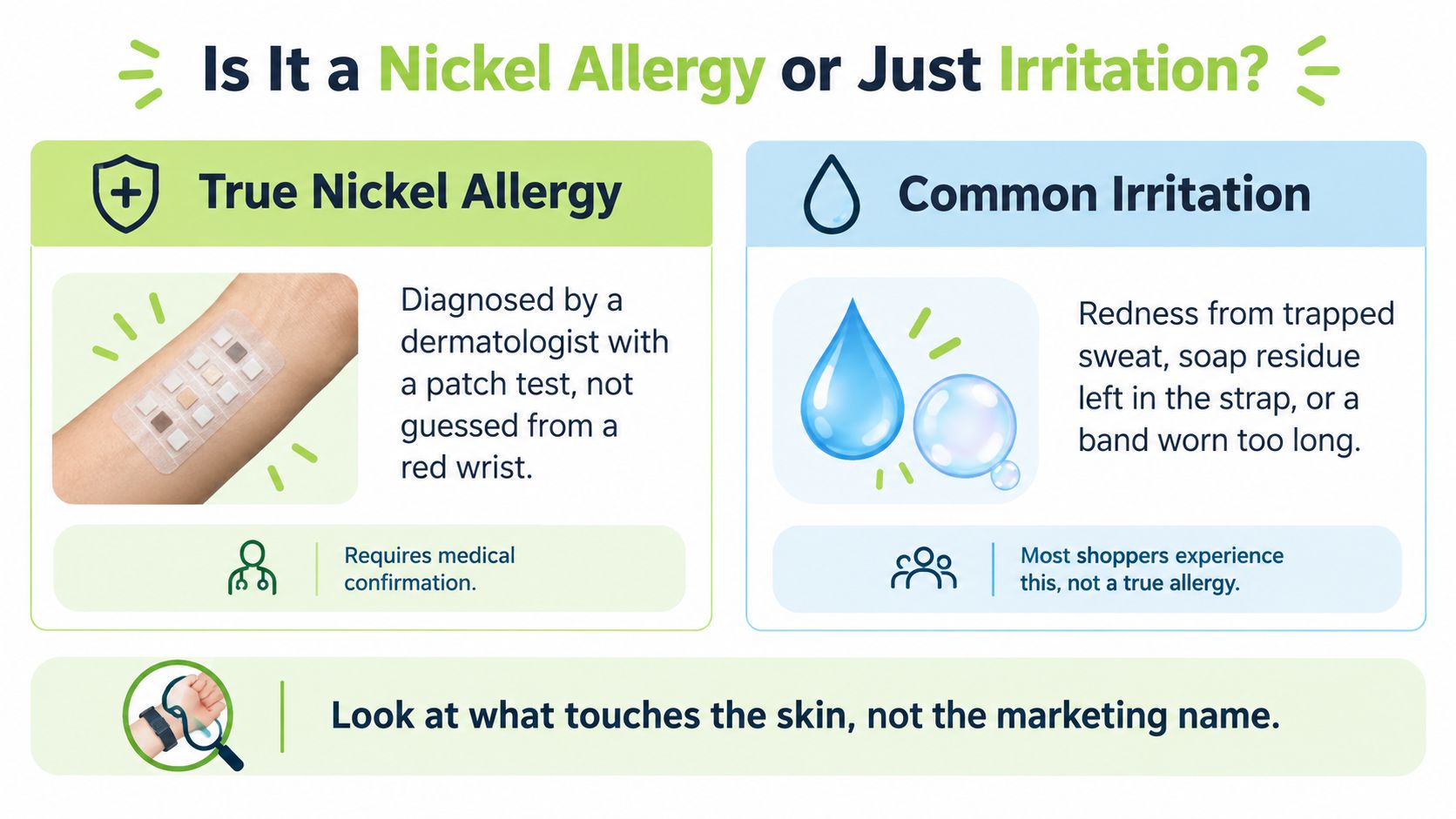
What should you do first
Remove the watch until the skin settles. Rinse the band, remove soap or sunscreen residue, dry every surface fully, and try a looser fit when you wear it again. Change only one variable at a time so you can tell whether the problem came from moisture, pressure, friction, or a particular material.
For general background on persistent itching and burning, this guide to itch and burn on skin causes can help you think through other possibilities. It shouldn't replace medical advice. If the rash keeps returning, spreads, becomes painful, or doesn't settle after removing the suspected trigger, speak with a clinician or dermatologist rather than trying to diagnose it from appearance alone.
The same practical approach applies to a rash under a watch band. A nickel-free label may remove one possible exposure, but it won't automatically fix a strap that traps moisture or presses against the wrist.
Which Watch Band Materials Avoid Metal on the Skin
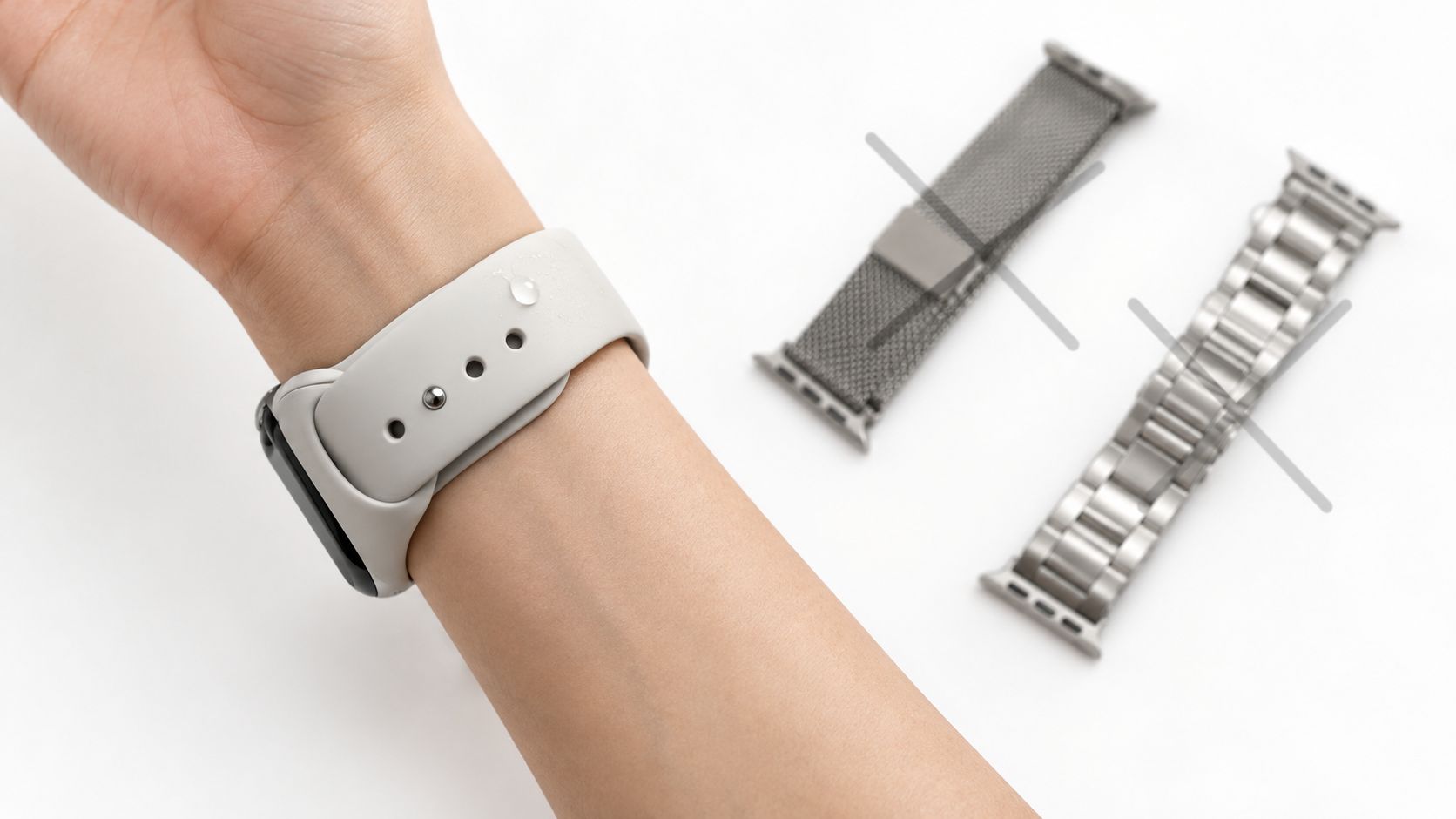
A band can be described as silicone, nylon, leather, or acetate while its closure, buckle, pin, adapter, or connector still touches the wrist. The whole contact assembly matters, not only the strap material. Woven nylon with a metal-free closure is often the clearest route away from metal contact. Silicone works well for rinsing and sweat, acetate offers a dressier non-steel option, and leather requires a careful buckle check.
Silicone and nylon
Silicone is smooth, flexible, and easy to rinse. The Selaro Silicone Sport Band for Fitbit Versa 3/4 and Sense 1/2 uses a pin-and-tuck closure, so no conventional buckle crosses the wrist. The strap still has other parts to inspect, including adapters and connectors. Browse the wider silicone bands range for workout-focused designs, but treat silicone as a material description, not a medical guarantee. Friction, residue, additives, or another component can still cause trouble.
Woven nylon can keep hardware away from the skin when its closure is designed accordingly. The Véllo Nylon Loop Quick Release 22mm uses a hook-and-loop closure, with no buckle or pin resting against the wrist. By contrast, a nylon band with a slider buckle needs a separate check of that metal part. The nylon bands collection helps identify the category, while the product details reveal what contacts the skin.
Rubber-like materials also vary. A material name alone, such as fluoroelastomer (FKM), cannot predict feel, durability, or contact points.
Leather and acetate
Leather can look refined, but it commonly comes with a metal buckle and pin. Check the underside of the buckle, the pin, and the strap adapters before buying. For pieces where metal remains against the skin, implant-grade body jewellery standards offer a useful comparison for how a properly specified alloy claim should be described. Compliance with a release standard still does not promise symptom-free wear for every person.
Acetate provides a structured alternative to a steel link bracelet. The Lyra Resin Composite Link for Apple Watch belongs in the non-metal strap-material category, yet its case connection and adapters still need inspection. A non-metal visible surface does not make the complete assembly metal-free.
Practical rule: If a product page names only the strap material, ask about the closure, buckle, pin, adapters, and connectors before treating it as nickel-free.
Milanese mesh and stainless link bands place metal across much of the underside. They therefore do not suit shoppers whose priority is keeping metal off the skin, even if the manufacturer describes the metal as compliant or low-release.
Why Stainless Steel Is Not Nickel Free
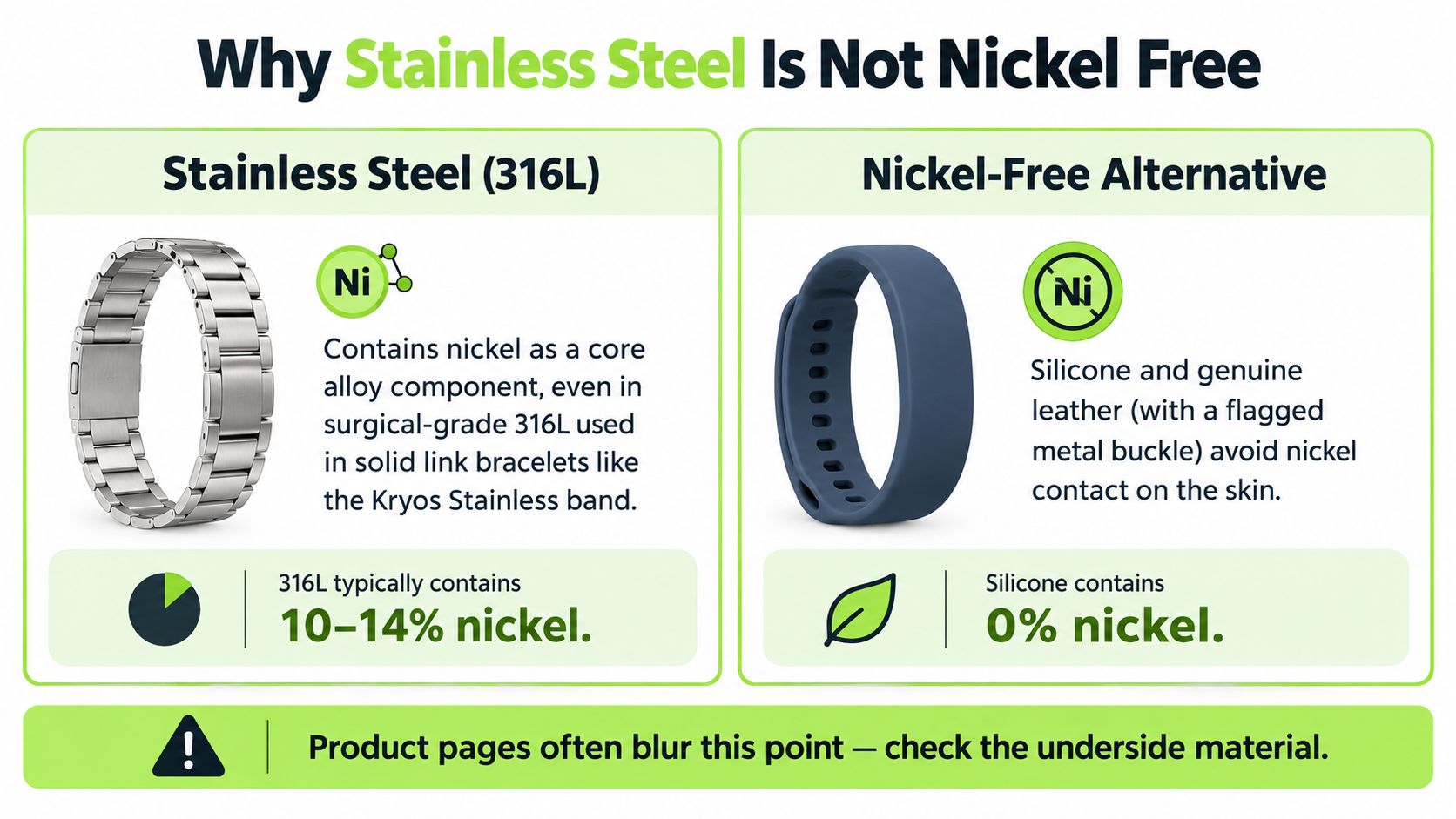
Stainless steel is not nickel-free, even when the component is made from 316L. The alloy can contain nickel while still meeting a nickel-release limit, so nickel content and nickel migration are different questions.
Under European Union REACH restrictions, articles intended for direct and prolonged skin contact, including watch cases, watch straps, and fasteners, must not release nickel above 0.5 micrograms per square centimetre per week. If a non-nickel coating is used, the coating must remain at or below that threshold for at least two years of normal use. (EU REACH Annex XVII nickel restriction)
That rule measures what migrates from the finished article onto skin. It doesn't mean the metal contains zero nickel. A stainless-steel part may contain nickel bound into the alloy and still release below the legal threshold. A coating may also wear through, while sweat, friction, and repeated contact change the exposure conditions.
What does 316L tell you
316L is a stainless-steel grade, not a promise of zero nickel. Our solid stainless link bands, such as the Kryos — Stainless Link — Galaxy Watch 8 & 9, are 316L on our records, which makes them steel bracelets rather than nickel-free options.
The British Stainless Steel Association notes that grades 304/304L and 316/316L can be expected to meet the 0.5 micrograms per square centimetre per week release limit, while free-machining grade 303 gave a release rate close to that limit and is considered unsuitable for items worn in close and prolonged contact with the skin. (BSSA guidance on stainless steel for skin contact)
For a nickel-avoiding shopper, the answer is simpler than comparing grades. Choose no metal on the skin, rather than assuming a stainless bracelet is nickel-free.
How to Verify a Nickel Free Claim Before You Buy
Look for a component-level description and, for a strong technical claim, an EN 1811 nickel-release report identifying the alloy, laboratory, and measured value. A generic “hypoallergenic” or “skin-friendly” label doesn't tell you enough.
These three claim levels are easy to confuse:
| Claim tier | What it means | Example style |
|---|---|---|
| Nickel-free material | The named strap material is not described as containing nickel, but hardware may still be metal | Silicone or nylon strap with a buckle |
| Nickel-free contact surfaces | The listed construction is intended to keep metal away from the skin | Véllo Nylon Loop with hook-and-loop closure |
| Tested nickel release below 0.5 micrograms per square centimetre per week | The finished contact article has been tested against the EU release benchmark | A product supported by an EN 1811 report |
EN 1811 is the reference test method for nickel release from articles intended for direct and prolonged skin contact, and it applies well beyond jewellery and watch straps. (TÜV explanation of EN 1811 testing) The method uses a synthetic sweat solution, and coated articles are first put through EN 12472, which simulates wear and corrosion before the release test.
Ask about the complete assembly
Before ordering, check:
- Strap body: Is the material clearly named as silicone, nylon, acetate, leather, or steel?
- Closure: Does a buckle, slider, pin, clasp, or hook touch the underside of your wrist?
- Connectors: Do adapters or spring bars contact the skin beside the watch case?
- Testing: Does the seller provide an EN 1811 report for the exact finished component?
- Durability: If the product relies on a coating, is there evidence that it remains compliant after wear?
At Nothing but Bands we describe our materials and do not certify any band as hypoallergenic or nickel-free. Our own checks are basic incoming and dispatch checks: visual finish, clasp operation, connector movement, pin seating, and whether the band sits squarely in its fitting. A supplier's general assurance is not something we treat as a laboratory certificate.
A credible stronger claim should name the exact alloy or contact material, the test laboratory, the test method, and the measured nickel-release value. Without those details, treat “nickel-free” as a question to investigate, not as proof of a medical outcome.
Matching the Right Style to Your Wrist and Your Day
For a known nickel sensitivity where no metal against the skin is the priority, choose a woven nylon loop with a hook-and-loop closure, such as the Véllo Nylon Loop Quick Release 22mm. Its closure avoids the buckle or pin that commonly creates a hidden metal contact point.
A different problem may call for a different material. If your wrist mainly becomes uncomfortable after workouts, silicone is often the more practical choice because you can rinse it and dry it without treating it like a delicate fabric. The Selaro Silicone Sport Band is listed for Fitbit Versa 3/4 and Sense 1/2 among our Fitbit bands, while the Vornis Silicone Sport Band Quick Release 22mm is another silicone option. Check the specific watch fitting before ordering.
| Your priority | Material route | Important limitation |
|---|---|---|
| Avoid metal at the closure | Woven nylon loop with hook-and-loop closure | Confirm the watch-side connectors |
| Rinse-clean convenience | Silicone | Silicone doesn't guarantee that every component is metal-free |
| Dressier non-steel appearance | Acetate resin composite link | Check the case and adapters |
| Traditional formal styling | Genuine leather | The buckle is metal, so it isn't a metal-free route |
| Steel bracelet appearance | Milanese mesh or stainless links | Avoid these when avoiding nickel contact |
Apple Watch owners should keep the model-specific sensitive-skin discussion in the dedicated guide to hypoallergenic Apple Watch bands. The broader rule remains the same: inspect the complete contact path rather than choosing by the watch brand or strap name.
Genuine leather is available across Fitbit, Apple, Garmin QuickFit, and Samsung ranges, but it shouldn't be presented as a nickel-free solution. If nickel is the concern, choose a closure that keeps metal away from your wrist.
Care Routine to Keep Irritation From Coming Back
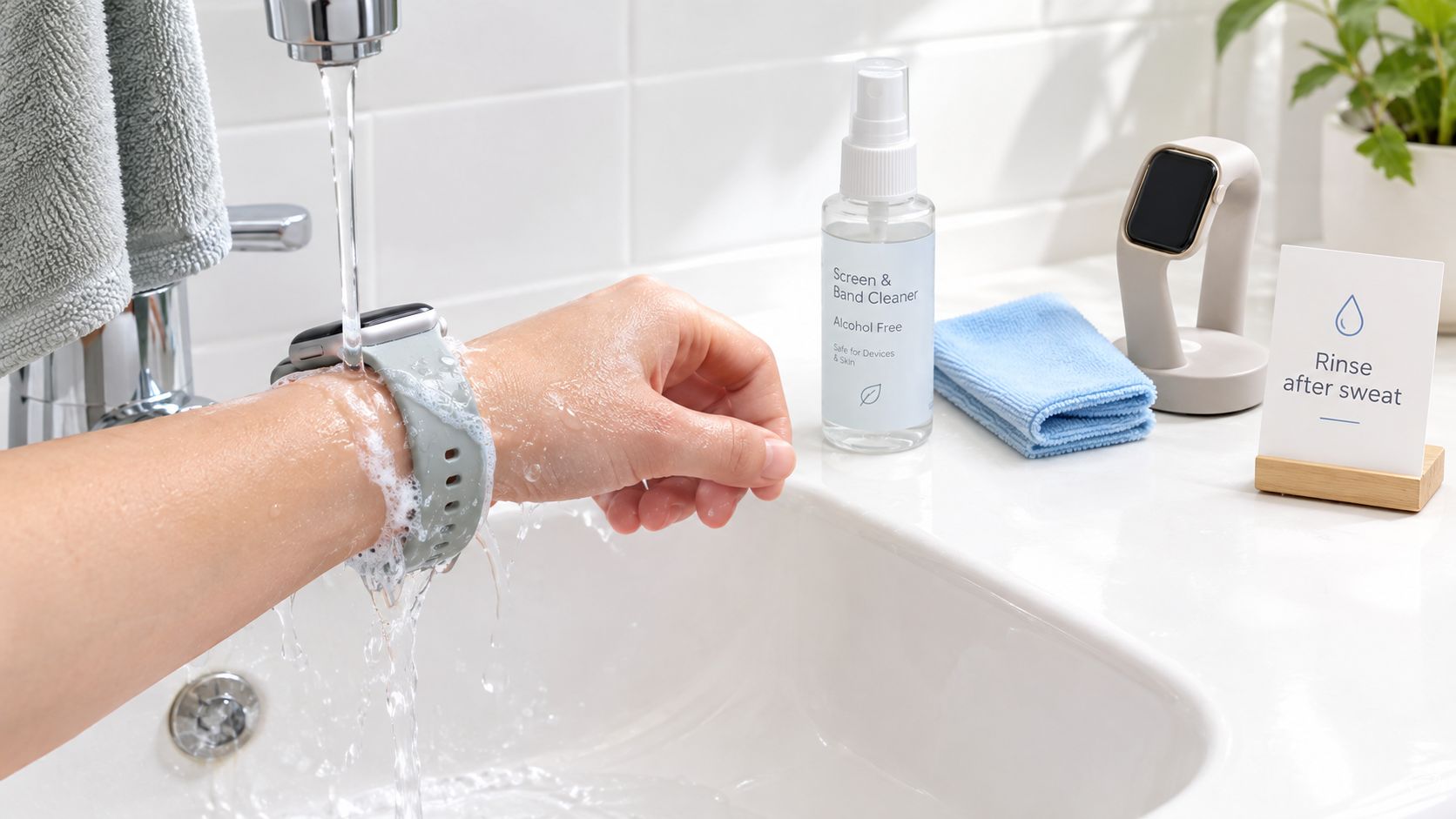
Rinse the band after sweat, dry it fully before refitting, rotate between bands, and loosen the fit so the strap isn't pressing tightly into damp skin. These habits reduce moisture, residue, and friction, but they aren't a cure for a confirmed allergy.
Use a short routine:
- Rinse after exercise: Remove sweat and surface residue before it dries on the band.
- Dry before refitting: Pat the strap dry and let the underside, closure, and connectors dry completely.
- Rotate bands: Alternate at least two bands so nothing goes back onto the wrist while damp.
- Loosen the fit: Keep the watch secure, but don't tighten the band until it squeezes the skin.
For silicone-specific cleaning, use the guide to clean a silicone watch band. If smell remains after ordinary washing, the separate guide to remove odours from watch bands covers that problem without confusing it with nickel allergy.
One customer's experience can illustrate comfort, but it can't diagnose anyone else's skin. Gregory Adams wrote about the Zera — Silicone Sport Band — Fitbit Charge 3/4: “Definitely worth the price, especially since it doesn’t irritate my skin like some other bands have before.” That's one buyer reporting that a silicone band suited him better than previous bands, not evidence of relief from a diagnosed allergy.
Trust Signals That Separate Honest Shops From Hype
An honest shop distinguishes material description, testing, and medical-sounding claims instead of blending them together. If a seller calls a band hypoallergenic or nickel-free, ask which components the statement covers and whether a named laboratory measured nickel release from the finished assembly.
Nothing but Bands carries silicone, nylon, leather, acetate, Milanese mesh, and stainless link styles and describes each one by its materials, without certifying any of them as hypoallergenic or nickel-free. That limitation is useful information because it lets you choose a material route without pretending that a product page has proved more than it has.
Other practical trust signals include a clearly stated returns policy and a secure checkout. Check both before buying. They don't prove that a band is suitable for your skin, but they give you a clearer way to manage the purchase if the fit or contact experience isn't right.
You can also read customer reviews for descriptions of fit and everyday comfort. Treat reviews as individual experiences, not clinical evidence.
Before buying: Choose the material, inspect the closure, confirm the watch fitting, and ask for test documentation if the seller makes a release-rate claim.
The safest shopping route for a nickel-avoiding wearer is straightforward. Pick a band with no metal against the skin, verify the closure as carefully as the strap, rinse and dry it before refitting, and loosen the fit enough to limit friction. If redness keeps returning, stop wearing the band and speak with a dermatologist.
Nothing but Bands offers silicone, woven nylon, acetate, leather, and steel replacement bands across Fitbit, Apple, Garmin, Samsung, and other smartwatch fittings. For the nickel question, start by comparing the contact materials and closures, then choose a Nothing but Bands band that matches your watch and daily routine.
Ähnliche Beiträge

- October 20, 2026
Learn what a watch strap adapter is, how it converts proprietary fittings, and whether your smartwatch actually needs one. Honest...

- October 19, 2026
Learn how to remove a link from a metal watch band safely at home, with simple tools and step-by-step tips...
