


Getting the right watch strap isn't just about aesthetics; it all starts with nailing the fit. The secret is to wrap a flexible measuring tape snugly just above your wrist bone and take down the measurement. This one simple step is the foundation for finding a strap that feels as good as it looks.
Table of Contents
- Why Getting Your Wrist Size Spot On Matters
- Simple Tools for an Accurate Measurement
- From Millimetres to the Perfect Band Size
- Fitting Advice for Different Watch Band Types
- Common Sizing Mistakes and How to Avoid Them
- A Few More Watch Sizing Questions Answered
Why Getting Your Wrist Size Spot On Matters
It’s tempting to just guess your watch band size, but that's a classic misstep that usually ends in a frustrating return. A poorly fitting strap is more than just a small bother—it completely changes how your watch wears and performs all day long.
If it’s too tight, you risk skin irritation. Too loose, and the watch will constantly slide about, which never looks sharp.
For anyone with a smartwatch, a precise fit is even more critical. Think about all the advanced sensors packed into a Garmin Fenix or a Samsung Galaxy Watch. They need solid, consistent contact with your skin to work properly.
A strap that’s even slightly off can throw off vital health data, from heart rate monitoring to sleep tracking. If you rely on your watch for accurate metrics, a secure fit isn't just nice to have—it's essential.
The Real Price of a Bad Guess
It might sound obvious, but skipping that quick measurement is a common reason for online returns. It's a surprisingly avoidable problem — a mismatched wrist size is one of the most common reasons a smartwatch band gets sent straight back.
Ultimately, taking a moment to measure your wrist properly saves you the hassle of returns and ensures your new strap is ready to wear straight out of the box. It’s the difference between a watch that’s a perfect accessory and one that’s a constant annoyance.
Simple Tools for an Accurate Measurement
You don't need any special gadgets to get your wrist size right; the best tools are probably hiding in a drawer at home. Nailing this simple measurement is the first and most important step to avoiding the hassle of a watch strap that just doesn't fit.
The easiest way, by far, is with a flexible tailor's measuring tape. These things are designed to wrap around curves, which makes them perfect for the job.
Just wrap it around your wrist right where you'd normally wear your watch—usually just above that prominent wrist bone. You're aiming for a snug fit, but not so tight that it's digging in. A good rule of thumb is being able to comfortably slide one finger underneath. Once you've got it positioned, just read the number where the tape overlaps. Simple as that.
What If You Don't Have a Measuring Tape?
No measuring tape? No worries. A strip of paper, a bit of string, or even a phone charging cable will work just as well when paired with a regular ruler.
Take your chosen item and wrap it around your wrist, just like you would with the tape. Mark the spot where the end overlaps with a pen. Then, lay it flat next to a ruler and measure the length from the end to your mark. It’s a simple trick that gives you a surprisingly accurate measurement.
Key Takeaway: The goal here is a snug, comfortable fit. Your final measurement should reflect how you actually want the watch to feel on your wrist—not so tight it cuts off circulation, but not so loose that it slides around and throws off sensor readings.
Find the Right Spot on Your Wrist
Where you measure matters almost as much as how. A common mistake is measuring directly over the bony bump on the outside of your wrist (the ulnar styloid) — that spot is wider than where a watch band actually sits, so you'll end up with a size that's too big. Instead, feel for the area just above that bone, a little closer to your elbow. That's the slimmest point and the natural resting spot for a watch, so it's where you should take your measurement.
Taking a moment to do this properly can save you a real headache later — a surprising number of smartwatch owners end up buying the wrong size simply because they measured in the wrong spot or skipped measuring altogether.
To help you get the best measurement at home, here's a quick look at the pros and cons of the most common tools you might have lying around.
Comparing Wrist Measurement Tools
| Tool | Accuracy | Ease of Use | Common Household Item? |
|---|---|---|---|
| Flexible Tailor's Tape | High | Very Easy | Sometimes |
| String & Ruler | High | Easy | Yes |
| Paper Strip & Ruler | Medium-High | Easy | Yes |
| Charging Cable & Ruler | Medium | A bit fiddly | Yes |
Ultimately, a tailor's tape is purpose-built for this, but a simple piece of string and a ruler will give you a result that's just as reliable.
The right fit truly makes all the difference, affecting everything from how the watch feels to how well it works.
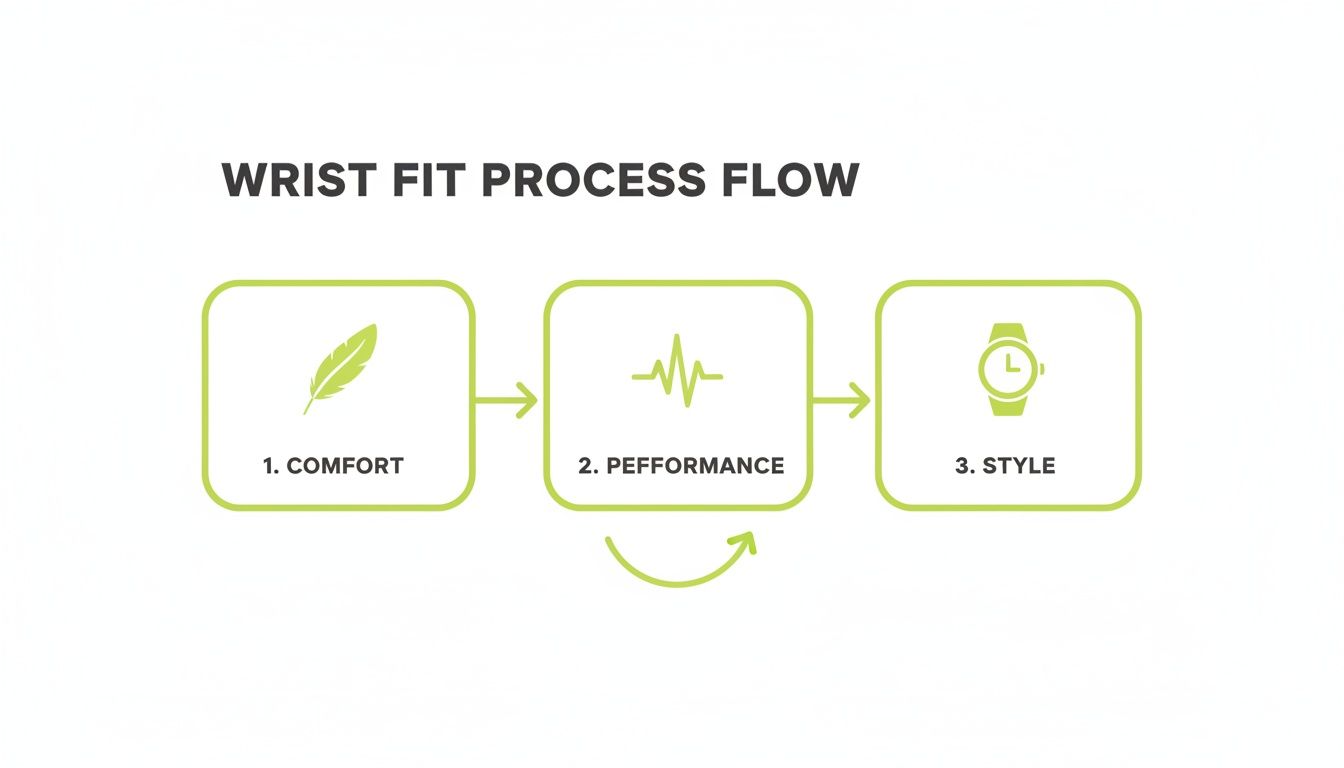
As you can see, getting the fit right isn't just about style. It’s fundamental to ensuring you get the accurate health and fitness data you expect from your device.
From Millimetres to the Perfect Band Size
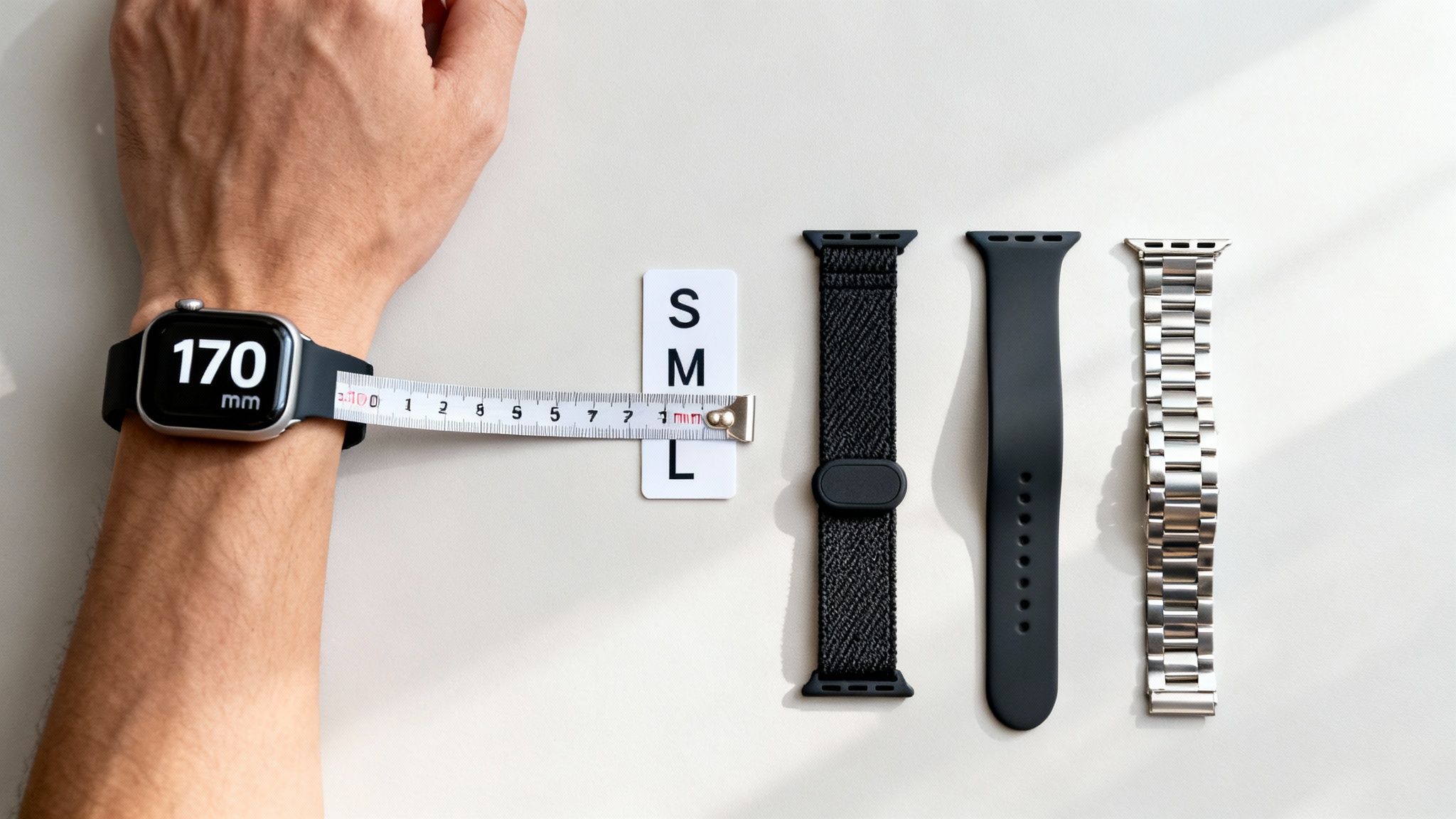
So, you’ve got your wrist measurement in millimetres. What now? The next step is turning that number into the right band size, which is the key to all-day comfort. It’s a common mistake to just buy a strap that matches your exact measurement, only to find it’s either uncomfortably tight or annoyingly loose.
Your raw measurement isn't the final number. You need to add a bit of wiggle room for comfort and movement. As a rule of thumb, add between 10mm to 20mm (that’s 1-2 cm) to your actual wrist circumference. This simple adjustment prevents the band from constricting your wrist, which is crucial for comfort and ensures any sensors on your watch can work properly.
Adding Wiggle Room for the Right Material
The type of material your band is made from really matters here. A soft, breathable nylon loop for a Garmin Fenix, for instance, is quite forgiving, so adding just 10mm might be perfect. On the other hand, a rigid metal link band for a Samsung Galaxy Watch will have no give at all, so you’ll want to add a bit more leeway—something closer to 15-20mm.
- For Silicone or Nylon: Add 10-15mm for a snug but flexible fit.
- For Leather or Metal: Add 15-20mm to allow for the material’s lack of stretch.
If you'd rather think in terms of overall feel instead of material, here's another way to land on the same result:
- Snug fit: add roughly 5-10mm — best for sport bands and anyone relying on accurate heart-rate readings during exercise.
- Standard, everyday fit: add roughly 10-15mm — the go-to for most people and most materials.
- Relaxed, jewellery-style fit: add up to 20mm — works well for decorative metal bracelets that are meant to drape a little.
It's surprising how many people get this wrong. Many Garmin and Fitbit users have returned their watch bands because of a poor fit. The main reason? They didn't account for that crucial extra space needed for a secure, irritation-free fit.
Here’s a practical example: if your wrist measures 165mm and you’re eyeing a silicone band, you should be looking for a total length of around 175-180mm. For a metal bracelet, you’d aim for the 180-185mm range. Remember to always double-check the brand's own sizing chart, because a "Medium" from one brand can be very different from another.
This same logic applies to other types of wristwear, and a good bracelet size guide can offer similar insights for different accessories.
Fitting Advice for Different Watch Band Types
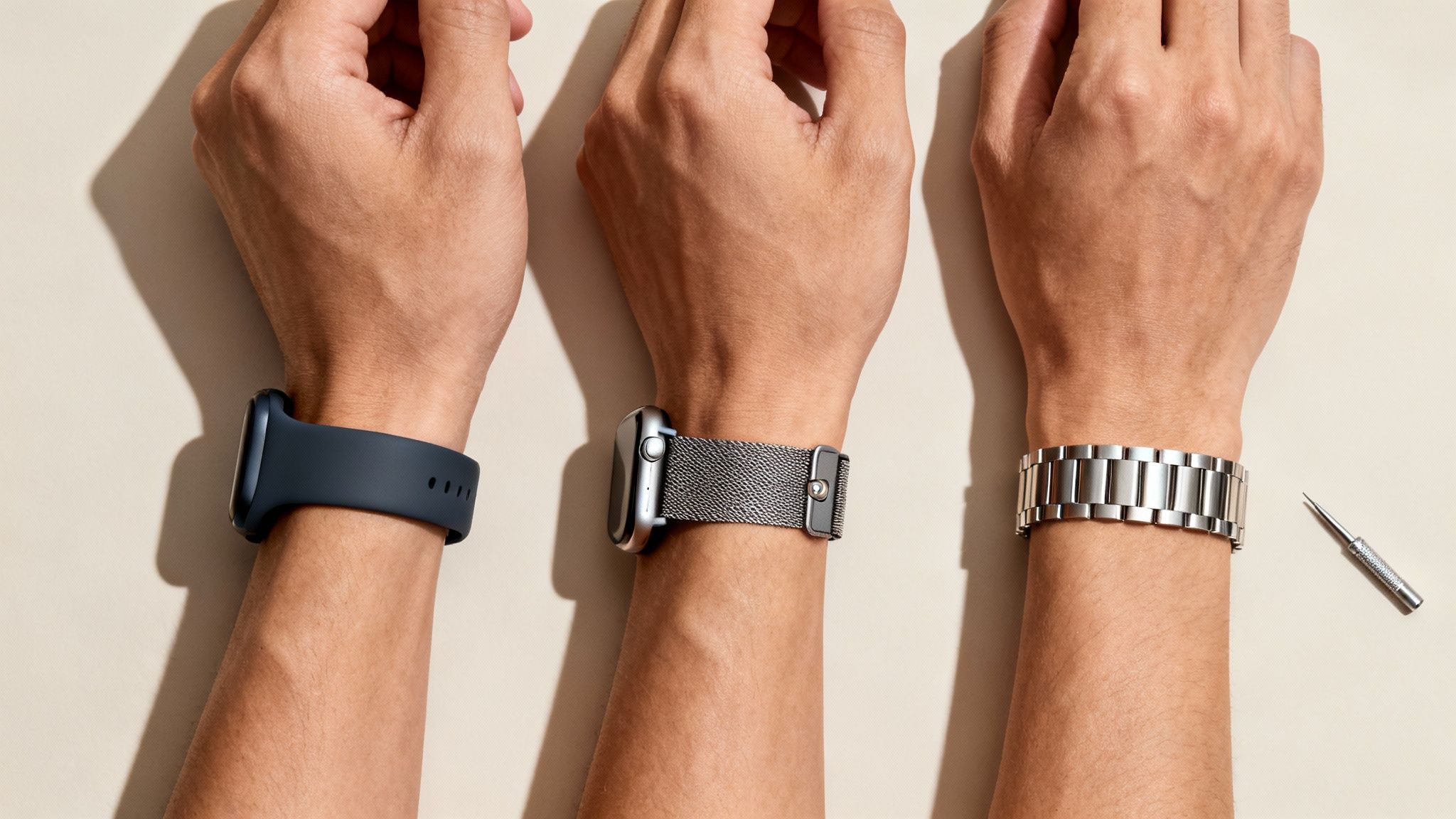
The material of your watch strap plays a huge part in how it fits and feels on your wrist. Getting the measurement right is step one, but knowing how each band type behaves is the real secret to all-day comfort, whether you're at your desk or out for a run.
For instance, silicone and nylon sport bands are built for an active life. They need to be snug enough for the watch's sensors to get an accurate heart rate reading, but not so tight that they trap sweat and irritate your skin. A good rule of thumb is to make sure you can slide one fingertip comfortably underneath the band.
Metal bracelets, however, are a different beast entirely.
Getting the Perfect Fit with Metal and Buckle Straps
With linked metal bracelets, a perfect fit usually means taking out a link or two. Most good quality bracelets are designed for this, and it's a small job that makes a world of difference. It takes a watch from being a loose, jangling accessory to a custom-fitted part of your look. Don't settle for "good enough"—a properly sized bracelet feels and looks so much better.
Traditional straps, like leather or fabric ones with a classic buckle, are simpler but offer less fine-tuning.
You're stuck with the pre-punched holes, which can sometimes put you in that awkward spot between 'a bit too tight' and 'a touch too loose'. If you're ever in doubt, always go for the slightly looser option. Your wrist naturally swells a little during the day, and you'll be glad for the extra breathing room.
Then you have Milanese loops, which offer the best of both worlds. Their magnetic clasps mean you can make tiny adjustments on the fly, dialling in that absolutely perfect fit without any compromises.
It’s worth noting that the principles for a good watch fit are similar to those for other wristwear. Understanding how to go about properly sizing and wearing cuff bracelets, for example, can provide some useful parallels. The key is always a secure fit that still allows for a little movement and comfort.
Common Sizing Mistakes and How to Avoid Them
Getting your wrist measurement seems simple enough, but a few common slip-ups can easily throw off the whole process. Knowing what to watch out for is the key to nailing the fit on your first try, ensuring that new strap feels like it was made just for you.
One of the most frequent mistakes I see is people pulling the measuring tape way too tight. You're aiming for a snug fit, not a tourniquet. A measurement that’s too tight will lead to a band that digs into your skin all day – it’s not just uncomfortable, it can also restrict your circulation.
Another classic error is measuring at the wrong time of day. Believe it or not, your wrist size can fluctuate due to things like temperature and how active you’ve been. For the most accurate reading, it’s always best to measure in the afternoon or evening when your wrist is likely to be at its largest.
Don't Forget the Watch Itself
It’s easy to get laser-focused on the strap, but the size of the watch case itself plays a massive role in the final fit. A bigger, chunkier watch, like a Garmin Fenix or one of the larger Samsung Galaxy Watch models, is going to sit on your wrist very differently than a slim, lightweight one.
- Large Cases (44mm+): These watches have a real presence and often feel more balanced with a slightly looser band to keep them comfortable all day.
- Small Cases (Under 40mm): With smaller watches, a snugger fit usually works best. It stops the watch from sliding up and down your arm.
The goal here is total comfort and balance. A perfect band fit should complement the watch case, making sure the whole package feels right on your wrist, not awkward or bulky.
Thinking about both the strap length and the case dimensions gives you the complete picture. And hey, if you end up with a metal band that still feels a little off, don't sweat it. You can learn more about how to adjust a metal watch band to get it just right.
A Few More Watch Sizing Questions Answered
Even after you've measured carefully, a few questions can pop up when you're trying to nail that perfect fit. We get these all the time, so let’s run through some of the most common ones to help you feel completely confident in your choice.
Does the Watch Case Size Matter?
It absolutely does. Think about it: a big, chunky watch case—like you see on many Garmin or dive watches—needs a more substantial strap to feel balanced on your wrist. If the strap is too thin, the whole thing will feel top-heavy. The most crucial measurement here is the lug width (the gap where the strap connects to the watch), not just your wrist size.
Should I Measure Both Wrists?
Here’s a little tip: always measure the specific wrist you actually wear your watch on. Your dominant wrist is usually a touch larger because of muscle use, so you'll get a different reading. If you’re someone who likes to switch your watch from one wrist to the other, you might find yourself needing to tweak the fit, especially with highly adjustable bands like a Milanese loop.
What If I’m Between Two Sizes?
This is a classic dilemma. You’ve measured, checked the chart, and your wrist falls squarely between a small and a medium. What now?
Our advice, based on years of experience, is to always go for the larger of the two sizes. A band that’s a little too tight is not only uncomfortable but can also mess with your watch's heart rate sensor. It’s much easier to use a different hole on a slightly longer strap than to live with one that’s constantly digging in.
A few final thoughts:
- How often should I re-measure? Your wrist size can fluctuate. It’s worth doing a quick re-measure every couple of years, or anytime your watch starts to feel a bit off.
- What if I have sensitive skin? A good fit is non-negotiable here. A strap that’s too snug can trap sweat and lead to irritation. Look for breathable materials like fabric nylon or a silicone band with perforations.
Want the short version, or need something more specific? Our quick wrist-measuring guide covers the same basics in under a minute, our watch band size & lug width guide walks through the exact number for your specific smartwatch brand, and if you're sizing a band as a surprise gift, our gift-sizing guide has you covered.
If you have more questions, we've probably answered them already! You can find a wealth of information over in our Nothing But Bands FAQ section.
Ready to find that perfect band? Nothing But Bands has a massive collection of stylish, comfortable, and durable straps for all the big smartwatch brands. Shop now and refresh your look today!
Related posts

- October 14, 2026
Find the best replacement watch bands for any smartwatch. Compare fit, material, and durability, with picks for everyday, sport, and...

- October 13, 2026
Learn how to clean rubber watch bands safely and effectively. Simple methods to remove dirt, sweat, and grime without harming...

- October 12, 2026
Most smartwatch owners don't need a quick release strap adapter. Learn what the term actually means, how to check your...

