30-day comfort guarantee · Easy exchanges
In stock · Ready to ship
Build your rotation · 2nd strap −50%


Log in
Reset password
Create an account
Your bag(0)
Your cart is empty
Continue ShoppingSearch
-
Apple Bands
- Apple Watch Series
- Apple Watch Ultra
- Apple Watch SE
-
-
Fitbit Bands
- Charge Bands
- Versa Bands
- Sense Bands
- Luxe Bands
-
-
Samsung Bands
- Galaxy Watch 8 / 8 Classic
- Galaxy Watch Ultra
- Galaxy Watch 7 / 7 Pro
- Galaxy Watch 6 / 6 Classic
- Galaxy Watch 5 / 5 Pro
- Galaxy Watch 4 / 4 Classic
- Galaxy Watch 3 Bands
- Galaxy Watch (2018) Bands
- Galaxy Watch Active / Active 2
- Gear Watch Bands
-
-
Garmin Bands
- Approach Bands
- D2 Bands
- Descent Bands
- Enduro Bands
- Epix Bands
- Forerunner Bands
- Foretrex Bands
- Fēnix Bands
- Instinct Bands
- MARQ Bands
- Quatix Bands
- Tactix Bands
- Venu Bands
- Vívoactive Bands
- Vívomove Bands
- Other Garmin Bands
-
- Help
€
EUR / EN

How to measure wrist size for watch: quick, accurate fit guide
- January 04, 2026
- |
- Eugene
Finding the perfect watch band is about so much more than just looks. It’s about nailing the comfort, performance, and overall style. A band that doesn’t fit properly can turn a premium smartwatch into a daily irritation, while the right one ensures everything from heart rate monitoring to simple comfort is spot on.
This guide will walk you through exactly how to measure your wrist at home, so you get it right the first time.
Why Getting the Right Fit Matters
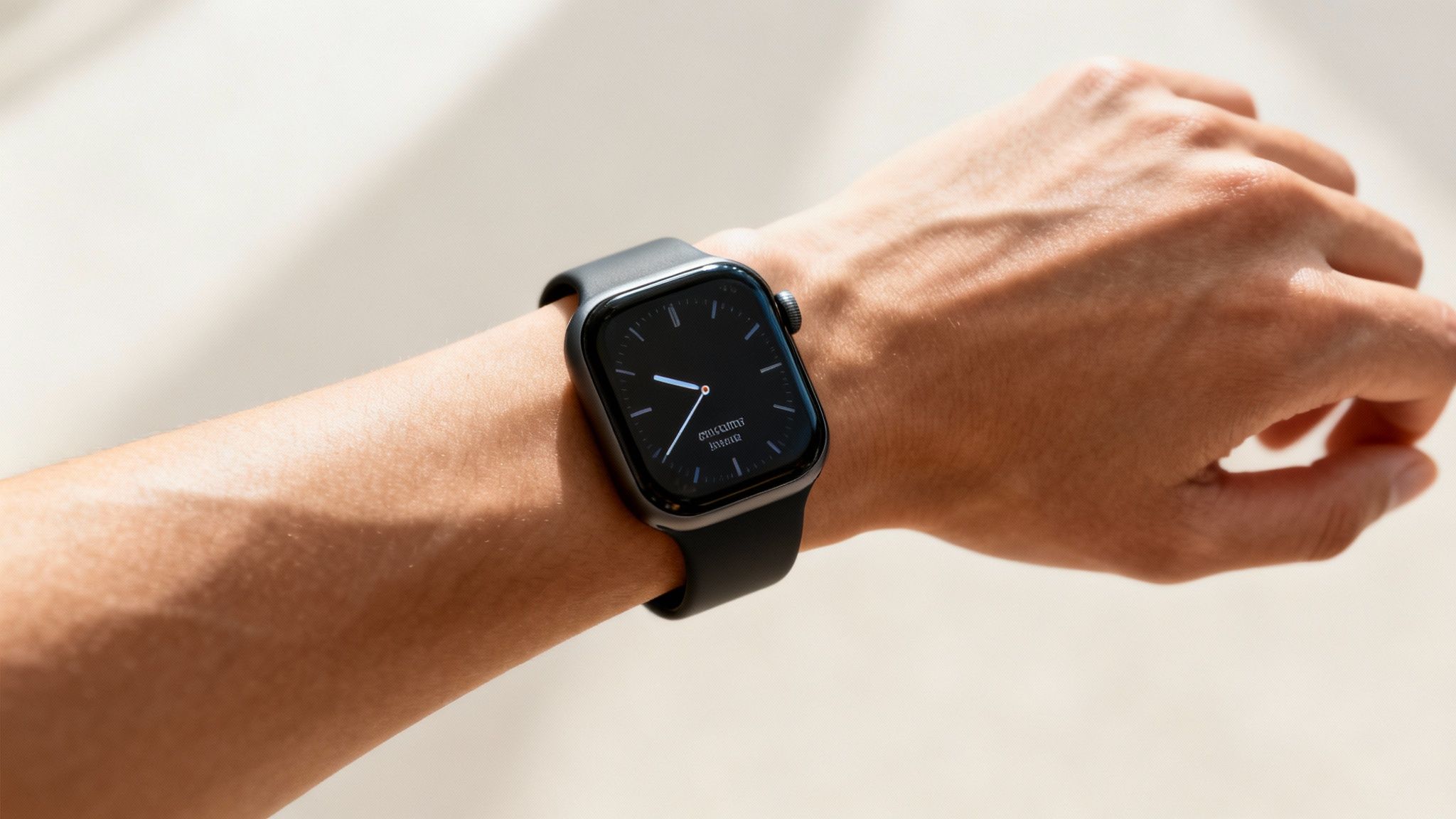
A poorly-fitting watch band does more than just look a bit off; it can completely undermine the reason you bought the watch in the first place. If it's too loose, the watch will slide around your arm during a workout, leading to dodgy sensor readings and generally just being a nuisance. On the other hand, a band that’s cinched too tight will dig into your skin, leaving marks and causing real discomfort throughout the day.
For anyone with a smartwatch, the stakes are even higher. All those clever features we rely on—heart rate tracking, blood oxygen levels, and even those subtle haptic notifications—depend on consistent contact with your skin. A loose band creates gaps, and gaps mean incomplete health data.
The perfect fit is that sweet spot between security and comfort. Your watch should feel secure enough to stay put, but never so tight that it leaves a deep impression on your skin when you take it off.
Beyond Function to Form
Getting the size right is also a huge part of the aesthetic. A correctly sized band makes sure the watch case sits neatly in the centre of your wrist, giving you a much more balanced and polished look. This is especially important when you consider different materials:
- Metal Bands: These really need a precise fit. Too loose and they look sloppy; too tight and they'll pinch your skin.
- Leather Straps: A good fit allows the leather to break in and mould perfectly to the shape of your wrist over time, without putting too much strain on the material.
- Milanese Loops: While the magnetic closure on these offers fantastic micro-adjustments, starting with the correct size range is still the key to getting that sleek, gapless appearance. You can see how a Milanese Apple Watch band uses this design for a customisable fit.
Honestly, this principle applies to almost any accessory you wear. It’s just like figuring out how to measure your ring size accurately for a perfect fit—taking that extra minute to measure properly guarantees you’ll get something you love to wear.
Finding the Right Tools for the Job
You don't need any fancy equipment to get a spot-on wrist measurement. Chances are, you already have exactly what you need lying around the house, which means you can get this sorted in just a minute or two.
The gold standard is a flexible tailor's tape measure. Because it’s soft and pliable, it wraps perfectly around your wrist, giving you a direct and accurate reading without any fuss. If you’ve got a sewing kit, you’re all set.
No Tape Measure? No Worries.
Don’t have one handy? That’s perfectly fine. A couple of everyday items can step in and do the job just as well when you need to figure out your watch band size.
You can easily grab one of these instead:
- A strip of paper: Just snip a straight, thin strip from any piece of A4.
- A piece of string: Any bit of non-stretchy string, cord, or even a spare phone charging cable will work a treat.
Of course, with either of these, you'll also need a regular flat ruler or a builder's tape measure to read the final length.
A Quick Word of Warning: The most important thing is to use something that doesn't stretch. Trying to use an elastic band, for instance, will skew your measurement and you'll end up with a band that's far too tight for comfort.
At the end of the day, the goal is to feel confident you've got the right size. With these simple tools, a perfect measurement is just moments away.
Three Foolproof Ways to Measure Your Wrist
Right, let's get down to the practical part. Nailing your wrist measurement is simple, and you've got a few great options depending on what you have lying around the house. We'll walk through three reliable methods to find your perfect size, so you can pick out a watch band with complete confidence.
As you can see, you don't need any fancy equipment.
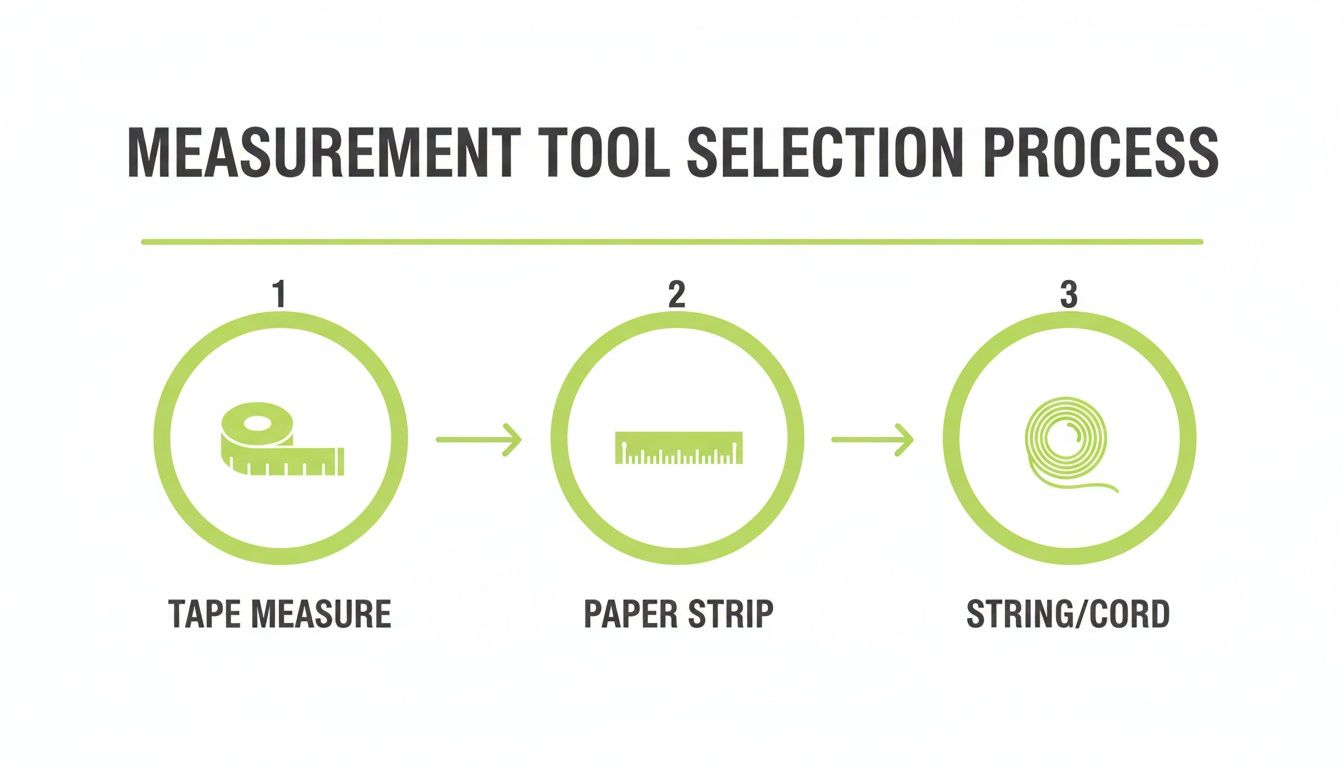
Whether you use a tape measure, a strip of paper, or even a bit of string, each one will get you the accurate circumference you need.
Using a Flexible Tape Measure
This is the gold standard for a reason. A soft, flexible tailor's tape is made for wrapping around curves, which makes it the most direct and accurate tool for the job.
Just wrap the tape measure snugly around your wrist, right where your watch would naturally sit. For most people, that's just above the prominent bone on the outside of your wrist (the ulnar styloid). Make sure it’s firm but not digging in—you shouldn't be cutting off your circulation! The number where the end of the tape meets the zero mark is your size. Simple as that.
Getting this right is more important than you might think. In the UK watch market alone, which is expected to hit USD 4.88 billion by 2033, a poor fit is a major reason for the 20-30% return rate you see with online accessory sales.
The Paper and Ruler Method
No tape measure? No problem. A thin strip of paper and a regular ruler will work just as well. This is a surprisingly reliable method using things everyone has at home.
- First, cut a straight strip of paper, about a centimetre wide.
- Wrap it around your wrist in the same spot you would a tape measure.
- Grab a pen and carefully mark where the paper overlaps to form a complete circle.
- Finally, unwrap the paper, lay it flat against a ruler, and measure from the end of the strip to your mark. That's your wrist size.
Pro Tip: Try measuring your wrist at the end of the day. Wrists can swell slightly throughout the day due to activity and temperature, so an evening measurement ensures your new band will stay comfortable from morning to night.
The String and Ruler Method
This is very similar to the paper strip trick, but using a piece of non-stretchy string is another excellent alternative. Honestly, a phone charging cable works perfectly in a pinch.
Wrap the string around your wrist and hold the exact point where it meets. You can either pinch it firmly or mark it with a felt tip pen. Then, lay the string out straight beside a ruler to measure the length.
The only catch here is to make sure the string has no stretch or give to it. A stretchy string could give you an inaccurate, smaller measurement. It’s a bit like knowing how to measure range of motion accurately; the right technique and tool are everything when you're after a precise result.
From Measurement to Perfect Fit
Right, you’ve got your number. Now what? That raw measurement is your starting line, but turning it into a watch band that feels like it was made just for you takes a bit of thought about how you actually want it to feel. This is where we go from a simple number to true, all-day comfort.
The first thing to think about is your personal comfort level. Do you like your watch to stay put, locked in place? Or do you prefer it to have a little breathing room, able to move a bit as you go about your day? There's no single correct answer here—it’s entirely down to what feels right on your wrist.
Finding Your Perfect Fit
As a rule of thumb, your base measurement will give you a pretty snug fit. From there, you can add a little extra length depending on your preference.
-
For a snug fit: Add about 0.5 cm to 1 cm to your wrist measurement. This is perfect for silicone sport bands or nylon loops, especially if you rely on your watch's heart rate sensor. A snug fit ensures consistent contact with your skin, giving you the most accurate readings during a workout.
-
For a standard, comfortable fit: Add 1 cm to 1.5 cm. This is the go-to for most people and most bands. It’s the ideal middle ground for everyday wear with materials like leather or flexible metal links, providing a secure feel without ever feeling too tight.
-
For a relaxed, looser fit: Add up to 2 cm. This approach works beautifully for more decorative, bracelet-style metal bands. It allows for a bit of elegant drape and movement, much like a piece of jewellery.
Making this small adjustment can completely change your experience. To give you some context, jewellers in the UK often work with a median male wrist size of around 17-18 cm as a benchmark. Knowing this can help you see where your own measurement fits in.
Don't Forget the Watch Case
Finally, the size of your watch case matters. A petite 38mm watch case will sit very differently than a bolder 45mm Apple Watch, and that changes the dynamic of the band. A larger, heavier watch head often feels more balanced with a slightly snugger band to stop it from sliding around on your wrist.
Ultimately, your measurement is the data, but your personal taste and the watch you're wearing guide the final decision. A breathable nylon loop, for instance, can be worn much tighter than a classic leather strap, which often feels better once it has a little room to breathe and soften up.
If you've opted for a metal link band, getting that perfect fit might involve removing a link or two. It's a surprisingly simple job you can do at home. Check out our guide on how to adjust a metal watch strap for easy-to-follow instructions.
Common Sizing Mistakes to Avoid
Even with the right tools, it's surprisingly easy to get an inaccurate wrist measurement. A small slip-up can mean the difference between a band that fits like a glove and one that's either uncomfortably tight or annoyingly loose. Let's walk through a few common pitfalls so you can get it right the first time.
The "Too Tight, Too Loose" Problem
One of the most frequent mistakes I see is pulling the measuring tape or string too tight. It's a natural instinct to cinch it for a "precise" reading, but this actually compresses your skin and gives you a measurement that’s smaller than your true wrist size. You’ll end up with a band that digs in.
On the other hand, leaving the tape too loose is just as bad. A floppy measurement leads to a watch that constantly slides up and down your arm, which isn't just irritating—it can also throw off the sensors on a smartwatch.
Finding the Right Spot and Tension
Another classic error is measuring directly over that bony bump on your wrist (the ulnar styloid). That spot is always wider than where your watch band will actually sit, so measuring there will throw your numbers off and result in a band that’s too big.
Here’s how to nail it:
- Find the sweet spot: Feel for the area just above your wrist bone, moving toward your elbow. This is the slimmest part and the natural resting place for a watch. Measure there.
- Use the fingertip rule: Once you have the tape or string in place, you should be able to slide one fingertip underneath it without a struggle. This creates a "comfort gap" – snug enough to be secure, but with enough room to breathe.
A quick tip from experience: Remember that some materials, especially genuine leather, have a break-in period. They might feel a little stiff at first but will soften and stretch slightly over time, moulding beautifully to your wrist.
For those who really want to perfect the fit, a good rule of thumb is to add 1-2 cm to your final measurement for a bit of breathing room. At Nothing But Bands, we try to take the guesswork out of it with clear sizing for every watch series and our 30-day money-back guarantee. Fit is a huge part of the experience, which is a key factor in trends across the UK ladies' watch market.
Your Sizing Questions, Answered
Once you’ve got your measurement, a few other questions usually pop up. It’s one thing to know your size, but another to feel totally confident in choosing the right band. Let's clear up some of the most common queries we hear.
What If My Wrist Is Between Two Sizes?
This happens all the time, and the answer is refreshingly simple. If your wrist measurement puts you right on the edge of two sizes, we almost always recommend choosing the larger option.
Why? A little extra length gives you breathing room, especially when your wrist swells slightly in warmer weather or during a workout. For bands with buckle holes, it means you won't be stretching the material on the very last hole, which can help it last longer. For styles like Milanese loops, it just provides a wider range for that perfect, precise fit.
Does My Watch Model Affect the Band Size?
Yes, absolutely—but it’s important to understand how. Your wrist measurement dictates the length of the band you need (like a Small/Medium vs. Medium/Large). Your specific watch model, however, determines the width of the connector that attaches to the watch case itself.
The perfect fit is a two-part equation: the right length for your wrist and the right connector width for your watch. Get one wrong, and the band simply won't work.
We take the guesswork out of it by sorting our bands by compatible models, such as "Apple Watch Series 9" or "Samsung Galaxy Watch 6." For a more detailed breakdown, our guide on Apple Watch size and compatibility explains exactly which bands fit which models.
How Do I Know the Fit Is Just Right?
The sweet spot is a balance between snug and comfortable. Your watch shouldn’t be able to slide more than an inch up or down your arm—this keeps the sensors in proper contact with your skin for accurate readings. On the flip side, it should never feel constricting or leave a deep mark when you take it off.
Here’s a tried-and-true test: you should be able to comfortably slip one fingertip between the band and your wrist. If you can do that without a struggle, you’ve nailed it.
Ready to find a band that feels like it was made just for you? Explore the full collection at Nothing But Bands and discover the perfect style and fit for your smartwatch. https://nothingbutbands.com